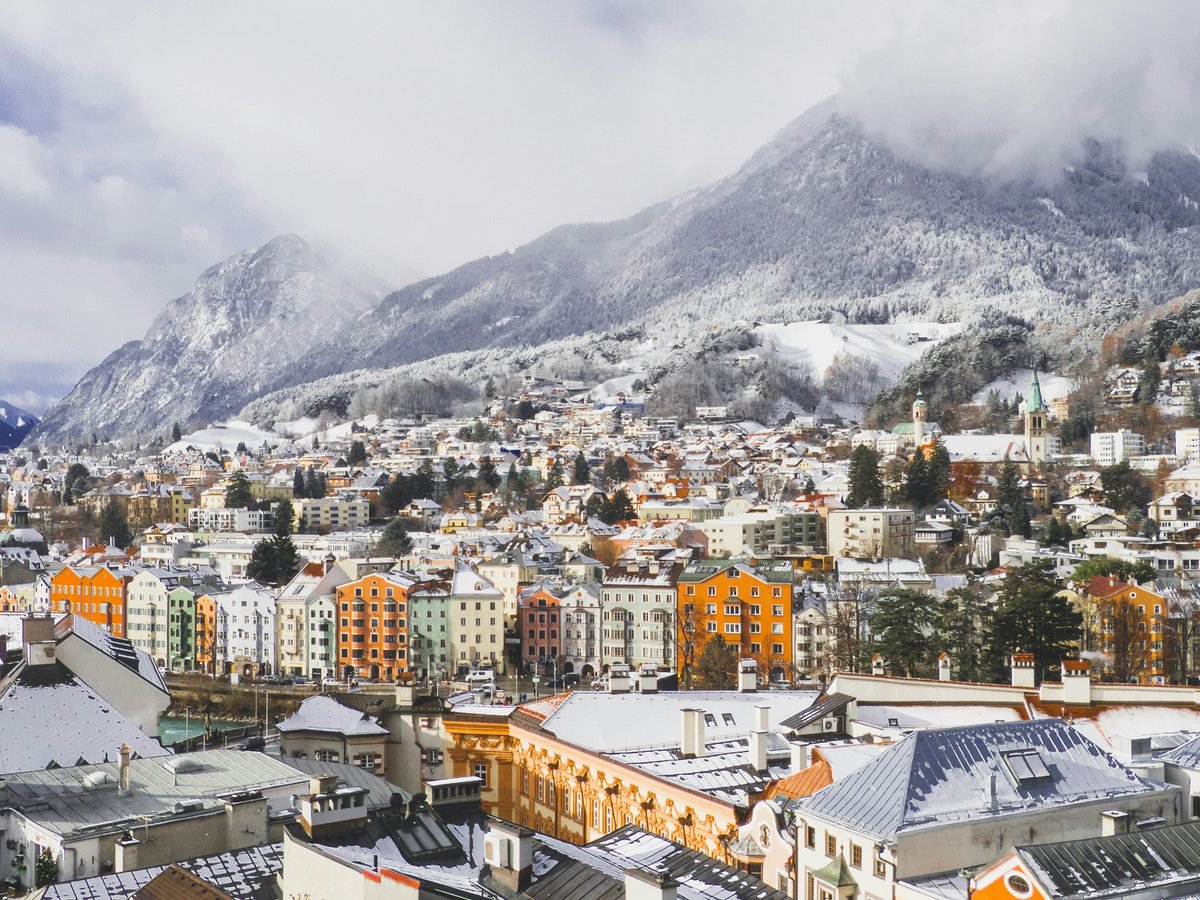
Stay in Innsbruck in June
43 hotels in the Trip.com pool for Innsbruck, from US$91 a night.
Opens Trip.com on Fri 4 Jun to Sun 6 Jun 2027; change the dates there.
June in Innsbruck is when alpine summer properly begins. The snow line pulls back above 2,000 meters (6,500 feet), high-altitude hiking trails on the Nordkette open for the first time since October, and the city gets close to 16 hours of daylight. Daytime temperatures reach an average high of 25.7°C (78°F), warm enough for short sleeves along Maria-Theresien-Straße but still cool enough that the air carries a mineral freshness off the glaciers to the south. This is the earliest reliable window for serious alpine hiking without ice axes or crampons.
That said, you will get rained on. June brings around 146mm of rainfall across roughly 14 days, mostly arriving as afternoon thunderstorms that build visibly over the Nordkette peaks between 14:00 and 16:00. Mornings tend to be clear and still. The pattern is predictable enough that Tyroleans structure their days around it, and you should too. Plan your high-altitude excursions before noon, and save the Altstadt wandering for after the storms pass.
The month also carries a piece of Tyrolean identity most visitors miss entirely. Herz-Jesu-Sonntag, the Sunday after Corpus Christi, falls in June. Bonfires are lit along the mountain ridges above the Inn Valley after dark, a tradition that dates to 1796 when Tyroleans pledged to defend their land against Napoleon. From the riverbank in St. Nikolaus, you can see the flames dotting the Nordkette without climbing anywhere. The smell of woodsmoke drifts into the valley and mixes with the linden blossoms along the Innpromenade. It remains one of the most quietly striking evenings you can spend in any Alpine city.
Why visit in June
- Longest days of the year. Mid-June sunrise is around 5:15 and sunset near 21:15, giving nearly 16 hours of usable daylight for hiking on the Nordkette or Patscherkofel.
- High-alpine trails above 2,000 meters (6,500 feet) typically open by mid-June, the earliest reliable window for summit walks without winter gear.
- Herz-Jesu-Feuer lights bonfires along the mountain ridges above the Inn Valley on a Sunday in June. You can watch the whole display from St. Nikolaus or Mariahilf without climbing anywhere.
- Crowds are noticeably lighter than July and August. Expect shorter lines at the Nordkettenbahnen cable car and easier restaurant bookings in the Altstadt.
- Alpine wildflowers hit peak bloom on meadows between 1,500 and 2,200 meters. The Goetheweg trail along the Nordkette ridge is carpeted with gentian and Alpine rose by late June.
Worth knowing
- 146mm of rainfall across roughly 14 rainy days, mostly as afternoon thunderstorms that can strand hikers above the treeline. Getting caught in an Alpine thunderstorm at 2,300 meters is no minor inconvenience.
- Some mountain huts and Almen above 1,800 meters are still opening for the season in early June. A hut you planned to eat lunch at might not start serving until the second or third week of the month.
- Evening temperatures drop to around 14°C (57°F), which catches visitors off guard after a warm 26°C afternoon. The temperature swing in the Inn Valley can be 12 degrees in 3 hours.
Best for
Think twice if
June days in Innsbruck typically start clear and still, with morning temperatures around 13.7°C (57°F) climbing toward 25.7°C (78°F) by early afternoon. The sun feels strong in the valley, and you'll notice it on exposed skin faster than the thermometer suggests. Afternoon thunderstorms are the dominant weather pattern. They tend to build visibly over the Nordkette peaks between 14:00 and 16:00, rolling into the Inn Valley with short but sometimes heavy downpours. You can often hear the thunder echoing between the valley walls before the rain arrives. Humidity sits around 72%, which feels noticeable on the valley floor but less oppressive than lowland cities at the same temperature. Evenings cool quickly once the sun drops behind the western ridges near Hötting, and a light fleece feels welcome by 21:00.
Seasonal caution
- Alpine thunderstorms build rapidly over peaks above 2,000 meters on roughly half the days in June. Lightning at exposed ridgelines like the Goetheweg or near the Hafelekar summit station is a real safety hazard. Check the ZAMG (Austrian weather service) forecast each morning and plan to be below the treeline by 13:00 on storm-risk days.
- UV radiation at altitude is significantly stronger than in the valley. At the Seegrube station (1,905 meters), UV index readings of 8-9 are common on clear June days. Sunburn can happen in under 20 minutes on exposed skin.
Year-round climate
Averages from the last 5 years.
| Month | Avg high (°C) | Avg low (°C) | Rainfall (mm) |
|---|---|---|---|
| Jan | 6 | -3 | 73 |
| Feb | 9 | -1 | 59 |
| Mar | 12 | 2 | 89 |
| Apr | 15 | 4 | 89 |
| May | 19 | 9 | 176 |
| Jun | 26 | 14 | 146 |
| Jul | 26 | 15 | 162 |
| Aug | 26 | 15 | 143 |
| Sep | 22 | 11 | 142 |
| Oct | 18 | 8 | 78 |
| Nov | 11 | 1 | 100 |
| Dec | 7 | -1 | 78 |
Best things to do in June
Hike the Goetheweg ridge trail on the Nordkette
hikingThe Goetheweg runs along the Nordkette ridge between the Hafelekar summit station at 2,334 meters and the Pfeishütte at 2,030 meters, with the entire Inn Valley and city of Innsbruck spread out 1,700 meters below. The trail traverses exposed limestone ridges with drop-offs on both sides in places. It takes roughly 3 hours one way, and the panoramic views stretch south to the Stubai glaciers on clear mornings.
The Goetheweg typically opens in mid-June once the last snow patches clear. By July it's busier, and by October it's closed again. June offers the freshest conditions and the lightest foot traffic.Booking tipNo booking needed, but buy your Nordkettenbahnen cable car ticket online the evening before to skip the morning queue at the Congress station. Start by 8:00 to finish before afternoon thunderstorms build.
Walk the Zirbenweg (Stone Pine Trail) on Patscherkofel
hikingA gentle 6km trail through a 500-year-old stone pine (Zirbe) forest on the south side of the Inn Valley at around 2,000 meters. The air smells distinctly of pine resin, and the spongy forest floor is soft underfoot. The trail connects the Patscherkofel cable car top station to the Glungezer lift, with views across to the Nordkette the entire way.
The Zirbenweg opens in June as snow clears. In early summer the forest floor is covered in Alpine wildflowers, and the stone pines are putting out fresh growth. The resinous smell is strongest in the warmth of June mornings.Booking tipTake the Patscherkofelbahn from Igls. Check whether the Glungezer return lift is already operating in early June, otherwise plan a return hike on the same trail.
Visit the Alpiner Botanischer Garten on Patscherkofel
natureA small alpine botanical garden at around 1,900 meters near the Patscherkofel cable car station, housing over 500 species of mountain plants from the Alps, Himalayas, and Andes. The garden is laid out across a natural slope with gravel paths and labeled beds. It takes about 45 minutes to walk through.
The garden opens for the season in June and the first weeks feature the earliest alpine blooms. Gentian, edelweiss, and Alpine poppy are typically in flower by mid-June. Combine it with the Zirbenweg for a full day on Patscherkofel.Booking tipNo booking needed. Free entry. Open daily during summer, though hours may be limited in the first week of June.
Watch the Herz-Jesu-Feuer from the Inn riverbank
culturalOn Herz-Jesu-Sonntag, the Sunday after Corpus Christi, Tyrolean mountain communities light bonfires along the ridgelines above the Inn Valley after dark. The fires form patterns and symbols visible from the valley floor. From St. Nikolaus or the Innpromenade, you can see dozens of fires dotting the Nordkette in a single panorama. The air takes on the smell of woodsmoke mingling with the river.
Herz-Jesu-Feuer happens once a year, always on the Sunday after Corpus Christi, which falls in June. This tradition dates to 1796 and is unique to Tyrol. No other month offers it.Booking tipNo tickets or booking. Walk to the north bank of the Inn River in St. Nikolaus or Mariahilf by 21:30 for the best sightlines toward the Nordkette. Bring a jacket, as it will be around 14°C by then.
Ride the Nordkettenbahnen to Hafelekar summit
sightseeingThree connected lifts carry you from the Congress station in the city center to the Hafelekar at 2,334 meters in about 20 minutes. The Hungerburgbahn funicular, designed by Zaha Hadid with its flowing concrete stations, climbs from the Altstadt to Hungerburg. From there, two cable cars continue to Seegrube (1,905 meters) and then Hafelekar. The summit terrace offers a 360-degree panorama from the Karwendel range to the north to the Stubai glaciers to the south.
June is the first month when the summit terrace and surrounding trails are reliably free of ice. On clear June mornings before 9:00, you might have the Hafelekar platform almost to yourself, something that rarely happens in July or August.Booking tipBuy the round-trip ticket online. Consider the Innsbruck Card if you plan to visit 2 or more attractions, as the Nordkettenbahnen round trip alone accounts for a large share of the card's value.
Swim at Baggersee Innsbruck
outdoorA former gravel quarry turned lake on the southern edge of Innsbruck, surrounded by grass banks and a few wooden piers. The water is clean and cold, typically reaching 18-20°C (64-68°F) by late June. The gravel bottom is smooth underfoot. Locals come after work with towels and picnic baskets, and the Nordkette is visible across the city skyline to the north.
Lake temperatures at the Baggersee become swimmable for most people by mid-to-late June. In May the water is still around 14°C (57°F), which is uncomfortable for all but the hardiest swimmers. By July and August the grass banks are packed.Booking tipFree entry. Weekday afternoons (Tuesday through Thursday) are quietest. There are no lifeguards, and the lake has no shallow wading area for small children.
Attend the Promenadenkonzerte in the Hofgarten
culturalFree outdoor concerts in the Hofgarten park in Saggen, held in the pavilion surrounded by chestnut trees. The program ranges from brass bands to classical ensembles to Tyrolean folk music. Locals bring blankets and bottles of wine. The scent of fresh-cut grass mixes with the evening air cooling off the nearby mountains.
The Promenadenkonzerte series launches in late May or early June and continues through summer. June evenings are the longest and warmest of the concert season, and the lighter crowds mean you can easily find a good spot on the lawn near the pavilion.Booking tipNo tickets needed. Concerts typically start at 19:30. Arrive 15 minutes early on weekends for a good spot on the grass. Bring a blanket and a light layer for when the sun drops.
Explore the Markthalle and Saturday Bauernmarkt
foodThe Markthalle sits on the south bank of the Inn River, a covered market hall with permanent stalls selling Tyrolean Speck, mountain cheeses, bread, and produce. On Saturday mornings, farmers from the Inn Valley and surrounding villages set up an open-air Bauernmarkt next to the hall with seasonal produce. In June, expect tables piled with local strawberries, bundles of fresh herbs, and wheels of new Almkäse from cattle recently driven up to high pastures.
June is when the first wave of Tyrolean seasonal produce arrives. Strawberries peak, elderflowers are in bloom, and the earliest Almkäse from freshly opened alpine dairies appears. The Saturday market in June has the excitement of a new growing season without the tourist density of August.Booking tipThe Saturday Bauernmarkt runs from around 7:00 to 13:00. Arrive before 9:00 for the best strawberry selection. Thursday is a quieter day for the permanent Markthalle stalls.
What to eat in June
In season: fruit
Erdbeeren (Tyrolean strawberries)
Local strawberries from the Inn Valley hit farmers' markets and the Markthalle in June. They're smaller and noticeably sweeter than the Spanish imports available the rest of the year, with a fragrance you can smell from a few stalls away. The Saturday Bauernmarkt is the best source.
On menus now
Kaspressknödel (cheese dumplings)
Pan-fried dumplings made from bread, mountain cheese, and onions appear on every alpine hut menu as the Almen open for summer in June. The high-altitude versions, cooked in butter on a wood stove at 1,800 meters, tend to be denser and more satisfying than the city restaurant versions. Typically served in a clear beef broth.
Tiroler Gröstl
A heavy pan-fry of cubed potatoes, onions, and leftover roast meat, topped with a fried egg. Available year-round, but this dish hits differently when you're genuinely hungry after a morning hike and sitting at a wooden table at 2,000 meters with the smell of hot butter and caramelized onions drifting from the kitchen.
What to drink
Hugo (elderflower prosecco cocktail)
Elderflowers bloom along the Inn riverbanks and in the gardens of Hötting throughout June. Locals make Holunderblütensirup at home, and nearly every bar and Gastgarten in the city serves Hugo, a mix of prosecco, elderflower cordial, mint, and sparkling water. The fresh-made versions taste nothing like the bottled stuff.
Radler
Half Tyrolean lager, half lemon soda. In June's warmth, you'll see Radler on every Gastgarten table along the Inn River by mid-afternoon. The ratio is always 50-50 in Austria, unlike the variable mixes elsewhere in Europe. Stiegl and Zipfer are the most common base beers in Innsbruck.
In markets
Spargel (white asparagus)
Spargelsaison officially ends on June 24, Johannistag. The first three weeks of June are your last window for white asparagus dishes at restaurants across the Altstadt and Wilten. Most places serve it with Hollandaise and new potatoes or wrapped in Tyrolean Speck.
Regular events in June
Herz-Jesu-FeuerFree
Bonfires lit along mountain ridges across Tyrol on the Sunday after Corpus Christi. The tradition dates to 1796 and is unique to the region. From Innsbruck's valley floor, dozens of fires are visible on the Nordkette and surrounding peaks after dark. The date moves with the church calendar but typically falls between early and mid-June.
Sunday after Corpus Christi, typically early to mid-JuneFronleichnam (Corpus Christi)Free
A national public holiday in Austria, marked in Innsbruck with a formal procession through the Altstadt. The route typically passes the Goldenes Dachl and continues along Maria-Theresien-Straße. Banks, government offices, and most shops close for the day, though restaurants and cafes remain open. The procession includes traditional Tyrolean Trachten (folk costumes) and brass bands.
Thursday, 60 days after Easter, typically early to mid-JuneNew Orleans Festival InnsbruckFree
A multi-day jazz, blues, and funk festival with performances on outdoor stages in and around the Altstadt. The festival typically features a mix of American and European acts, with free open-air stages along the Inn River and ticketed headline concerts in indoor venues. The sound of brass and slide guitar carries through the medieval streets after dark.
Late June into early JulyPromenadenkonzerte im HofgartenFree
A summer-long series of free outdoor concerts in the Hofgarten park pavilion in Saggen. The program includes brass ensembles, classical groups, and Tyrolean folk musicians. Performances run most evenings through the summer months. June marks the early part of the series, before the biggest tourist crowds arrive.
Multiple evenings throughout June, typically starting at 19:30Best places this June
Nordkette (Seegrube and Hafelekar)
mountainThe mountain range rising directly behind the Altstadt, accessible by the Nordkettenbahnen cable car system. The Seegrube terrace at 1,905 meters has a restaurant with valley views, and the Hafelekar summit at 2,334 meters is the starting point for the Goetheweg ridge trail. In June, the snow has retreated enough for summit walks, and the morning light on the limestone peaks is particularly sharp.
HungerburgHofgarten
parkA public park in Saggen, originally laid out as an imperial garden in the 15th century. In June the chestnut trees are in full canopy, the flower beds are planted out, and the lawn is thick enough to sit on comfortably. The park hosts the Promenadenkonzerte series on summer evenings. A quiet spot after the afternoon rain clears, when the grass smells of wet earth and the light turns golden through the trees.
SaggenAltstadt (Old Town) and Goldenes Dachl
historic districtThe medieval core of Innsbruck, centered on the Goldenes Dachl (Golden Roof), a 15th-century balcony covered in 2,657 fire-gilded copper tiles. The narrow streets between Herzog-Friedrich-Straße and the Inn River are lined with painted facades in ochre, pink, and pale green. In June the Altstadt is warm enough for long outdoor meals at the restaurants lining the pedestrian streets, without the shoulder-to-shoulder density of July and August.
AltstadtBergisel Schanze
landmarkThe ski jump tower on the Bergisel hill in Wilten, redesigned by Zaha Hadid in 2002. A funicular-style elevator carries visitors to the panoramic cafe and viewing platform at 50 meters above the jump takeoff, with views north across the city to the Nordkette and south toward the Wipp Valley and Brenner Pass. The concrete and steel structure is striking against the green hillside in summer.
WiltenInnpromenade and St. Nikolaus riverbank
walkThe walking path along the north bank of the Inn River in St. Nikolaus and Mariahilf offers some of the best casual evening walks in June. The river runs a distinctive milky turquoise from glacial melt, and the facades of the Mariahilf row houses reflect in the water. With sunset after 21:00, the evening light lasts long enough for a slow walk from the Altstadt bridge west toward Hötting.
St. NikolausMarkthalle Innsbruck
marketA covered market hall on the south bank of the Inn, housing permanent stalls for Tyrolean Speck, mountain cheese, bread, pastries, and seasonal produce. In June, the strawberry and elderflower season fills the hall with fragrance. The Saturday Bauernmarkt outside the hall adds open-air farmers' stalls. A good rainy-afternoon destination when the thunderstorms hit.
AltstadtAlpenzoo
zooEurope's highest-elevation zoo at 750 meters on the slope above Hungerburg, focused exclusively on Alpine species. Brown bears, ibex, wolves, lynx, and bearded vultures are housed in enclosures built into the hillside. In June the animals are at their most active after the quieter winter months, and several species have young. Reachable by the Hungerburgbahn funicular or a steep 20-minute walk from the Altstadt.
Hungerburg
Your packing checklist
Tick items off as you pack. Your progress saves in this browser.
All packed — have a great trip.
Insider tips
The Hungerburgbahn funicular to the Nordkette starts at the Congress station in the city center and reaches Hungerburg in 8 minutes. On clear June mornings, take the first car up (usually around 7:15) and you'll have the Hafelekar summit terrace nearly to yourself before the tour groups arrive at 10:00. The light on the Karwendel peaks at that hour is worth the early start.
The Markthalle's permanent stalls are open Monday through Saturday, but Thursday tends to be the quietest day with nearly the same selection as the more crowded Saturday Bauernmarkt. If you want local strawberries and Almkäse without competing for elbow room, Thursday morning is the move.
After afternoon thunderstorms clear, usually by 17:00 or 18:00, the air in the valley is noticeably cleaner and the mountains look sharper against a washed sky. This is the best window for photographs from the Innpromenade in St. Nikolaus or the Bergisel viewing platform in Wilten. Most day-trippers have already left by then.
If you're visiting during Fronleichnam (Corpus Christi), which is a public holiday, be aware that supermarkets, banks, and most shops close for the entire day. Stock up on supplies the day before. Restaurants, the Markthalle food stalls, and all tourist attractions remain open.
Avoid these mistakes
- Starting a high-altitude ridge hike like the Goetheweg after 11:00. Afternoon thunderstorms build over the Nordkette peaks between 14:00 and 16:00, and the exposed ridgeline at 2,300 meters has no shelter. By the time you see lightning, it's too late to descend safely. Check the ZAMG forecast each morning and aim to be below the treeline by 13:00 on unstable days.
- Packing only summer clothes. The city can be 26°C at 14:00 and 14°C by 21:00, a swing of 12 degrees in a few hours. At the Hafelekar summit station (2,334 meters), temperatures of 5°C (41°F) are normal even on warm June days. Visitors in shorts and sandals at the top of the Nordkettenbahnen are visibly miserable.
- Assuming all alpine huts and trails are fully open on June 1. Some higher-altitude Almen above 1,800 meters don't open their kitchens until mid-June, and snow patches can linger on north-facing trails until late in the month. Check the DAV (German Alpine Club) or ÖAV (Austrian Alpine Club) hut status pages before planning a route that depends on a specific hut for food or shelter.
Practical tips for June
Book Nordkettenbahnen cable car tickets online the day before, especially for weekends, to skip the ticket-counter queue at the Congress station. Corpus Christi (Fronleichnam) is a public holiday when banks, post offices, and most retail shops close entirely, though restaurants, cafes, and tourist attractions remain open. Stock up on groceries the day before. The Innsbruck Card covers the Nordkettenbahnen, Patscherkofelbahn, Bergisel elevator, all city museums, public buses and trams, and the Alpenzoo for a flat 24, 48, or 72-hour price. It pays for itself quickly if you plan to ride even one cable car and visit a museum. Austrian tipping convention is to round up by 5-10% at restaurants. Buses and trams run roughly every 10-15 minutes from 5:00 to 23:30. The number 1 tram connects the Hauptbahnhof with the Altstadt and Bergisel in Wilten. Mountain weather forecasts are available from ZAMG (Austrian meteorological service) and are more reliable than generic weather apps for predicting afternoon thunderstorm timing.
FAQ
Is June a good time to visit Innsbruck?
June is one of the two best months for visiting Innsbruck, alongside September. Temperatures average a comfortable 25.7°C (78°F) during the day, high-alpine hiking trails on the Nordkette and Patscherkofel open for the first time since autumn, and the city enjoys nearly 16 hours of daylight. The trade-off is rainfall. Expect around 146mm across 14 days, mostly as afternoon thunderstorms. But mornings are typically clear, and the pattern is predictable enough to plan around. Crowds are lighter than July and August, and hotel prices sit below peak summer rates.
What is the weather like in Innsbruck in June?
Average highs reach 25.7°C (78°F) and lows settle around 13.7°C (57°F). Mornings tend to be clear and warm, with afternoon thunderstorms building over the mountains on roughly half the days. Total rainfall averages 146mm for the month, with humidity around 72%. The temperature difference between the city and mountain summits is significant. At the Hafelekar station on the Nordkette (2,334 meters), expect temperatures 15-20°C below the valley floor. Pack layers, a rain shell, and sun protection.
Is Innsbruck crowded in June?
June sees moderate crowds, noticeably lighter than the July-August peak when European school holidays are in full swing. Early June in particular is relatively quiet. Cable car queues at the Nordkettenbahnen are shorter, restaurant reservations in the Altstadt are easier to get, and popular trails like the Goetheweg have fewer hikers. Late June begins to pick up as Austrian and German schools break for summer. If crowd avoidance is a priority, the first two weeks of June are the sweet spot.
Can you hike in the Alps around Innsbruck in June?
Yes. June is the first reliable month for high-alpine hiking without winter gear. Most trails below 2,000 meters are clear by early June, and higher routes like the Goetheweg on the Nordkette ridge (reaching 2,334 meters) typically open by mid-June. Some north-facing trails above 2,200 meters may retain snow patches into late June, so check conditions with the DAV or ÖAV hut wardens before setting out. The main hazard is afternoon thunderstorms. Plan to be on summit ridges before noon and below the treeline by 13:00 on days when storms are forecast.
What should I not miss in Innsbruck in June?
Riding the Nordkettenbahnen to the Hafelekar summit on a clear morning is the single most rewarding thing you can do. The Zirbenweg trail on Patscherkofel through 500-year-old stone pines is a gentler alternative with equally good views. If your visit coincides with Herz-Jesu-Sonntag (the Sunday after Corpus Christi), watch the ridge fires from the Inn riverbank in St. Nikolaus after dark. For food, visit the Markthalle for local strawberries and fresh Almkäse. On evenings, the free Promenadenkonzerte in the Hofgarten are a low-key highlight.
Find a flight to Innsbruck
Live fares to Innsbruck appear here once cookies are accepted.
Last verified by automated review (v1.7.2) on . What is automated review?