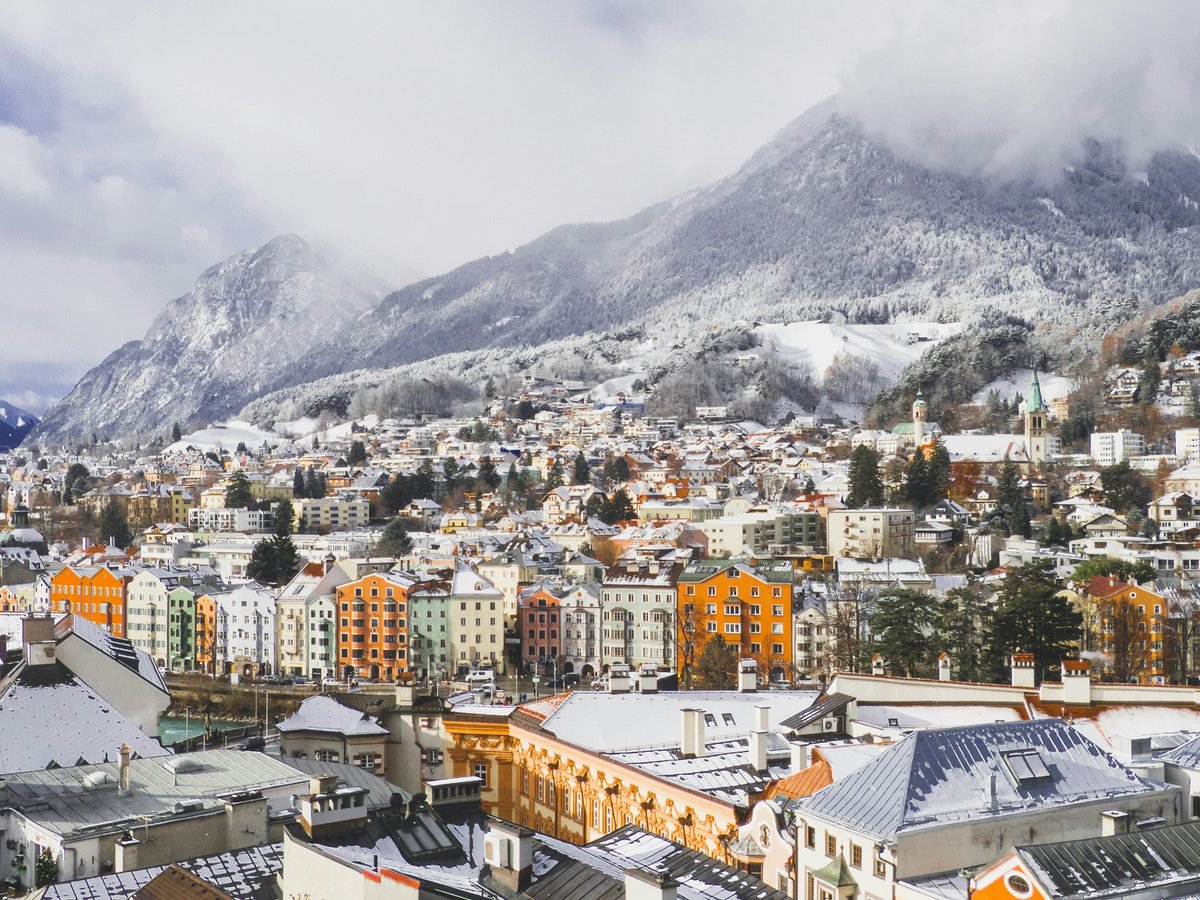
Stay in Innsbruck in August
43 hotels in the Trip.com pool for Innsbruck, from US$91 a night.
Opens Trip.com on Fri 6 Aug to Sun 8 Aug 2027; change the dates there.
August in Innsbruck means afternoon thunderstorms. Mornings tend to start clear and dry, with temperatures reaching around 25.6°C (78°F) by midday. By 2 or 3 p.m., clouds stack up behind the Nordkette ridge and thunder rolls down the Inn valley. The city sees about 143mm of rain across roughly 15 days this month, though most storms blow through in under an hour. After one passes, the air along the Innpromenade carries that sharp scent of wet limestone and pine resin drying in the returning sun.
This is also peak European school holiday season, and Innsbruck's Altstadt fills accordingly. Hotel rates run 30-40% above May or October prices, and the Nordkettenbahnen cable car queue starts building by 9 a.m. on sunny mornings. Worth noting, though, is the Innsbrucker Festwochen der Alten Musik, one of Europe's top early music festivals since 1976, which runs through late August in venues across the city including the Tiroler Landestheater. The festival presents baroque opera, Renaissance chamber music, and orchestral recitals. If you time a hike up the Hafelekar in the morning and catch a Monteverdi performance in the evening, August reveals a side of Innsbruck that the ski-season crowd never encounters. The headline performances typically sell out 4-6 weeks in advance.
Why visit in August
- The Nordkette, Patscherkofel, and surrounding alpine trails are fully snow-free up to about 2,500m, opening high-altitude routes like the Goetheweg that remain inaccessible from October through June.
- The Innsbrucker Festwochen der Alten Musik brings world-class baroque and Renaissance performances to the Tiroler Landestheater and other historic venues through late August.
- Daylight lasts until about 8:45 p.m. in early August, giving hikers a generous window for full-day mountain routes without a 5 a.m. start.
- Lake swimming at Baggersee and Lanser See reaches the warmest water temperatures of the year, typically around 22-24°C (72-75°F).
Worth knowing
- Afternoon thunderstorms develop on roughly half the days in August, totaling 143mm of rainfall. Storms typically pass within an hour, but they can strand hikers above treeline and produce dangerous lightning at altitude.
- European school holidays run from late July through August, driving hotel prices up 30-40% and creating noticeable queues at the Nordkettenbahnen, Bergisel Schanze, and Altstadt attractions.
- August 15, Mariä Himmelfahrt (Assumption Day), is a public holiday across Austria. Most shops close for the day, catching visitors off guard if they had planned shopping in the Altstadt or Sillpark.
Best for
Think twice if
August brings Innsbruck's warmest temperatures alongside frequent afternoon thunderstorms. Mornings are typically sunny and pleasant, reaching 25.6°C (78°F) by midday. The alpine setting means storms build fast after lunch, with thunder rolling across the Inn valley by 2 or 3 p.m. on roughly half the days. Rain totals hit about 143mm for the month, but individual storms rarely last more than an hour. Humidity sits around 76%, noticeable but not oppressive given the city's elevation at 574m. Evenings cool to a comfortable 14.9°C (59°F), and you'll want a light layer if you're eating outside past sunset.
Seasonal caution
- Alpine thunderstorms develop on about 15 of 31 days in August, typically between 2 and 4 p.m. Lightning at high altitude is a genuine hazard for hikers above treeline on the Nordkette, Patscherkofel, and surrounding peaks. Local mountain rescue services handle storm-related incidents every August. Check the Tyrolean weather service (zamg.ac.at) each morning and plan to descend below 2,000m by early afternoon.
- UV intensity increases roughly 10-12% per 1,000m of elevation. At the Hafelekar summit (2,334m), UV exposure is significantly stronger than in the city at 574m. Sunburn at altitude is common among visitors who underestimate this effect.
Year-round climate
Averages from the last 5 years.
| Month | Avg high (°C) | Avg low (°C) | Rainfall (mm) |
|---|---|---|---|
| Jan | 6 | -3 | 73 |
| Feb | 9 | -1 | 59 |
| Mar | 12 | 2 | 89 |
| Apr | 15 | 4 | 89 |
| May | 19 | 9 | 176 |
| Jun | 26 | 14 | 146 |
| Jul | 26 | 15 | 162 |
| Aug | 26 | 15 | 143 |
| Sep | 22 | 11 | 142 |
| Oct | 18 | 8 | 78 |
| Nov | 11 | 1 | 100 |
| Dec | 7 | -1 | 78 |
Holidays and festivals in August
Public holidays
- Assumption Day(Maria Himmelfahrt)15 August 2027
Headline events
Innsbrucker Festwochen der Alten Musik
Mid-July through late August
One of Europe's premier early music festivals, running since 1976. Baroque opera, Renaissance chamber music, and period-instrument orchestral performances fill the Tiroler Landestheater, the Hofkirche, and smaller venues across the city for roughly 5 weeks each summer. Conductors and ensembles specializing in historically informed performance travel from across the continent. Headline operas typically sell out 4-6 weeks in advance.
Best things to do in August
Hiking the Goetheweg on the Nordkette
hikingA high-altitude trail traversing the Nordkette ridge at roughly 2,000-2,100m, named after Goethe's travels through Tyrol. The route runs from the Hafelekar summit station east toward the Pfeishütte, with views across the Inn valley to the Stubai Alps and Brenner Pass. The trail is narrow in places with exposed sections that require confidence with heights.
Snow patches block sections of the Goetheweg until mid-July most years. August offers the most reliably snow-free conditions before early autumn snowfall returns in late September.Booking tipNo booking needed, but take the first Nordkettenbahnen car (around 8:30 a.m.) to finish before afternoon storms. Check the Seegrube webcam for cloud cover before you go.
Swimming at Baggersee
swimmingA former gravel quarry turned swimming lake in the south of the city, about 3km from the Altstadt. The lake has a small gravel beach, grassy sunbathing areas, and water that glows an unusually clear blue-green. Local families treat it as their backyard pool in summer. There's a small kiosk for drinks and Leberkässemmel.
Water temperatures peak at 22-24°C (72-75°F) in August. By late September, the lake drops below 16°C. This is the only month when the water feels genuinely warm rather than bracing.Booking tipFree entry. Arrive before 11 a.m. on weekends for a good spot on the grass. Weekday mornings are quiet.
Attending the Festwochen der Alten Musik
cultureBaroque opera, Renaissance vocal works, and period-instrument orchestral concerts performed by international ensembles in the Tiroler Landestheater and smaller venues including the Hofkirche. Performances range from fully staged operas to intimate chamber recitals in rooms that have hosted music for 400 years. The sound of a countertenor in the Hofkirche's stone nave is something you feel in your sternum.
The festival only runs from mid-July through late August. There is no equivalent in Innsbruck for the rest of the year.Booking tipHeadline opera productions sell out 4-6 weeks ahead. Smaller chamber concerts and late additions often have day-of availability at the festival box office on Universitätsstrasse.
Evening drinks at the Seegrube terrace
scenicThe mid-station of the Nordkettenbahnen sits at 1,905m with a south-facing sun terrace overlooking the entire Inn valley and Innsbruck's rooftops far below. On clear August evenings, the terrace catches golden light as the sun drops behind the western peaks. The air up here is noticeably cooler and thinner than in the city.
The Nordkettenbahnen runs extended summer hours into the evening in July and August. Outside these months, the last car down leaves too early for a sunset visit. August evenings are warm enough to sit outside at 1,905m without a heavy jacket.Booking tipNo reservation needed for the terrace. Take the second-to-last cable car up to avoid being stranded if you lose track of time.
Via ferrata on the Innsbrucker Klettersteig
climbingA moderately difficult via ferrata (fixed-rope climbing route) on the Nordkette, starting near the Seegrube station. The route traverses exposed limestone faces with steel cables, ladders, and iron rungs. It requires a harness, helmet, and via ferrata set. The exposure is real, with vertical drops of several hundred meters visible below your feet.
The route is only safely climbable when fully snow-free and dry, which is typically July through early September. August has the longest dry windows between afternoon storms and the rock is warm to the touch in morning sun.Booking tipRent via ferrata gear at outdoor shops in the Altstadt or at the Nordkettenbahnen base station. Start by 7 a.m. to finish before afternoon thunderstorms. The route takes 3-5 hours depending on ability.
Day trip to the Stubaier Gletscher
excursionThe Stubai Glacier sits about 45 minutes south of Innsbruck by car or bus. At over 3,000m, it offers summer glacier hiking trails, an ice grotto, and panoramic views across the Austrian and Italian Alps. The air up here is cold and thin even in August, and the light on the ice is blindingly bright. A distinctly different world from the green valley floor.
Summer glacier access for non-technical hikers is limited to July and August when approach routes are clear and crevasse conditions are stable. The Stubaier Gletscher cable cars run their full summer schedule through late August.Booking tipDrive early or take the Stubai valley bus from Innsbruck Hauptbahnhof. The parking lot at Mutterberg fills by 10 a.m. on weekends.
Cycling the Inntalradweg
cyclingThe Inn valley cycle path runs flat along the Inn River for over 500km in total, but the section from Hall in Tirol through Innsbruck to Völs is a gentle 25km stretch with mountain views on both sides. The path passes through riverside meadows, small villages, and stretches where the only sound is the Inn rushing over gravel. Rental bikes are available at the Hauptbahnhof area.
August's long daylight (sunset around 8:45 p.m.) and warm temperatures make this the best month for longer cycling stages. The path is fully dry and the riverside sections feel 2-3°C cooler than the city center on hot afternoons.Booking tipInnsbruck's public bike-sharing stations are convenient for short rides. For a full day, rent from a dedicated shop and ask about one-way return options along the Inn valley.
Visiting Alpenzoo
wildlifeEurope's highest-altitude zoo sits at 750m on the slopes above Hötting, reachable by the Hungerburgbahn or a steep 20-minute walk. The zoo focuses entirely on alpine species. Ibex, chamois, brown bears, lynx, bearded vultures, and alpine salamanders live in enclosures built into the mountainside. The setting, with views down over Innsbruck and up toward the Nordkette, is genuinely unusual for a zoo.
The alpine animals are most active in their outdoor summer enclosures during warm months. August's extended opening hours (until 6 p.m. versus 5 p.m. in shoulder months) give more time. Bear and wolf feeding times in summer draw the largest crowds.Booking tipCombine with a Nordkettenbahnen trip. The Hungerburgbahn stops at the zoo on the way up. Arrive by 10 a.m. to see animal feedings.
What to eat in August
In season: fruit
Heidelbeeren
Wild blueberries picked in alpine meadows above 1,500m elevation. Smaller and more intensely flavored than cultivated varieties. Sold at the Markthalle and by farmers at Saturday morning markets. They appear in Strudel, with Topfen (quark), or served plain at mountain huts.
On menus now
Marillenknödel
Apricot dumplings made with fresh Wachau valley apricots, which reach peak ripeness in late July and August. The dumplings are rolled in buttered breadcrumbs and dusted with powdered sugar. You'll find them on nearly every restaurant menu and at Almhütten across the Nordkette.
Zwetschgenknödel
Plum dumplings that appear on menus in late August as the first Tyrolean plums ripen. Similar in construction to Marillenknödel but with a tarter, deeper flavor. The transition from apricot to plum dumplings marks the slow turn toward autumn on Innsbruck restaurant menus.
What to drink
Radler
A 50/50 mix of lager beer and lemon soda, served ice-cold at every Biergarten and mountain hut terrace. Not technically seasonal, but consumption peaks in August when half of Innsbruck seems to be drinking them at the Seegrube terrace or along the Innufer by late afternoon.
In markets
Eierschwammerl (Pfifferlinge)
Wild chanterelle mushrooms foraged from Tyrolean forests through July and August. They appear pan-fried with butter and parsley, in cream sauces with Knödel, or scattered over Tiroler Gröstl. August is peak foraging season.
Almkäse
Fresh alpine cheese produced on Tyrolean summer pastures between June and September. The flavor is noticeably different from the aged winter version because the cows graze on high-altitude wildflower meadows. Sold at farmers' markets and Sennereien across the region. August is mid-season when production is at its highest.
Regular events in August
Mariä Himmelfahrt (Assumption Day)Free
A national public holiday across Austria on August 15. Shops close throughout Innsbruck, and many churches hold special services. Some restaurants operate on reduced menus. In rural Tyrolean communities near Innsbruck, the day often includes processions with traditional Trachten (folk costume) and brass band music through the village centers.
August 15Promenadenkonzerte im HofgartenFree
Free open-air concerts in the Hofgarten (Imperial Garden) in Saggen. The concerts run on selected evenings through the summer months, featuring brass ensembles, chamber groups, and occasionally the Musikkapelle (local brass band). The setting under old chestnut trees with the Hofburg walls behind the stage gives the concerts a distinctly old-world feel. Locals bring their own blankets.
Various evenings throughout July and AugustTiroler Festspiele Erl
An opera and orchestral festival in the village of Erl, about 80km northeast of Innsbruck in the lower Inn valley. The festival uses a striking modern Festspielhaus designed by Delugan Meissl and stages grand opera productions and symphonic concerts through the summer. A feasible day trip or evening excursion from Innsbruck by car or regional train.
July through early AugustBest places this August
Seegrube sun terrace
viewpointThe mid-station of the Nordkettenbahnen at 1,905m, with a panoramic south-facing terrace overlooking the entire Inn valley. In August, the terrace is warm enough for a long sit with a cold drink. The contrast between alpine air up here and city heat 1,300m below is striking. On clear evenings, the golden light on the surrounding peaks draws photographers.
Hötting (above)Hofgarten
parkThe Imperial Garden in Saggen, originally laid out in the 15th century. Massive chestnut trees provide shade on hot August afternoons, and the Promenadenkonzerte stage free evening concerts here through the summer. Local chess players set up at the outdoor tables near the pavilion. The garden backs onto the Hofburg walls and is one of the few spots in central Innsbruck where you can sit on grass.
SaggenBaggersee
lakeA former gravel quarry turned swimming lake about 3km south of the Altstadt. The water reaches 22-24°C (72-75°F) in August, warm enough for comfortable swimming. Gravel beach, grassy areas, and a kiosk. Popular with Innsbruck locals for after-work swims on weekday evenings.
RossauBergisel Schanze
landmarkThe Zaha Hadid-designed ski jump south of the city in Wilten. In August, there are no competitions, so you can take the funicular to the observation deck without winter-sports crowds. The panoramic view from the top stretches across the Inn valley to the Nordkette. The concrete and glass structure itself is worth seeing for the architecture alone.
WiltenWiltener Basilika
churchA Rococo church in Wilten, about 15 minutes on foot south of the Altstadt. The interior is ornate, white and gold with ceiling frescoes, and noticeably cooler than the summer streets outside. Far fewer tourists than the Hofkirche in the old town. The acoustics are remarkable, and occasional summer organ recitals take advantage of them.
WiltenInnufer walk through St. Nikolaus and Mariahilf
walkA riverside walk along the north bank of the Inn, passing the painted facades of the Mariahilf houses (the classic Innsbruck postcard view, seen from the other side). In August evenings, the low sun lights up the colored houses across the water. The St. Nikolaus side has a few quieter cafes and Gasthäuser that the Altstadt crowds rarely reach.
St. NikolausHafelekar summit
summitThe top station of the Nordkettenbahnen at 2,334m. In August, you can step out of the cable car into genuine alpine terrain with 360-degree views. The Karwendel nature park stretches north, and the Inn valley and Stubai Alps spread to the south. Wind is common up here even on calm days in the city. Snow patches may linger in shaded north-facing gullies.
Hötting (above)
Your packing checklist
Tick items off as you pack. Your progress saves in this browser.
All packed — have a great trip.
Insider tips
Board the Nordkettenbahnen at the Congress station before 9 a.m. By 10 a.m. on sunny August mornings, the queue for the Hungerburgbahn can stretch to 30-45 minutes. The early risers are mostly local hikers, and the cable car is nearly empty.
For lunch, walk 15 minutes south from the Altstadt into Wilten along Leopoldstrasse. Restaurants there serve the same Tyrolean dishes at noticeably lower prices because they cater to university students and locals rather than day-trippers.
Innsbruck's tap water comes directly from alpine springs in the Karwendel range. It's excellent quality and cold year-round. You can fill your bottle at any public fountain in the city. Buying bottled water here is unnecessary.
After an afternoon thunderstorm clears, usually by 4 or 5 p.m., the light on the Nordkette turns golden and the air becomes remarkably clear. This 60-90 minute window is the best photography opportunity of the day, and most tourists have already retreated to their hotels.
The Innsbruck Card covers all cable cars, public transit, and museum entry for 24, 48, or 72 hours. In August, a 48-hour card typically pays for itself if you ride the Nordkettenbahnen once and visit 2 museums, since the cable car alone costs over 30 EUR return.
Avoid these mistakes
- Starting a mountain hike at noon. Afternoon thunderstorms in August develop between 2 and 4 p.m. with regularity. Local hikers start by 7 or 8 a.m. and aim to be below treeline before early afternoon. Getting caught above 2,000m in an electrical storm on the Nordkette is genuinely dangerous, and Tyrolean mountain rescue handles cases every summer.
- Planning a shopping trip on August 15 without checking the calendar. Mariä Himmelfahrt is a national public holiday in Austria. Shops close across the city, including the Altstadt boutiques and the Sillpark shopping center. Restaurants generally remain open, but some operate on reduced hours.
- Packing only summer clothing. The Altstadt at 574m might be 25°C, but the Hafelekar summit at 2,334m can be 10°C with wind. That 1,760m elevation difference produces a temperature drop of roughly 10-12°C. Tourists in shorts and sandals at Seegrube are a common sight in August. They are always cold.
- Spending all your time in the Altstadt. The old town covers about 4 square blocks and concentrates most of the tourist traffic. A 10-15 minute walk into Wilten, Pradl, St. Nikolaus, or Hötting gives you a much quieter, more local experience with cheaper restaurants and a feel for how Innsbruck lives.
Practical tips for August
August 15, Mariä Himmelfahrt, is a public holiday across Austria. Most shops in Innsbruck close for the day, including those in the Altstadt and the Sillpark shopping center. Restaurants remain open but some run reduced menus. Book accommodations at least 6-8 weeks ahead for August, especially if your dates overlap with Festwochen der Alten Musik performances. Mountain cable cars like the Nordkettenbahnen and Patscherkofelbahn run extended summer hours, typically 8:30 a.m. to 5:30 p.m. If you're planning multi-day hiking, look into the Innsbruck Card, which covers cable cars, public transit, and museum entry for 24, 48, or 72 hours. Dress in layers for mountain excursions even in August. The Hafelekar summit at 2,334m can be 15°C cooler than the city center at 574m. Tipping in Tyrolean restaurants is typically 5-10%, rounded up to a convenient amount. Credit cards are widely accepted in the Altstadt but some mountain huts and smaller Gasthäuser in the outer neighborhoods still prefer cash.
FAQ
Is August a good time to visit Innsbruck?
August is a good time for Innsbruck, but likely not the best month of the year. You get the warmest temperatures (around 25.6°C / 78°F), fully snow-free mountain trails up to about 2,500m, and the Festwochen der Alten Musik classical festival. The trade-offs are European school holiday crowds, hotel rates 30-40% above shoulder season, and afternoon thunderstorms on about half the days. June and September offer similar weather with fewer people and lower prices. If you're locked into school holiday schedules or the Festwochen specifically interests you, August still works well.
What is the weather like in Innsbruck in August?
Expect highs around 25.6°C (78°F) and lows near 14.9°C (59°F) in the city center. Mornings are typically clear and pleasant. Afternoon thunderstorms develop on roughly 15 of 31 days, dropping about 143mm of rain for the month, but they usually pass within an hour. Humidity averages 76%. Up in the mountains at Seegrube (1,905m) or Hafelekar (2,334m), temperatures are 10-15°C cooler and wind is common even on calm days in the valley.
Is Innsbruck crowded in August?
Yes, noticeably so. August is one of Innsbruck's busiest months because European school holidays concentrate family travel into a 4-6 week window from late July through August. The Altstadt, Nordkettenbahnen cable car, and Bergisel Schanze all see heavy visitor traffic. Neighborhoods like Wilten, Pradl, and St. Nikolaus feel much calmer. Arriving at popular sites before 9 a.m. makes a real difference in queue times.
Can you still hike if it rains in August in Innsbruck?
Yes, with planning. August storms are mostly an afternoon phenomenon, developing between 2 and 4 p.m. Start your hike by 7 or 8 a.m. and aim to descend before early afternoon. Valley-floor walks along the Innpromenade or through the Hofgarten are fine in light rain. If a full rain day occurs, Innsbruck has solid indoor options. The Tiroler Landesmuseum Ferdinandeum, the Hofburg, and Alpenzoo all work as rain-day alternatives. Full rain-out days where it rains morning to night are relatively uncommon in August.
Is August or September better for visiting Innsbruck?
September is likely the better choice for most visitors. Temperatures are still comfortable at around 22°C (72°F), crowds thin out noticeably after European schools reopen in early September, and hotel prices drop. The mountains may show the first hints of fall color in late September, and rainfall is similar (142mm vs 143mm). August's advantage is warmer temperatures, longer days (sunset 45 minutes later), and the Festwochen der Alten Musik festival. If the festival matters to you or you're tied to school holiday schedules, August is the right call.
Find a flight to Innsbruck
Live fares to Innsbruck appear here once cookies are accepted.
Last verified by automated review (v1.7.2) on . What is automated review?