Stay in Innsbruck in January
43 hotels in the Trip.com pool for Innsbruck, from US$91 a night.
Opens Trip.com on Fri 1 Jan to Sun 3 Jan 2027; change the dates there.
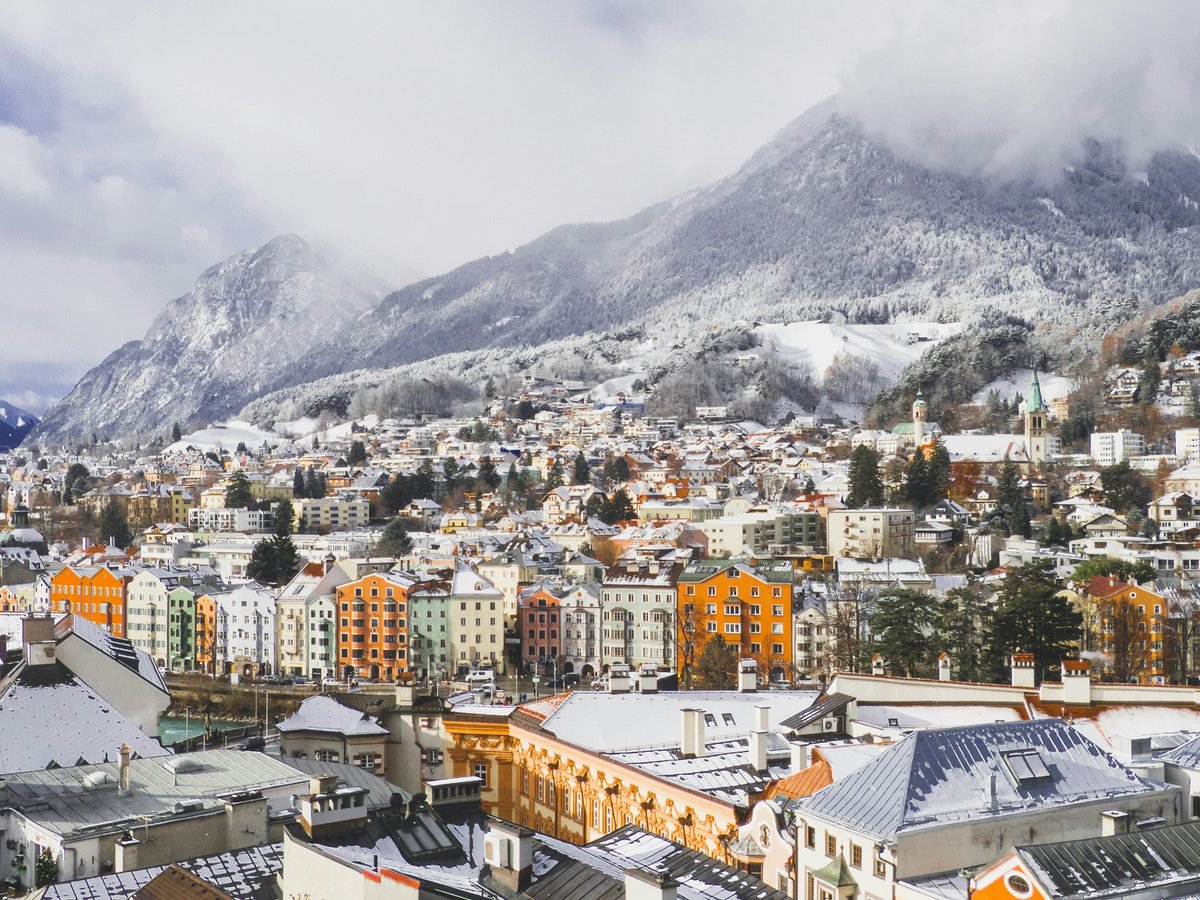
January in Innsbruck is defined by snow. The Nordkette range rises directly above the Altstadt, and on a clear morning the peaks catch pink light while the city below sits at a crisp -3°C (26°F). This is prime ski season, and Innsbruck leans into it. The Nordkettenbahnen carries skiers from the city center to 2,300 meters of elevation in about 20 minutes. You'll find fewer tourists than December's Christmas-market crush, but the ski crowd fills the gap. Daytime highs tend to hover around 5.9°C (43°F), which feels tolerable with proper layers, though the sun disappears behind the mountains by 4:30 pm.
The month opens with a genuine spectacle. The Vierschanzentournee, the Four Hills Tournament, hits Bergisel on January 4th. Around 25,000 spectators pack the hillside to watch ski jumpers launch off the Zaha Hadid-designed ramp. The atmosphere is closer to a football match than a genteel winter sport. Beer, Bratwurst, cowbells. If you happen to arrive before January 6th, the tail end of the Christkindlmarkt in the Altstadt is still running for Dreikönigstag, Epiphany.
To be fair, January is not the month for leisurely outdoor strolls. The Inn River corridor funnels cold air through the valley, and evenings regularly drop to -5°C (23°F) or lower. Short days mean limited sightseeing windows. But if you're here for the mountains, either on skis or snowshoes, Innsbruck in January delivers in a way that few Alpine cities can match at this price point. Hotel rates sit below December's peak but above summer levels, landing somewhere in the expensive bracket for Innsbruck's own calendar.
Why visit in January
- World-class skiing within 20 minutes of the city center. The Olympia SkiWorld pass covers 9 resorts and 300+ kilometers of runs across the greater Innsbruck area.
- The Vierschanzentournee at Bergisel on January 4th is one of the most electric live sporting events in the Alps, and general admission tickets typically cost under 30 euros.
- Crowd levels drop noticeably after the Christmas-market season ends around January 6th, making the Hofburg, Hofkirche, and Tiroler Landesmuseum Ferdinandeum easier to visit without queues.
- Fresh snowfall in January tends to keep the Nordkette and surrounding peaks in excellent condition, and the Stubai Glacier offers reliable snow cover above 3,000 meters even in lean years.
- Hearty Tirolean winter food peaks now. Restaurants in Hötting and Wilten serve Tiroler Gröstl, Kasspatzln, and Germknödel that feel purpose-built for cold days.
Worth knowing
- Daylight is limited to roughly 8.5 hours, with the sun dropping behind the Nordkette by 4:30 pm. Planning outdoor sightseeing around this short window takes effort.
- Temperatures regularly fall below -5°C (23°F) at night, and the Inn River valley funnels wind that makes the cold feel sharper than the thermometer suggests.
- Hotel and ski-pass prices sit 20-35% above Innsbruck's annual average. A day pass for the Nordkette alone runs around 45-50 euros.
- Some hiking trails in the Karwendel range and around Patscherkofel are closed or require full winter mountaineering equipment, limiting options for non-skiers.
Best for
Think twice if
Cold and dry by Alpine standards. January brings the lowest temperatures of the year, with nights that frequently dip below -5°C (23°F) in the valley floor. Snowfall is common but tends to come in 2-3 day bursts rather than constant precipitation. The Föhn wind can push daytime temperatures to 10°C (50°F) for a day or two before the cold reasserts itself. Overcast skies are typical, though Föhn days produce startlingly clear views of the Nordkette. The 73mm of precipitation falls as snow at city elevation roughly half the time, turning the Altstadt into something out of a postcard.
Seasonal caution
- Nighttime temperatures frequently drop to -8°C (18°F) or lower. Exposed skin risks frostnip within 30 minutes at these temperatures, especially with wind chill along the Inn valley.
- Föhn wind events can arrive without much warning, raising temperatures by 10-15°C in a few hours. The rapid pressure change triggers headaches and poor sleep in some visitors. Locals call it Föhnkrankheit.
- Avalanche risk in the backcountry around the Karwendel and Stubai ranges is significant in January. The Tiroler Lawinenwarndienst publishes daily bulletins. Never leave marked ski runs or snowshoe trails without checking the current danger level.
Year-round climate
Averages from the last 5 years.
| Month | Avg high (°C) | Avg low (°C) | Rainfall (mm) |
|---|---|---|---|
| Jan | 6 | -3 | 73 |
| Feb | 9 | -1 | 59 |
| Mar | 12 | 2 | 89 |
| Apr | 15 | 4 | 89 |
| May | 19 | 9 | 176 |
| Jun | 26 | 14 | 146 |
| Jul | 26 | 15 | 162 |
| Aug | 26 | 15 | 143 |
| Sep | 22 | 11 | 142 |
| Oct | 18 | 8 | 78 |
| Nov | 11 | 1 | 100 |
| Dec | 7 | -1 | 78 |
Holidays and festivals in January
Public holidays
- New Year's Day(Neujahr)1 January 2027
- Epiphany(Heilige Drei Könige)6 January 2027
Headline events
Vierschanzentournee (Four Hills Tournament) at Bergisel
January 3-4
The third leg of the legendary Four Hills ski-jumping tournament lands at Innsbruck's Bergisel stadium on January 4th. Around 25,000 spectators crowd the hillside below Zaha Hadid's cantilevered tower to watch jumpers launch off the 130-meter hill. The atmosphere is raucous. Cowbells, brass bands, beer stands, and Bratwurst stalls line the approach from Wilten. The qualification round on January 3rd tends to be less packed and still delivers spectacular jumping.
Best things to do in January
Skiing the Nordkette from the city center
winter_sportsThe Nordkettenbahnen funicular and cable car take you from the Congress station in the city center to the Hafelekar peak at 2,334 meters in about 20 minutes. The Seegrube mid-station at 1,905 meters has a sun terrace with views across the entire Inn valley. The Karrinne run from Hafelekar down to Seegrube is steep, north-facing, and holds powder well into late January.
January snowpack on the north-facing Nordkette slopes tends to be at its deepest, and the cold temperatures preserve powder conditions between storms.Booking tipBuy the combined city-transport-plus-Nordkette ticket at the Congress station to save about 8 euros over separate purchases. Morning arrivals before 9 am avoid the ski-school groups.
Watch the Vierschanzentournee at Bergisel
spectator_sportThe Four Hills Tournament qualifying round on January 3rd and competition day on January 4th fill the Bergisel hillside with 25,000 fans. The walk up from Wilten takes about 15 minutes and the path is lined with food and drink stalls. Watching a ski jumper in flight from directly below the outrun is a different experience from television. The silence during the jump, then the roar.
This event only happens once a year, on January 3-4. Innsbruck's leg is the third of four stops on the tournament circuit.Booking tipGeneral standing tickets go on sale in late October and sell out by mid-December. The qualification round on January 3rd is easier to get into and nearly as good.
Snowshoeing in the Sellraintal
winter_sportsThe Sellrain valley, about 30 minutes west of Innsbruck by bus, offers marked snowshoe trails through forests of spruce and larch at elevations between 1,200 and 1,800 meters. The Lüsens trail follows a frozen stream bed with views up to the Lisenser Fernerkogel glacier. You'll hear nothing but your own footsteps and the occasional crack of a branch dropping its snow load.
January's consistent cold keeps the snowpack stable on lower-altitude trails. By March, afternoon warmth softens the snow and makes the same trails slushy.Booking tipSnowshoe rental at the Innsbruck tourist office on Burggraben runs about 12-15 euros per day. Guided group tours depart on Wednesdays and Saturdays.
Bergisel Ski Jump tower visit
sightseeingEven outside the Vierschanzentournee, the Bergisel tower designed by Zaha Hadid is open for visits. The panoramic café at the top sits at the same height as the ski jumpers' launch point, 47 meters above the outrun. Looking down the steep inrun from behind the glass is mildly vertigo-inducing. The panorama takes in the entire Inn valley from Wilten to Hall in Tirol.
The snow-covered Nordkette backdrop in January makes the panorama from the tower considerably more dramatic than in summer. And the jump hill itself is in active competition condition around the Vierschanzentournee.Booking tipVisit in the morning on weekdays. The tower closes for private events occasionally, so check the Bergisel website the day before.
Thermal bathing at Aqua Dome in Längenfeld
wellnessAbout 75 minutes southwest of Innsbruck in the Ötztal, the Aqua Dome thermal spa has 3 outdoor bowl-shaped pools at 34-36°C (93-97°F) set against a backdrop of snow-covered peaks. Sitting in 36°C water while snowflakes land on your face and the air temperature hovers at -5°C is a specific kind of January pleasure. The contrast stings for about 10 seconds, then your body adjusts.
The temperature differential between the 36°C pools and the sub-zero January air is at its most extreme, which is the whole point. Summer visits lack this contrast entirely.Booking tipBook a 4-hour evening slot online at least 3 days ahead for January weekends. The 3-hour afternoon window fills up with day-trippers from Innsbruck.
Explore the Hofburg Imperial Palace and Hofkirche
cultureThe Hofburg in the Altstadt, rebuilt under Maria Theresa in the 1770s, has Rococo state rooms with ceiling frescoes that you can take time to study in January's thinner crowds. The adjacent Hofkirche holds the cenotaph of Emperor Maximilian I, flanked by 28 larger-than-life bronze statues that locals call the Schwarze Mander (Black Fellows). The craftsmanship on these 500-year-old figures is worth a close look.
January's reduced tourist flow means you can spend 10 minutes with each of the Schwarze Mander without being elbowed aside. Summer queues at the Hofkirche entrance often reach 20-30 minutes.Day trip to the Stubai Glacier
winter_sportsThe Stubaier Gletscher, about 45 minutes south of Innsbruck, offers skiing at elevations up to 3,210 meters with near-guaranteed snow conditions. The panorama platform at the Schaufeljoch top station extends over the railing into open air at 3,150 meters. On a clear January day, you can see into Italy's South Tirol. The glacier runs are wide, well-groomed, and particularly suited to intermediate skiers.
The glacier's high altitude ensures reliable snow cover even in low-snowfall January seasons. The cold temperatures keep the pistes firm from first lift to last.Booking tipThe free ski bus from Innsbruck Hauptbahnhof runs every 30-60 minutes. Arrive at the valley station before 8:30 am on weekends to avoid a 20-minute wait for the gondola.
Evening concert at the Tiroler Landestheater
cultureInnsbruck's main theater on Rennweg runs a full winter program of opera, ballet, and orchestral performances through January. The 1967 building is not architecturally remarkable, but the acoustics are good and ticket prices for mid-week performances start around 20 euros. The Tiroler Symphonieorchester Innsbruck performs here regularly.
The winter season program is in full swing in January, with 15-20 performances across the month. Short daylight hours make evening cultural programming a natural fit.Booking tipMid-week performances on Tuesday and Wednesday are least likely to sell out. Book through the Landestheater website rather than third-party resellers.
What to eat in January
On menus now
Tiroler Gröstl
Pan-fried potatoes with leftover roast pork or beef, topped with a fried egg. This is Tirolean comfort food at its most direct. Restaurants in Hötting and the Altstadt serve it as a lunch staple, and after a morning on the Nordkette slopes it might be the most satisfying plate in the Alps. The name comes from the Tirolean dialect word for 'roasted.'
Kasspatzln
Handmade spaetzle baked with melted Tiroler Graukäse and Bergkäse, finished with crispy fried onions. The cheese pulls in long strings when the dish arrives at the table still bubbling. Most ski huts on the Nordkette and Patscherkofel serve their own version, and the altitude seems to make it taste better.
Germknödel
A fist-sized steamed yeast dumpling filled with plum jam, served swimming in melted butter, poppy seeds, and vanilla sauce. The contrast of the warm, pillowy dough and the tart Powidl filling works particularly well after 4 hours in the cold. Ski huts at the Axamer Lizum sell these for around 6-8 euros.
Speckknödel in Broth
Dense bread dumplings studded with Tiroler Speck, served in a clear beef broth. The salty, smoky Speck comes from pigs raised in the Stubai and Wipp valleys, and the smoke flavor intensifies in January batches that have been curing since autumn. Gasthäuser in St. Nikolaus serve these as a first course.
Street food peaks
Kiachl
Fried dough rounds, slightly sweet, served with lingonberry jam or sauerkraut. These appear at winter markets and festivals across Tirol, and the tail end of the Christkindlmarkt before January 6th is a reliable place to find them fresh from the fryer. The outside crackles, the inside is soft and yeasty.
What to drink
Jagertee
A potent blend of black tea, rum, red wine, and fruit schnapps served scalding hot. Every hut on the mountain seems to have a slightly different recipe. The drink is technically an Austrian protected designation, so what you get in Innsbruck is the real thing. One or two glasses on a cold January afternoon on the Seegrube terrace at 1,905 meters is a genuine sensory experience. The warmth starts in your chest.
Regular events in January
Dreikönigstag (Epiphany)Free
January 6th is a public holiday in Austria. The Sternsinger, children dressed as the Three Kings, go door to door singing carols and collecting donations for charity. Many shops and restaurants in the Altstadt and Maria-Theresien-Strasse close for the day. The remaining Christmas market stalls in the Marktplatz typically pack up after this date.
January 6Neujahrskonzert der Tiroler Symphonieorchester
The Tiroler Symphonieorchester Innsbruck performs a New Year's concert at the Congress Innsbruck in the first week of January, with a program of Strauss waltzes and polkas following the Viennese tradition. The setting is less famous than the Musikverein, but the musicianship is serious and tickets are far easier to get.
Early January (typically January 1-3)Tanzcafé Innsbruck winter series
The Treibhaus cultural center on Angerzellgasse runs its Tanzcafé series through January, with live jazz, world music, and swing dance nights on Fridays and Saturdays. The venue is intimate, maybe 200 capacity, and draws a mixed local crowd from students to retirees.
Friday and Saturday evenings throughout JanuaryPerchtenlaufFree
In villages around Innsbruck, particularly in the Stubai and Wipp valleys, masked Perchten runners parade through the streets in carved wooden masks and sheepskin costumes during early January. The tradition dates to pre-Christian Alpine culture. The masks are genuinely unsettling, with horns, animal teeth, and twisted faces. The sound of cowbells and wooden clogs on cobblestones carries through the cold valley air.
Early January, dates vary by village (typically January 2-6)Best places this January
Seegrube terrace on the Nordkette
viewpointThe mid-station of the Nordkettenbahnen at 1,905 meters has an open terrace facing south across the Inn valley. On a clear January day, the sun hits this terrace even when the city below sits in shadow. A Jagertee from the restaurant while watching paragliders launch off the ridge is one of Innsbruck's genuine winter pleasures. The temperature up here tends to run 8-10°C colder than the city.
NordketteGoldenes Dachl and the Altstadt
historic_siteThe late-Gothic oriel window with its 2,657 fire-gilded copper tiles is the most photographed spot in Innsbruck, and under a dusting of January snow the surrounding Helblinghaus and Stadtturm look their best. The narrow streets of the Altstadt between Herzog-Friedrich-Strasse and the Inn River hold well-preserved 15th and 16th century facades. Morning light hits the Dachl around 10 am in January.
AltstadtMarkthalle Innsbruck
marketThe covered market hall on Innrain, at the edge of the Altstadt near the Inn River, has about 40 stalls selling Tiroler Speck, mountain cheese, bread, and prepared foods. In January it functions as a warm refuge between outdoor sightseeing. The Speck stands let you taste before buying. The upstairs section has several small restaurants with views over the river to the Mariahilf neighborhood.
AltstadtBergisel Ski Jump and Tower
landmarkThe stadium sits on the hill above Wilten where Andreas Hofer's Tirolean fighters battled Bavarian troops in 1809. Zaha Hadid's 2002 tower cantilevers over the hillside at 47 meters. Outside of competition days, you can ride the funicular to the café at the top and look down the 90-meter inrun. The combined view of the jump hill, the city, and the Nordkette behind it is the most complete panorama in Innsbruck.
WiltenTiroler Landesmuseum Ferdinandeum
museumThe main regional museum on Museumstrasse holds an unexpectedly strong collection of Gothic altarpieces from Tirolean churches, 19th century landscape paintings of the Alps, and archaeological finds from the Brenner Pass trade routes. The collection of medieval panel paintings on the second floor rivals much larger museums. January is a good month for this because the galleries are nearly empty on weekday mornings.
SaggenHungerburg plateau
neighborhoodThe first stop on the Nordkettenbahnen, accessible via the Hungerburgbahn funicular designed by Zaha Hadid, sits at 860 meters above the city. The residential plateau has walking paths through snow-covered forest and a view straight down into the Altstadt. The Alpenzoo at this station is open year-round and has Alpine species like ibex, chamois, and bearded vultures in naturalistic enclosures. The zoo is quieter in January than any other month.
HungerburgSt. Nikolaus riverside quarter
neighborhoodThe neighborhood across the Inn River from the Altstadt has a cluster of traditional Gasthäuser along the Innstrasse that serve Tirolean home cooking at prices 20-30% below the tourist-facing Altstadt restaurants. The painted facades of the riverside houses, reflected in the blue-green Inn water, are photogenic year-round but particularly striking when snow sits on the rooflines and window ledges.
St. Nikolaus
Your packing checklist
Tick items off as you pack. Your progress saves in this browser.
All packed — have a great trip.
Insider tips
The free ski bus to the Stubai Glacier from Innsbruck Hauptbahnhof is one of the best-kept logistical advantages of the city. It runs year-round in winter, takes about 45 minutes, and saves you roughly 15 euros in parking fees at the base station. Locals use it routinely.
The Markthalle Innsbruck on Innrain is where locals eat lunch. The upstairs restaurants serve Tiroler Gröstl and Kasspatzln for about 10-13 euros, while the same dishes at Altstadt tourist restaurants tend to run 16-20 euros. The quality at the Markthalle is at least as good.
On Föhn days in January, when a warm south wind pushes temperatures 10°C above normal and the sky turns an unusually deep blue, drop whatever you planned and head to the Seegrube. The visibility on these days extends past the Zugspitze into Bavaria, 60+ kilometers north. Locals check the forecast specifically for this.
If you're watching the Vierschanzentournee at Bergisel, the standing area on the right side of the outrun (as you face the tower) gives you a slightly better angle on the landing. Arrive at least 90 minutes before the first jump to stake a spot. The qualification round on January 3rd is nearly as exciting and significantly less packed.
The Innsbruck Card covers the Nordkettenbahnen, Bergisel tower, all major museums, the Alpenzoo, and public transport for 24, 48, or 72 hours. In January, the 48-hour version at around 53 euros typically pays for itself within 3 activities, since the Nordkette cable car alone costs 38 euros round-trip.
Avoid these mistakes
- Underestimating the altitude difference between the city (574 meters) and the Nordkette top station (2,334 meters). Visitors pack for the mild 6°C valley temperature and arrive at the Hafelekar in -12°C wind. The Seegrube terrace at 1,905 meters is already 8-10°C colder than the Altstadt. Layer accordingly before boarding the cable car.
- Planning a full day of outdoor sightseeing without accounting for the 8.5 hours of daylight. The sun drops behind the western ridge around 4:30 pm, and the temperature falls sharply within 30 minutes of sunset. Front-load outdoor plans and save museums for the late afternoon.
- Booking a city hotel and expecting to ski every day without a car or bus research. The Nordkette is walkable, but the Stubai Glacier and Axamer Lizum require 45-75 minutes by bus. The ski buses are free with valid lift passes, but they run on fixed schedules, and missing the last one at 5:30 pm means a 40-euro taxi.
- Shopping or sightseeing on January 6th without checking opening hours. Dreikönigstag is a public holiday in Austria. Most shops on Maria-Theresien-Strasse and in the Altstadt close entirely, and museum hours are often reduced. Restaurants in Wilten and Pradl may also close or run limited menus.
Practical tips for January
Book accommodation 4-6 weeks ahead for January weekends, especially around the Vierschanzentournee on January 3-4. Hotels in the Altstadt and Saggen fill first. Pradl and Wilten offer lower rates and are still within 10-15 minutes of the center by tram. The Innsbruck Card is worth buying for stays of 2 days or longer. Austria uses the euro. Tipping at restaurants is typically 5-10%, rounded to a convenient number when paying. Most Innsbruck restaurants accept cards, but smaller Gasthäuser in St. Nikolaus and market stalls at the Markthalle may prefer cash. The Innsbruck Hauptbahnhof has direct rail connections to Munich (1 hour 45 minutes), Salzburg (2 hours), and Bolzano in Italy (2 hours 15 minutes) via the Brenner Pass. Public transport within Innsbruck runs on the IVB network. Single tickets cost about 2.40 euros. Most ski buses are free with a valid lift pass. Shops typically close by 6 pm on weekdays and 5 pm on Saturdays. Sunday closures are universal except for some restaurants and ski-area facilities. Dress code for the Landestheater and Congress Innsbruck performances is smart casual, not formal.
FAQ
Is January a good time to visit Innsbruck?
January is a good time if you want winter sports, Alpine scenery under snow, or a quieter cultural visit after the December tourist rush. The skiing across 9 nearby resorts is at its best, and the Vierschanzentournee at Bergisel on January 4th is a genuinely exciting event. That said, it is cold. Temperatures drop below -5°C (23°F) most nights, daylight runs to about 8.5 hours, and some high-altitude hiking is inaccessible without winter mountaineering equipment. If you dislike cold weather or want long days for sightseeing, June through September is a better fit.
What is the weather like in Innsbruck in January?
The average high reaches 5.9°C (43°F) and the average low sits at -3.5°C (26°F), though colder snaps can push nights to -10°C (14°F) or below. Innsbruck receives about 73mm of precipitation across roughly 12 days, falling as snow at city elevation about half the time. Humidity averages 73%. The Föhn wind occasionally pushes daytime temperatures to 10°C (50°F) with unusually clear skies, but these episodes typically last only 1-2 days. At the Stubai Glacier (3,200 meters), expect temperatures 15-20°C colder than the valley floor.
Is Innsbruck crowded in January?
Crowds are moderate. The Christmas-market tourists leave after Dreikönigstag on January 6th, and the summer hiking crowd won't arrive until June. Ski resorts see their busiest periods during Austrian school holidays, which sometimes overlap with late January. The Vierschanzentournee on January 3-4 draws about 25,000 people to Bergisel and fills nearby hotels, but the rest of the city remains manageable. Museums like the Ferdinandeum and the Hofburg are noticeably quieter than in July or August.
Can you ski in Innsbruck in January without a car?
Yes. The Nordkette is accessible by public funicular from the Congress station in the city center, a 20-minute ride to the slopes. For the Stubai Glacier, Axamer Lizum, and other Olympia SkiWorld resorts, free ski buses run from Innsbruck Hauptbahnhof on regular schedules throughout the day. The last buses typically return around 5:30 pm. The Innsbruck Card covers public transport within the city. A car adds flexibility but is not required for a ski-focused January visit.
What should I eat in Innsbruck in January?
January is the peak month for hearty Tirolean mountain food. Tiroler Gröstl (pan-fried potatoes with roast meat and a fried egg) and Kasspatzln (cheese spaetzle with fried onions) are the two staples you'll find at nearly every Gasthaus in Hötting, Wilten, and St. Nikolaus. Germknödel, a steamed yeast dumpling filled with plum jam, is the classic ski-hut dessert. For drinks, Jagertee (a hot mix of black tea, rum, and red wine) warms you from the inside after a day on the slopes. The Markthalle on Innrain is the best spot for sampling Tiroler Speck and local mountain cheeses.
Find a flight to Innsbruck
Live fares to Innsbruck appear here once cookies are accepted.
Last verified by automated review (v1.7.2) on . What is automated review?