Stay in Innsbruck in May
43 hotels in the Trip.com pool for Innsbruck, from US$91 a night.
Opens Trip.com on Fri 7 May to Sun 9 May 2027; change the dates there.
May in Innsbruck is the rainiest month of the year, and that single fact shapes everything about a visit. The city sees roughly 176mm of precipitation across 21 rainy days, mostly as afternoon thunderstorms that build over the Nordkette ridge, crack open with surprising force, and clear within 30 to 45 minutes. On a clear morning the air smells of wet pine and fresh grass from the Mittelgebirge slopes above the city. Daytime temperatures sit around 19°C (66°F), comfortable in a light jacket when the sun is out, though evenings still dip to about 9°C (48°F) with a cold edge off the Inn River.
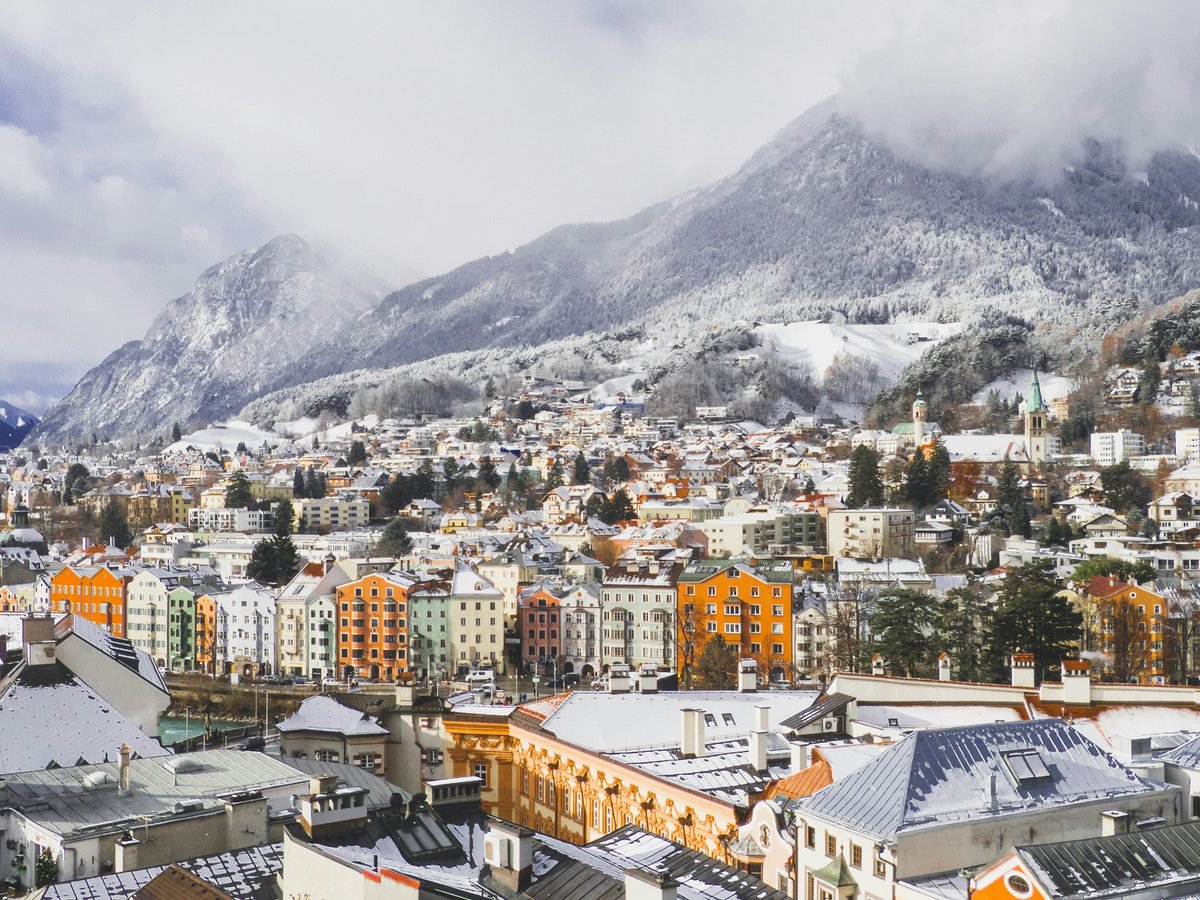
That said, May has a quality the summer crowds never see. The Nordkette peaks above the Altstadt still carry thick snow cover while the valley floor below runs deep green. The contrast is startling. You'll stand on Maria-Theresien-Straße and look up at what feels like two seasons stacked on top of each other. Hotel rates in Wilten and Pradl tend to drop 20-30% below their July-August levels. The Nordkettenbahn cable car queue at the Congress station takes 5 minutes instead of 40. Innsbruck, at 130,000 residents, is a small city, and in May it feels like one.
If rain doesn't rattle you and you can shift plans around afternoon storms, May is honest value. If you need guaranteed sunshine for multi-day hiking or outdoor photography, wait until September or October when the Nordkette trails are clear and rainfall drops to under 80mm.
Why visit in May
- Shoulder season pricing. Hotels in central Innsbruck typically run 20-30% below their July-August rates, and you'll rarely need reservations at restaurants in the Altstadt.
- The Nordkette range still carries heavy snow above 2,000 meters while the Inn Valley floor is bright green. This snow-and-spring contrast reaches its peak in May and largely disappears by early July.
- The Hofgarten hits peak spring bloom with magnolias, rhododendrons, and tulips through mid-May, filling the air with a sweetness you won't find in the drier autumn months.
- Three public holidays in May 2026 (Tag der Arbeit on the 1st, Christi Himmelfahrt on the 14th, Pfingstmontag on the 25th) create long weekends. Locals leave town, and the city gets even quieter.
Worth knowing
- At 176mm over 21 days, May is Innsbruck's wettest month. Afternoon thunderstorms are common and can be fierce, with hail and sudden temperature drops of 10°C in the mountains.
- Higher-elevation hiking trails above roughly 1,800 meters remain snow-covered or icy. The popular Goetheweg ridge trail on the Nordkette usually doesn't fully open until mid-June.
- The three public holidays mean shops, banks, and the Markthalle close entirely on those days. Even some restaurants run limited menus or shut for the long weekends.
Best for
Think twice if
May brings Innsbruck's heaviest rainfall of the year at 176mm across roughly 21 days. Mornings often start clear with cool, crisp air, then clouds build over the Nordkette by early afternoon and break into short, sometimes fierce thunderstorms. You can smell the ozone and wet limestone before they hit. Temperatures feel pleasant in the sun at 19°C (66°F), but the 9°C (48°F) evenings still carry a proper alpine bite, especially in the shade along the Inn River where cold air pools. Humidity sits around 75%, and you'll notice it when the sun breaks through after a storm and the cobblestones in the Altstadt start steaming.
Seasonal caution
- Afternoon thunderstorms in the Alps can produce lightning, hail, and sudden temperature drops of 10°C or more within minutes. If you're on the Nordkette or any exposed ridge and see clouds building above the peaks, descend before the storm arrives. Lightning above the tree line is a genuine safety concern.
- The Hafelekar summit at 2,334 meters can see below-freezing conditions and near-zero visibility even when the valley floor is a comfortable 19°C. Trails above 1,800 meters may still have compacted snow and ice patches that require microspikes or crampons.
Year-round climate
Averages from the last 5 years.
| Month | Avg high (°C) | Avg low (°C) | Rainfall (mm) |
|---|---|---|---|
| Jan | 6 | -3 | 73 |
| Feb | 9 | -1 | 59 |
| Mar | 12 | 2 | 89 |
| Apr | 15 | 4 | 89 |
| May | 19 | 9 | 176 |
| Jun | 26 | 14 | 146 |
| Jul | 26 | 15 | 162 |
| Aug | 26 | 15 | 143 |
| Sep | 22 | 11 | 142 |
| Oct | 18 | 8 | 78 |
| Nov | 11 | 1 | 100 |
| Dec | 7 | -1 | 78 |
Holidays and festivals in May
Public holidays
- Saint Florian's Day(Florianitag)4 May 2027
- Ascension Day(Christi Himmelfahrt)6 May 2027
- Pentecost(Pfingstsonntag)16 May 2027
- Whit Monday(Pfingstmontag)17 May 2027
- Corpus Christi(Fronleichnam)27 May 2027
Best things to do in May
Nordkettenbahn to Hafelekar Summit
sightseeingRide the Hungerburgbahn funicular and two cable cars from the Congress station in the city center at 574 meters to the Hafelekar summit at 2,334 meters. The whole ascent takes about 20 minutes. At the top in May, you'll likely be standing in winter conditions with snow underfoot and biting wind, while the green valley floor spreads out 1,760 meters below. The Seegrube station at 1,905 meters has a panoramic terrace and restaurant where you can sit with a coffee and watch the clouds form below you.
The snow line sits well below the summit in May, creating the most dramatic valley-to-peak seasonal contrast of the year. By July the snow recedes above 2,500 meters and the effect fades considerably.Booking tipBuy tickets online at the Nordkettenbahn site to skip the queue at the Congress station. Weekday mornings before 10am have the shortest waits and the clearest visibility before afternoon clouds build.
Spring hike on the Zirbenweg (Stone Pine Trail)
hikingThis 6km trail at about 2,000 meters near the Patscherkofel connects Patscherkofel with Tulfes through one of Europe's oldest stone pine forests. The trees are gnarled and aromatic, some over 300 years old, and the trail offers wide views across the Inntal valley. The scent of pine resin warms in the morning sun and hits you in waves. The ground is soft with needles.
The lower sections of this trail typically open by mid-May while higher Nordkette routes remain closed. Stone pines release their strongest resin scent as temperatures rise in spring. By summer the trail gets busy with day-hikers from Innsbruck.Booking tipTake the Patscherkofelbahn gondola from Igls, about 15 minutes south of the city center by bus. Check the Patscherkofelbahn website for spring opening dates, as the gondola sometimes delays its seasonal restart after heavy late snow.
Hofgarten spring walk
natureThe Imperial Garden sits below the Nordkette at the edge of Saggen, a 10-minute walk from the Goldenes Dachl. In May it fills with magnolia blooms, banks of rhododendrons in pink and white, and formal tulip beds planted in late autumn. The garden's 500-year-old plane trees leaf out dramatically, their canopy creating dappled shade over the gravel paths. Birdsong is loud here in the early morning, before the city noise picks up.
Peak bloom for the Hofgarten's 4 magnolia varieties and extensive tulip beds falls in May. By June the magnolias are finished and the tulips have been pulled. Early May mornings after rain bring out the strongest scent from the wet soil and opening flowers.Markthalle Innsbruck food tour
foodThe indoor market hall on Innrain street in the Mariahilf quarter hosts about 40 vendors selling Tyrolean cheese, speck, fresh bread, produce, and prepared food. The atmosphere is functional rather than touristy. Vendors call out greetings in Tyrolean dialect. The cheese counter alone might keep you occupied for 20 minutes, with samples of Bergkäse ranging from 3-week to 18-month aged.
White asparagus season peaks in May. Several vendors run Spargel tasting platters and Bärlauch pesto samples only during Spargelzeit, roughly late April through mid-June. The Saturday Bauernmarkt extension brings additional seasonal producers.Booking tipArrive before 9am on Saturday for the best Bauernmarkt selection. The Markthalle closes entirely on the three May public holidays (1st, 14th, 25th in 2026).
Bergisel Schanze panorama
sightseeingZaha Hadid's 2002 Olympic ski jump tower stands on the Bergisel hill at 746 meters in the Wilten district, about 3km south of the Altstadt. An elevator and staircase take you to the top, where a 360-degree panorama covers the Inntal valley, the Nordkette range to the north, and the Stubai Alps to the south. The on-site cafe serves coffee and Tyrolean pastries with the view. The surrounding meadows on the north slope of Bergisel are thick with wildflowers by mid-May.
Morning visibility in May tends to be excellent before the afternoon cloud buildup. The wildflower meadows on Bergisel hill peak in May and early June. In summer the panorama competes with haze, and in winter the meadows are under snow.Cycling the Innradweg
outdoorThe paved cycling path follows the Inn River through the city and extends east toward Hall in Tirol, about 10km away, and west into the Inntal valley. The path is flat and well-maintained, suitable for casual cyclists. You pass through St. Nikolaus on the north bank, where cafe terraces spill onto the riverside, and the sound of the fast-moving Inn is a constant companion.
The path is fully clear of winter ice by May, and river levels are high with snowmelt, making the ride along the water more dramatic. Summer crowds haven't arrived, so you won't be dodging joggers and families every 50 meters.Booking tipRent bikes from stands near Innsbruck Hauptbahnhof. The city's bike-sharing system (Stadtrad) has stations throughout the center.
Day trip to Hall in Tirol
day tripThis medieval salt-trading town sits 10km east of Innsbruck, reachable in 12 minutes by train from Innsbruck Hauptbahnhof. Its Altstadt is remarkably intact, with the Burg Hasegg where the first Taler coins were struck in 1486 (the word 'dollar' descends from Taler). The Oberer Stadtplatz is compact and quiet, ringed by pastel-painted merchant houses. The Stiftskirche has an understated Gothic interior worth 15 minutes.
The Saturday Bauernmarkt in Hall's Oberer Stadtplatz runs its spring program with local Inntal producers selling Spargel, fresh dairy, and Tyrolean honey. May's shoulder-season calm means you might have the Burg Hasegg's mint museum nearly to yourself.Booking tipThe train from Innsbruck Hauptbahnhof costs under 5 EUR one way. Trains run every 15-30 minutes. Hall is small enough to cover on foot in 3-4 hours.
Alpenzoo spring visit
natureEurope's highest-elevation zoo at 750 meters sits on the Nordkette slope in the Hötting district, reachable by the Hungerburgbahn funicular or a steep 20-minute walk from the Inn bridge. The zoo focuses on alpine species. About 150 species live here, including ibex, chamois, brown bears, and bearded vultures. The enclosures are built into the hillside, so you climb as you visit.
Spring means active animals after winter dormancy and new births, particularly among the ibex and chamois. The bearded vultures are typically nesting. Young alpine marmots start appearing in their outdoor enclosure by mid-May, and their alarm whistles are unmistakable.Booking tipCombine with a Nordkettenbahn ticket for a discount. Visit on a weekday morning when school groups are less likely.
What to eat in May
In season: fruit
Erdbeeren (Tyrolean strawberries)
Local strawberries from the Inntal valley start appearing at the Saturday Bauernmarkt in late May. They're smaller and more fragrant than supermarket imports, with a sweetness that comes from the alpine temperature swings between warm days and cool nights.
On menus now
Holunderblütenküchle (fried elderflower fritters)
Elderflower blooms along the Inn River banks from mid-May. Tyrolean kitchens dip full flower heads in a light beer batter and fry them until golden. Served warm with a dusting of powdered sugar, they smell like honey and taste faintly of muscat grape. A Gasthaus tradition, not a tourist novelty.
What to drink
Holunderblütensirup-Spritzer
Elderflower syrup mixed with sparkling water or Prosecco. Cafe terraces along the Innpromenade in St. Nikolaus start serving it as soon as the first blooms appear in mid-May. The syrup is made fresh by many Gasthäuser from foraged flowers. Tastes like floral lemonade with a honeyed finish.
In markets
Spargel (white asparagus)
May is peak Spargelzeit in Tyrol. Restaurants across the Altstadt and in Wilten run dedicated Spargelkarte menus with cream soup, grilled spears with Hollandaise, and Spargel-Schinken-Flammkuchen. Austrian white asparagus tends to be shorter and slightly sweeter than German varieties. Look for it at the Saturday Bauernmarkt in the Markthalle before 9am.
Bärlauch (wild garlic)
The last 2-3 weeks of wild garlic season. You'll smell it before you see it, a sharp, garlicky scent rising from shaded spots along the Inn River banks and at the edges of the Hofgarten. Market vendors sell fresh bundles and Bärlauch pesto. By early June it's gone.
Tiroler Bergkäse (spring alpine cheese)
Spring milk from cows newly on fresh grass produces a sweeter, more floral alpine cheese than the winter batches. The Markthalle vendors sell it in various ages, from a few weeks to 12 months. The young spring Bergkäse has a soft, almost buttery texture that's noticeably different from the harder autumn wheels.
Regular events in May
Tag der Arbeit (Labour Day)Free
Public holiday on 1 May with open-air concerts and political gatherings along the Innpromenade and in the Altstadt. Most shops, banks, and the Markthalle close entirely. Restaurants vary, so check ahead.
1 MayChristi Himmelfahrt (Ascension Day)Free
Public holiday 40 days after Easter. In 2026 this falls on 14 May. Special masses at the Dom zu St. Jakob and the Stiftskirche Wilten. Many Austrians take a 4-day weekend, so domestic tourists appear but the city itself can feel quieter as locals leave.
Mid-May (varies with Easter; 14 May in 2026)Pfingstmontag (Whit Monday)Free
Public holiday falling 50 days after Easter. In 2026 this lands on 25 May. Some restaurants close, others run holiday menus. Occasional free public events in the Hofgarten. A third long weekend in the same month, which is unusual.
Late May (varies with Easter; 25 May in 2026)Saturday Bauernmarkt at MarkthalleFree
Weekly farmers' market with Tyrolean producers selling seasonal produce, aged Bergkäse, fresh bread, speck, and baked goods. The May editions feature Spargel, Bärlauch, and early Erdbeeren from the Inntal valley. Runs year-round but spring is the most aromatic season.
Every Saturday morning, roughly 7am to 1pmBest places this May
Hofgarten
parkThe Imperial Garden fills with magnolia, rhododendron, and tulip blooms through May. Ancient plane trees leaf out into a green canopy. The Renaissance music pavilion occasionally hosts small spring concerts. Free entry, open dawn to dusk.
SaggenNordkette (Seegrube and Hafelekar stations)
mountainThe mountain range directly above the city. The Seegrube station at 1,905 meters has a panoramic terrace with coffee service and views over the entire Inntal. Hafelekar at 2,334 meters is still winter in May. The snow-capped ridgeline viewed from below is the defining image of Innsbruck.
Above HöttingMarkthalle Innsbruck
marketIndoor market hall on Innrain with about 40 vendors. In May, the Spargel and Bärlauch stalls dominate. Closes on the three public holidays, so plan around those dates. The ground floor food stands serve Tyrolean lunches for under 12 EUR.
MariahilfAltstadt (Goldenes Dachl and Dom zu St. Jakob)
historic districtThe Goldenes Dachl, the Hofburg, and the Dom zu St. Jakob sit within 200 meters of each other. May's lower foot traffic means you can photograph the Goldenes Dachl's 2,657 gilded copper tiles without 40 tourists in frame. The Dom's Cranach painting of Mary is worth seeking out.
AltstadtBergisel and surroundings
viewpointThe hill south of the city center holds Zaha Hadid's ski jump, the Tirol Panorama museum (housing a massive 1809 battle panorama painting), and wildflower meadows that peak in May. Worth 2-3 hours combined.
WiltenAlpenzoo
zooAlpine species zoo at 750 meters on the Nordkette slope. Spring births among the ibex, chamois, and marmots make May one of the best months to visit. The walk up from the Inn bridge is steep but takes only 20 minutes through a wooded hillside.
HöttingStiftskirche Wilten
churchBaroque abbey church in Wilten with one of Tyrol's most ornate Rococo interiors. Less visited than the Dom zu St. Jakob but arguably more visually striking. The ceiling frescoes by Matthäus Günther date to the 1750s. The organ is from 1755. Free entry.
WiltenInnpromenade along St. Nikolaus
riverside walkThe riverside walk through the St. Nikolaus quarter on the north bank of the Inn has good sightlines to the Altstadt's coloured facades. Cafe terraces open their outdoor seating in May, and the sound of the fast-flowing Inn mixes with clinking glasses. The morning light on the painted house fronts is best from this side.
St. Nikolaus
Your packing checklist
Tick items off as you pack. Your progress saves in this browser.
All packed — have a great trip.
Insider tips
The Saturday Bauernmarkt at the Markthalle opens at 7am. By 9am the best Spargel is picked over and the Bärlauch bundles are gone. Locals who care about produce arrive before 8. The weekday market is calmer but has fewer seasonal vendors.
When afternoon clouds build over the Nordkette ridge (you'll see them stacking above the peaks around 1pm), you have roughly 60-90 minutes before the storm hits the valley floor. Locals use this as their weather clock. If you see dark buildup at noon, cancel any exposed-ridge plans.
For Spargel done properly, look for restaurants in Wilten and Pradl rather than the tourist-facing places on Herzog-Friedrich-Straße. You'll pay less, portions tend to be more generous, and the preparation is more traditional.
The Innsbruck Card covers public transport including the Nordkettenbahn, entry to most museums, and the Alpenzoo. The 48-hour version typically pays for itself if you do the Nordkette ride and 2 museum visits. Sold at the Tourismus Innsbruck office on Burggraben and at most hotel front desks.
The best free viewpoint in the city is the Stadtturm (city tower) terrace in the Altstadt on a clear May morning, before clouds build. It's not free, but at a few euros it's a fraction of the Nordkettenbahn price and gives a rooftop perspective over the coloured facades with the Nordkette behind.
Avoid these mistakes
- Planning a full day of hiking above 1,800 meters in May. The trails are still snow-covered, potentially icy, and afternoon storms make exposed ridges dangerous. A visitor in hiking gear heading for the Goetheweg in mid-May will likely turn back within 30 minutes. Stick to valley trails and Mittelgebirge paths until mid-June.
- Not checking for public holiday closures before heading out. May 2026 has three public holidays (1st, 14th, 25th). The Markthalle, most shops, and some smaller museums close entirely. Even restaurants may shut or run limited menus. Walking across town to find a locked door wastes an hour.
- Packing only for spring warmth and being caught out at altitude. The valley floor at 574 meters and the Hafelekar summit at 2,334 meters are two different seasons separated by a 20-minute cable car ride. Visitors in T-shirts at the top are miserable. Bring winter-capable layers if you're going above the tree line.
- Spending all your time in the Altstadt and missing the north-bank neighborhoods. St. Nikolaus and Mariahilf have the better cafe terraces, the Markthalle, and a more residential feel that gives you a sense of how the city works beyond the tourist spine of Maria-Theresien-Straße.
Practical tips for May
May 2026 has three public holidays, which is unusual. Tag der Arbeit falls on the 1st, Christi Himmelfahrt on the 14th, and Pfingstmontag on the 25th. Shops, banks, and the Markthalle close on all three. Book restaurant tables ahead for these dates, particularly around the 14th when many Austrians take a 4-day weekend. The Innsbruck Card is sold at the Tourismus Innsbruck office on Burggraben and at most hotel front desks. Public transport (IVB buses and tram) runs a Sunday schedule on all public holidays, which means reduced frequency, so check departure times. The Nordkettenbahn typically operates daily from early May onward, but check their site for weather closures after heavy storms. Dress in layers you can strip off. A clear 19°C morning at the Goldenes Dachl can turn into a 9°C rainy afternoon within 2 hours. If you're hiring a car, note that the Altstadt is largely pedestrianised and parking garages charge around 2-3 EUR per hour. The Marktplatz Garage near the Markthalle is the most central option. For tipping, rounding up or adding 5-10% at restaurants is standard practice in Tyrol, not the 15-20% North American visitors might expect.
FAQ
Is May a good time to visit Innsbruck?
May is a solid but imperfect month for Innsbruck. The temperatures are comfortable at 19°C (66°F) and the snow-capped mountain scenery is at its most dramatic contrast with the green valley floor. But it's also the wettest month of the year, with 176mm of rain across 21 days, and higher hiking trails above 1,800 meters remain closed. If you prefer museums, Tyrolean food, lower-altitude walks, and spring blooms over serious alpine hiking, and you can handle afternoon thunderstorms, May offers good value and low crowds. For reliable sunshine and full trail access, September or October are stronger picks.
What is the weather like in Innsbruck in May?
Expect daytime highs around 19°C (66°F) and nighttime lows near 9°C (48°F). It rains on roughly 21 of 31 days, usually as afternoon thunderstorms that build over the Nordkette and pass within 30-45 minutes. Mornings are often clear and cool. Humidity sits at about 75%. At the Hafelekar summit (2,334 meters), temperatures can drop below freezing even when the valley floor is warm and sunny.
Is Innsbruck crowded in May?
Not particularly. May falls between ski season (December through March) and summer hiking season (June through September), so it's firmly shoulder season. Hotel occupancy tends to be moderate, and you can walk the Altstadt without the shoulder-to-shoulder density of July and August. The three public holidays bring some domestic Austrian tourism on the long weekends, but nothing comparable to peak months.
Can I hike in Innsbruck in May?
You can hike lower-elevation trails in the Inn Valley and Mittelgebirge paths below about 1,800 meters. The Zirbenweg near Patscherkofel typically opens by mid-May. Higher routes like the Goetheweg on the Nordkette ridge usually remain snow-covered and potentially icy until mid-June. Always check current trail conditions at the Tourismus Innsbruck office on Burggraben before heading out. Mountain rescue call-outs for ill-prepared hikers on closed trails are not uncommon in May.
What should I pack for Innsbruck in May?
A proper waterproof jacket is the single most important item for May. Bring layers for a daily temperature range of 9-19°C (48-66°F), including a mid-weight fleece for evenings. If you're taking the Nordkettenbahn above the snow line at 2,000 meters, pack gloves, a warm hat, and UV-blocking sunglasses for the snow glare. Sturdy shoes with grip are essential for wet cobblestones in the Altstadt and muddy lower trails.
Find a flight to Innsbruck
Live fares to Innsbruck appear here once cookies are accepted.
Last verified by automated review (v1.7.2) on . What is automated review?