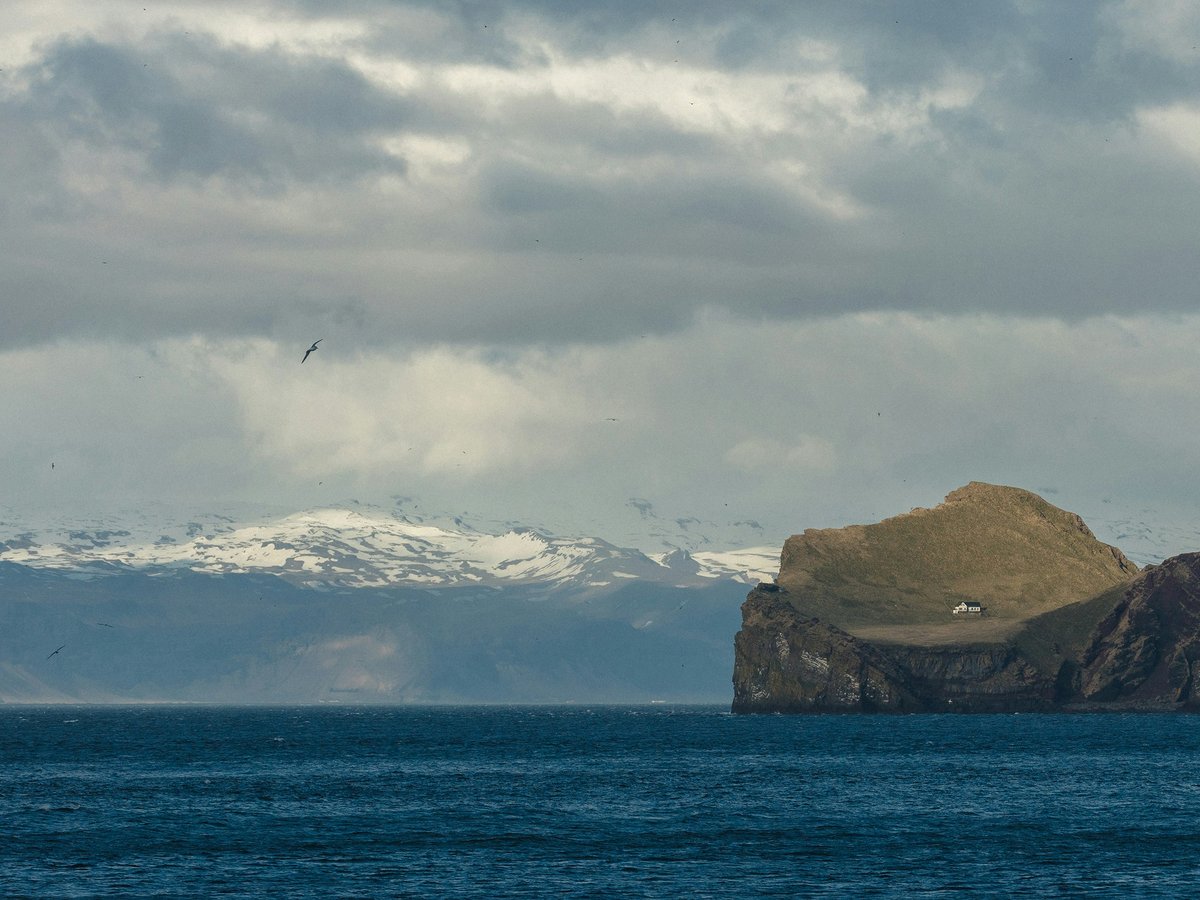
Stay in Vestmannaeyjar in October
7 hotels in the Trip.com pool for Vestmannaeyjar, from US$70 a night.
Opens Trip.com on Fri 2 Oct to Sun 4 Oct 2026; change the dates there.
October in Vestmannaeyjar means one thing above all else. The puffins are gone. The massive Atlantic puffin colony that nests across the Westman Islands from April through August has migrated out to open ocean, and the tourists who came for them have left too. Heimaey, the only inhabited island in the archipelago, settles into its year-round rhythm of roughly 4,500 residents, fishing boats, and wind. Expect daytime highs around 8.4°C (47°F) and lows near 5.8°C (42°F), with rain falling on about 18 of the 31 days.
That said, October has a raw appeal that works for a specific kind of traveler. The northern lights become reliably visible over the archipelago, the Eldheimar volcano museum has no queues, and the town's geothermal swimming pool, Sundlaug Vestmannaeyja, becomes the social center it has always been for locals. You can walk through the old Skansinn fortress area and across the Bæjarhraun lava field without seeing another tourist. The landscape, all dark volcanic rock and autumn-browned grass against grey Atlantic swells, looks its most dramatic in October's moody, low-angled light.
To be fair, though, this is not an easy month. Wind gusts regularly top 80 km/h (50 mph) on exposed headlands like Stórhöfði, and the Herjólfur ferry from Landeyjahöfn gets cancelled often enough that you should build buffer days into any itinerary. Daylight drops from roughly 11 hours at the start of October to under 9 by month's end. If you need sunshine, calm seas, or puffins, October is the wrong month for Vestmannaeyjar.
Why visit in October
- Northern lights season begins in earnest, and Heimaey's low light pollution plus unobstructed ocean horizons make Stórhöfði one of Iceland's better viewing points.
- Off-season pricing drops guesthouse rates 30-40% from summer highs on Heimaey, and the Herjólfur ferry has open slots even on short notice.
- Zero crowds at Eldheimar, Sæheimar, and Eldfell. In summer, tour groups from Reykjavik fill these sites by mid-morning. In October you'll likely have them to yourself.
- The volcanic landscape looks its most photogenic in moody October light. Low clouds threading between Eldfell and Helgafell at dawn create conditions landscape photographers travel for.
Worth knowing
- Wind is relentless. Stórhöfði, one of Europe's windiest recorded points, frequently sees gusts above 90 km/h (56 mph) in October. Even the town center gets hammered.
- Rain falls on roughly 18 days, totaling 146mm (5.7 inches). Extended dry stretches are rare.
- The Herjólfur ferry from Landeyjahöfn cancels several times per month due to weather. If the backup Þorlákshöfn route runs, it adds about 2 hours each way.
- Daylight shrinks noticeably across the month. By October 31, sunrise is after 09:00 and sunset before 17:30, leaving a narrow window for outdoor activities.
Best for
Think twice if
October on the Westman Islands feels like the North Atlantic announcing winter. Temperatures stay above freezing but the wind-chill factor regularly shaves 5-8°C off the perceived temperature, so an 8°C afternoon can feel like 2°C on exposed ridgelines. Rain arrives in sideways bursts rather than steady downpours, often mixed with salt spray near the coast. Fog can settle over Heimaey for a full day, then lift within 20 minutes. The weather changes so fast that you might experience sun, rain, hail, and wind in a single 3-hour hike up Eldfell.
Seasonal caution
- Sustained winds above 60 km/h (37 mph) are common, with gusts exceeding 100 km/h (62 mph) on exposed areas like Stórhöfði. Walking on cliff edges in these conditions is genuinely dangerous.
- The Herjólfur ferry cancels multiple times per month due to sea conditions. Build at least 1 buffer day into your itinerary to avoid being stranded or missing flights from Keflavik.
- Daylight drops from about 11 hours on October 1 to under 9 hours by October 31. Plan outdoor activities for the 10:00 to 16:00 window.
- Hypothermia risk is real if you get wet and wind-exposed on a long hike. Wind-chill can push the perceived temperature below 0°C (32°F) even when the air temperature is 6-8°C.
Year-round climate
Averages from the last 5 years.
| Month | Avg high (°C) | Avg low (°C) | Rainfall (mm) |
|---|---|---|---|
| Jan | 5 | 1 | 154 |
| Feb | 6 | 3 | 185 |
| Mar | 5 | 3 | 139 |
| Apr | 7 | 4 | 110 |
| May | 8 | 7 | 109 |
| Jun | 10 | 8 | 97 |
| Jul | 12 | 11 | 90 |
| Aug | 12 | 11 | 120 |
| Sep | 11 | 9 | 163 |
| Oct | 8 | 6 | 146 |
| Nov | 7 | 4 | 163 |
| Dec | 5 | 2 | 154 |
Best things to do in October
Northern lights viewing from Stórhöfði
natureThe Stórhöfði peninsula on Heimaey's southern tip offers 270 degrees of unobstructed horizon over the open Atlantic, with zero light pollution to the south. On clear nights, the aurora can reflect off the ocean surface, an effect you rarely get from mainland Iceland's inland locations.
October is the first month with reliably dark skies long enough for aurora viewing. Earlier months have too much twilight, and later months are colder with harsher conditions for standing outside.Booking tipNo booking needed. Drive or walk to the Stórhöfði weather station parking area. Check vedur.is for cloud cover forecasts and the Icelandic Met Office aurora forecast before heading out.
Hiking Eldfell volcano
hikingThe 200m (660 ft) cinder cone that erupted in January 1973 sits right at the edge of town. The 45-minute trail to the summit crosses reddish-black volcanic scree, and the ground near the top still radiates warmth in places. On a clear day the view extends to Surtsey, the island born from a 1963 eruption 20 km (12 miles) to the southwest.
October's low-angle light and frequent cloud breaks create dramatic conditions on the red-and-black volcanic slopes. Summer crowds are gone, so you'll likely summit alone.Booking tipNo booking required. Start from the trailhead near the eastern edge of Bæjarhraun. Allow 2 hours round-trip with time at the summit. Avoid on days with wind gusts above 70 km/h.
Exploring Eldheimar volcano museum
museumThis museum on Heimaey was built around a house excavated from the 1973 lava and ash. The preserved building sits inside the museum exactly as it was found, buried under 4 meters of tephra. Interactive exhibits cover the eruption's 5-month timeline, the evacuation of 5,300 residents in a single night, and the effort to cool the lava flow with seawater.
October's frequent rain and wind make indoor activities essential. With summer tour groups absent, you can spend 2-3 hours at Eldheimar without being rushed through exhibits.Booking tipOpen year-round. Check current opening hours, as October schedules are sometimes shorter than summer. Allow at least 90 minutes.
Geothermal swimming at Sundlaug Vestmannaeyja
wellnessHeimaey's outdoor geothermal pool stays at 28-30°C (82-86°F) year-round, with hot pots at 38-42°C (100-108°F). In October, sitting in 40°C water while rain and wind lash around you is one of those experiences that makes Iceland feel like Iceland. The pool is where locals socialize, so you'll overhear fishing reports, school gossip, and weather complaints.
The contrast between the hot water and cold, wet October air makes the experience more intense than summer swimming. Locals use the pool more in autumn and winter, so it's the best time to experience it as a social ritual rather than a tourist attraction.Booking tipNo booking needed. Bring your own towel or rent one. Follow Icelandic pool etiquette and shower without a swimsuit before entering.
Walking the 1973 lava field of Bæjarhraun
sightseeingThe eastern third of Heimaey town sits on top of the lava flow from the 1973 Eldfell eruption. Streets end abruptly at walls of solidified lava. In places you can see the outlines of buried houses poking through. The self-guided walk from the edge of town into the raw lava field takes about an hour and covers roughly 3 km (1.9 miles).
October's low autumn light and frequent mist give the lava field an atmospheric quality it lacks in bright summer sunshine. Moss is turning golden-brown on the older sections, adding color to the black basalt.Booking tipNo booking needed. Wear sturdy boots with ankle support. Volcanic rock is sharp and uneven.
Visiting Sæheimar natural history museum
museumA small but well-curated museum on Heimaey focused on the natural history of the Westman Islands. The collection includes taxidermied seabirds, geological specimens from Surtsey and Eldfell, and exhibits on the marine ecosystem around the archipelago. Sæheimar once housed a famous rescued puffin, and the museum's puffin exhibit remains a draw.
With puffins gone from the cliffs until April, Sæheimar is the next best place to learn about them in October. The museum is one of Heimaey's few indoor attractions, making it a good rainy-day option.Booking tipCheck seasonal hours before visiting. October hours are typically shorter than summer.
Storm watching from the harbor breakwater
natureThe Heimaey harbor is one of Iceland's busiest fishing ports, protected by a breakwater partly formed by the 1973 lava flow. When North Atlantic storms hit in October, waves crash against the outer breakwater and send spray 10-15 meters into the air. The inner harbor stays calm, creating a strange contrast of violence and shelter within a few hundred meters.
October storms intensify compared to summer months. Wave heights around the archipelago regularly reach 4-6 meters (13-20 feet), making the breakwater spectacle more dramatic than the relatively calm July-August period.Booking tipFree. Watch from the paved walkway along the inner harbor, not from the breakwater itself. Rogue waves are a real danger on the outer structure.
What to eat in October
On menus now
Kjötsúpa
Traditional Icelandic lamb soup made with root vegetables, herbs, and fresh autumn lamb from the réttir season. October is when this hearty dish peaks, served at most restaurants on Heimaey as the comfort food of choice when the weather turns.
Plokkfiskur
A traditional Icelandic mashed fish stew combining cod or haddock with potatoes, onions, and béchamel. It becomes a staple in October as locals shift to warming winter dishes. Some Heimaey households still make it with the day's fresh catch.
Street food peaks
Harðfiskur
Wind-dried fish, typically haddock, torn into strips and eaten with butter. Available year-round but deeply tied to the fishing culture of Vestmannaeyjar. The autumn batches dry in the cool, windy October air along racks near the harbor.
What to drink
Brennivín
Iceland's signature caraway-flavored schnapps, sometimes called svarti dauði (black death) by locals. October's cold evenings make it a natural companion to seafood dishes. Restaurants on Heimaey serve it as a digestif with dried fish.
In markets
Fresh Atlantic cod
October falls within the prime cod fishing season around the Westman Islands. The local fishing fleet brings in fresh catches daily, and restaurants on Heimaey serve it baked, pan-fried, or as the base for plokkfiskur (mashed fish stew).
Regular events in October
Fyrsti vetrardagur (First Day of Winter)Free
The traditional Icelandic First Day of Winter marks the start of the old Norse winter month Gormánuður. It falls on the Saturday between October 19 and 25. On Heimaey, the day is a public holiday. Schools close, and some local bakeries produce seasonal cream pastries called vetrarbollur (winter buns) for the occasion.
Saturday between October 19-25Dagur íslenskrar tungu (Icelandic Language Day)Free
Observed on October 9 across Iceland, honoring the birthday of 19th-century poet Jónas Hallgrímsson. Heimaey's library and school typically hold readings and small cultural events. It is a public observance rather than a full holiday, but shops and services may close early.
October 9Réttir (Autumn Sheep Roundup)Free
The Westman Islands hold their own small-scale réttir in early October. Sheep that graze on the outer islands are gathered by boat, a tradition unique to the archipelago since there are no roads connecting the grazing islands. On the mainland, réttir involves horses and open valleys. Here it involves dinghies and volcanic islets. The event draws locals and is followed by sorting at the pens near town.
Early October (weather-dependent)Best places this October
Eldheimar
museumThe volcano museum built around a house excavated from the 1973 eruption. The preserved dwelling sits inside under exactly the ash and tephra that buried it. Allow 90 minutes minimum. One of Iceland's best small museums.
BæjarhraunSkansinn
historic siteThe remains of a 15th-century English trading fort on Heimaey's eastern coast, later the site of the 1627 Turkish Raid (Tyrkjaránið) when Barbary pirates captured nearly 250 islanders. The Stafkirkjan replica stave church, a gift from Norway in 2000, stands inside the old fort walls.
SkansinnStórhöfði
viewpointThe wind-battered peninsula at Heimaey's southern tip. In summer it hosts Iceland's most accessible puffin viewing. In October, it becomes a northern lights platform with ocean horizons in three directions. The weather station here recorded one of Europe's highest sustained wind speeds at 220 km/h (137 mph).
StórhöfðiHerjólfsdalur
valleyThe sheltered valley on Heimaey's southwestern side, named after the island's first Norse settler Herjólfur Bárðarson. In August it hosts the Þjóðhátíð festival for 16,000 people. In October it is completely empty, a natural amphitheater ringed by steep grass-covered walls. The walking trail along the rim takes about 40 minutes.
HerjólfsdalurEldfell and Helgafell
volcanoThe two volcanic cones that define Heimaey's skyline. Eldfell (200m / 660 ft) erupted in 1973 and still has warm ground near its summit. Helgafell (226m / 741 ft) last erupted roughly 5,000 years ago. You can hike both in a single 3-hour loop from the edge of town.
BæjarhraunElephant Rock (Fílinn)
natural landmarkA basalt sea cliff on Heimaey's southern coast that bears an uncanny resemblance to an elephant dipping its trunk into the ocean. Best viewed from a boat or from the coastal path below Ófanleitishöfði. In October, the moody sky and crashing waves make the formation more dramatic than in calm summer light.
StórhöfðiStafkirkjan
churchA replica Norse stave church built of Norwegian timber, gifted to Vestmannaeyjar by the Norwegian government in 2000 to mark Iceland's millennium of Christianity. It sits within the old Skansinn fortress walls overlooking the harbor. The dark timber against October's grey sky photographs well.
SkansinnSundlaug Vestmannaeyja
swimming poolThe town's geothermal swimming pool with an outdoor 25m pool at 28-30°C (82-86°F) and several hot pots up to 42°C (108°F). In October this becomes the island's living room, where locals catch up, debate fishing quotas, and complain about the weather. Open year-round.
Town center
Your packing checklist
Tick items off as you pack. Your progress saves in this browser.
All packed — have a great trip.
Insider tips
Check the Herjólfur ferry status on vedur.is the morning of your crossing, not the night before. Conditions in the strait between Landeyjahöfn and Heimaey can change overnight, and cancellations are often announced by 07:00. If you see a westerly gale forecast, have the Þorlákshöfn backup route or a flight booking ready.
Sundlaug Vestmannaeyja is the real social hub of Heimaey, not the cafes or restaurants. Go between 17:00 and 19:00 on a weekday to catch locals unwinding after work. Sit in the hottest pot (usually around 42°C) and you'll end up in conversations that no tour guide can replicate.
The warm ground near Eldfell's summit is not folklore. Dig a few centimeters into the scree at the top and you can feel residual geothermal heat from the 1973 eruption. The eastern side of the crater rim tends to be warmer than the western side.
For northern lights, skip the town and drive or walk 15 minutes south to Stórhöfði. The town's few streetlights are enough to wash out faint aurora. Stórhöfði has no artificial light south of the weather station, giving you a dark-sky horizon over open ocean.
The lava field walking path through Bæjarhraun has no signs or markers. Download an offline map of Heimaey before arriving. Mobile signal is usually fine in town but drops in the lava field's deeper gullies.
Avoid these mistakes
- Arriving at Landeyjahöfn without checking whether the Herjólfur ferry is running that day. The drive from Reykjavik to Landeyjahöfn takes about 2 hours, and there is nothing at the terminal if the ferry is cancelled. Check vedur.is and the ferry schedule the morning of travel.
- Packing for the temperature reading instead of the wind-chill reality. 8°C (47°F) in calm air is fine with a light jacket. 8°C with a 60 km/h (37 mph) wind and rain feels like -3°C (27°F). Dress for winter, not for mild autumn.
- Planning a 1-day visit with no buffer. If the return ferry cancels, you are stuck on Heimaey until the next sailing or the next available flight. Bring enough medication, charging cables, and cash (some smaller shops are cash-only) for an extra unplanned night.
- Walking on the outer harbor breakwater during a storm for dramatic photos. Rogue waves along Vestmannaeyjar's coast can sweep people off exposed rocks. Watch the waves from the inner harbor walkway, where you are protected by the 1973 lava barrier.
Practical tips for October
Book the Herjólfur ferry through the official booking site in advance, but keep your mainland accommodation flexible in case of cancellation. A small prop plane also connects Reykjavik domestic airport to Vestmannaeyjar in about 25 minutes, carrying fewer than 20 passengers per flight, so book early if you want it as a backup. Most guesthouses on Heimaey offer flexible cancellation with 24 hours notice. Restaurants in town tend to close by 20:00 on weekdays in October, so eat early or buy groceries at the supermarket near the harbor for self-catering evenings. Dress in layers with a windproof outer shell every time you leave your accommodation, even for a 5-minute walk. Carry cash as a backup since some smaller shops and the swimming pool may not accept cards reliably during system outages. If you are renting a car on the island, note that Heimaey's roads are mostly paved but narrow, and the gravel road to Stórhöfði can be slippery when wet.
FAQ
Is October a good time to visit Vestmannaeyjar?
It depends on what you're looking for. October is firmly off-season, with cold temperatures around 8°C (47°F), frequent rain, and heavy wind. Puffins left by September, and the Þjóðhátíð festival was in August. That said, October offers northern lights, empty trails, cheap accommodation, and the volcanic landscape at its moodiest. If you actively enjoy wild, storm-lashed North Atlantic islands and don't need sunshine, it can be rewarding. If you want puffins, festivals, or reliable outdoor conditions, visit between June and August instead.
What is the weather like in Vestmannaeyjar in October?
Cold, wet, and windy. The average high is 8.4°C (47°F) and the average low is 5.8°C (42°F), but wind-chill regularly makes it feel 5-8 degrees colder. Rain falls on roughly 18 of 31 days, totaling about 146mm (5.7 inches). Humidity sits around 78%. Wind is the defining feature, with gusts frequently exceeding 80 km/h (50 mph) on exposed headlands. Clear, calm days do happen, maybe 2-3 per month. Pack as if every day will be wet and windy, and treat a sunny day as a bonus.
Can I see puffins in Vestmannaeyjar in October?
No. Atlantic puffins nest on the Westman Islands from roughly April through mid-August. By early September, most adults and juveniles have left the cliffs for the open ocean, where they spend the winter. You will not see puffins on Heimaey or the surrounding islands in October. If puffins are the reason for your trip, aim for late May through mid-August. In October, visit the Sæheimar natural history museum for puffin exhibits instead.
Is the Herjólfur ferry reliable in October?
Mostly, but not entirely. The ferry from Landeyjahöfn to Heimaey runs year-round, but October's weather causes several cancellations per month due to high winds and rough seas. When the Landeyjahöfn route is cancelled, the ferry sometimes runs from Þorlákshöfn instead, which is a longer crossing of about 2.5-3 hours. A small domestic flight from Reykjavik to Vestmannaeyjar also operates and takes about 25 minutes. Build at least 1 buffer day into your itinerary to account for possible disruptions.
Are the northern lights visible from Vestmannaeyjar in October?
Yes, October is one of the first reliable months for aurora viewing over the Westman Islands. You need dark skies and clear weather, which means checking the Icelandic Met Office aurora forecast on vedur.is. The best viewing spot on Heimaey is Stórhöfði, the peninsula at the island's southern tip, which has no artificial light and a wide-open ocean horizon. Aurora activity varies by solar cycle, so some Octobers are better than others. Even on active nights, cloud cover can block the view. Expect maybe 5-8 potential viewing nights per month if the solar conditions cooperate.
Find a flight to Vestmannaeyjar
Live fares to Vestmannaeyjar appear here once cookies are accepted.
Last verified by automated review (v1.7.2) on . What is automated review?