Stay in Vestmannaeyjar in June
7 hotels in the Trip.com pool for Vestmannaeyjar, from US$70 a night.
Opens Trip.com on Fri 4 Jun to Sun 6 Jun 2027; change the dates there.
June on the Westman Islands belongs to the puffins. An estimated 8 to 10 million Atlantic puffins nest across the Vestmannaeyjar archipelago each summer, and June sits squarely in peak nesting season. You'll find them at Stórhöfði, the wind-battered southern peninsula of Heimaey, hunched in pairs outside their burrows while the subarctic light lingers well past midnight. At 63°N, the sun barely dips below the horizon. Expect roughly 22 hours of functional daylight, with a pale twilight filling the gap around 1am.
That said, 'summer' here needs recalibration. Average highs reach 9.9°C (50°F), and lows sit around 8.3°C (47°F). The North Atlantic wind, which hits Stórhöfði at some of the highest sustained speeds recorded in Europe, adds a persistent bite. June brings about 97mm of rain spread across 15 days, usually as sideways drizzle rather than full downpours. The air carries the smell of salt, wet grass, and a faint sulfur note from Eldfell's still-warm 1973 lava. Pack for 10°C and wind, not for Scandinavian summer postcards.
Tourist season is building but hasn't peaked. Þjóðhátíð, the August bonfire festival that fills Herjólfsdalur valley with thousands of Icelanders, is still weeks out. The Herjólfur ferry from Landeyjahöfn on the mainland runs its summer timetable, though wind cancellations happen a few times each month. June also brings two national occasions worth planning around. Sjómannadagurinn (Seamen's Day) falls on the first Sunday, and Þjóðhátíðardagurinn (Icelandic National Day) is June 17. In a fishing town of roughly 4,500 people, both feel genuinely communal rather than staged for visitors.
Why visit in June
- Near-constant daylight with roughly 22 hours of usable light and a soft twilight filling the rest, perfect for all-hours cliff walks and wildlife photography at Stórhöfði.
- Peak Atlantic puffin nesting season on Heimaey, one of the largest puffin colonies on Earth, with reliable sightings from accessible viewing points.
- Fewer tourists than the July-August peak, meaning Eldheimar museum, hiking trails up Eldfell, and the Herjólfur ferry all have more breathing room.
- Sjómannadagurinn (first Sunday of June) and Icelandic National Day (June 17) bring authentic community celebrations that still feel local rather than tourist-packaged.
Worth knowing
- Temperatures hover near 10°C (50°F), and wind chill off the North Atlantic regularly makes it feel closer to 4-5°C (39-41°F), especially on exposed cliff paths.
- The Herjólfur ferry from Landeyjahöfn gets cancelled several times per month due to wind and sea conditions, which can strand you on the island or delay your arrival by a full day.
- Rain falls on roughly 15 of 30 days, usually as persistent mist or drizzle that makes outdoor activities damp even when it never fully pours.
- Dining options are limited compared to Reykjavík. Heimaey has a handful of restaurants, and some operate on reduced hours into early June before full summer schedules kick in.
Best for
Think twice if
June is statistically the third-driest month in Vestmannaeyjar, behind only July (90mm) and April (110mm), but 97mm across 15 rainy days means you'll likely encounter drizzle on most outings. Humidity tends to sit around 83%. The temperature range is narrow, between 8.3°C (47°F) at night and 9.9°C (50°F) during the day, so it never feels warm, even in direct sun. Wind is the defining factor. Stórhöfði regularly records sustained winds above 15 m/s, and even in the sheltered harbor area, a stiff breeze off the water is normal. The combination of damp air, wind, and single-digit temperatures creates a raw, penetrating cold that cotton and fleece alone won't handle. Clear days do happen, and when they do, the volcanic landscape against a pale blue sky and midnight sun glow is striking.
Seasonal caution
- Wind chill regularly drops the perceived temperature to 4-5°C (39-41°F) at exposed sites like Stórhöfði and the Eldfell summit, even when the thermometer reads 10°C. Cliff-edge paths become genuinely hazardous in gusts above 20 m/s.
- Sudden fog banks roll in off the North Atlantic without much warning, reducing visibility on coastal hiking paths and occasionally grounding the small prop planes that connect Heimaey to Reykjavík's domestic airport.
Year-round climate
Averages from the last 5 years.
| Month | Avg high (°C) | Avg low (°C) | Rainfall (mm) |
|---|---|---|---|
| Jan | 5 | 1 | 154 |
| Feb | 6 | 3 | 185 |
| Mar | 5 | 3 | 139 |
| Apr | 7 | 4 | 110 |
| May | 8 | 7 | 109 |
| Jun | 10 | 8 | 97 |
| Jul | 12 | 11 | 90 |
| Aug | 12 | 11 | 120 |
| Sep | 11 | 9 | 163 |
| Oct | 8 | 6 | 146 |
| Nov | 7 | 4 | 163 |
| Dec | 5 | 2 | 154 |
Holidays and festivals in June
Public holidays
- Icelandic National Day(Þjóðhátíðardagurinn)17 June 2027
Headline events
Atlantic Puffin Nesting Season
Late May through mid-August, with June peak nesting activity
An estimated 8 to 10 million Atlantic puffins nest across the Vestmannaeyjar archipelago each summer, and June falls in the heart of the nesting window. Stórhöfði peninsula on Heimaey's southern tip is the most accessible colony, with viewing points where you can watch pairs tend their burrows from a few meters away. This is one of the largest puffin concentrations on Earth and the primary reason most summer visitors come to the Westman Islands. The birds are present from roughly late April through mid-August, but June nesting activity tends to be at its most visible.
Best things to do in June
Puffin watching at Stórhöfði
wildlifeStórhöfði, the southernmost point of Heimaey, hosts one of Iceland's most accessible Atlantic puffin colonies. A short boardwalk trail leads to viewing areas where puffins nest in burrows only a few meters from the path. You'll see them landing with beaks full of sand eels, preening in pairs, and occasionally taking flight in loose formations over the cliff edge. Bring binoculars, but the birds are close enough for a decent phone photo.
June is peak nesting season. Puffins are actively tending burrows and feeding chicks, making them more visible and stationary than during the arrival period in May or the departure in August.Booking tipNo booking needed. The trail is open and free. Visit early morning or late evening for softer light and fewer other visitors, though the near-24-hour daylight means there's no bad time.
Hiking Eldfell volcano
hikingThe 1973 eruption of Eldfell added 2.5 square kilometers of new land to Heimaey and buried 400 homes under lava and ash. The climb to Eldfell's 200-meter summit takes about 30-40 minutes from the trailhead at the edge of town. The ground near the top still radiates noticeable warmth in spots, over 50 years after the eruption. On a clear day, the panorama takes in the full archipelago, the mainland glaciers, and the lava field below.
Snow has melted from the trail by June, and the extended daylight means you can summit at 10pm in golden light with nobody else around.Midnight sun photography on the cliffs
photographyThe summer solstice falls around June 20-21, and Vestmannaeyjar's coastal cliffs offer unobstructed horizons in nearly every direction. The light between 11pm and 2am turns a warm amber-gold, with long shadows across the volcanic rock. Stórhöfði, Skansinn, and the harbor all offer distinct compositions. The puffins are still active during these hours, which makes for wildlife-and-landscape combinations you can't get at any other time of year.
The June solstice delivers the longest light window of the year, with the sun dipping to the horizon but never fully setting. No other month offers this combination of light angle and duration.Exploring Eldheimar museum
museumEldheimar was built around a house excavated from the 1973 volcanic ash, preserved like a Pompeii time capsule. The museum covers the eruption, the evacuation of Heimaey's 5,300 residents in a single night, and the months-long effort to cool the advancing lava with seawater. The excavated house, with its ash-filled rooms and crushed furniture, is genuinely affecting. Audio guides are available in several languages.
June crowds are lighter than July-August, so you can spend time in the excavated house without being shuffled through. The museum's indoor exhibits also provide a welcome break from wind and drizzle.Booking tipNo advance booking typically needed in June. Allow at least 90 minutes.
Boat tour around the archipelago
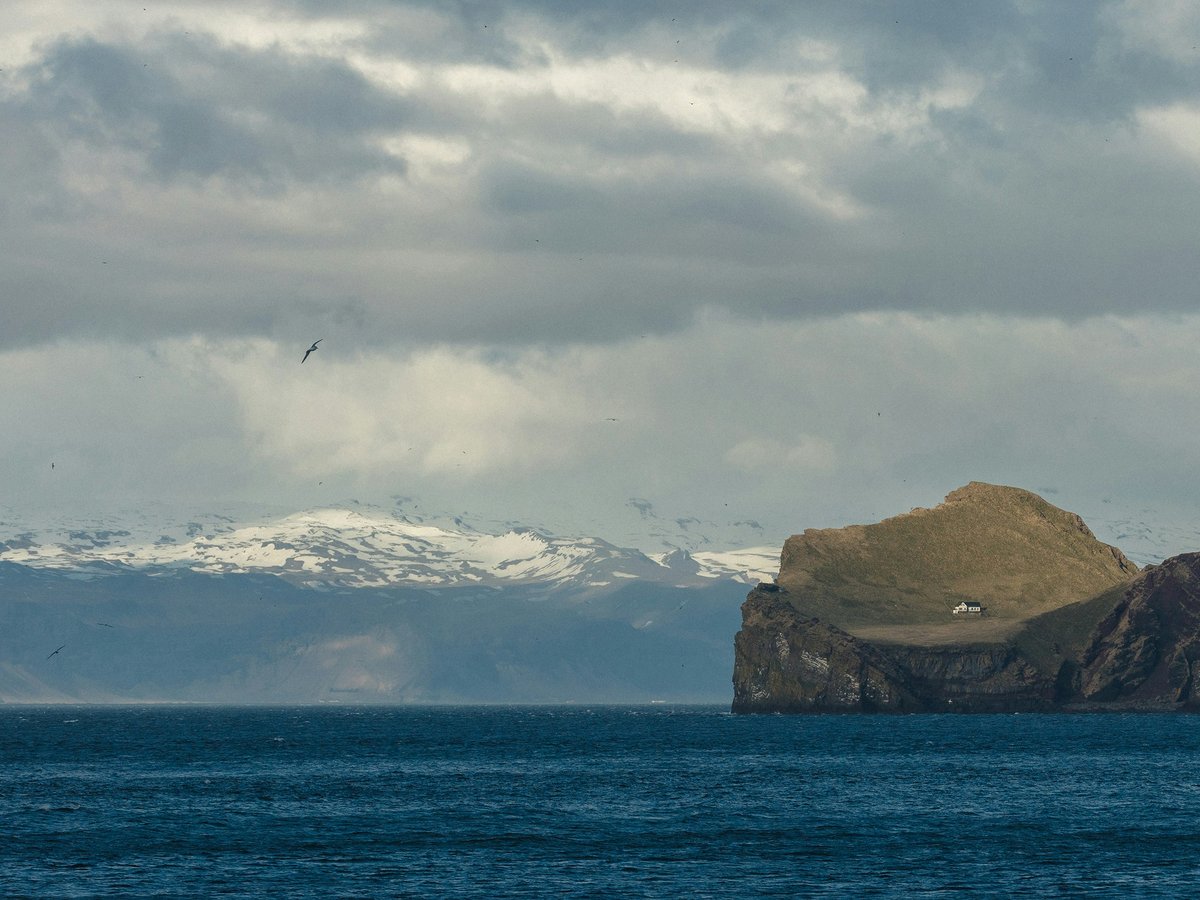
boat tourSeveral operators run circumnavigation tours of Heimaey and the surrounding islets, passing sea caves, basalt columns, and cliff faces covered in nesting seabirds. The boats get close to Bjarnarey, Álsey, and Elliðaey, the famously isolated island with its single white house. You'll see puffins, guillemots, fulmars, and gannets from water level. The spray off the bow is cold.
June's longer daylight hours allow for evening departures, and seabird colonies are at peak nesting activity. Seas tend to be calmer than the autumn-winter months, though 'calm' is relative here.Booking tipBook at least a few days ahead for weekend sailings. Morning tours tend to have slightly calmer conditions than afternoon.
Walking the 1973 lava fields
hikingEast of the town center, the Eldfell lava field is a surreal landscape of black and rust-red rock, slowly being colonized by moss and grass. Marked paths wind through the lava, passing buried streets and the edges of homes that were consumed by the flow. In a few spots near the Eldfell base, you can feel warmth radiating from the ground through your boots. The scale of the destruction is easier to grasp here than in the museum.
Snow and ice clear from the lava-field paths by late May, and June's long daylight lets you explore at a slow pace without watching the clock. The moss cover tends to be vivid green after spring rains.Sprangan cliff rope-swinging
culturalSprangan is a centuries-old Vestmannaeyjar tradition where islanders swing on long ropes across cliff faces, originally to reach bird nests and egg-collection sites. The technique requires launching from a cliff edge, swinging out over the sea, and landing on a narrow ledge. In summer, locals sometimes demonstrate sprangan at the cliffs near Herjólfsdalur. It looks reckless. The skill required is considerable.
Sprangan demonstrations happen during summer months, and the May-June egg-collection season is when the tradition has its historical roots. Sjómannadagurinn celebrations on the first Sunday of June sometimes include sprangan.Booking tipCheck locally for scheduled demonstrations. This isn't a bookable tourist activity but a living tradition you may witness if the timing is right.
What to eat in June
In season: fruit
Rabarbari (rhubarb)
Rhubarb comes into season across Iceland in June, and it shows up in jams (rabarbarasulta), cakes, and skyr-based desserts. The tart, bright flavor pairs well with the rich dairy that Iceland does so well. Look for rhubarb desserts on restaurant menus and at any local bakeries.
On menus now
Fresh-caught Atlantic cod
Heimaey's fishing boats land cod daily at the harbor, and June's calmer seas (relative to winter) mean consistent fresh supply. The difference between harbor-fresh cod and anything transported to the mainland is noticeable, with a cleaner, almost sweet flavor and firmer texture. Several of the island's restaurants serve it pan-fried or baked within hours of landing.
Plokkfiskur
Traditional Icelandic fish stew made with mashed cod or haddock, potatoes, onions, and béchamel. In Vestmannaeyjar, the dish tends to use whatever the morning boats brought in. A warming meal that makes particular sense when June highs still sit below 10°C and you've spent the day in sea spray on the cliff paths.
Lamb soup (kjötsúpa)
Spring lambs head to highland pastures in June, and the traditional lamb soup appears on menus as a seasonal staple. Made with lamb, root vegetables, and fresh Icelandic herbs, it's the kind of simple, hearty bowl you want after a windy morning on Eldfell. The lamb has a distinctive clean, slightly grassy flavor from the free-range grazing.
In markets
Svartfuglsegg (guillemot eggs)
Collected from Heimaey's sea cliffs during the May-June harvest window using the traditional sprangan rope-swinging technique, these large, speckled eggs appear in local kitchens only for a few weeks each year. Rich and slightly gamey, they're typically served hard-boiled. You might spot them offered by locals near the harbor during egg season.
Regular events in June
Sjómannadagurinn (Seamen's Day)Free
Iceland's national celebration of its fishing heritage, held on the first Sunday of June. In Vestmannaeyjar, a town built on fishing, this is a bigger deal than in most of Iceland. Expect swimming competitions in the harbor, rowing races, tugs-of-war, rescue demonstrations by the coast guard, and community gatherings along Hafnarbakki. The events run most of the day.
First Sunday of JuneÞjóðhátíðardagurinn (Icelandic National Day)Free
June 17 marks Iceland's independence from Denmark in 1944. Vestmannaeyjar holds a community parade through Miðbærinn (the town center), with speeches, flag ceremonies, and events for children. Banks and government offices close, but restaurants and tourist sites generally stay open. The atmosphere is festive but low-key compared to Reykjavík's larger celebrations.
June 17Sumarsólstöður (Summer Solstice)Free
The longest day of the year falls around June 20-21, and while there isn't a single organized festival, locals and visitors gather at viewpoints like Stórhöfði and Skansinn to watch the sun skim the horizon without setting. Some guesthouses and tour operators run informal solstice events. The light at this latitude is remarkable, a golden glow that lasts for hours.
Around June 20-21Best places this June
Stórhöfði
nature and wildlifeThe southern tip of Heimaey and one of the windiest measured points in Europe. A short trail leads to puffin-viewing platforms where the birds nest in burrows within arm's reach of the path. The wind here is a physical force. On clear days, the views south across open ocean are immense. A small weather station has operated here since 1921.
StórhöfðiEldheimar
museumThe 'Pompeii of the North' museum, built around a house excavated from the 1973 Eldfell eruption ash. The preserved rooms, still half-filled with volcanic debris, give an unsettling sense of the speed of the evacuation. Multimedia exhibits cover the eruption timeline, the seawater-cooling operation that saved the harbor, and the aftermath. Worth at least 90 minutes.
MiðbærinnEldfell
natural landmarkThe volcano that erupted on January 23, 1973 and reshaped Heimaey. The 200-meter summit is a 30-40 minute hike from the edge of town. Ground heat is still palpable near the top. The crater rim offers a full panorama of the archipelago and, on clear days, the Mýrdalsjökull glacier on the mainland.
EldfellshraunSkansinn and Stafkirkjan
historic siteSkansinn is a grassy promontory on the southeastern edge of town where a 15th-century English trading fort once stood. The site now holds Stafkirkjan, a wooden stave church gifted by Norway in 2000 to mark 1,000 years of Christianity in Iceland. The dark timber church against the sea and the lava cliffs of the 1973 flow is one of the most photographed scenes on the island.
SkansinnHerjólfsdalur
nature and recreationA wide, sheltered valley on Heimaey's western side, ringed by steep green walls. This is where the Þjóðhátíð festival takes place each August, but in June it's quiet, with a campsite, a small golf course, and trails leading up to the valley rim. The acoustics are strange. A shout from the valley floor echoes back clearly off the rock walls.
HerjólfsdalurSæheimar
museumA small natural history museum and aquarium focused on the wildlife of the Vestmannaeyjar archipelago. In June, the exhibits on puffin ecology and the island's volcanic geology pair well with what you'll see outside. The museum has been involved in puffin rehabilitation, and you might see recovering birds during your visit.
MiðbærinnHafnarbakki (the harbor)
harbor and waterfrontHeimaey's working fishing harbor is the heart of the town. Walk along the breakwater to watch trawlers unloading the day's catch, look for the painted cliff faces (locals have painted images of famous Icelanders and fictional characters on the harbor rocks over the years), and check the arrival board for the Herjólfur ferry. The salt and diesel smell of a real fishing port. In June, the harbor hosts Sjómannadagurinn celebrations.
Hafnarbakki
Your packing checklist
Tick items off as you pack. Your progress saves in this browser.
All packed — have a great trip.
Insider tips
The Herjólfur ferry's backup port is Þorlákshöfn, about 2.5 hours further from Reykjavík than Landeyjahöfn. When seas close the closer port, the ferry reroutes without much notice. Build at least a half-day buffer into your mainland connections, especially if you have a flight out of Keflavík to catch.
The painted cliff faces in the harbor are easy to miss if you don't know to look for them. Walk along the inner breakwater at Hafnarbakki and look at the rock walls facing the water. Locals have painted portraits and figures on the basalt over the years. Ask at the harbor about which ones are new.
For puffin watching at Stórhöfði, the late evening hours (around 9-11pm) tend to have the best combination of bird activity and softer wind. The puffins return from fishing runs in waves during the evening, and the midnight sun light at that hour is warmer than midday.
Heimaey's golf course at Herjólfsdalur sits inside a volcanic crater, surrounded by steep green walls. It's a 9-hole course, green fees are modest by Icelandic standards, and you can play past midnight in June's endless daylight. You don't need to be a serious golfer to appreciate the setting.
Avoid these mistakes
- Treating Vestmannaeyjar as a day trip from the mainland. The ferry takes 35 minutes each way when it runs, but cancellations can wipe out half your day. With one overnight, you can hike Eldfell, visit Eldheimar, and spend an evening at Stórhöfði. With a day trip, a single ferry delay means you see the harbor and the inside of the Krónan supermarket.
- Dressing for the temperature reading instead of the wind chill. The thermometer says 10°C (50°F), which sounds mild. But sustained 15 m/s winds with salt spray create effective temperatures near 4°C (39°F). Visitors in fleece jackets and jeans are visibly miserable on the cliff paths by noon.
- Not booking the Herjólfur ferry in advance for summer weekends. The boat has limited vehicle capacity, and June weekends fill up as Icelanders head to the island for Sjómannadagurinn and early summer. Walk-on passengers have better odds, but vehicle reservations should be made at least a week ahead.
Practical tips for June
The Herjólfur ferry from Landeyjahöfn takes about 35 minutes and runs 4-5 departures daily in June. Book through the Herjólfur website rather than showing up at the dock, especially for vehicles. When Landeyjahöfn port closes due to sea conditions, the ferry sometimes reroutes to Þorlákshöfn, which stretches the crossing to roughly 3 hours. Keep your schedule loose enough to absorb a half-day delay.
The airport on Heimaey (Vestmannaeyjaflugvöllur) offers small prop-plane flights from Reykjavík's domestic airport, typically taking 25 minutes. Summer seats fill quickly. Consider booking a flight one direction and the ferry the other as a hedge against cancellations.
Most shops and restaurants in Miðbærinn keep summer hours from June through August, though summer hours on an island of 4,500 people still means limited options after 21:00. The Krónan supermarket near the harbor is the main grocery store. ATMs are available on Vestmannabraut, and nearly everywhere accepts card payment.
Þjóðhátíðardagurinn (National Day) on June 17 is a public holiday. Banks and government offices close. Restaurants and tourist sites typically stay open with normal hours. Sjómannadagurinn on the first Sunday is not an official public holiday, but expect harbor-area businesses to be busy with festivities.
FAQ
Is June a good time to visit Vestmannaeyjar?
June is one of the two best months to visit, ranking second behind July. You get peak puffin nesting season at Stórhöfði, near-24-hour daylight including the summer solstice around June 20-21, and lighter crowds than the July-August peak. The tradeoff is cold. Average highs reach only 9.9°C (50°F), and wind chill makes it feel colder. Rain falls on about 15 days. If you can handle subarctic summer weather and pack properly, June is a strong choice.
What is the weather like in Vestmannaeyjar in June?
Expect daytime highs around 9.9°C (50°F) and overnight lows near 8.3°C (47°F), with humidity around 83%. Rainfall averages 97mm across roughly 15 days, mostly as light drizzle or mist rather than heavy downpours. Wind is the defining condition. Stórhöfði regularly sees sustained winds above 15 m/s, and even the sheltered harbor area gets a steady breeze. Wind chill can drop the perceived temperature to 4-5°C (39-41°F) on exposed paths. Clear, calm days do happen, but count on layering up.
Can you see puffins in Vestmannaeyjar in June?
Yes, and June is arguably the single best month for it. Atlantic puffins are actively nesting and feeding chicks during June, which makes them more visible and stationary than during arrival in late April or departure in August. Stórhöfði on Heimaey's southern tip has boardwalk viewing platforms where you can watch puffins from a few meters away, free of charge, at any hour of the day or night thanks to the midnight sun.
How do you get to Vestmannaeyjar from Reykjavík?
Two options. The Herjólfur ferry departs from Landeyjahöfn, about a 2-hour drive southeast of Reykjavík, and the crossing takes 35 minutes. In summer, 4-5 sailings run daily, but wind and sea conditions cancel crossings several times per month. When Landeyjahöfn closes, the ferry reroutes to Þorlákshöfn, adding about 2.5 hours to the trip. Small propeller aircraft also fly from Reykjavík's domestic airport to Vestmannaeyjaflugvöllur on Heimaey, a 25-minute flight. Booking both options as a contingency is worth considering in June.
Find a flight to Vestmannaeyjar
Live fares to Vestmannaeyjar appear here once cookies are accepted.
Last verified by automated review (v1.7.2) on . What is automated review?