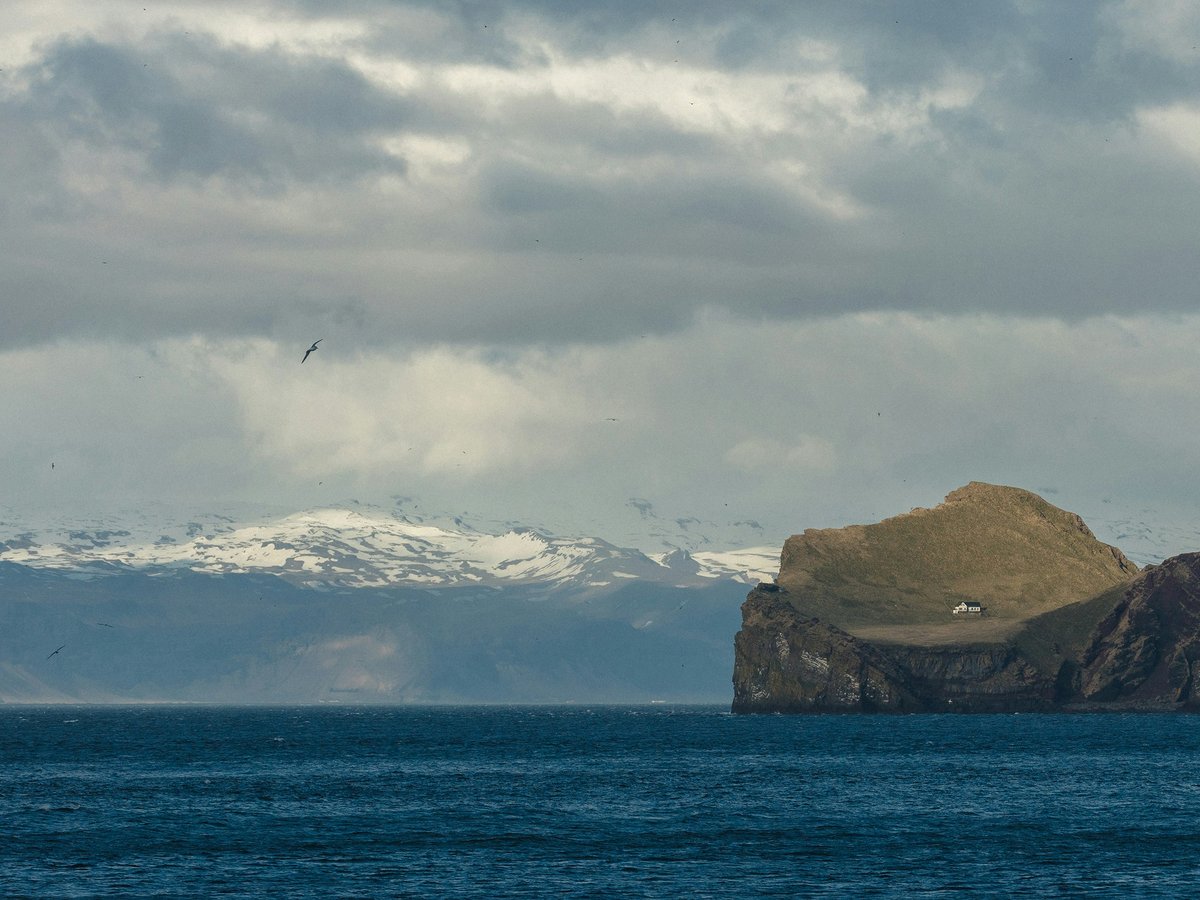
Vestmannaeyjar sits 7.4 kilometers off Iceland's south coast, a volcanic archipelago where the largest island, Heimaey, holds around 4,500 residents, two volcanoes, and one of the North Atlantic's biggest Atlantic puffin colonies within roughly 13 square kilometers. The 1973 Eldfell eruption buried 400 homes under lava and added nearly 2 square kilometers to the island's eastern shore. That landscape is still raw, more than 50 years on. In places the lava field still radiates warmth, and you can feel heat through your boots on the Eldfellshraun trail. The wind is constant here. It carries salt spray and the cries of nesting seabirds off the southern cliffs. What separates Vestmannaeyjar from most Icelandic destinations, which tend to drain a budget fast, is that its defining experiences are all outdoors and all free. You can hike the Eldfell crater rim, watch puffins nesting at arm's length on Stórhöfði, trace the edge where the 1973 lava flow stopped at Skansinn, and walk the full coastal loop of the island without paying a króna. Heimaey is compact enough to cross on foot in about 25 minutes, so there is no reason to spend on transport. The Herjólfur ferry from Landeyjahöfn runs the 30-minute crossing several times daily year-round.
Free attractions
-
Eldfell
The 1973 volcano rises about 200 meters above the town's eastern edge. A trail from the end of Heimagata reaches the crater rim in roughly 20 minutes, where geothermal heat still radiates from the red-black scoria underfoot. On clear days the summit opens a view south toward Surtsey, the island that emerged from the sea in 1963. Some spots near the top run warm enough to melt snow in midwinter. The scoria is loose in places, so sturdy shoes help, but the hike is manageable for anyone with basic fitness.
East HeimaeyVolcano and viewpoint -
Helgafell
The older of Heimaey's two volcanoes, Helgafell last erupted roughly 5,000 years ago. The 226-meter cone sits north of Eldfell and offers a wider panoramic view of the harbor and, on the horizon, the mainland glacier Eyjafjallajökull. A short trail through the lava field connects Eldfell and Helgafell into a combined loop of about 90 minutes. The slopes are grassy and gentle compared to Eldfell's loose scoria. Worth noting, this was the only volcano on the island before 1973.
North of EldfellVolcano and viewpoint -
Stórhöfði
The headland at Heimaey's southern tip is one of the windiest measured spots in Europe, with gusts that regularly exceed 150 km/h in winter. From May through August it becomes one of Iceland's most accessible puffin-watching sites. A wooden observation platform lets you watch Atlantic puffins at close range, often within 3 to 5 meters, without disturbing the nesting burrows below. The automated weather station here has been recording data since 1921. Bring a windproof layer, even in summer.
South HeimaeyNature and viewpoint -
Skansinn
This grassy terrace on Heimaey's eastern shore was fortified by the Danish crown in the 1620s, the same decade Algerian-backed pirates raided the islands in 1627 and captured 242 residents in what locals still call the Tyrkjaránið. The 1973 lava flow stopped right at Skansinn's edge, and you can see the abrupt boundary where black lava meets green turf. Informational panels around the site cover both the pirate raid and the eruption. The Stafkirkjan stave church stands here as well. On a still day the contrast between the manicured grass and the lava wall behind it is striking.
East HeimaeyHistoric site -
Stafkirkjan
Norway donated this replica stave church to Iceland in 2000, marking 1,000 years since the Christianization of Iceland. It sits on the Skansinn grounds and follows the medieval Norwegian stave-church style, with a dark timber exterior and turf-roofed form that look almost ancient against the lava field backdrop. The interior is small and spare, with carved wooden details and a quiet atmosphere. Free to enter.
SkansinnHistoric church -
Landakirkja
Heimaey's main parish church sits on a slight rise near the center of town. The white exterior and simple spire are visible from most of the harbor area. Inside, the wooden pews and modest altar reflect the island's Lutheran tradition. The church is one of the oldest active sites of worship on the island and is free to enter during daylight hours. Mind you, opening times can shift in winter, so try mornings.
Town centerChurch -
Klettsvík
This sheltered bay on Heimaey's northern coast gained international attention in 1998, when the orca Keiko, star of the Free Willy films, was flown here from Oregon for rehabilitation. The sea pen structure where Keiko lived from 1998 to 2002 is still partly visible from the shoreline path. Keiko was released into open water in 2002 and later died off the Norwegian coast in December 2003. The bay itself is a quiet spot for watching harbor seals and eider ducks, and you can walk the full perimeter in about 20 minutes.
North HeimaeyBay and wildlife -
Herjólfsdalur
A broad valley on Heimaey's southwest side, ringed by steep grassy walls that form a natural amphitheater. The valley floor holds a campground, a small golf course, and the stage used for the annual Þjóðhátíð festival each August. That festival is ticketed and sells out, but outside the festival weekend the valley is open, quiet, and free to walk. Trails climb the surrounding ridges for good views back over the harbor. Archaeological remains of a Viking-age farmstead were excavated here, believed to be the homestead of Herjólfur Bárðarson, one of Iceland's earliest settlers.
Southwest HeimaeyValley and park -
Eldfellshraun
The lava field from the 1973 eruption covers roughly 3 square kilometers of Heimaey's eastern side. Several marked paths cross the field, and you pass half-buried houses and twisted lava formations along the way. The terrain looks otherworldly. Black, ropy lava piles in ridges, some of it still noticeably warm to the touch. A few buried structures remain partially visible, their rooflines or walls poking through the rock. At dusk, with the low Icelandic sun casting long shadows across the formations, the field has a strange, quiet quality unlike anywhere else on the island.
East HeimaeyLava field and walking trail
Free activities
-
Sprangan (cliff-edge rope swinging)
Vestmannaeyjar has a long tradition of cliff-swinging called sprangan, where you grab ropes or chains fixed to cliff edges and swing out over the sea below. Several spots around the island's coast have fixed chains for this, and the most accessible site is near Skansinn. It looks terrifying. The locals, especially kids, make it look effortless, launching off rocky ledges and arcing out over the waves. Free and open to anyone bold enough to try. No safety equipment, no instructor, no fee. That said, it demands some upper-body strength and a tolerance for heights.
Various coastal cliffsOutdoor activity -
Puffin watching from the coastal cliffs
From roughly early May to mid-August, Atlantic puffins nest in burrows along Heimaey's southern and western sea cliffs. Stórhöfði has the dedicated viewing platform, but you will also find puffins along the cliffs south of Herjólfsdalur and near the golf course. Bring binoculars if you have them, though at Stórhöfði you can often watch the birds at 3 to 5 meters without any optics. The colony here numbers in the hundreds of thousands. The smell of guano and the low, growling calls of the birds are part of the experience. To be fair, the wind at Stórhöfði can make a summer afternoon feel like February.
South and west HeimaeyWildlife watching -
Heimaey harbor walk
The harbor is the economic heart of the island and one of Iceland's most productive fishing ports. Walk the docks on an early morning and you will catch the fishing boats returning with their hauls. The smell of salt, diesel, and fresh catch is thick in the air. Bright-painted trawlers and smaller vessels line the quays, and in summer you might notice whale-watching boats heading out toward the open Atlantic. A few public benches face the water with views toward the mainland cliffs. The harbor area is also where you will find the town's handful of shops and restaurants, though browsing is free.
Heimaey harborWalking -
Street art and mural walk through town
Heimaey's town center has accumulated a growing collection of murals and public artworks over recent years. Several building walls feature large-scale painted works, some depicting the 1973 eruption and scenes of island life. The pieces tend to rotate and change from year to year, so what is up now might differ from last season. A slow walk through the residential streets east of the harbor turns up painted electrical boxes and smaller works too. No map needed for a town this small.
Town centerArt and walking -
Heimaey coastal rim walk
A roughly 10-kilometer trail follows much of Heimaey's coastline, tracing cliff edges, grassy slopes, and lava fields. The full circuit takes 4 to 5 hours at a moderate pace and passes Stórhöfði, Herjólfsdalur, and the Eldfellshraun lava field. Sections of the trail are exposed to strong wind, particularly along the southern cliffs, so layers are essential. The views shift constantly, from open Atlantic stretches to sheltered green valleys to raw volcanic terrain. On the western side, you pass dramatic sea stacks and cliff-nesting bird colonies. This is likely the single best free experience on the island, and it costs nothing but time and shoe rubber.
Coastal HeimaeyHiking
Free events
-
Puffling Rescue Season
Mid-August to mid-September, nightlyFrom mid-August into September, young puffins leave their cliff burrows at night and become disoriented by Heimaey's town lights, crash-landing on streets, in gardens, and against buildings. Local children and families head out after dark with flashlights and cardboard boxes, gently collecting the pufflings and releasing them from the sea cliffs at dawn. The tradition has been running for decades and is open to anyone who wants to help. Hundreds of pufflings are rescued each season, sometimes over a thousand in a good year. The experience is surreal. Toddlers in pajamas scooping bewildered baby puffins off the pavement at midnight, the whole town participating like it is the most normal thing in the world.
Throughout Heimaey town -
Goslokahátíð (End of Eruption commemoration)
Early July, around July 3A community gathering in early July that marks the anniversary of the end of the 1973 Eldfell eruption. The lava stopped flowing around July 3, 1973, after roughly five months of continuous eruption that displaced the island's entire population. The commemoration typically includes free outdoor gatherings and community events around Skansinn and the harbor area. The mood tends to be more reflective than celebratory, given what the eruption cost Vestmannaeyjar. Many of the older residents still carry direct memories of the evacuation night.
Skansinn and harbor area -
Þjóðhátíðardagurinn (Icelandic National Day)
June 17, annuallyJune 17 marks Iceland's independence from Denmark in 1944, and Vestmannaeyjar holds free public celebrations with parades, speeches, and community gatherings. Children's activities, live music, and traditional Icelandic treats appear in the town center and around the harbor. The atmosphere is relaxed and family-oriented. Heimaey's small size makes the whole event feel intimate compared to the larger Reykjavík celebrations, and the local brass band typically leads the procession through town.
Town center and harbor -
Sumardagurinn fyrsti (First Day of Summer)
A Thursday between April 19 and 25, annuallyIceland's traditional first day of summer falls on a Thursday between April 19 and 25 each year, following the old Norse calendar. Vestmannaeyjar marks the day with free community events, children's activities, and public gatherings. The weather in late April is still firmly winter by most standards on the islands, typically 3 to 7°C with frequent wind. That gap between the name and the reality is part of the charm.
Town center
Museums with Occasional Free Admission
Vestmannaeyjar has two notable museums that normally charge admission but have offered free entry on select occasions. Eldheimar, the volcanic eruption museum, was built directly around a house excavated from the 1973 lava. Regular adult admission currently runs around ISK 2,500 to 3,000 (roughly €16 to 20), but Eldheimar has participated in Safnadagurinn, Iceland's Museum Day, which falls around May 18 each year as part of the international program. On that day, participating museums open their doors free of charge. Byggðasafn Vestmannaeyja, the island's folk and heritage museum, covers fishing heritage, the 1627 Tyrkjaránið pirate raid, and centuries of daily island life. It too has historically participated in the May free-admission day. Both museums are worth the regular price, but if you are timing a visit around free access, aim for the week around May 18 and check the national museum listings for confirmed participating institutions that year. Outside those dates, neither museum currently offers regularly scheduled free hours. Children under a certain age may enter at reduced or free rates at both, though the exact cutoff has shifted over the years, so check current policy before arriving.
Seasonal Guide to Free Activities
Summer, from roughly late May through August, is peak season and offers the widest range of free experiences. Puffins are present on the cliffs from early May to mid-August, with the best viewing in June and July. The coastal rim walk is most comfortable in June through August, when daylight lasts nearly 24 hours and temperatures sit around 8 to 13°C. The puffling rescue runs nightly from mid-August into September. Herjólfsdalur is green and walkable from May onward, though the Þjóðhátíð festival weekend in early August briefly restricts access to parts of the valley. Spring, roughly April and May, is quieter. The First Day of Summer celebration falls in late April, and Museum Day in mid-May. The cliffs are dramatic in spring storms, though the wind can make exposed trails challenging. Winter brings short days, around 4 to 5 hours of daylight in December, and the most severe weather. Eldfell and Helgafell remain climbable in winter, and the geothermal warmth on Eldfell's slopes offers a strange contrast to the cold air. The harbor walk is year-round. You might notice the Northern Lights from the darker areas south of town between September and March, weather permitting.
Practical Tips for Free Exploration
Iceland's tap water is drawn from glacial and spring sources and is among the cleanest in the world. Fill your water bottle at any public tap and skip buying bottled water entirely. The sulfur smell from hot water taps is normal and harmless. Bring windproof and waterproof layers regardless of season. Vestmannaeyjar's weather shifts rapidly. A clear morning can become a horizontal-rain afternoon within an hour. Temperatures rarely drop below minus 5°C in winter or rise above 15°C in summer, but the wind chill is the real factor. No public transport runs on the island, but Heimaey is small enough that walking covers everything. The farthest point from the harbor, Stórhöfði, is about a 60-minute walk. Free public restrooms are available near the harbor and at the Herjólfsdalur campground area. If you are camping, the campground in Herjólfsdalur charges a nightly fee, so it is not a free option, but the day-use walking trails around it cost nothing. The Herjólfur ferry from Landeyjahöfn to Vestmannaeyjar currently costs around ISK 1,650 per adult one way, roughly €11, so the crossing itself is not free, but once you step off the dock nearly everything described in this guide is.
FAQ
Can you see puffins in Vestmannaeyjar without paying for a boat tour?
Yes. From roughly early May to mid-August, Atlantic puffins nest in burrows along the southern and western sea cliffs of Heimaey. The viewing platform at Stórhöfði provides close-range views, often within 3 to 5 meters of nesting birds, without any admission charge. A boat tour gets you closer to colonies on the smaller, inaccessible islands in the archipelago, but for most visitors the free cliff-top viewing at Stórhöfði is more than sufficient. The birds are remarkably unbothered by quiet observers.
Is the Herjólfsdalur valley open to visitors outside the Þjóðhátíð festival?
Yes. Herjólfsdalur is open and free to walk year-round. During the Þjóðhátíð festival weekend in early August, portions of the valley floor are fenced off for the ticketed event and access is restricted. The rest of the year, the valley, its hiking trails up the surrounding ridges, and the archaeological site area are all free and open. The valley is one of the most sheltered spots on the island, so it makes a good walking destination even on windy days.
How long does it take to walk around Heimaey island?
The coastal rim trail covers roughly 10 kilometers and takes 4 to 5 hours at a moderate pace with stops for views and puffin watching. The town itself is compact enough to cross in about 15 minutes on foot. No public transport runs on the island, but distances are short enough that walking is the standard way to get around. The longest walk most visitors make is from the harbor to Stórhöfði, which takes about 60 minutes one way.
Are any museums in Vestmannaeyjar ever free to enter?
The two main museums, Eldheimar (the eruption museum) and Byggðasafn Vestmannaeyja (the heritage museum), normally charge admission. Both have participated in Safnadagurinn, Iceland's Museum Day around May 18, when many institutions across the country open for free. Outside that date, neither offers regularly scheduled free hours, though children may enter at reduced or no cost depending on age. Check current listings before your visit, as participation in the free-admission day is confirmed annually.
Is the tap water safe to drink in Vestmannaeyjar?
Yes. Iceland's tap water is drawn from glacial and spring sources and is consistently rated among the cleanest drinking water in the world. You can refill bottles at any public tap on Heimaey. The hot water taps carry a faint sulfur smell due to the geothermal heating system, which is normal and harmless. There is no need to buy bottled water at any point on the island.
Last verified by automated review (v1.7.2) on . What is automated review?