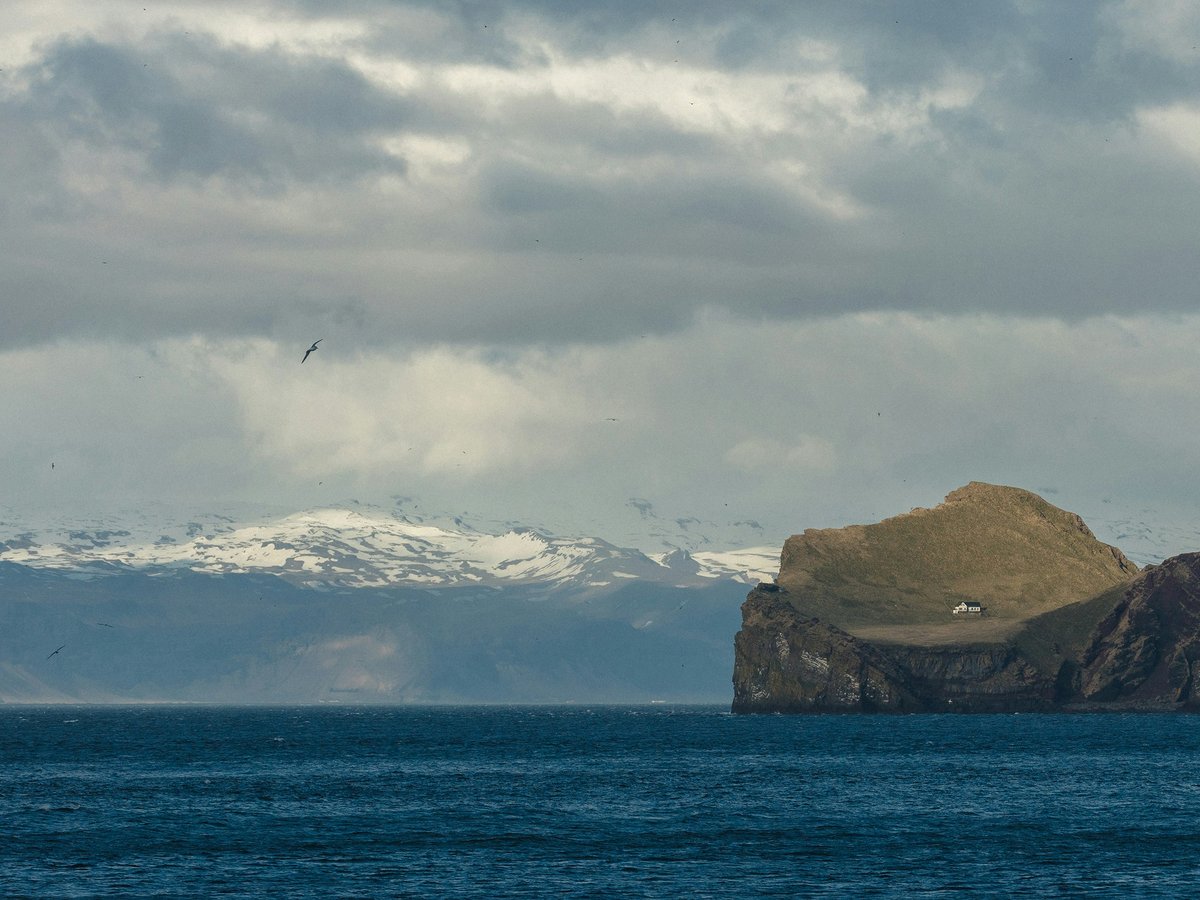
Vestmannaeyjar sits about 7 kilometers off Iceland's south coast, a volcanic archipelago of 15 islands where only Heimaey is inhabited. The town of roughly 4,500 people occupies the northern third of Heimaey, wedged between two volcanoes and a harbor that nearly closed during the 1973 Eldfell eruption. Wind is the defining feature here. Stórhöfði, at the island's southern tip, regularly logs gusts above 150 km/h, and even calm summer days on Heimaey tend to carry a persistent 20-knot breeze that smells of salt and guano. The landscape shifts between raw black lava fields, sea cliffs stacked with nesting puffins, and surprisingly green valleys where sheep graze year-round. It feels remote in a way that mainland Iceland, with its Ring Road traffic, does not. The ferry from Landeyjahöfn takes about 35 minutes, and once you step off the Herjólfur, you're on an island that still runs largely on fishing, volcanic soil, and a stubborn local pride rooted in the 1973 evacuation and rebuilding.
Outdoor activities
-
Puffin watching at Stórhöfði
Heimaey hosts one of the largest Atlantic puffin colonies in the world, and Stórhöfði, the southernmost headland, is the most accessible viewing point. A wooden observation hut sits at the cliff edge, and from late April through mid-August, thousands of puffins nest in burrows along the grassy slopes. You'll hear them before you see them. The sound is a low, constant murmur punctuated by the whirring of stubby wings. Breeding pairs tend to arrive in April and the chicks fledge by mid-August. Stay on the marked paths to avoid collapsing burrows underfoot.
- Difficulty
- Easy
- Duration
- 1-2 hours including the drive or walk from town
- Best season
- Late April to mid-August
-
Sprangan (cliff rope-swinging)
A tradition unique to the Westman Islands, sprangan involves swinging on a long rope from cliff tops, pendulum-style, across the rock face. Locals have practiced it for centuries, originally to collect seabird eggs from cliff nests. During Þjóðhátíð festival weekend in early August, you can watch experienced swingers demonstrate on the cliffs above Herjólfsdalur. Some local guides offer introductory sessions for visitors during summer, though availability varies year to year. The cliffs drop 40-80 meters. This is genuinely dangerous and not a tourist attraction in the conventional sense.
- Difficulty
- Advanced (spectating is easy)
- Duration
- Varies
- Best season
- June to August, with demonstrations during Þjóðhátíð (first weekend in August)
-
RIB boat tour around the archipelago
Several operators run rigid inflatable boat tours from Heimaey's harbor, circling the island and passing the smaller uninhabited islands. The boats nose into sea caves carved from the volcanic rock, and guides cut the engine near Elephant Rock (Halldórsskora) so you can photograph the basalt formation that looks convincingly like an elephant dipping its trunk into the sea. You'll likely see seals hauled out on rocky skerries, and in summer, puffins bobbing on the surface in rafts of 50 or more. The spray is constant, and even in July the ocean temperature sits around 8-10°C. Expect to get wet despite the provided overalls.
- Difficulty
- Easy (no fitness required, but rough seas possible)
- Duration
- 1-2 hours depending on the route
- Best season
- May to September
-
Cycling around Heimaey
Heimaey is small enough to circle in a few hours by bike, roughly 15 km around the main road and tracks. The terrain is hilly in places, particularly climbing south toward Stórhöfði, where the wind alone can stop you cold. The northern half near the harbor and airstrip is relatively flat. You can rent bikes in town during summer. Worth noting that the roads are narrow and shared with occasional trucks heading to the fish processing plants. The payoff is views of the mainland glaciers, Eyjafjallajökull and Mýrdalsjökull, from the island's southern ridge on clear days.
- Difficulty
- Moderate (wind and hills)
- Duration
- 3-5 hours for a full circuit
- Best season
- June to August
-
Birdwatching beyond puffins
Puffins get the attention, but Heimaey also supports breeding colonies of northern fulmars, common guillemots, razorbills, and Manx shearwaters. The cliffs along the western coast between Stórhöfði and Ófanleitishjáleiga hold dense nesting ledges visible from the coastal paths. Arctic terns nest on the flat ground near the airstrip and will dive-bomb anyone who strays too close. By September, most seabirds have departed, but wintering birds including purple sandpipers and glaucous gulls appear along the harbor breakwater from October onward.
- Difficulty
- Easy to moderate depending on terrain
- Duration
- Half-day to full day
- Best season
- May to August for breeding colonies, October to March for wintering species
-
Golf at Vestmannaeyjar Golf Club (Herjólfsdalur)
The 18-hole course sits in the bowl of Herjólfsdalur, an ancient volcanic crater that shelters the fairways from the worst of the wind. It might be the most scenic municipal course in Iceland, framed by steep green crater walls on three sides. The grass is thick and the rough is genuinely rough. Greens fees have historically been reasonable, around 5,000-7,000 ISK. The course is open roughly late May through September depending on conditions. The same valley hosts the Þjóðhátíð festival each August, so expect the course to be closed for setup and teardown around that week.
- Difficulty
- Recreational
- Duration
- 3-4 hours for 18 holes
- Best season
- June to August
Day hikes
-
Eldfell summit
The volcano that erupted in January 1973, forcing the evacuation of all 5,300 residents in a single night. Eldfell's cone rises about 200 meters above the town, and the trail up the south side is short but steep, crossing loose red-and-black scoria that slides underfoot. At the summit, the crater rim is still warm to the touch in places, and you can smell sulfur on windless days. The views from the top take in the harbor, the 1973 lava field, neighboring Helgafell, and the mainland glaciers. The trail is unmarked but obvious, a direct scramble up the cinder slope. Wear boots with ankle support. The scoria is abrasive and will shred thin-soled shoes.
- Difficulty
- Easy to moderate (steep, loose footing)
- Duration
- 45 minutes to 1 hour round trip
- Best season
- May to September (accessible year-round in dry conditions, but winter ice on scoria is treacherous)
-
Helgafell
The older of Heimaey's two volcanoes, Helgafell last erupted roughly 5,000 years ago. The trail starts near the base of Eldfell and climbs grassy slopes to a flat summit at about 227 meters. The footing is much more stable than Eldfell, with actual turf rather than loose cinder. From the top, the perspective over the 1973 lava field and the harbor extension it created is striking. You can clearly see how the lava nearly sealed the harbor mouth. The descent can be made via the same route or looped around the northern side, though the north-facing slopes can be muddy after rain.
- Difficulty
- Easy
- Duration
- 1-1.5 hours round trip
- Best season
- May to September
-
Stórhöfði headland walk
Stórhöfði is the southernmost point of Heimaey, about 4 km from town along the road. You can drive or bike most of the way, then walk the final stretch to the headland and puffin observation area. The exposed grassland here is some of the windiest terrain in Europe, and the wind is not a figure of speech. On gusty days you will lean into it at a 30-degree angle. The cliffs drop sharply into the Atlantic, and the waves below throw spray high enough to taste salt 50 meters up. A weather station on the headland has been recording data since 1921. The walk itself is flat but the wind makes it genuinely physical.
- Difficulty
- Easy (terrain), moderate (wind exposure)
- Duration
- 2-3 hours round trip from town on foot, under 1 hour if driving to the trailhead
- Best season
- June to August (puffin season aligns with best weather windows)
-
Coastal cliff path, west side
An informal trail follows sections of Heimaey's western coastline, starting from near the golf course in Herjólfsdalur and heading south along the cliff tops. The path is grassy and narrow in places, with no railings or barriers along the cliff edge. Drop-offs of 80-100 meters are common, and the grass can be slick when wet. The views west toward Surtsey on clear days are worth the effort. You'll pass multiple seabird nesting areas, and in summer the noise from guillemot colonies on the ledges below is constant, a low growling chorus that carries upward. This route is not formally maintained, so expect sheep tracks and occasional boggy patches.
- Difficulty
- Moderate (exposure, uneven terrain, cliff edges)
- Duration
- 2-4 hours depending on how far south you go
- Best season
- June to August
-
1973 lava field exploration
Walking through the Kirkjubæjarhraun lava field is more urban archaeology than backcountry hiking, but it is unlike any other walk on the island. The lava flowed over the eastern part of town, burying roughly 400 houses. Several paths wind through the field, and you can still see half-buried structures at the margins. The terrain is uneven, with sharp edges on the basalt that will cut unprotected hands if you stumble. In places, steam still rises from cracks when rain hits the subsurface heat. The Eldheimar museum at the field's edge is worth combining with the walk. Allow time to absorb the scale of what happened here.
- Difficulty
- Easy (flat but uneven footing)
- Duration
- 1-2 hours
- Best season
- Year-round (drier and more comfortable May to September)
Water activities
-
Sundlaug Vestmannaeyja (geothermal swimming pool)
The town's public swimming pool is heated to 28-30°C with geothermal water and includes a 25-meter lap pool, wading pool, two hot tubs at 38-42°C, a steam bath, and a waterslide. Like all Icelandic pools, you shower without a swimsuit before entering. The pool sits near the center of town and is open year-round, though hours vary seasonally. Admission runs around 1,000 ISK for adults. On a cold, windy day, and there will be many, soaking in the hot tubs while rain blows sideways overhead is the most Icelandic experience you'll have on Heimaey. Locals gather here in the evenings, and the hot tub conversations range from fishing quotas to football.
- Difficulty
- Easy
- Duration
- 1-2 hours
- Best season
- Year-round (arguably best in winter, when the contrast between hot water and cold air is sharpest)
-
Sea kayaking around Heimaey
A handful of operators offer guided kayaking tours from Heimaey harbor, typically paddling along the eastern or northern coastline. From water level, the sea caves, arches, and columnar basalt formations are more imposing than from a boat deck. You paddle through channels between the harbor and the offshore skerries where seals haul out on low rocks. The water is cold, around 8-10°C even in August, and dry suits are provided. Conditions can change quickly. A morning forecast of calm seas can turn to 2-meter swells by afternoon when the Atlantic weather systems move through. Guides will cancel if conditions are poor. That said, on a calm July morning with the sun low and puffins flying past at eye level, it is hard to think of a better place to paddle.
- Difficulty
- Moderate (cold water, weather-dependent)
- Duration
- 2-3 hours for a guided tour
- Best season
- June to August
-
Fishing tours from Heimaey harbor
Vestmannaeyjar is one of Iceland's most productive fishing ports, and recreational fishing trips run from the harbor during summer. Atlantic cod, haddock, and pollock are the common catches, with gear provided on the boat. Some tours combine fishing with a circumnavigation of the island, passing the bird cliffs and smaller islands. The harbor itself is worth watching even if you don't fish. Trawlers unload throughout the day, and the processing plants along the waterfront fill the air with the sharp mineral smell of fresh-caught cod.
- Difficulty
- Easy
- Duration
- 3-4 hours
- Best season
- May to September
-
Boat excursion to view Surtsey
You cannot land on Surtsey. The island, which rose from the ocean floor during eruptions between 1963 and 1967, is a UNESCO World Heritage site and access is restricted to a small number of researchers each year. But several boat operators approach within a few hundred meters on good-weather days, circling the island so you can see the black sand beaches, the eroding southern cliffs, and the vegetation that has slowly colonized the lava over 60 years. Surtsey is currently about 1.3 square kilometers, down from a peak of 2.7 km² shortly after the eruptions ended. Erosion is winning. Seeing it from the water, this raw, still-new island, feels appropriately humbling.
- Difficulty
- Easy (weather-dependent departure)
- Duration
- 3-5 hours round trip
- Best season
- June to August
Parks & gardens
-
Herjólfsdalur
FreeThis broad, bowl-shaped valley formed inside an ancient volcanic crater is the closest thing Heimaey has to a public park. The steep grassy walls rise 100 meters on three sides, creating a natural amphitheater that blocks much of the wind. The valley floor holds the golf course, a campground, and the festival grounds for Þjóðhátíð. Outside of August festival preparations, it's a quiet place to walk or sit on the grass. The acoustics inside the crater are odd and noticeable. Sound carries strangely off the walls.
Highlights: Ancient crater walls, campground, Þjóðhátíð festival grounds, 18-hole golf course, sheltered picnic spots
-
Skansinn
FreeA small grassy area on the eastern edge of town near the old fortress ruins and the stave church (Stafkirkjan), which was a gift from Norway in 2000 to mark 1,000 years of Christianity in Iceland. The park sits on a rise above the harbor, and on a clear day you can see across to the mainland. The Skansinn fort itself dates to the 15th century and was the site of the 1627 Turkish raid, when Barbary pirates kidnapped roughly 240 islanders. A few interpretation panels tell the story. The wind off the harbor is persistent, but the low stone walls provide partial shelter.
Highlights: Stafkirkjan (Norwegian stave church replica), 15th-century fort ruins, harbor views, 1627 Turkish raid memorial panels
-
The lava park at Kirkjubæjarhraun
FreeNot a landscaped park in any traditional sense, but the 1973 lava field on Heimaey's eastern side has been left largely as it cooled. Walking paths thread through the jagged, ropy basalt, and in places you can still feel warmth radiating from the ground, over 50 years after the eruption. Moss has started to colonize the surface in patches of fluorescent green against the black rock. Several houses partially buried by the lava flow remain visible at the edges, their rooflines poking out from the solidified rock. The Eldheimar museum sits at the lava field's northern edge and provides context, though the outdoor area is free to walk at any time.
Highlights: Warm ground from residual volcanic heat, moss-colonized lava formations, partially buried houses from the 1973 eruption, proximity to Eldheimar museum
-
Town churchyard and green areas
FreeThe area around Landakirkja, Heimaey's main church, includes a small cemetery and open grassy grounds that locals use for casual walks. A few benches face west toward the harbor. It is a modest space, nothing curated, but the thick grass and low wind exposure make it one of the more comfortable spots to sit outdoors in the town center. The church itself dates to 1964, replacing earlier structures.
Highlights: Landakirkja church (1964), quiet grassy cemetery, benches with westward harbor views
Practical tips
- Wind protection
- Heimaey's wind is persistent and often stronger than forecasts suggest, particularly at Stórhöfði and along the western cliffs. A windproof shell layer is non-negotiable, even in July. Fleece underneath works better than cotton, which soaks through with spray and sweat. Buff-style neck gaiters keep windchill off exposed skin. On high-wind days (gusts above 70 km/h are not unusual), avoid cliff-edge paths entirely.
- Footwear
- Eldfell's loose scoria and the sharp edges of the 1973 lava field will destroy lightweight trail runners within a few hikes. Bring proper hiking boots with stiff soles and ankle support. Waterproofing matters because the grass on Helgafell and the coastal paths holds moisture even on dry days. Crampons or micro-spikes are worth carrying from October to April, as ice on the volcanic gravel is invisible and the slopes are steep enough to make a fall serious.
- Sun and daylight
- From late May through late July, Heimaey gets near-continuous daylight, with the sun barely dipping below the horizon around midnight. Sunscreen (SPF 30+) and sunglasses are essential even on overcast days, as UV reflects off the ocean and the dark volcanic rock. The flip side is winter. By December, you get about 4-5 hours of usable daylight, which limits hiking windows considerably. Headlamps are mandatory gear from October to February.
- Water and supplies
- Iceland's tap water is excellent. Fill bottles from the tap before heading out and save yourself the cost and plastic of bottled water. There is a Krónan supermarket in town for supplies, plus a few smaller shops. Once you leave town for Stórhöfði or the western cliffs, there are no facilities, no toilets, no shelter huts, no water sources. Carry everything you need. Mobile signal covers most of the island but gets patchy along the southern cliffs.
- Ferry logistics
- The Herjólfur ferry from Landeyjahöfn runs several times daily in summer (roughly 35 minutes) and less frequently in winter. Booking ahead is advisable in July and during Þjóðhátíð weekend in early August, when the island's population temporarily triples. Bad weather, particularly south-coast swells, can cancel sailings with limited notice. The alternative is a short domestic flight from Reykjavik, which takes about 25 minutes. In winter, the ferry sometimes diverts to Þorlákshöfn, a longer crossing of about 3 hours, when Landeyjahöfn's shallow harbor silts up or seas are too rough.
- Trail conditions and safety
- Most paths on Heimaey are informal, unblazed routes over grass, scoria, or lava rock. There are no mountain rescue huts or waymarked trail systems like you might find in the highlands. Cliff edges are unmarked and unprotected. The grass can overhang the cliff face, creating a false edge. Stay well back, at least 2-3 meters from where the grass seems to end. Weather can shift in under an hour. If fog rolls in while you are on the western cliffs, sit down and wait rather than navigating by memory. ICE-SAR (the volunteer rescue squad) is reachable at 112, but response to the island requires a helicopter in serious cases.
FAQ
When is the best time to visit Vestmannaeyjar for outdoor activities?
June through August offers the widest range of options. Puffins are present from late April to mid-August, the ferry runs most reliably, boat tours operate daily, and daylight is nearly 24 hours. July tends to be the warmest month, though average highs still hover around 11-13°C. September can deliver calm, clear days with fewer visitors, but boat tours and bike rentals start winding down. Winter visits are possible, especially for the swimming pool, Eldfell, and storm-watching, but ferry cancellations and limited daylight narrow the window considerably.
Can you land on Surtsey island?
No. Surtsey has been closed to public access since the eruptions ended in 1967. Only a small team of scientists, typically 10-15 researchers, is permitted to land each summer to study ecological succession, the process by which life colonizes new land. Boat tours from Heimaey approach the island for viewing, usually getting within a few hundred meters, but landing is strictly prohibited to protect the ongoing natural experiment. It is one of the few places on earth where scientists can study colonization with minimal human contamination.
Is it possible to hike between Eldfell and Helgafell in a single trip?
Yes, and it is a common combination. Start at the base of Eldfell on the town side, scramble up to the crater rim (about 20-30 minutes), then descend the southern slope and cross the saddle between the two volcanoes to reach Helgafell's grassy flanks. The total round trip from town, summiting both, takes roughly 2-3 hours at a comfortable pace. The terrain between the two peaks is a mix of loose scoria and grassy patches. It is one of the best half-day outings on the island because you get the raw volcanic landscape of Eldfell and the older, greener perspective from Helgafell in a single loop.
What should I do if the ferry is cancelled due to weather?
Ferry cancellations happen, especially outside of summer. Check the Herjólfur ferry schedule and status online or at the harbor terminal. If seas are too rough for the Landeyjahöfn crossing, the ferry sometimes diverts to Þorlákshöfn, which is a longer trip (about 3 hours) but still operational in rougher conditions. Alternatively, Eagle Air and Icelandair operate short domestic flights between Reykjavik and Vestmannaeyjar (about 25 minutes). Book flights as backup if your schedule is tight. The island has hotels, guesthouses, and the Herjólfsdalur campground if you need to extend your stay.
Are there any dangerous animals or insects to worry about on Heimaey?
No dangerous land animals. Iceland has no snakes, no bears, and essentially no biting insects. The main wildlife hazard is arctic terns, which nest on flat ground near the airstrip and in some grassy areas during June and July. They are fiercely territorial and will dive at your head if you walk near a nest. Holding a stick or trekking pole above your head deflects them, as they aim for the highest point. Seals are curious but harmless. At sea, there are no sharks that pose a risk in these waters. The cold water itself is the primary hazard around Heimaey.
How warm does it get in Vestmannaeyjar during summer?
Not very. Average highs in July and August reach about 11-13°C, and nighttime lows hover around 7-9°C. Windchill regularly drops the felt temperature by another 5-10 degrees, particularly at Stórhöfði and along the cliff paths. Days above 15°C happen a few times each summer and feel almost tropical to locals. Pack layers rather than summer clothes. A base layer, fleece, and windproof shell will cover most conditions. The geothermal swimming pool at 28-42°C is the warmest outdoor experience available on the island.
Last verified by automated review (v1.7.2) on . What is automated review?