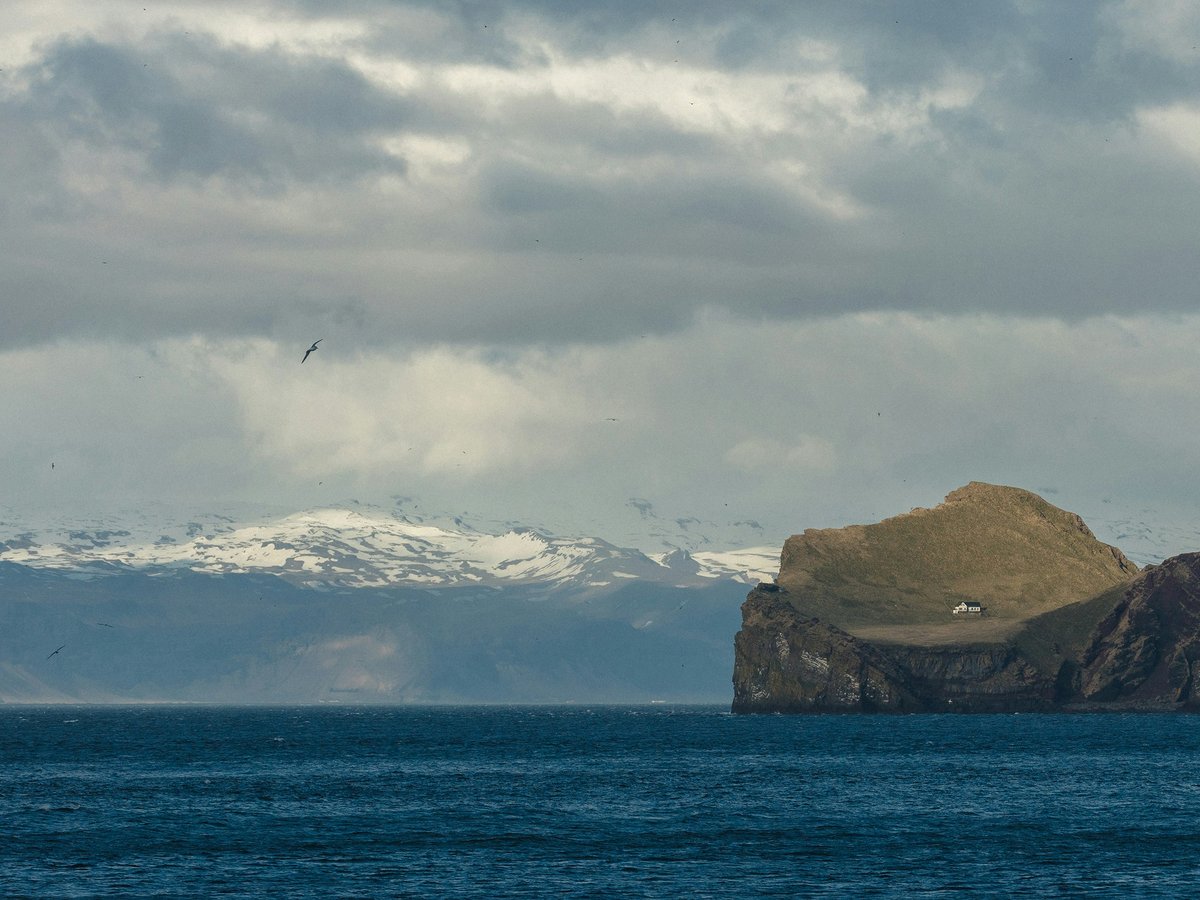
Stay in Vestmannaeyjar in December
7 hotels in the Trip.com pool for Vestmannaeyjar, from US$70 a night.
Opens Trip.com on Fri 4 Dec to Sun 6 Dec 2026; change the dates there.
December in Vestmannaeyjar means darkness. That's the first thing you need to know. The sun crawls above the horizon around 11:15 and drops again by 15:30, leaving roughly 4 hours of dim, grey-blue daylight on the best days. Temperatures hover between 2°C and 5°C (36-41°F), which sounds manageable until you factor in the wind. The Westman Islands sit exposed in the North Atlantic, 7 kilometres off Iceland's south coast, and December gusts regularly reach 20-25 m/s (45-56 mph). The Herjólfur ferry from Landeyjahöfn gets rerouted to the longer Þorlákshöfn crossing, or cancelled outright, several times a month. You could get stranded for a day or two. That's a real possibility.
That said, there are reasons to come. Vestmannaeyjar celebrates Þorláksmessa on December 23rd with more conviction than most Icelandic towns, and the smell of kæst skata (fermented skate) drifting from kitchens across Heiðarvegur is something you won't forget, whether you enjoy it or not. The 13 Jólasveinar (Yule Lads) arrive one per night starting December 12th, and local families in the Vesturbær and Skansinn neighbourhoods still put shoes in the window for them. On New Year's Eve, a bonfire in Herjólfsdalur valley draws most of the island's 4,300 residents. It's intimate and windswept and nothing like Reykjavik's fireworks spectacle.
Mind you, December is not why people come to Vestmannaeyjar. The puffins left in September. The hiking trails on Eldfell and Helgafell are slippery with ice. Stórhöfði, already one of the windiest headlands in Europe on a calm day, becomes genuinely dangerous. If you're here in December, you're here for the culture, the solitude, and the northern lights. That's a specific kind of traveller, and if it's you, the island delivers.
Why visit in December
- Þorláksmessa (December 23) and Icelandic Christmas traditions are celebrated with particular warmth in a community of 4,300 people. You're not watching from behind a rope line. Neighbours invite you in.
- Northern lights are visible on clear nights with minimal light pollution. The harbour area near Bæjarbryggja and the Herjólfsdalur valley offer dark-sky viewing without any driving.
- Zero tourist crowds. Eldheimar museum, Sæheimar aquarium, and the Stafkirkjan stave church at Skansinn are likely to be empty. You might be the only visitor that day.
- Accommodation rates drop 30-40% compared to the June-August peak. Guesthouses that sell out months ahead in puffin season have open rooms.
Worth knowing
- Only 4-5 hours of functional daylight, and much of it is a dim twilight. Outdoor sightseeing is compressed into a tight midday window.
- The Herjólfur ferry cancellations are frequent in December storms. Plan for the possibility of 1-2 extra days on the island. Eagle Air flights from Reykjavik domestic airport also cancel in high winds.
- Wind speeds at Stórhöfði regularly exceed 25 m/s (56 mph), making exposed coastal walks uncomfortable and sometimes dangerous. The wind chill can push felt temperatures well below freezing.
- Several restaurants and tour operators close for the winter or run reduced hours. The dining scene, which is already small, contracts to a handful of spots.
Best for
Think twice if
Cold, wet, and windy, with near-constant overcast skies. December averages 5.2°C (41°F) for the high and 2.0°C (36°F) for the low. That sounds mild for a subarctic island, and the Gulf Stream keeps it from truly freezing most days, but the wind changes everything. Sustained winds of 10-15 m/s are normal, with gusts well above 20 m/s during storms. Rain falls on roughly 17 of the 31 days, often driven sideways by the wind. Snow is possible but tends to melt quickly at sea level. The humidity sits around 76%, and the damp cold has a way of getting through layers that dry cold at the same temperature would not. Expect grey skies, occasional horizontal rain, and brief windows of pale light around midday.
Seasonal caution
- Wind speeds at exposed headlands like Stórhöfði can exceed 30 m/s (67 mph) during December storms. At that speed, standing upright near cliff edges is dangerous. Check vedur.is forecasts before any coastal walk.
- Temperatures hover near freezing and paths on Eldfell and Helgafell become icy. Microspikes or crampon grips for boots are strongly recommended for any uphill walking.
- The combination of 76% humidity and near-0°C wind chill creates a penetrating wet cold that hypothermia charts don't fully capture. Cotton clothing becomes dangerous when wet. Wool and synthetics only.
Year-round climate
Averages from the last 5 years.
| Month | Avg high (°C) | Avg low (°C) | Rainfall (mm) |
|---|---|---|---|
| Jan | 5 | 1 | 154 |
| Feb | 6 | 3 | 185 |
| Mar | 5 | 3 | 139 |
| Apr | 7 | 4 | 110 |
| May | 8 | 7 | 109 |
| Jun | 10 | 8 | 97 |
| Jul | 12 | 11 | 90 |
| Aug | 12 | 11 | 120 |
| Sep | 11 | 9 | 163 |
| Oct | 8 | 6 | 146 |
| Nov | 7 | 4 | 163 |
| Dec | 5 | 2 | 154 |
Holidays and festivals in December
Public holidays
- Christmas Eve(Aðfangadagur)24 December 2026
- Christmas Day(Jóladagur)25 December 2026
- St. Stephen's Day(Annar í jólum)26 December 2026
- New Year's Eve(Gamlársdagur)31 December 2026
Best things to do in December
Northern lights viewing from Herjólfsdalur valley
natureThe natural amphitheatre of Herjólfsdalur, a short walk south of town, blocks most artificial light from the harbour and town centre. On clear December nights, you can see auroral displays reflected in the dark valley walls. The lack of any nearby town glow makes this one of the better viewing spots in southern Iceland, with the added drama of volcanic ridgelines silhouetted against the green and white bands.
December's 19-20 hours of darkness maximise the viewing window. Geomagnetic activity tends to peak around the equinoxes, but December's long nights mean even moderate activity produces visible displays.Booking tipNo booking needed. Check the Icelandic Met Office aurora forecast at vedur.is before heading out. Cloud cover, not aurora strength, is usually the limiting factor.
Eldheimar museum visit
museumThis museum preserves a house excavated from the 1973 Eldfell tephra fall, buried under 4 metres of volcanic ash when the eruption forced the evacuation of all 5,300 residents on January 23rd, 1973. In December, with the volcano itself too icy for most walkers, the museum is the best way to understand what happened. The excavated house still has its kitchen table and wallpaper under the ash. The silence inside, while sleet hits the windows outside, tends to sharpen the experience.
December's limited daylight makes indoor attractions essential. Eldheimar is likely empty, giving you time to read every panel and watch every film clip without a tour group at your shoulder.Booking tipCheck winter opening hours in advance. The museum sometimes runs reduced hours (weekends only) in deep winter.
Þorláksmessa skata dinner
culturalOn December 23rd, Vestmannaeyjar fills with the sharp ammonia scent of fermented skate. This is not a tourist event. It's a local tradition with deep roots in the fishing community. Some restaurants and community halls serve skata dinners, and if you're staying at a guesthouse, your host may well invite you to join their family's table. The fish is challenging. The atmosphere is warm.
Þorláksmessa falls on December 23rd and the skata tradition is specifically tied to this date. You cannot experience it any other time of year.Booking tipIf a local restaurant is offering a Þorláksmessa dinner, book by mid-December. Seats are limited and locals fill them quickly.
Stafkirkjan stave church at Skansinn
historic siteThis small wooden stave church, a gift from Norway in 2000 to mark 1,000 years of Christianity in Iceland, sits on the Skansinn cliff above the harbour. The original 13th-century church on this site was destroyed by Algerian pirates in 1627 during a raid that killed or enslaved much of the island's population. In December, the church is sometimes lit with candles, and the dark volcanic rock of the Skansinn ramparts behind it creates a stark contrast against snow.
The church holds special Christmas services in late December. Even outside services, the combination of snow, candlelight, and 4 hours of blue twilight gives the site a winter atmosphere that doesn't exist in the long summer days.New Year's Eve bonfire at Herjólfsdalur
culturalOn December 31st, the town builds a large bonfire in the Herjólfsdalur valley, the same natural amphitheatre that hosts the Þjóðhátíð festival in August. Most of the island's 4,300 residents gather around it. Fireworks go off from the surrounding ridgelines. It's not choreographed or polished. People stand in the wind and the cold, drink brennivín, and watch the flames. By Reykjavik standards it's small. By community-intimacy standards it's hard to match.
December 31st only. This is the town's collective New Year's celebration.Booking tipNo tickets or booking. Dress for sustained outdoor exposure in wind and near-freezing temperatures.
Walk the 1973 lava field edge in winter light
walkingThe eastern side of Heimaey is still defined by the lava flow from the 1973 eruption, which added 2.2 square kilometres to the island. A walking path traces the boundary where the lava stopped, passing houses that survived on one side and rough, dark rock on the other. In December's low-angle midday light, the lava textures and rust-red oxidation are more visible than under the flat light of summer. The walk takes about 45 minutes at a slow pace.
The low sun angle around the winter solstice (December 21) creates long shadows across the lava field that reveal textures invisible in summer's high-angle light. Frost on the moss-covered older lava adds a silver-green layer.Booking tipFree and unguided. Stick to the marked path, as the lava field has sharp edges and hidden crevices.
Sæheimar aquarium and natural history museum
museumThis small municipal aquarium on Heiðarvegur keeps rescued puffins and other seabirds year-round, which matters in December because the wild colonies are entirely empty. The museum section covers the island's volcanic and natural history. It's a 30-45 minute visit, not a full afternoon, but the rescued puffin residents are genuinely engaging and the staff know the colony dynamics well.
December means zero chance of seeing wild puffins. Sæheimar's resident rescued birds are the only puffins on the island. For anyone who came partly hoping to see them, this is worth the stop.Booking tipVerify winter opening hours. Like most small Icelandic museums, hours may be limited to afternoons or weekends in December.
What to eat in December
On menus now
Kæst skata (fermented skate)
The defining food of Þorláksmessa on December 23rd. Skate is fermented for weeks until it develops an intense ammonia smell that divides opinion sharply. Vestmannaeyjar, as a fishing community, takes this tradition seriously. The smell of skata drifts through the Heiðarvegur area for hours. It's typically served with melted tallow, boiled potatoes, and rúgbrauð (dark rye bread). Try a small piece before committing to a full plate.
Hangikjöt (smoked lamb)
Icelandic Christmas lamb, smoked over birch wood or dried sheep dung, thinly sliced and served cold on laufabrauð or warm with béchamel sauce and green peas. Vestmannaeyjar families typically prepare it for Christmas Eve dinner on December 24th. The smoky, slightly sweet flavour is gentler than the skata.
Street food peaks
Fresh harðfiskur (wind-dried fish)
Vestmannaeyjar's fishing fleet operates year-round, and dried fish with butter remains a common snack through December. The harbour shops near Bæjarbryggja stock it fresh. The texture is chewy and dense, with a concentrated salt-and-ocean flavour that grows on you.
What to drink
Jólaöl (Christmas ale)
A seasonal malt drink, non-alcoholic in its traditional form, mixed 50/50 with Appelsín (an Icelandic orange soda) to make the holiday drink called jólaöl-og-Appelsín. It appears in shops and homes from early December through the 26th. Sweet, malty, fizzy, and an acquired taste for visitors.
Festival food
Laufabrauð (leaf bread)
Paper-thin flatbread with intricate geometric patterns cut by hand, deep-fried until golden and crispy. Families on the islands gather in late November and early December to cut the patterns together, often across generations. Each household tends to have its own designs. It shatters when you bite into it, flaky and buttery.
Regular events in December
Jólasveinar (Yule Lads) arrivalsFree
The 13 Icelandic Yule Lads arrive one per night from the mountains, starting December 12th and ending December 24th. Children in Vestmannaeyjar place shoes in their windows each evening, and the Yule Lad of the night leaves a small gift for well-behaved children or a potato for those who weren't. Each Lad has a distinct personality, from Stekkjastaur (Sheep-Cote Clod) to Kertasníkir (Candle-Stealer). Local shops and schools in town mark the arrivals.
December 12-24Þorláksmessa (St. Thorlak's Mass)Free
Iceland's patron saint's day on December 23rd is celebrated across the country, but Vestmannaeyjar's fishing heritage makes the fermented skate tradition particularly strong here. The smell of kæst skata permeates the streets near the harbour and Heiðarvegur by midday. Some households open their doors to neighbours and visitors.
December 23New Year's Eve bonfire (Áramótabrenna)Free
The community bonfire in Herjólfsdalur valley gathers most of the island's population for a collective send-off of the old year. Fireworks launched from the valley ridges follow. Smaller neighbourhood bonfires may also appear around town. The scale is modest compared to Reykjavik's citywide display, but the setting in the volcanic valley is distinctive.
December 31Christmas church services at LandakirkjaFree
Landakirkja, the main church in the town centre, holds Christmas Eve and Christmas Day services that draw a significant portion of the community. The church was rebuilt after the 1973 eruption and seats around 350 people. Services are in Icelandic, but the candlelit atmosphere and hymn-singing are accessible regardless of language.
December 24-25Best places this December
Eldheimar (Pompeii of the North)
museumThe eruption museum built around an excavated house buried in the 1973 Eldfell tephra. Interactive exhibits trace the 6-month eruption, the full-island evacuation, and the decision to pump seawater onto the advancing lava. In December's short daylight, this is likely your best single indoor hour on the island.
GerðisbrautSkansinn
historic siteThe historic fortification area on the eastern cliff above the harbour. The Stafkirkjan stave church sits here, along with the remains of the old fort walls. Plaques mark the site of the 1627 Turkish Raid (Tyrkjaránið), when Algerian pirates killed dozens and took nearly 250 islanders as captives. The cliff edge views over the harbour are best in the 2-3 PM twilight when the fishing boats' lights start to appear.
SkansinnHerjólfsdalur valley
natureThe broad natural amphitheatre south-west of town, site of the annual Þjóðhátíð festival in August and the New Year's Eve bonfire. In December, it's empty, wind-scoured, and dramatically framed by volcanic ridges. Worth walking through for the scale of the landscape and for dark-sky aurora viewing on clear nights.
HerjólfsdalurVestmannaeyjar harbour (Bæjarbryggja)
harbourThe working harbour is the economic centre of the island. In December, the fishing fleet operates as usual, and you can watch boats unloading cod, haddock, and lumpfish at the docks. The harbour area has a few cafes open in winter. The smell of diesel, salt, and fresh fish is constant. The harbour entrance, where the 1973 lava flow nearly sealed the port before the seawater-pumping operation saved it, is visible from the breakwater.
BæjarbryggjaEldfell crater rim
volcanoThe 200-metre-high crater from the 1973 eruption. In December, the ground near the summit still feels warm in places, over 50 years after the eruption. The climb takes 20-30 minutes but the path may be icy. On a clear day, views extend to Surtsey, the island that rose from the sea in 1963, 20 kilometres to the south-west. Attempt this only in calm conditions with proper footwear.
Eastern HeimaeyStórhöfði headland
viewpointThe southern tip of Heimaey, famous as one of the windiest places in Europe with recorded gusts above 60 m/s. In summer, it's a prime puffin-watching site. In December, the birds are gone and the wind can make the walk hazardous. On a rare calm day, the views south toward Surtsey and the open Atlantic are worth the 3-kilometre walk from town. Check the wind forecast first.
StórhöfðiLandakirkja
churchThe main parish church near the town centre, rebuilt after the 1973 eruption. Its modest white exterior and simple interior host well-attended Christmas services. The churchyard memorials to lost fishermen offer a quiet window into the island's maritime history.
Town centre
Your packing checklist
Tick items off as you pack. Your progress saves in this browser.
All packed — have a great trip.
Insider tips
The Herjólfur ferry schedule in December is more of a guideline than a promise. If your return flight leaves from Keflavík on a fixed date, book the ferry crossing for the day before you need to be back on the mainland, and have a backup plan (Eagle Air flights from Vestmannaeyjar airport, weather permitting). Getting stuck an extra day happens to locals too.
On Þorláksmessa (December 23), walk down Heiðarvegur in the early afternoon. The skata smell will lead you to open doors. Islanders are often generous about inviting strangers to try a bite. You don't need to eat a full plate. Trying a forkful and making a genuine face (whatever that face may be) is participation enough.
The geothermally warm ground near the top of Eldfell is one of the stranger sensory experiences on the island. Dig your hand a few centimetres into the reddish gravel near the crater rim and feel the heat. In December, with cold rain on your face and warm rock under your fingers, the contrast is startling. The warmth is most noticeable on the north-east slope.
For northern lights, skip the aurora apps and check vedur.is directly. The Icelandic Met Office cloud cover forecast, combined with the aurora activity scale, tells you more than any phone notification. Clear skies matter more than strong geomagnetic activity. A KP-2 aurora under clear skies beats a KP-5 behind overcast.
The swimming pool (Sundlaug Vestmannaeyja) is open year-round and heated to 29-30°C. After a cold, windy walk around the lava field, the outdoor hot pots at the pool are where locals decompress. December evenings, after the 4 PM dark falls, the hot pots are quiet and the steam rises into the cold air.
Avoid these mistakes
- Planning a tight itinerary that depends on the Herjólfur ferry running on schedule. December storms cancel or reroute the ferry to the 3-hour Þorlákshöfn crossing several times a month. Build at least one buffer day into your plans, especially around December 23-26 when you don't want to be stranded away from your flight.
- Attempting the walk to Stórhöfði without checking the wind forecast on vedur.is first. In December, gusts above 25 m/s (56 mph) are common at the headland even when town feels tolerable. The path is exposed and runs near cliff edges. Locals postpone the walk to a calmer day without thinking twice.
- Packing for the temperature but not the wind. 5°C (41°F) sounds almost mild, and visitors from colder continental climates sometimes show up in light jackets. But 5°C with 20 m/s sustained wind and horizontal rain feels closer to -5°C. The wind is the weather in Vestmannaeyjar, not the thermometer.
- Assuming restaurants will be open on December 24-26. Most of the island's small dining spots close for the family-centred Jól holiday. Stock up on food from the Krónan supermarket by December 23rd, or confirm with your guesthouse that meals are included over the holiday period.
Practical tips for December
Book accommodation by early December if you plan to be on the island for Christmas (December 24-26) or New Year's Eve. The island has limited rooms and visiting family absorb much of the capacity. The Krónan supermarket in the town centre is the main grocery option and has shorter hours December 24-31. Stock up by the 23rd. Dress in layers for any indoor-outdoor transitions. Buildings are heated to around 22°C but stepping outside into 3°C wind makes temperature swings jarring. The Vestmannaeyjar airport (VEY) handles Eagle Air (Ernir) flights from Reykjavik domestic airport (RKV). Flight time is about 25 minutes, but December cancellations for wind are common. Always have the ferry as a backup, and vice versa. Mobile coverage is good on Heimaey itself, but data speeds can be slow in storms. Download offline maps before arrival. Tipping is not customary in Iceland. Prices on the island are comparable to mainland Iceland, which means everything is expensive by international standards. A meal out typically runs ISK 3,000-5,000. Card payment is accepted everywhere, even the swimming pool. The island has no ATM fee-free international withdrawals; pay by card.
FAQ
Is December a good time to visit Vestmannaeyjar?
It depends entirely on what you're looking for. If you want puffins, hiking, or more than 4-5 hours of daylight, December is a poor choice. June through August is your window for those. But if you're drawn to Icelandic Christmas traditions in a small fishing community, northern lights viewing with minimal light pollution, and empty museums where you can take your time, December has a genuine appeal. The weather will test you. Expect wind, rain, and possible ferry cancellations. Come with flexibility and the right gear, or don't come at all.
What is the weather like in Vestmannaeyjar in December?
Cold, wet, and windy. Average highs reach about 5°C (41°F) and lows sit around 2°C (36°F). Rainfall averages 154mm across roughly 17 rainy days. Humidity hovers at 76%. But the defining feature is wind, not temperature. The islands are exposed to North Atlantic storms, and December gusts above 20 m/s (45 mph) are routine. Wind chill makes the felt temperature significantly colder than the thermometer suggests. Snow is possible but rarely accumulates at sea level for long.
Can you see the northern lights from Vestmannaeyjar in December?
Yes, when skies are clear. Vestmannaeyjar has very low light pollution compared to Reykjavik, and December's 19-20 hours of darkness provide a wide viewing window. Herjólfsdalur valley and the area around Stórhöfði (on calm nights) offer good dark-sky positions. The catch is cloud cover. December is overcast more often than not, and you might wait several nights for a clear window. Check the vedur.is cloud cover and aurora forecasts daily. A 3-4 night stay gives reasonable odds of at least one clear night.
How do you get to Vestmannaeyjar in December?
Two options. The Herjólfur car ferry departs from Landeyjahöfn on the south coast (30-minute crossing) but reroutes to Þorlákshöfn (3-hour crossing) in heavy weather, which happens several times per month in December. Eagle Air (Ernir) flies from Reykjavik domestic airport to Vestmannaeyjar in about 25 minutes. Both services cancel in severe storms. Book both as backup if your schedule is tight. The drive from Reykjavik to Landeyjahöfn takes about 2 hours on Route 1.
Is Vestmannaeyjar crowded in December?
Not at all. December is deep off-season. The island's 4,300 residents go about their daily lives, and tourist infrastructure operates at minimal capacity. You'll likely have Eldheimar museum and Sæheimar aquarium mostly to yourself. The one exception is the New Year's Eve bonfire at Herjólfsdalur, which draws the whole community, but even that crowd is 2,000-3,000 people, not a tourist horde. The quiet is part of the appeal.
Find a flight to Vestmannaeyjar
Live fares to Vestmannaeyjar appear here once cookies are accepted.
Last verified by automated review (v1.7.2) on . What is automated review?