Compare every Greece city in March →
Stay in Athens in March
111 hotels in the Trip.com pool for Athens, from US$15 a night.
Opens Trip.com on Fri 5 Mar to Sun 7 Mar 2027; change the dates there.
March in Athens sits in that early-spring window where the city belongs to you more than it does in any summer month. Daytime temperatures hover around 15.8°C (60°F), cool enough that walking the 3-kilometre stretch from Kerameikos to the Acropolis feels pleasant rather than punishing. The big calendar marker is Greek Independence Day on March 25, when a military parade rolls down Vasilissis Sofias Avenue and the entire city shuts down for the holiday. You might catch the tail end of Apokries, the Greek Carnival season, in early March depending on when Orthodox Easter falls that year.
This is shoulder season in the truest sense. Hotel rates in Plaka and Koukaki tend to run 30-40% below their July peaks. The major archaeological sites see a fraction of their summer foot traffic. You can walk into the Acropolis Museum on a Tuesday afternoon and linger in the Parthenon Gallery without elbowing past tour groups. The tradeoff is real, though. March weather in Athens is unpredictable. You might get 3 days of 20°C sunshine followed by a cold, damp stretch where the thermometer barely clears 12°C. Rain is not heavy (about 34mm across 6 days), but the wind off the Saronic Gulf can make those cooler days feel genuinely chilly.
If you want warm beach weather, wait until June. If you want to explore ruins, eat well, and walk the city's neighbourhoods at a pace that lets you notice things, March is a strong choice. The almond trees along Philopappou Hill are typically in full bloom by mid-month, and the wild poppies start appearing across the hillsides around the Pnyx.
Why visit in March
- Acropolis and major archaeological sites are uncrowded. You can spend an hour at the Erechtheion without tour groups blocking every angle. Summer visits often mean queuing 45 minutes before entry.
- Hotel rates in central neighbourhoods like Plaka, Monastiraki, and Koukaki typically run 30-40% below July and August prices, with last-minute availability common even on weekends.
- Walking weather for sightseeing. Highs around 15.8°C (60°F) mean full-day exploration without the heat exhaustion risk that limits summer itineraries to early morning and late evening.
- Wildflowers and almond blossoms cover Philopappou Hill and the slopes of the Ancient Agora from mid-March onward. The National Garden shifts from winter brown to green, with citrus trees beginning to fruit.
- Greek Independence Day on March 25 offers a genuine cultural experience. The military parade, the flags draped across Syntagma Square, the atmosphere in the tavernas that evening. It is a window into national identity that summer tourism rarely provides.
Worth knowing
- Weather is genuinely unpredictable. A sunny 20°C morning can turn into a 12°C afternoon with wind and drizzle. You will need layers every day, and at least 2 of your 6 rainy days will likely catch you outdoors.
- The sea is too cold for swimming. Water temperatures around the Athenian Riviera hover near 15°C in March, which rules out beach days at Vouliagmeni or Glyfada.
- Some island ferry routes still run on reduced winter schedules through mid-March, limiting spontaneous day-trip options to places like Hydra or Aegina.
- Shorter daylight hours compared to summer. Sunset falls around 18:30, giving you roughly 2 fewer hours of evening light than a June visit.
Best for
Think twice if
March in Athens feels like early spring with a stubborn streak of winter. Mornings tend to start cool, often around 7.9°C (46°F), and you will want a jacket for any walk before 10:00. By early afternoon, temperatures typically reach 15.8°C (60°F), sometimes climbing to 20°C on the warmest days. Rainfall averages 34mm spread across about 6 days, usually arriving as short showers rather than all-day downpours. Humidity sits around 67%, which is noticeable but not oppressive. The wind is the wild card. Northerly gusts off the Aegean can drop the perceived temperature by 5-7 degrees, particularly near exposed hilltop sites like the Acropolis or Lycabettus. By late March, you will start to feel the seasonal turn. More sun, less wind, longer evenings.
Year-round climate
Averages from the last 5 years.
| Month | Avg high (°C) | Avg low (°C) | Rainfall (mm) |
|---|---|---|---|
| Jan | 13 | 6 | 62 |
| Feb | 14 | 6 | 45 |
| Mar | 16 | 8 | 34 |
| Apr | 20 | 11 | 38 |
| May | 25 | 16 | 36 |
| Jun | 31 | 21 | 25 |
| Jul | 35 | 24 | 8 |
| Aug | 33 | 24 | 16 |
| Sep | 29 | 20 | 18 |
| Oct | 23 | 15 | 27 |
| Nov | 19 | 12 | 85 |
| Dec | 15 | 9 | 101 |
Holidays and festivals in March
Public holidays
- Clean Monday(Καθαρά Δευτέρα)15 March 2027
- Annunciation(Ευαγγελισμός της Θεοτόκου)25 March 2027
- Independence Day(Εικοστή Πέμπτη Μαρτίου)25 March 2027
Headline events
Greek Independence Day (Εθνική Επέτειος)
March 25 (fixed date every year)
Greece's national day commemorates the start of the 1821 War of Independence against Ottoman rule. In Athens, the centerpiece is a large military parade along Vasilissis Sofias Avenue, passing the Parliament building in Syntagma Square. Schools, government offices, and many businesses close. Greek flags appear on nearly every balcony in the city. The atmosphere in the tavernas that evening tends to be patriotic and lively, with families gathering for long meals.
Best things to do in March
Walk the Acropolis and south slope without summer crowds
sightseeingThe Acropolis complex, including the Parthenon, Erechtheion, and Theatre of Dionysus, is manageable in March in a way that July and August make difficult. You can spend 90 minutes on the hilltop without being funnelled through a one-way crowd corridor. The marble is not scorching underfoot. The south slope, with the Odeon of Herodes Atticus and the Stoa of Eumenes, is often nearly empty on weekday mornings.
Visitor numbers in March are a fraction of summer peaks, and the mild 15-16°C temperatures allow extended outdoor exploration without heat risk.Booking tipBuy the 30 EUR combined ticket online, which covers the Acropolis and 6 other sites over 5 days. Lines at the ticket booth are short in March, but online purchase still saves 10-15 minutes.
Hike Philopappou Hill during almond blossom season
natureThe hill directly south of the Acropolis is covered in almond trees that typically bloom from late February through mid-March. The trail from Dionysiou Areopagitou Street to the Philopappou Monument at the summit takes about 20 minutes and gives you a head-on view of the Parthenon that most tourists miss. Wild poppies start appearing on the lower slopes by late March.
Almond blossom peaks in early-to-mid March. By April the petals have mostly fallen. The hillside is green and alive in a way that summer's dry brown cannot match.Watch the Independence Day parade on Vasilissis Sofias Avenue
culturalOn March 25, the Greek military stages its largest annual parade through central Athens. Infantry, naval units, armoured vehicles, and flyovers pass in front of the Parliament building. The route runs along Vasilissis Sofias from the Hilton area toward Syntagma Square. Crowds line the avenue 3-4 deep, but it is a relaxed atmosphere. Arrive by 09:30 for a decent vantage point near the Benaki Museum.
March 25 is the fixed date. This event does not occur any other month.Booking tipNo tickets needed. Free to watch from the street. Cafes on Vasilissis Sofias fill quickly that morning, so arrive early if you want a seated vantage point.
Explore the Ancient Agora and Stoa of Attalos
sightseeingThe Ancient Agora sits below the Acropolis in the Monastiraki area. In March, the site's pomegranate and olive trees are coming back to life, and the rebuilt Stoa of Attalos houses a museum of everyday Athenian life. The Temple of Hephaestus, the best-preserved Greek temple in the world, stands on the western hill. You can easily spend 2 hours here without feeling rushed.
Low visitor numbers mean you can photograph the Temple of Hephaestus without other tourists in frame. The spring greenery around the site creates a contrast with the stone that summer does not offer.Booking tipCovered by the combined Acropolis ticket. Enter from Adrianou Street in Monastiraki.
Browse the Sunday morning Monastiraki flea market
shoppingEvery Sunday, the streets around Plateia Avyssinias in Monastiraki fill with vendors selling antiques, vintage furniture, old records, and assorted odds and ends. The market spills out from the permanent antique shops on Ifestou Street. March Sundays tend to draw more locals than tourists, and the cool morning air makes the browsing comfortable. Arrive between 08:00 and 10:00 for the best selection.
In summer the flea market starts early to beat the heat and empties out by midday. In March, the moderate temperatures keep the market lively well into early afternoon, and the vendor-to-tourist ratio favours actual bargaining.Day trip to Temple of Poseidon at Cape Sounion
day_tripThe 5th-century BC temple sits on a cliff 70 metres above the Aegean, about 70 km (43 miles) southeast of central Athens. The coastal drive along the Apollo Coast takes roughly 90 minutes. In March, the headland is uncrowded and often windy, with dramatic cloud formations over the sea. Sunset here is famous, though March sunsets fall around 18:30, earlier than summer's 20:30.
The site draws large coach-tour crowds in summer. In March, you might share the temple platform with 10-15 other visitors rather than 200. The spring light on the Doric columns is softer and warmer than midsummer glare.Booking tipKTEL buses run from the Pedion Areos terminal. Alternatively, rent a car for the flexibility to stop at coastal tavernas along the way. The site closes at sunset, so check the exact time for your visit date.
Visit the National Archaeological Museum
museumGreece's largest museum, on Patission Street in the Exarchia area, holds the Mask of Agamemnon, the Antikythera Mechanism, and one of the world's finest collections of Cycladic art. The building itself is a 19th-century neoclassical landmark. A proper visit takes 3-4 hours. March is an especially good time because you can pair an indoor museum morning with an afternoon walk through nearby Pedion Areos park.
March rain days need indoor options, and this museum fills that role better than any other in Athens. Low-season visitor numbers mean you can stand in front of the Artemision Bronze without a crowd.Booking tipArrive when doors open to have the Mycenaean gold collection largely to yourself. Monday hours are reduced. Check ahead for the current schedule.
Walk the Anafiotika neighbourhood on the north slope of the Acropolis
neighbourhood_walkThis cluster of about 45 white-washed houses on the rocky slope below the Acropolis walls was built by stonemasons from the Cycladic island of Anafi in the 1840s. The narrow paths, bougainvillea (still dormant in early March but greening by month's end), and cat population give it a quiet, island-village character in the middle of the city. The walk from Plaka up through Anafiotika to the Acropolis entrance takes about 15 minutes.
Summer heat and tourist density make this steep, shadeless climb uncomfortable. March temperatures and low foot traffic let you linger and photograph the houses without rushing.What to eat in March
In season: fruit
Blood oranges (sanguinia)
The tail end of Greek blood-orange season runs through March. Vendors at Varvakios Agora and the Laiki street markets sell them by the kilo. The juice is tart and deep red. Several cafes in Koukaki and Pangrati squeeze them fresh.
On menus now
Horta (wild greens)
March is peak season for foraged wild greens in Attica. Tavernas across Psyrri and Exarchia serve plates of boiled vlita, radikia (wild chicory), and amaranth leaves dressed in lemon and olive oil. The flavour is bitter and grassy, nothing like cultivated spinach. Varvakios Agora stallholders sell bundles for a couple of euros.
Galaktoboureko
This custard-filled phyllo pastry is available year-round, but the cooler March temperatures make the warm semolina custard and syrup-soaked layers feel right in a way that a 35°C August afternoon does not. Bakeries in Exarchia and around Plateia Victorias are known for good versions.
In markets
Artichokes (aginares)
Greek artichokes come into season in March. You will find them braised with broad beans and dill (aginares me koukia), or served alla polita, stewed with potatoes, carrots, and lemon. Tavernas in Monastiraki and Plaka tend to feature them as daily specials through April.
Festival food
Lagana bread and taramosalata (Lenten foods)
If Orthodox Lent overlaps with March, bakeries across Athens produce lagana, a flat sesame-topped bread traditionally eaten on Clean Monday. Taramosalata, the pink or white fish-roe dip, appears alongside it. Even outside Clean Monday, Lenten menus at traditional tavernas offer seafood and vegetable dishes that skip meat and dairy entirely.
Regular events in March
Apokries (Greek Carnival season)Free
In years when Orthodox Easter falls in late April or May, the 3-week Carnival season (Apokries) extends into early March. Athens's celebration is smaller than Patras's famous Carnival, but Plaka and Psyrri see costume parties, street performers, and children in fancy dress. The atmosphere is playful rather than spectacular.
Early March (moveable, depends on Orthodox Easter date)Kathara Deftera (Clean Monday)Free
The first day of Orthodox Lent. In years when it falls in March, Athenians head to parks and open spaces to fly kites and eat Lenten food. Philopappou Hill and the area around the Temple of Olympian Zeus fill with families. Bakeries sell lagana bread. It is a public holiday with wide closures.
Late February or early-to-mid March (moveable, 48 days before Orthodox Easter)Art Athina (Athens International Art Fair)
Greece's leading contemporary art fair, typically held at the Zappeion Hall in the National Garden. Galleries from across Greece and southeastern Europe exhibit painting, sculpture, and installation work. The fair has run since 1993. Dates shift year to year but often land in the March-April window.
Late March or early April (varies by year)Feast of the Annunciation (Evangelismos)Free
March 25 is also a major religious feast day in the Greek Orthodox calendar. Churches across Athens hold special liturgies, with the Cathedral of Athens (Mitropoli) on Plateia Mitropoleos hosting the most prominent service. The religious and national celebrations overlap on the same date.
March 25Best places this March
National Garden (Ethnikos Kipos)
parkAthens's 15.5-hectare central park, directly behind the Parliament building, transitions from bare winter to early spring green in March. The duck pond, the small botanical museum, and the shaded paths feel refreshed after winter rain. Morning joggers and families replace the summer tourist crowds. The orange and lemon trees are beginning to set fruit.
SyntagmaVarvakios Agora (Athens Central Market)
marketThe 1886 iron-and-glass market hall on Athinas Street is at its most interesting in March, when spring produce appears alongside the permanent meat and fish halls. Wild greens, blood oranges, and early artichokes fill the vegetable stalls on the outer streets. The noise, the smell of fish and herbs, the vendors calling prices. This is the sensory opposite of a supermarket. Go before 11:00 on a weekday.
MonastirakiStavros Niarchos Foundation Cultural Center (SNFCC)
cultural_centerRenzo Piano's 2016 building in the Kallithea district, about 4 km south of the centre, houses the National Library and Greek National Opera. The 21-hectare park surrounding it is one of Athens's best green spaces. In March, the Mediterranean garden and the canal-side paths are in early bloom. The rooftop terrace gives panoramic views toward the Acropolis and the Saronic Gulf. Free entry to the park and most events.
KallitheaBenaki Museum of Greek Culture
museumThe main Benaki building on Koubari Street, at the edge of Kolonaki, traces Greek history from prehistory through the 20th century. The rooftop cafe has one of the better Acropolis views in the city. March is a good time to visit because the museum runs a programme of temporary exhibitions that often open in early spring, and the galleries are quiet enough that you can read every label without being shuffled along.
KolonakiPlateia Avyssinias and the Monastiraki antique quarter
neighbourhoodThe small square and surrounding streets south of Ermou are lined with antique dealers, junk shops, and salvage stores that have been here since the 1910s. In March, without summer tourist traffic, the shop owners are more likely to chat and negotiate. The square's two cafes are good spots to sit and watch the neighbourhood.
MonastirakiLycabettus Hill
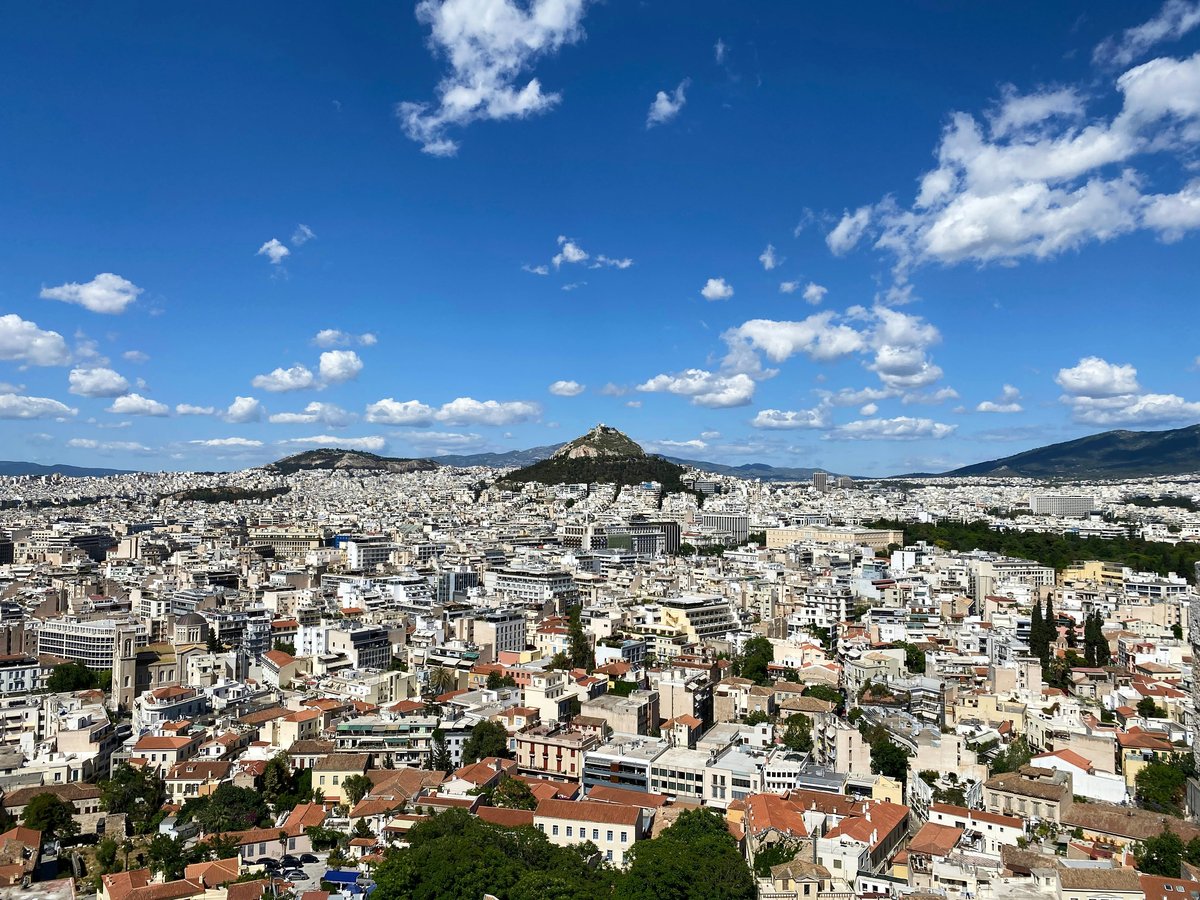
viewpointThe 277-metre limestone hill in the centre of Athens offers the city's highest viewpoint. You can walk up from Kolonaki in about 30-40 minutes, or take the funicular from Aristippou Street. March mornings tend to be clearer than summer's haze, giving longer sight lines to Piraeus, Aegina island, and the mountains of the Peloponnese. The small Chapel of Agios Georgios at the summit is a quiet spot. Bring a windbreaker for the top.
KolonakiExarchia neighbourhood
neighbourhoodAthens's counter-cultural district, north of the Polytechnic, has the city's densest concentration of independent bookshops, record stores, street art, and affordable tavernas. The area around Plateia Exarchion is where students, artists, and activists gather. March evenings, with temperatures around 10-12°C, are comfortable for a long dinner at one of the square's open-air ouzeries. The neighbourhood is also the closest to the National Archaeological Museum.
Exarchia
Your packing checklist
Tick items off as you pack. Your progress saves in this browser.
All packed — have a great trip.
Insider tips
The 30 EUR combined archaeological ticket covers the Acropolis plus the Ancient Agora, Roman Agora, Kerameikos, Temple of Olympian Zeus, and Hadrian's Library. It is valid for 5 days. Almost every tourist buys single-site tickets, paying more in total and queuing at each entrance. Buy the combined ticket at the quieter Kerameikos entrance on Ermou Street, not the main Acropolis gate.
For Greek Independence Day on March 25, the area around Syntagma Square fills with spectators by 09:00. If crowds are not your thing, walk up Philopappou Hill instead. You can watch the military jets fly over the city from the hilltop, and the view of the Acropolis with Greek flags is better than anything at street level.
The laiki agores (street markets) rotate through Athens's neighbourhoods on fixed days. Friday mornings in Kolonaki and Saturday mornings in Pangrati bring seasonal produce at roughly half the price of Varvakios Agora. Ask your hotel which day the nearest laiki runs. In March, look for the first artichokes and bundles of fresh horta (wild greens).
Athens tap water is drinkable and comes from the Mornos reservoir. Buying bottled water at archaeological sites is an unnecessary expense. Fill a reusable bottle at any tap or public fountain. The water is slightly mineral and cold.
Restaurant dinner service in Athens typically starts at 20:30 or 21:00, later than most northern European visitors expect. If you show up at 18:30, you will be eating alone in an empty room. The exception is tavernas near Monastiraki Square that cater to tourists, but the food there tends to be weaker than neighbourhood places in Koukaki, Pangrati, or Petralona.
Avoid these mistakes
- Packing for summer. March in Athens is not warm by Mediterranean standards. Tourists arriving in shorts and sandals spend their first afternoon buying a jacket on Ermou Street. Temperatures regularly dip to 10-12°C with wind chill, and the Acropolis hilltop is exposed. Dress for a cool spring day, not a beach holiday.
- Planning a day trip to Santorini or Mykonos. In March, these islands are still in winter mode. Many hotels, restaurants, and shops are closed until late April. Ferry schedules run 2-3 times per week rather than daily. Hydra and Aegina, both under 2 hours from Piraeus by ferry and open year-round, are better March day-trip choices.
- Scheduling outdoor activities on March 25 without knowing it is a national holiday. Museums, shops, and most services close for Greek Independence Day. The parade blocks central streets from early morning. This is not a disaster if you plan around it, but travellers who expected a normal sightseeing day are often caught off guard.
- Assuming all restaurants serve lunch. Many traditional Athenian tavernas open only for dinner, from 19:00 or 20:00 onward. For midday meals, look for places in Monastiraki and Psyrri that explicitly serve lunch, or eat at a meze spot near Varvakios Agora. The market-area restaurants tend to operate from morning through afternoon.
Practical tips for March
Book accommodation 2-3 weeks ahead for late March if your dates overlap with Greek Independence Day weekend (March 25). Hotels in Plaka and Syntagma see a bump in domestic tourism around the holiday. For the rest of March, last-minute bookings are typically fine. The Athens Metro runs from 05:30 to 00:30 (until 02:00 on Friday and Saturday nights). Line 2 (red) stops at Acropoli station, the closest to the south slope entrance. Taxis from the airport cost a flat 40 EUR to the city centre between 05:00 and 00:00, and 55 EUR for night trips. Uber operates in Athens but uses licensed taxi drivers, so pricing is similar. Dress codes are relaxed at most restaurants, but if you plan to enter active churches (especially on March 25), cover your shoulders and knees. Most archaeological sites open at 08:00 and close at 17:00 or 18:00 in March, with last entry 30 minutes before closing. Check the specific schedule for the Acropolis, which sometimes extends hours on certain days. Pharmacies (farmakeio) rotate 24-hour duty, and the on-duty pharmacy is posted on every pharmacy door. Credit cards are accepted at most restaurants and shops, but carry cash for street markets, kiosks, and smaller tavernas.
FAQ
Is March a good time to visit Athens?
March is a genuinely good time for Athens if your priorities are sightseeing, archaeology, and food rather than beaches and island-hopping. Temperatures around 15.8°C (60°F) are comfortable for walking, the major sites are uncrowded, and shoulder-season pricing saves you 30-40% on hotels compared to summer. The tradeoff is unpredictable weather. You should expect 2-3 rainy days and occasional cold snaps where the wind makes it feel closer to 8-10°C. If that sounds tolerable, March ranks as one of the better months to visit. If you need guaranteed warmth, May through October is the safer window.
What is the weather like in Athens in March?
Expect daytime highs around 15.8°C (60°F) and overnight lows near 7.9°C (46°F). Rainfall averages 34mm across about 6 days, typically as short showers rather than all-day rain. Humidity sits around 67%. The variable factor is wind. Northerly gusts off the Aegean are common, particularly on hilltop sites, and can make a 15°C day feel noticeably colder. Late March tends to be warmer and drier than early March, with more days reaching 18-20°C. Pack layers, a rain jacket, and a scarf for windy ridgelines.
Is Athens crowded in March?
No. March is one of the quieter months. The Acropolis, which can see over 20,000 visitors per day in July, draws a fraction of that in March. You will rarely queue for more than 10 minutes at any site. Hotels have availability, restaurants have tables, and the Metro is not packed with tourist luggage. The one exception is Greek Independence Day on March 25, when domestic visitors and Athenian families gather along Vasilissis Sofias Avenue for the parade. Even then, the crowds are localised to Syntagma and the parade route.
Can I visit the Greek islands from Athens in March?
You can, but options are limited. The popular Cycladic islands like Santorini and Mykonos are largely shut down until late April. Many hotels and restaurants close for winter. Ferry schedules are reduced to 2-3 sailings per week. The better March options are the Saronic Gulf islands. Hydra, Aegina, and Poros run year-round ferry services from Piraeus (1-2 hours), have open tavernas and hotels, and make comfortable day trips even in cooler weather. Aegina's pistachio orchards and the Temple of Aphaia are worth the 40-minute fast ferry from Piraeus.
What should I eat in Athens in March?
March is peak season for wild greens (horta), which appear on nearly every taverna menu, boiled and dressed with lemon and olive oil. Artichokes come into season and show up braised with broad beans and dill. Blood oranges are still available at the street markets and fruit stalls. If Orthodox Lent falls in March, bakeries produce lagana bread and Lenten specialties like taramosalata and seafood dishes that skip meat and dairy. For the freshest produce, visit Varvakios Agora on Athinas Street or a neighbourhood laiki (street market) any weekday morning.
Things to Do in Athens in March
 Free cancellation
 Best of Athens Half Day Private Tour
Day trip: free cancellation.
via Viator Free cancellation
 Cape Sounion and Temple of Poseidon Half-Day Small-Group Tour from Athens
Day trip: free cancellation.
via Viator Free cancellation
 Athens Full Day Private Tour
Day trip: 8 hours, free cancellation.
via Viator Free cancellation
 Athens All Included: Acropolis and Museum Guided Tour with Ticket
Day trip: 3 hours, free cancellation.
via Viator Free cancellation
 Athens cruise: Agistri, Moni/Metopi, Aegina with lunch & drinks
Day trip: 10 hours, free cancellation.
via Viator Free cancellation
 Delphi Experience With live Official Guide in the museum and site
Day trip: 10 hours, free cancellation.
via ViatorFind a flight to Athens
Live fares to Athens appear here once cookies are accepted.
Last verified by automated review (v1.7.2) on . What is automated review?