Compare every Greece city in May →
Stay in Athens in May
111 hotels in the Trip.com pool for Athens, from US$15 a night.
Opens Trip.com on Fri 7 May to Sun 9 May 2027; change the dates there.
May is likely the best month to visit Athens. Daytime temperatures settle around 25°C (77°F), warm enough to eat outdoors in Plaka past 9pm but still cool enough to spend a full morning walking the Acropolis without the dangerous heat that arrives in July. Summer crowds haven't descended yet. Lines at the Acropolis Museum that stretch 45 minutes in August typically take 10-15 minutes in early May.
The city smells different this month. Jasmine starts blooming across the hillside neighborhood of Anafiotika in the first week, and the scent drifts through narrow stone stairways on the north slope of the Acropolis. Orange trees that line avenues in Kolonaki and Pangrati are still heavy with late fruit. Bougainvillea climbs whitewashed walls in Plaka. Evenings cool to around 16°C (61°F), enough for a light jacket on a rooftop in Monastiraki but nothing heavier.
May 1st is Protomagia, Greece's national May Day holiday, and it shuts down more of the city than most visitors expect. Banks close, shops close, and even some tavernas take the day off. Athenians head to Philopappos Hill or the National Garden to make flower wreaths and picnic on the grass. If your trip overlaps with the 1st, plan for limited services. The Athens and Epidaurus Festival typically opens its season in the final week of May at the Odeon of Herodes Atticus. Early-season tickets for the 5,000-seat Roman-era theater tend to be easier to get than the June performances that sell out in hours.
Why visit in May
- Temperatures average 25°C (77°F) during the day, comfortable for walking archaeological sites like the Ancient Agora, the Acropolis, and the Temple of Olympian Zeus without the dangerous July-August heat above 35°C (95°F)
- Shoulder-season hotel rates in Plaka, Koukaki, and Monastiraki run roughly 20-30% below July-August peaks, with wider last-minute availability
- Daylight lasts until about 8:30pm, giving you 14+ hours of usable light for sightseeing and golden-hour photography at Lycabettus Hill and Cape Sounion
- Seasonal produce peaks at the Varvakeios Agora. Cherries, strawberries, artichokes, and fresh broad beans are all at their best in the market stalls along Athinas Street
- The Athens and Epidaurus Festival often opens its program in late May at the Odeon of Herodes Atticus, and early-season performances are easier to book than the June headliners
Worth knowing
- Protomagia on May 1st shuts down most shops, banks, and some restaurants for the entire day. If it falls mid-week, some businesses extend the closure into a long weekend
- Crowds build noticeably through the month. By late May, foot traffic around the Acropolis and through Plaka feels closer to summer levels than spring levels
- Athens still sees about 36mm of rain across 5 days in May. A brief afternoon shower can catch you on the exposed rock of the Acropolis or Philopappos Hill with no shelter nearby
Best for
Think twice if
May in Athens tends to feel like the last comfortable month before summer takes over. Mornings start around 16°C (61°F) with dry, clear air and a light breeze off the Saronic Gulf. Humidity sits at a manageable 54%, a world away from the sticky coastal heat of July. By midday you'll see 25.2°C (77°F) under mostly blue skies. Rain is possible but rarely disruptive. About 5 days in the month bring some rainfall, totaling roughly 36mm, typically arriving as brief afternoon showers that dry on warm pavement within the hour. The Mediterranean sun is strong by late May, stronger than most Northern Europeans expect at this latitude.
Year-round climate
Averages from the last 5 years.
| Month | Avg high (°C) | Avg low (°C) | Rainfall (mm) |
|---|---|---|---|
| Jan | 13 | 6 | 62 |
| Feb | 14 | 6 | 45 |
| Mar | 16 | 8 | 34 |
| Apr | 20 | 11 | 38 |
| May | 25 | 16 | 36 |
| Jun | 31 | 21 | 25 |
| Jul | 35 | 24 | 8 |
| Aug | 33 | 24 | 16 |
| Sep | 29 | 20 | 18 |
| Oct | 23 | 15 | 27 |
| Nov | 19 | 12 | 85 |
| Dec | 15 | 9 | 101 |
Holidays and festivals in May
Public holidays
- Labour Day(Εργατική Πρωτομαγιά)1 May 2027
- Easter Sunday(Κυριακή του Πάσχα)2 May 2027
- Easter Monday(Δευτέρα του Πάσχα)3 May 2027
Best things to do in May
Walk the Acropolis and south slope at opening time
sightseeingThe Acropolis opens at 8am in May. The morning air is still cool, around 18-20°C (64-68°F), and the Parthenon catches soft eastern light that photographs far better than the harsh midday glare. The south slope, with the Theatre of Dionysus and the Odeon of Herodes Atticus, is largely empty before 9am.
By July the 8am temperature already sits above 28°C (82°F) and tour groups arrive in force by 8:30am. May gives you comfortable temperatures and relative quiet at the same hour.Booking tipBook timed-entry tickets online at least a few days ahead. Walk-up queues grow through May as visitor numbers rise.
Sunset drinks on Monastiraki and Psyrri rooftops
nightlifeSeveral rooftop bars in Monastiraki and Psyrri face directly at the Acropolis, which is lit after dark. In May, sunset falls around 8:20pm, and the temperature drops to a comfortable 20-22°C (68-72°F) by the time you're settling in. The warm stone and cool breeze make for a distinctly Mediterranean evening.
Rooftop season opens properly in May. In July and August, evening temperatures above 30°C (86°F) make sitting on a sun-baked terrace unpleasant. May evenings are warm without being oppressive.Day trip to the Temple of Poseidon at Cape Sounion
day tripThe 5th-century BC temple sits on a cliff 60 meters above the Aegean, about 70km south of central Athens. The coastal drive passes wildflower-covered hillsides in May and takes roughly 1 hour. Sunset at Sounion around 8:20pm lights the marble columns orange against the sea.
May's mild temperatures make the exposed, shadeless clifftop comfortable. In July-August the 35°C (95°F) heat on bare rock with no cover is genuinely punishing. Spring wildflowers along the coastal road are a bonus.Booking tipA KTEL bus runs from central Athens to Sounion several times daily for well under 10 EUR each way. The coastal route is slower but more scenic than the inland highway.
Explore the Ancient Agora and the Stoa of Attalos
sightseeingThe Ancient Agora was the commercial and political center of classical Athens. The reconstructed 2nd-century BC Stoa of Attalos now houses a museum of daily-life artifacts. The site has more shade than the Acropolis, with paths winding through olive trees and past the well-preserved Temple of Hephaestus.
The open-air ruins are best walked at May's 25°C (77°F). By midsummer, the treeless sections become heat traps above 35°C (95°F). May also means fewer tour groups crowding the Stoa's ground-floor colonnade.Hike Lycabettus Hill for sunset
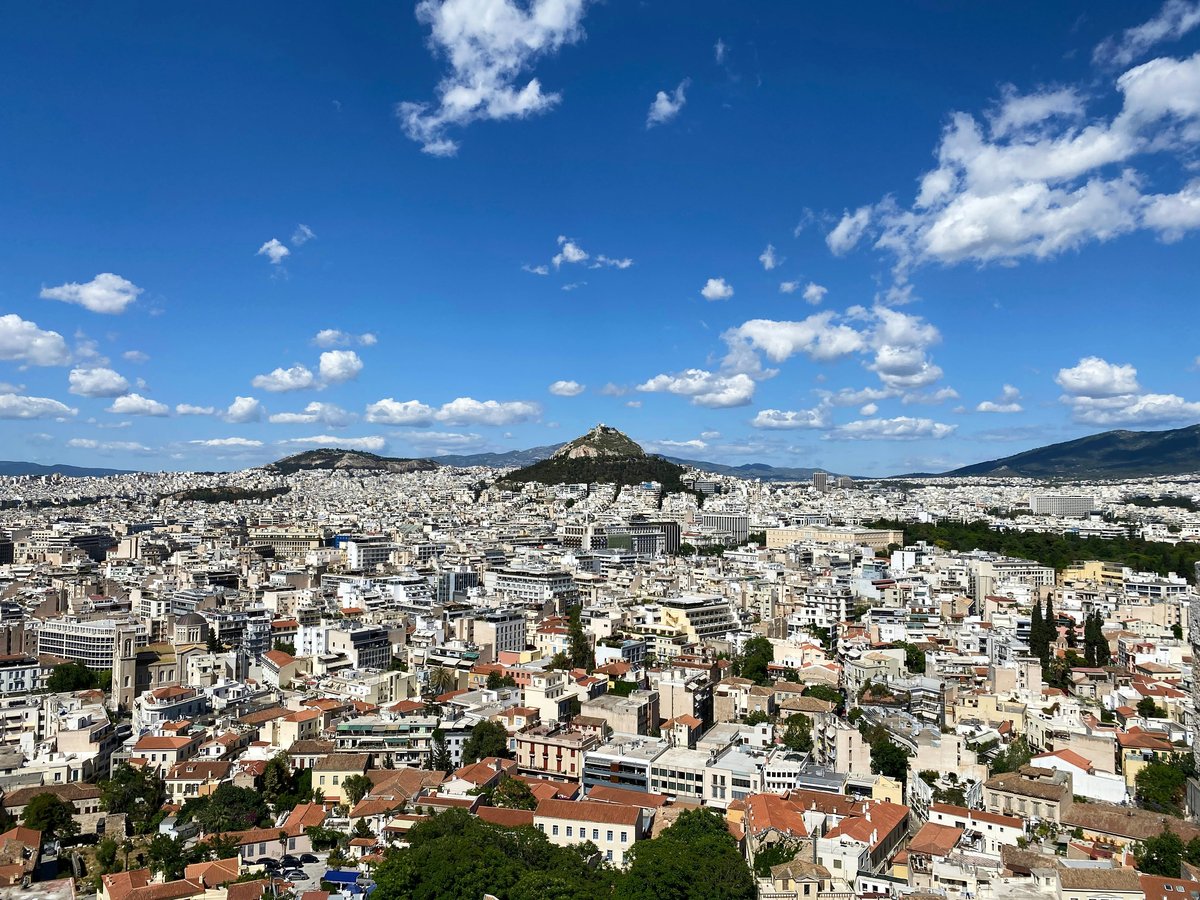
outdoorsAt 277 meters, Lycabettus is the highest point in central Athens. The whitewashed Chapel of St. George sits at the summit, and the 360-degree panorama takes in the Acropolis, the Saronic Gulf, and on clear days the mountains of the Peloponnese. The walk up from Kolonaki takes about 20 minutes on a paved switchback path.
Late-afternoon temperatures in May drop to around 22°C (72°F), making the uphill walk comfortable. The funicular runs until late, but walking lets you stop at viewpoints along the way. Summer heat makes this climb miserable after June.Booking tipNo booking needed. The funicular runs frequently if you prefer not to walk. Arrive 30-40 minutes before sunset for a good spot near the chapel.
Browse the Sunday Monastiraki Flea Market
shoppingThe daily antique shops around Avyssinias Square expand on Sunday mornings into a sprawling open-air market that spills down side streets toward Thissio. Vendors sell everything from old vinyl records and Ottoman-era coins to brass lamps, secondhand books, and Soviet military watches. The texture of the market is gritty and chaotic, not curated.
May mornings sit around 18-20°C (64-68°F), comfortable for browsing outdoors for a couple of hours. By midsummer the Sunday market bakes in 35°C heat, and many vendors stop coming.Walk through the National Garden and Zappeion
outdoorsThe National Garden (Ethnikos Kipos) covers 15.5 hectares behind the Parliament building on Syntagma Square. In May the 500+ plant species are at their lushest, the duck pond is active, and the shaded paths stay 3-4°C cooler than the surrounding streets. The neoclassical Zappeion hall and its surrounding gardens connect to the south end.
May hits the green peak before summer dries out the undergrowth. The garden is at its most fragrant and densely shaded. By August many plants go dormant and the paths feel dusty.Visit the Stavros Niarchos Foundation Cultural Center
cultureThe Renzo Piano-designed complex in the Kallithea neighborhood includes the Greek National Opera, the National Library, and a 21-hectare park with a canal, running paths, a lavender garden, and a great lawn that slopes up to a rooftop with views to the Saronic Gulf. The park is free and open daily.
The lavender garden starts blooming in May, and the park's greenery is at its densest before summer heat browns the grass. Outdoor events in the park's Great Lawn area begin in late May.What to eat in May
In season: fruit
Kerasia (Greek cherries)
Greek cherries from the Pelion peninsula and northern Greece appear at market stalls in Varvakeios Agora and neighborhood laiki (street markets) from mid-May onward. Smaller and more intensely flavored than imported varieties, typically sold by the kilo.
Fraoules (Greek strawberries)
Greek-grown strawberries peak in May, smaller and sweeter than the large imported ones that fill supermarket shelves the rest of the year. Street vendors near Monastiraki Square and Syntagma sell them in small baskets.
Mespila (loquats)
These small orange-yellow fruits turn up at fruit stalls and neighborhood vendors for a short window in May and early June. Slightly tart, with a texture somewhere between an apricot and a pear. Most Athenians eat them as a snack straight from the bag.
On menus now
Aginares a la polita
Artichokes Constantinople-style, braised with potatoes, carrots, dill, and lemon. This is a spring dish that appears on taverna menus across Plaka and Pangrati when artichokes are at their peak in April and May. The version at old-school tavernas in Psyrri tends to use more dill than the tourist-oriented spots.
What to drink
Freddo espresso
While available year-round in Athens cafes, May marks the unofficial start of cold coffee season. The Athenian freddo espresso, shaken with ice into a creamy foam, replaces hot Greek coffee at every kafeneio from Exarchia to Koukaki. Typically costs 2-4 EUR depending on the neighborhood.
In markets
Koukia (fresh broad beans)
Available for about 6 weeks starting in late April. Eaten raw with a slab of feta and crusty bread at ouzeries, or stewed slowly with dill and olive oil. The fresh pods appear in piles at the Varvakeios Agora and neighborhood laiki markets through May.
Regular events in May
Protomagia (May Day)Free
National holiday on May 1st. Athenians make flower wreaths called stefania, picnic in parks, and head to the countryside. Most businesses, banks, and some museums close for the day. Demonstrations and marches typically pass through Syntagma Square.
May 1European Night of MuseumsFree
Part of a continent-wide initiative. Participating Athens museums, including the Acropolis Museum and the Benaki Museum on Koumbari Street, open their doors late into the evening with free admission and special programming. Typically draws long but fast-moving lines.
3rd Saturday of MayAthens and Epidaurus Festival opening
Greece's premier performing arts festival typically launches its Athens program at the Odeon of Herodes Atticus in the final week of May. Early performances might include orchestral concerts, opera, or contemporary dance. The full summer program, running through August, is announced in April or early May.
Late MayBest places this May
Philopappos Hill
parkThe pine-shaded hill southwest of the Acropolis is covered in spring wildflowers through May. The paths up to the Philopappos Monument pass a stone-walled section with clear views of the Parthenon. Locals gather here on May 1st for Protomagia picnics. Quieter and less touristy than Lycabettus.
KoukakiAnafiotika
neighborhoodA tiny cluster of whitewashed Cycladic-style houses on the north slope of the Acropolis, built by stonemasons from the island of Anafi in the 19th century. Bougainvillea and jasmine bloom through narrow stairways in May. The neighborhood holds about 45 houses and feels like a Greek island dropped into the middle of the city.
PlakaVarvakeios Agora (Central Market)
marketThe covered meat and fish hall on Athinas Street, with the open-air fruit and vegetable stalls directly across the road. In May the seasonal produce section is stacked with cherries, strawberries, artichokes, and fresh koukia. The fish side has the briny, cold smell of a working market. Best visited before 11am when selection is fullest.
MonastirakiKerameikos Archaeological Site and Museum
archaeological siteThe ancient cemetery and potters' quarter is one of the least crowded major sites in central Athens. In May the grounds are green and shaded, with wildflowers growing between ancient tombstones. The small on-site museum holds grave stelae and pottery. Far fewer visitors than the Acropolis or Ancient Agora.
ThissioStavros Niarchos Foundation Cultural Center park
parkThe 21-hectare park designed by Renzo Piano includes a canal open for free kayaking, a lavender garden that starts blooming in May, running paths, and a Mediterranean garden with labeled plant species. The rooftop terrace offers an unobstructed view south to the Saronic Gulf. Free entry.
KallitheaNational Archaeological Museum
museumThe largest archaeological museum in Greece, on 28is Oktovriou Street in Exarchia. The Mycenaean gold collection, including the Mask of Agamemnon, and the Antikythera mechanism are worth 2-3 hours alone. In May the crowds are manageable enough to stand in front of exhibits without being pushed through.
ExarchiaFilopappou pedestrian promenade
walkwayThe cobblestoned pedestrian walkway that runs along the south side of the Acropolis, connecting Thissio metro station to the Acropolis Museum. In May, cafe tables spill out onto the promenade, and the evening walk with the Parthenon lit above you and the smell of grilled souvlaki drifting from Thissio is one of the better free experiences in the city.
Thissio
Your packing checklist
Tick items off as you pack. Your progress saves in this browser.
All packed — have a great trip.
Insider tips
The Acropolis is noticeably less crowded before 9am and after 5pm. In May the site stays open until 8pm, so a late-afternoon entry gives you better photography light and fewer tour groups around the Parthenon. The 8am opening is the quietest slot of all.
Skip the tourist-oriented tavernas on the main stretch of Adrianou Street in Plaka. Walk 10 minutes south into Koukaki or east into Pangrati for the same dishes at roughly 30-40% lower prices, with a crowd that's mostly Greek.
The 3rd-floor restaurant at the Acropolis Museum has the same direct Parthenon view as the expensive cocktail bars in Monastiraki, and coffee costs 4-5 EUR. It's open to anyone with a museum ticket.
If Protomagia falls during your trip, head to Philopappos Hill in the morning. Athenians gather to picnic, fly kites, and weave flower wreaths. It's one of the few times you'll see the parks genuinely full of local families rather than tourists.
The neighborhood laiki (open-air street markets) rotate through Athens neighborhoods on fixed days of the week. Prices for seasonal produce like cherries, strawberries, and koukia run about half of what the tourist-facing shops on Ermou Street charge. Ask your hotel which day the nearest laiki runs.
Avoid these mistakes
- Planning a full sightseeing day on May 1st without checking closures. Protomagia shuts down most museums, shops, banks, and many restaurants across Athens. The Acropolis typically stays open with reduced hours, but confirm the schedule before your visit.
- Visiting the Acropolis between 11am and 3pm in late May. By the last week of the month, midday temperatures on exposed rock with no shade can reach 28-30°C (82-86°F), which is more draining than it sounds when you're climbing steep marble steps. Go at 8am or after 5pm.
- Packing only summer clothes and no layers. May evenings in Athens regularly drop to 16°C (61°F), and the breeze on rooftops or by the waterfront at Piraeus makes it feel cooler still. One light jacket saves the evening.
- Assuming you can swim comfortably at the coastal beaches. Sea temperatures along the Attica coast are still 19-20°C (66-68°F) in May, which most visitors from warmer climates find uncomfortably cold. The beaches at Vouliagmeni and Glyfada are fine for sunbathing, but relaxed swimming typically waits until mid-June.
Practical tips for May
Book Acropolis timed-entry tickets online at least a few days ahead, since walk-up queues grow throughout May as visitor numbers rise toward summer levels. The Athens and Epidaurus Festival announces its program in April or early May, and popular performances at the Odeon of Herodes Atticus can sell out within days of release. Hotels in Plaka, Monastiraki, and Koukaki fill up for late May, so booking 3-4 weeks in advance is wise. The Athens metro runs from 5:30am to midnight on weekdays, extending to 2am on Fridays and Saturdays. Tipping at restaurants is not obligatory, but rounding up by 5-10% is standard practice. Most churches and some museums enforce a dress code covering shoulders and knees. Pharmacies rotate Sunday and holiday duty. If you need one on May 1st, check the posted schedule on the door of any pharmacy to find the nearest one open. The Athens transport system accepts a rechargeable Ath.ena card, which works across metro, bus, tram, and trolley. A 5-day tourist pass costs around 9 EUR.
FAQ
Is May a good time to visit Athens?
May is likely the single best month to visit Athens. Temperatures average 25°C (77°F) during the day, comfortable for walking archaeological sites without the 35°C (95°F) heat of July and August. Crowds are present but manageable, especially in early May. Hotel rates run 20-30% below peak summer prices. The main thing to watch for is Protomagia on May 1st, when banks, shops, and some museums close for the national holiday.
What is the weather like in Athens in May?
Expect warm, mostly dry days. The average high is 25.2°C (77°F) and the low is 16.0°C (61°F). Humidity sits at a comfortable 54%. Athens sees about 36mm of rain across roughly 5 days in May, typically as brief afternoon showers that clear within an hour. Late May can push toward 28-30°C (82-86°F) on warmer days. Evenings are pleasant but cool enough for a light jacket.
Is Athens crowded in May?
Athens in May is noticeably busier than winter months but still well below the July-August peak. Early May tends to be quieter than late May, when European school holidays start in several countries. You'll encounter moderate queues of 10-20 minutes at the Acropolis during midday, compared to 45-60 minutes in midsummer. Restaurants in Plaka that need reservations in July are generally walk-in friendly in May.
Can you swim in the sea in Athens in May?
Technically yes, but the water is still cool. Sea temperatures along the Attica coast reach about 19-20°C (66-68°F) in May, which most people find bracing rather than comfortable. The organized beaches at Vouliagmeni and Glyfada are open and popular for sunbathing, but relaxed swimming typically starts in mid-June when the water warms to 22-23°C (72-73°F). Lake Vouliagmeni, fed by thermal springs, stays around 22-25°C year-round and is an alternative.
What should I wear in Athens in May?
Light layers work best. Cotton or linen during the day when temperatures reach 25°C (77°F), and a light jacket or cardigan for evenings that drop to 16°C (61°F). Pack comfortable walking shoes with grip, as central Athens is hilly and the marble paths around the Acropolis are slippery when wet. A light scarf is useful for church visits that require covered shoulders. Sunglasses and a hat are not optional since the Mediterranean sun on white marble creates strong glare.
Things to Do in Athens in May
 Free cancellation
 Best of Athens Half Day Private Tour
Day trip: free cancellation.
via Viator Free cancellation
 All Day Cruise -3 Islands to Agistri,Moni, Aegina with lunch and drinks included
Day trip: 10 hours, free cancellation.
via Viator Free cancellation
 Cape Sounion and Temple of Poseidon Half-Day Small-Group Tour from Athens
Day trip: free cancellation.
via Viator Free cancellation
 Athens Full Day Private Tour
Day trip: 8 hours, free cancellation.
via Viator Free cancellation
 Athens All Included: Acropolis and Museum Guided Tour with Ticket
Day trip: 3 hours, free cancellation.
via Viator Free cancellation
 Athens cruise: Agistri, Moni/Metopi, Aegina with lunch & drinks
Day trip: 10 hours, free cancellation.
via ViatorFind a flight to Athens
Live fares to Athens appear here once cookies are accepted.
Last verified by automated review (v1.7.2) on . What is automated review?