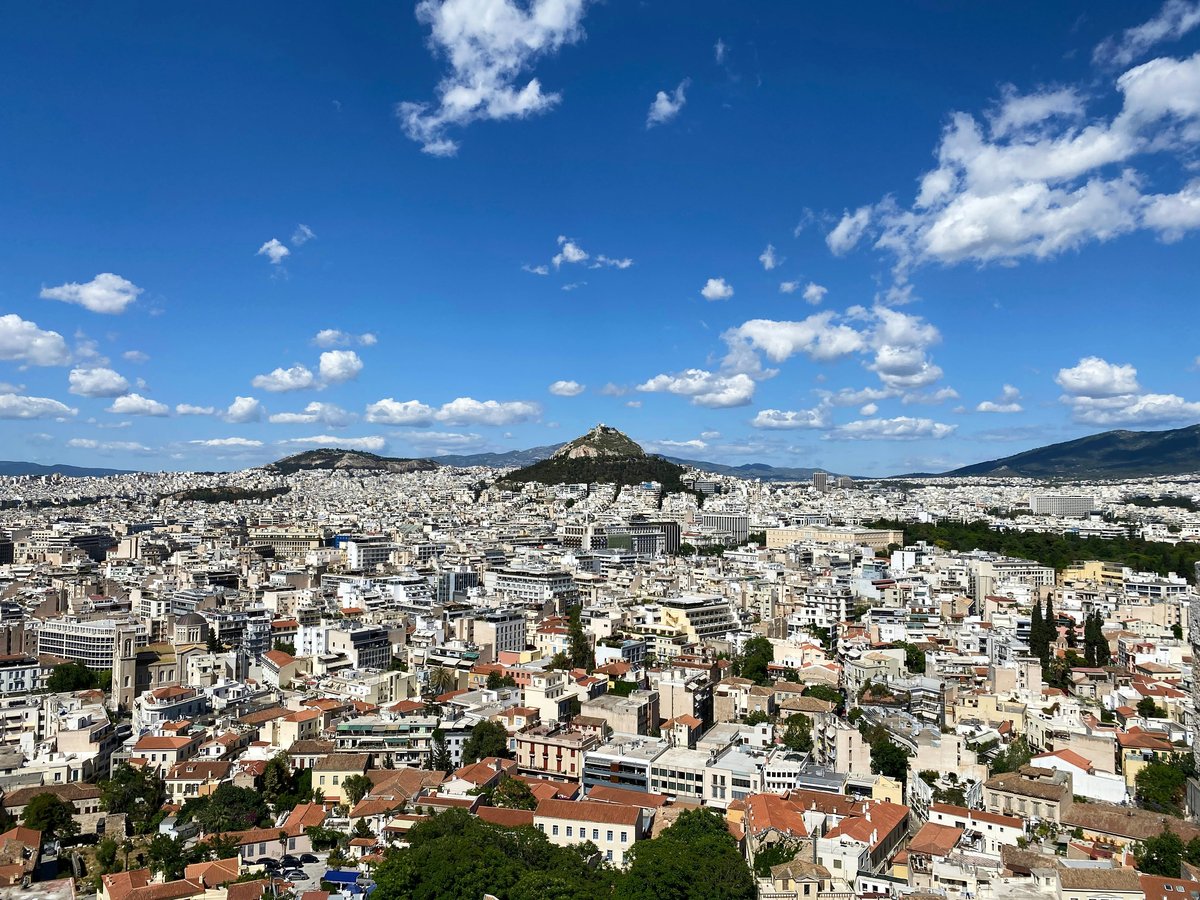
Athens might be the only European capital where 2,500 years of history sit in plain view from the sidewalk. The Parthenon is visible from half the city, from the cafes of Plaka, from the rooftops of Monastiraki, from a window seat over a €2.50 freddo cappuccino on Adrianou Street. Athens gets roughly 300 sunny days a year, which matters because so much of what makes this city worth visiting happens outdoors and costs nothing. You can walk up Filopappou Hill and sit under the pines looking at the western face of the Acropolis. You can browse the Monastiraki flea market on a Sunday morning, watch the Evzones' hourly guard change at Syntagma Square, eat a €1.50 koulouri from a cart near Omonia. The National Archaeological Museum and the Acropolis Museum both waive their entry fees on the first Sunday of each month from November through March, and on national holidays like March 25 and October 28. The Stavros Niarchos Foundation Cultural Center, designed by Renzo Piano and opened in 2016, maintains a permanent policy of free admission to its park, its library, and its year-round concert programming.
Free attractions
-
Filopappou Hill (Λόφος Φιλοπάππου)
Pine-shaded hill directly across from the Acropolis, always free to walk. The paths wind past the Philopappos Monument, a Roman-era marble tomb built between 114 and 116 AD. The western slope catches the sunset. You'll smell warm pine resin on summer afternoons, and the cicadas are loud enough by July to drown out traffic from Dionysiou Areopagitou below. The summit view of the Parthenon, about 300 meters away, is arguably the best in Athens.
ThissioViewpoint and park -
Areopagus Hill (Άρειος Πάγος)
A bare limestone outcrop below the Acropolis entrance, about a 5-minute walk from Monastiraki metro. The rock surface is polished smooth from centuries of foot traffic and gets slippery when wet. The Apostle Paul reportedly addressed the Athenians here around 51 AD, and a bronze plaque with the text of Acts 17 is set into the rock face. Locals and visitors sit here at dusk, watching the city light up below. Always free, no operating hours, no entrance gate.
PlakaViewpoint and historic site -
Lycabettus Hill (Λόφος Λυκαβηττού)
The highest point in central Athens at 277 meters. Walking to the top is free, though the path from upper Kolonaki takes 30 to 40 minutes and gets steep near the summit. The whitewashed Chapel of Agios Georgios sits at the peak, and on a clear day you can see the Saronic Gulf islands. A funicular runs up for about €10 round trip, but the walk through the pine forest is more interesting. The temperature drops noticeably on the ascent, even in August.
KolonakiViewpoint and green space -
National Garden (Εθνικός Κήπος)
A 15.5-hectare park behind the Parliament building, open from dawn to dusk, always free. Queen Amalia commissioned the planting in 1838, and the mature canopy keeps it 5 to 8 degrees cooler than the surrounding streets in summer. Inside you'll find a small duck pond, a botanical museum, and quiet gravel paths. The Zappeion exhibition hall sits at the southern end. The garden connects to the Panathenaic Stadium area if you walk all the way through.
SyntagmaPark -
Stavros Niarchos Foundation Cultural Center (ΚΠΙΣΝ)
Renzo Piano designed this 210,000-square-meter complex in Kallithea, which opened in 2016. It houses the National Library of Greece and the Greek National Opera, and the park, canal, and public programming are permanently free. The rooftop terrace looks out toward the Saronic Gulf. Summer evenings bring free outdoor film screenings and concerts on the Great Lawn. The complex is about 25 minutes from Syntagma by tram.
KallitheaCultural center and park -
Syntagma Square and the Evzones Guard Change
The Evzones, Greece's presidential guard, perform a changing ceremony every hour at the Tomb of the Unknown Soldier in front of the Parliament building. The elaborate Sunday ceremony at 11:00 features the full guard in traditional fustanella uniforms with 400-pleat skirts. The sound of their tsarouchia shoes striking the marble is distinctive. Always free, every day, regardless of weather.
SyntagmaCeremony and public square -
Panagia Kapnikarea (Παναγία Καπνικαρέα)
An 11th-century Byzantine church sitting in the middle of Ermou Street, Athens' main commercial pedestrian road. You'll be walking past Zara and H&M, and suddenly there's a thousand-year-old church with original frescoes. It remains an active parish, so admission is always free. The interior is small and dim, thick with the scent of beeswax candles and incense.
MonastirakiHistoric church -
Pedion tou Areos (Πεδίον του Άρεως)
The largest park in central Athens at roughly 27 hectares, north of the National Archaeological Museum. Wide tree-lined avenues, a children's playground, shaded benches. Pedion tou Areos tends to feel more local than the National Garden, with fewer tourists and more Athenian families on the paths. The park connects the Victoria metro station area to Exarchia. Free and open at all hours.
Pedion AreosPark -
Metropolitan Cathedral of Athens (Μητρόπολη Αθηνών)
The main Orthodox cathedral in Athens, completed in 1862 on Mitropoleos Square. Inside you'll find painted ceilings and a gilt iconostasis. Next to it stands the smaller Agios Eleftherios, also called Mikri Mitropoli, a 12th-century church built partly from ancient marble fragments and column drums. Both are always free to enter. The plaza fills with pigeons and the smell of roasted chestnuts during winter months.
PlakaHistoric church -
Hadrian's Arch (Πύλη του Αδριανού)
A Roman arch from 131 AD, standing 18 meters tall on Amalias Avenue. It originally marked the boundary between the ancient Greek city and the Roman quarter built by Emperor Hadrian. You can walk right up to it from the sidewalk. Worth noting that the Temple of Olympian Zeus is visible directly through the arch, though the temple grounds require a paid ticket. The arch itself is always free to view.
PlakaAncient monument
Free activities
-
Walking Anafiotika
A tiny neighborhood on the north slope of the Acropolis that looks like a Cycladic island village transplanted onto an Athenian hillside. Workers from the island of Anafi built these whitewashed houses in the 1840s and 1850s, replicating their island architecture. The lanes are narrow enough to touch both walls at once. Bougainvillea spills over stone staircases, and cats hold the right of way at every turn. The entrance is easy to miss. Walk up Stratonos Street from Plaka and follow the signs.
PlakaWalking route -
Monastiraki Flea Market
Avissinias Square and the surrounding streets fill with vendors every day, but Sunday is when the market swells. Tables cover the sidewalks with old records, brass doorknobs, secondhand cameras, Turkish coffee sets, and things that might charitably be called antiques. The haggling is part of the experience. You don't need to buy anything to enjoy the atmosphere. The smell of grilled corn drifts in from the street carts on Ifestou. The market has been running in some form since the Ottoman period.
MonastirakiMarket -
Walking Dionysiou Areopagitou
The main pedestrian boulevard below the Acropolis, running about 1 kilometer from Thissio metro to the Acropolis Museum. Street musicians set up along the route, the Acropolis rises above you on the left, and the marble underfoot is polished smooth. It connects to Apostolou Pavlou, which continues west below Filopappou Hill. The walk is flat and shaded in stretches, and on weekend evenings the whole strip fills with Athenians out for a stroll.
MakrigianniWalking route -
Browsing Exarchia
Athens' counterculture quarter sits north of the Polytechnic campus on 28is Oktovriou Street. The walls are covered in street art and political murals, some of them genuinely striking. The neighborhood has a strong cafe culture, with small squares like Plateia Exarchion filled with locals at all hours. The November 17 memorial at the Polytechnic gates marks the 1973 student uprising against the military junta. Free to explore, though it has a different feel from the tourist-heavy center.
ExarchiaWalking route -
Watching Sunset from Pnyx Hill
The Pnyx was the meeting place of the Athenian democratic assembly from around the 6th century BC. The carved stone platform where orators like Demosthenes and Pericles spoke still faces the Acropolis. It sits between Filopappou and the Acropolis, and is less crowded than Areopagus at sunset. The view takes in the Parthenon, the Agora, and the city spreading north toward Lycabettus. Free access at all times.
ThissioViewpoint
Free events
-
First Sunday Free Museum Days
First Sunday of each month, November through MarchMajor state-run museums and archaeological sites waive admission on the first Sunday of each month from November through March. This includes the National Archaeological Museum, the Acropolis Museum, the Ancient Agora, and the Roman Agora. Lines can be long at the Acropolis Museum by 10:00, so arriving at opening helps. The policy also applies on select national holidays, including March 25 and October 28.
Various museums and sites across Athens -
SNFCC Free Outdoor Events
Year-round, concentrated May through OctoberThe Stavros Niarchos Foundation Cultural Center runs a full calendar of free programming on the Great Lawn and in the Agora area. Summer brings open-air cinema screenings, typically on Friday evenings. Free yoga sessions, dance workshops, and live music concerts happen regularly from May through October. Check the SNFCC website for the current month's schedule.
Stavros Niarchos Foundation Cultural Center, Kallithea -
Changing of the Guard, Full Ceremony
Every Sunday at 11:00The elaborate Sunday ceremony features the full Evzones detachment marching down Vasilissis Sofias Avenue to Syntagma Square in dress uniform. The fustanella skirts have exactly 400 pleats, representing the years of Ottoman rule. The ceremony starts at 11:00 and lasts about 15 minutes. It draws a large crowd, so arriving by 10:30 secures a better view along the railing.
Tomb of the Unknown Soldier, Syntagma Square -
Athens Open Air Film Festival
June through SeptemberFree outdoor screenings run through the summer months at various locations around the city, including Technopolis in Gazi and parks. The festival typically screens a mix of Greek and international films. Screenings start after dark, usually around 21:00 in June and July. Bring something to sit on. The program is announced each May.
Various outdoor venues, primarily Technopolis in Gazi -
Technopolis Jazz and Music Events
Year-round, schedule variesThe old gasworks complex in Gazi, converted into the Technopolis cultural venue, hosts free concerts and exhibitions throughout the year. The restored 19th-century industrial buildings have a distinctive brick exterior. Events range from jazz nights to book fairs to digital art exhibitions. The venue sits next to Kerameikos metro station.
Technopolis, Pireos 100, Gazi
Free Beaches Near Athens
The Athenian Riviera stretches south along the Saronic Gulf coast, and several beaches are free to access. Kavouri Beach in Vouliagmeni is a sandy stretch popular with local families, about 40 minutes from Syntagma by bus 122. Glyfada's free municipal beaches tend to be packed on summer weekends but are easy to reach on tram line 5. Voula's A beach has been free to enter since the municipality dropped the gate fee. Mind you, the water quality along the closer-in stretches varies, and the sand at Alimos can feel gritty. For cleaner swimming, the bus ride to Kavouri or Lagonisi, about 50 minutes south on the KTEL Attikis line, is worth it. The sea temperature reaches about 26°C by late July.
Free Water and Practical Tips
Athens tap water is drinkable and comes from the Mornos reservoir, about 200 kilometers northwest of the city. Refill bottles at any public fountain or bathroom tap. Free public Wi-Fi covers Syntagma Square, Monastiraki Square, and the Thissio pedestrian zone, though the connection tends to be slow by mid-afternoon when everyone is on it. The Athens metro itself is worth a look at no extra cost if you're already riding. Syntagma station has a glass-walled archaeological display showing layers of Athenian history from the 4th century BC through the Ottoman period, visible from the platform. Monastiraki station has a similar excavation window. Public restrooms are scarce, but the larger museums have clean facilities, and most cafes won't object if you buy a €1.50 water.
Free Walking Routes Beyond the Center
Ermou Street runs as a pedestrian zone from Syntagma to Monastiraki, roughly 800 meters of shops, churches, and street performers. To be fair, it's a commercial strip, but Kapnikarea church sits right in the middle of it, which makes the walk more interesting than a typical shopping street. The Kerameikos archaeological site neighborhood, west of Monastiraki, has free-access streets running through what was ancient Athens' cemetery district. Plaka's narrow streets south of Adrianou feel almost like a village, with neoclassical houses painted in ochre and terracotta. Walking from the Panathenaic Stadium along Vasileos Konstantinou Avenue to the National Garden takes about 15 minutes and passes the bust-lined path along the Zappeion gardens.
FAQ
Are museums in Athens really free on certain days?
Several major state-run museums and archaeological sites waive admission on the first Sunday of each month from November through March. This includes the National Archaeological Museum, the Acropolis Museum, the Ancient Agora, and Kerameikos. Free admission also applies on national holidays like March 25 (Independence Day) and October 28 (Ohi Day). The Benaki Museum on Pireos Street maintains free admission on Thursdays. Private museums generally do not participate.
Is it safe to walk around Athens at night for free?
Central Athens is generally walkable at night, particularly in Plaka, Monastiraki, Syntagma, Thissio, and Koukaki. Omonia Square and parts of Metaxourgeio have a rougher feel after dark, though this has been improving. Exarchia is lively late into the night but has a different atmosphere. Standard urban precautions apply. The metro runs until about midnight on most lines, and until 2:00 on Friday and Saturday nights.
What is the best free viewpoint in Athens?
Filopappou Hill gives you the closest unobstructed view of the Parthenon's western face, roughly 300 meters away. Areopagus Hill is more popular at sunset because it's easier to reach from Monastiraki, but it gets crowded and the rock is slippery. Lycabettus Hill at 277 meters is the highest point and offers a 360-degree panorama, but the walk up takes 30 to 40 minutes. Each has a different character. Filopappou is the quietest of the three.
How much does the Athens metro cost, and are there free transport options?
A single metro ticket currently costs €1.20 and is valid for 90 minutes across metro, bus, tram, and trolley. There is no free public transport in Athens, but most of the central attractions are within a 3-kilometer walking radius of Syntagma Square. A 5-day tourist ticket runs €8.20 if you plan to use buses and trams to reach spots like the SNFCC or the coast. Children under 6 ride free.
Can you swim for free in Athens?
Several beaches along the Athenian Riviera are free to access. Kavouri Beach in Vouliagmeni is one of the better free options, reachable by bus 122 in about 40 minutes from central Athens. Glyfada has free municipal beach areas along the tram line. The sea is warm enough for comfortable swimming from roughly June through mid-October, with water temperatures peaking around 26°C in late July and August.
Last verified by automated review (v1.7.2) on . What is automated review?