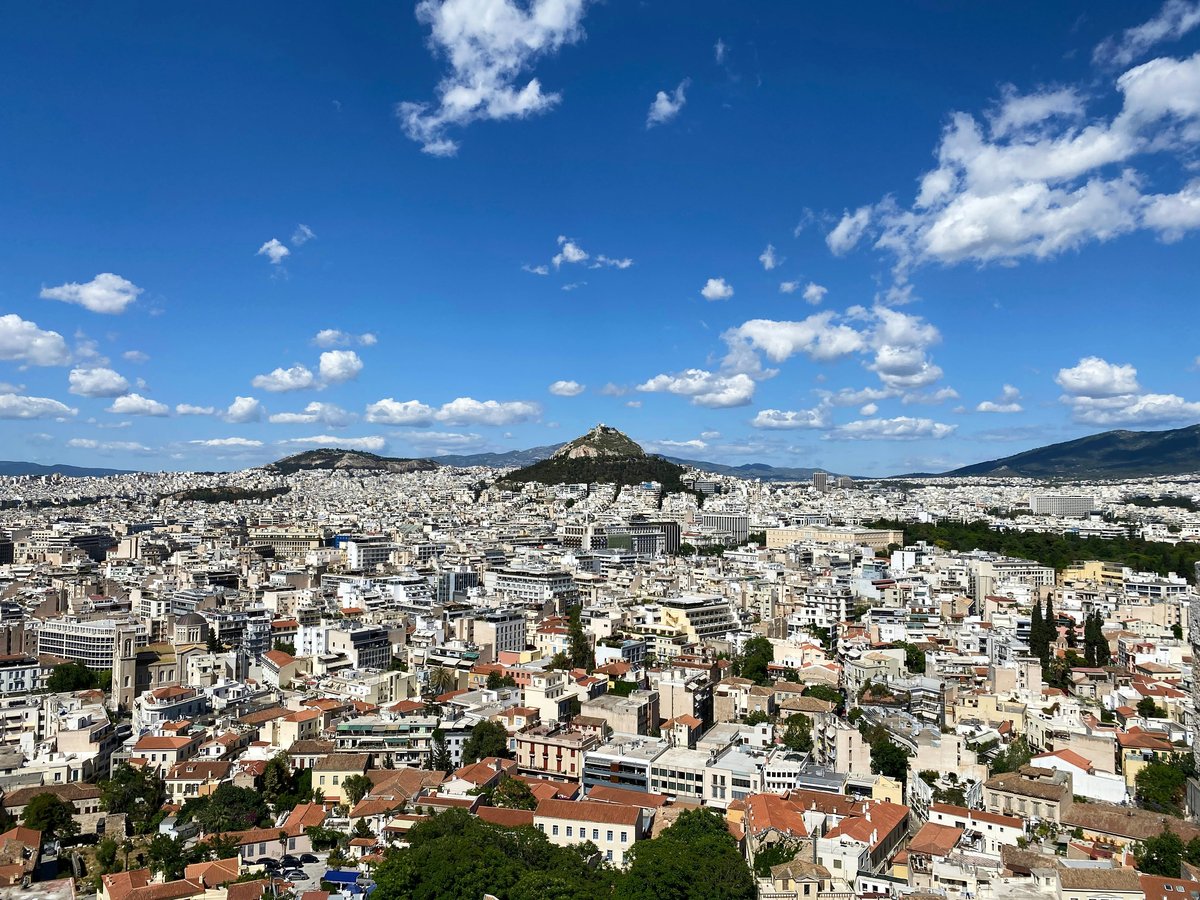
Athens sits in a basin ringed by mountains on three sides and open to the Saronic Gulf on the fourth. Mount Hymettus rises to 1,026 meters along the eastern skyline, Mount Parnitha tops out at 1,413 meters to the north, and Mount Penteli reaches 1,109 meters to the northeast. That triple wall of limestone and pine forest means genuine trail networks start less than 30 minutes from Syntagma Square. The city itself holds more green space than most visitors expect. Philopappou Hill, Lycabettus Hill, and the National Garden sit within walking distance of the Acropolis. Between October and May, temperatures hover in a comfortable range for hiking, cycling, and climbing. July and August tend to push past 38°C in the basin, which shifts the smart outdoor hours to before 9 a.m. or after 6 p.m. The Athenian Riviera, running from Palaio Faliro south to Cape Sounion, gives the city roughly 70 kilometers of accessible coastline for swimming, kayaking, and coastal walks. Wind patterns in the Saronic Gulf pick up reliably from the north (the meltemi) between June and September, which has made the area south of Vouliagmeni a consistent spot for windsurfing and small-boat sailing.
Outdoor activities
-
Rock Climbing at Hymettus
The quarried limestone faces on the western slopes of Mount Hymettus, near the Kaisariani Monastery area, offer sport climbing routes from 5a to 7b+ on the French scale. About 40 bolted routes currently exist across several small crags. The rock is compact grey limestone with good friction when dry. You'll find some single-pitch routes of 15 to 25 meters. The approach from the Kaisariani parking area takes roughly 20 minutes on foot. A small community of Athenian climbers maintains the bolts, though you should still visually inspect every anchor.
- Difficulty
- 5a to 7b+ (French sport grades)
- Duration
- Half day
- Best season
- October through April, when temperatures on the south-facing walls stay manageable
-
Road Cycling on the Athens Riviera
The coastal road from Palaio Faliro to Cape Sounion covers roughly 65 kilometers one way, following the old Athens-Sounion road past Glyfada, Vouliagmeni, and Lagonisi. The route is mostly flat until Saronida, then rolls through low hills before the final climb to the Temple of Poseidon at the cape. Weekend mornings before 8 a.m. see lighter traffic. Several cycling clubs in Athens run group rides on this route, typically departing from the Flisvos Marina area around 6:30 a.m. on Saturdays. You can rent decent road bikes from shops in Glyfada for around 25 to 40 euros per day.
- Difficulty
- Moderate, with one sustained climb near Sounion
- Duration
- 4 to 6 hours round trip depending on pace
- Best season
- March through June and September through November
-
Trail Running on Lycabettus Hill
Lycabettus Hill rises 277 meters above sea level in the Kolonaki district, and the network of paths circling and ascending it has become the go-to after-work trail run for central Athens. The main loop path around the base is about 1.5 kilometers on packed dirt. The summit trail gains roughly 150 meters of elevation in under a kilometer, with uneven stone steps in places. You'll share the paths with walkers and the occasional stray dog. The open-air theatre partway up makes a good landmark for interval repeats.
- Difficulty
- Easy to moderate depending on the route
- Duration
- 30 to 60 minutes
- Best season
- Year-round, though summer runs are best before 8 a.m.
-
Mountain Biking on Mount Parnitha
The former royal hunting grounds on Mount Parnitha, now a national park about 35 kilometers north of central Athens, have a network of dirt roads and single-track through Aleppo pine and Greek fir forest. The main fire roads from the Bafi refuge area toward the summit are rideable on any mountain bike. Some narrower trails off the main tracks require full-suspension bikes due to loose rock and root sections. The Tatoi estate trails on the lower southern slopes tend to be better maintained and less technical. Watch for wild boar, especially near dawn. The park suffered badly in the 2007 fire but has regenerated significantly.
- Difficulty
- Moderate to difficult depending on trail choice
- Duration
- 3 to 5 hours
- Best season
- April through June and September through November
-
Sea Kayaking along the Vouliagmeni Coast
Several outfitters based near Vouliagmeni Lake and the Limanakia coves run guided sea kayak trips along the rocky coast south of Vouliagmeni. The typical route paddles from Vouliagmeni Beach south past the small sea caves and limestone cliffs toward Varkiza, covering 8 to 12 kilometers round trip. The water is typically calm in the morning before the afternoon wind builds. You'll paddle over water that drops from turquoise shallows to a deep blue within 50 meters of shore. Expect to pay around 40 to 60 euros for a half-day guided trip including equipment.
- Difficulty
- Easy to moderate, suitable for beginners in calm conditions
- Duration
- 3 to 4 hours
- Best season
- May through October
Day hikes
-
Mount Hymettus Ridge Walk (Kaisariani to Profitis Ilias)
Starting from the Kaisariani Monastery, this trail follows the western ridge of Hymettus up to the Profitis Ilias chapel near the summit at 1,026 meters. The route passes through pine forest on the lower slopes, then opens to scrubby hillside with views across the entire Athens basin. On clear days, you can see the Saronic islands. The path is well-worn but not always well-marked. Bring a GPS track or the Anavasi 1:10,000 Hymettus map. The final section to the summit is rocky and exposed. That said, the chapel at the top has a certain quiet to it.
- Difficulty
- Moderate, with about 700 meters of elevation gain from Kaisariani
- Duration
- 4 to 5 hours round trip
- Best season
- October through May, avoid midsummer heat on the exposed upper ridge
-
Mount Parnitha Summit via Bafi Refuge
Parnitha is the highest mountain in the immediate Athens area at 1,413 meters. The standard route starts from the Bafi refuge, which you reach by car (about 40 minutes from central Athens). From Bafi, the trail climbs through fir forest, crosses a plateau, and reaches the summit in roughly 3 hours. The forest here was heavily damaged in the 2007 wildfire but has been regrowing steadily. You might spot red deer, which were reintroduced to the park. The trail can be muddy in winter and occasionally sees snow above 1,200 meters from December through February.
- Difficulty
- Moderate to difficult, with roughly 600 meters of elevation gain from the refuge
- Duration
- 5 to 7 hours round trip
- Best season
- April through June and September through November
-
Sounion Coastal Path
A walking route follows parts of the old coastal track from Lagonisi south toward the Temple of Poseidon at Cape Sounion, roughly 15 kilometers one way. Some sections run along the road, but several stretches pass through low scrub and maquis directly above the sea cliffs. The temple at the cape dates to 440 BC and sits 60 meters above the water. You'll want to time your arrival for late afternoon if possible. The light on the remaining Doric columns against the Aegean tends to be best in the 2 hours before sunset. Local buses from Athens reach Lagonisi, making this feasible as a one-way walk with a bus return.
- Difficulty
- Easy to moderate, mostly flat with some rocky sections near the cape
- Duration
- 4 to 5 hours one way
- Best season
- March through May and October through November
-
Penteli Mountain and Monastery Loop
Mount Penteli, northeast of Athens, is where the marble for the Parthenon was quarried. A loop trail from the Penteli Monastery at about 450 meters elevation climbs through pine forest past old marble quarry sites, reaching the antenna-studded summit at 1,109 meters. The quarry scars are still visible, and you can see chisel marks on exposed marble faces that have been there since the 5th century BC. The lower trails near the monastery are popular with families. Above the tree line, the route gets rockier and the wind picks up.
- Difficulty
- Moderate, approximately 650 meters of elevation gain
- Duration
- 4 to 6 hours for the full loop
- Best season
- March through June and September through November
-
Philopappou Hill to Filopappou and Pnyx Circuit
For visitors with limited time, this 3-kilometer urban walk connects the Acropolis south slope path with Philopappou Hill and the Pnyx, all within the archaeological pedestrian zone. The route climbs about 100 meters total across gentle stone paths and ancient steps. It is the most accessible hike in Athens and still feels surprisingly removed from the city. Wild capers grow from the rock walls in spring, and the smell of thyme carries on the wind. The circuit takes you past the Socrates prison cave site, the Pnyx speaker's platform, and the Philopappos Monument.
- Difficulty
- Easy, suitable for all fitness levels
- Duration
- 1.5 to 2 hours at a relaxed pace
- Best season
- Year-round, with wildflowers in March through April
Water activities
-
Swimming at Vouliagmeni Lake
This thermal lake at the foot of the Vouliagmeni peninsula stays at 22 to 29°C year-round, fed by underground thermal springs. The water has a slightly brackish mineral quality to it. The lake is small, roughly 100 meters across, with limestone cliffs on one side and a paid beach facility on the other. Entry currently costs around 15 euros on weekdays and 18 euros on weekends, which includes a sunbed and umbrella. The underwater caves connecting to the sea have claimed several divers over the years, and cave diving here is prohibited. For open swimming, the lake is calm and peculiar, warm enough to swim comfortably even in January.
- Difficulty
- Easy, calm water
- Duration
- 1 to 3 hours
- Best season
- Year-round, though the contrast with the cool air makes winter swimming particularly memorable
-
Open Water Swimming at Limanakia Coves
The string of small rocky coves between Vouliagmeni and Varkiza, known collectively as Limanakia, offers some of the cleanest swimming water accessible by city bus. The coves are natural, with no sand beaches. You climb down rocky ledges to reach the water. Depth drops off quickly, and the water clarity is often 10 to 15 meters of visibility. Some coves are clothing-optional. The rocks can be sharp, so water shoes help. During summer, especially on weekends, the popular coves get crowded by mid-morning. Bus 122 from Vouliagmeni stops nearby.
- Difficulty
- Easy swimming, moderate access (rocky entry)
- Duration
- Half day
- Best season
- May through October
-
Sailing in the Saronic Gulf
The Saronic Gulf islands of Aegina, Poros, Hydra, and Spetses sit between 1 and 3 hours from the marinas at Alimos and Flisvos. Charter companies offer bareboat and skippered rentals from Alimos Marina, which has over 1,000 berths and is the largest marina in Greece. A 30-foot bareboat might run 200 to 350 euros per day in high season. The meltemi wind blows from the north-northeast between June and September, typically building from late morning to Force 4 to 6 by afternoon. Morning departures and sheltered anchorages are the standard pattern. Aegina sits only about 17 nautical miles from Alimos, making it feasible for day sails.
- Difficulty
- Requires sailing certification for bareboat, no experience needed for skippered charters
- Duration
- Full day to multi-day
- Best season
- May through October, with the strongest winds in July and August
-
Stand-Up Paddleboarding at Kavouri Beach
Kavouri Beach in Vouliagmeni has become one of the more popular SUP spots on the Athenian Riviera. The bay is partially sheltered, so morning conditions before the wind picks up are usually glassy. Several rental stands along the beach offer boards for around 15 to 20 euros per hour. The beach itself is a mix of sand and fine pebble with entry free of charge. From the water, you get a different perspective on the pine-covered Vouliagmeni peninsula. Paddle north along the coast toward the Astir Beach complex to see the rocky shoreline and the occasional small cave entrance.
- Difficulty
- Easy in calm morning conditions
- Duration
- 1 to 2 hours
- Best season
- May through October, mornings before the wind builds
-
Scuba Diving off the Athens Riviera
Several PADI-affiliated dive centers operate along the coast between Glyfada and Lagonisi. Common dive sites include the reef off Lagonisi at 12 to 25 meters depth and wall dives near Anavyssos. Visibility ranges from 10 to 30 meters depending on season and recent weather. The water temperature drops to about 15°C in February and reaches 26°C by August. A 5mm wetsuit is standard from November through May. Expect to see grouper, octopus, moray eels, and nudibranch on most dives. A two-tank boat dive with equipment typically costs 80 to 110 euros. Worth noting, Greece has historically restricted diving near archaeological sites, but many areas along the Riviera are open.
- Difficulty
- Beginner sites available (PADI Open Water sufficient), advanced sites to 40 meters
- Duration
- Half day for a two-tank dive
- Best season
- June through October for warm water and best visibility
Parks & gardens
-
National Garden (Ethnikos Kipos)
FreeThis 15.5-hectare garden behind the Hellenic Parliament on Syntagma Square dates to the 1840s, when Queen Amalia commissioned the planting. The canopy is dense enough to drop temperatures by 5 to 7 degrees on a summer afternoon. Over 500 species of plants and trees fill the grounds, including palms, cypresses, and Judas trees. The paths are shaded gravel, winding past a small botanical museum, a duck pond, and a few rather melancholy animal enclosures. It feels miles from the traffic outside, though you can still hear it. The Zappeion exhibition hall sits at the southern end.
Highlights: Ancient Roman mosaic fragments near the east entrance, the shaded duck pond, over 500 labeled plant species, the Zappeion gardens extending south toward the Panathenaic Stadium
-
Philopappou Hill (Hill of the Muses)
FreeThis 147-meter hill directly south of the Acropolis is threaded with stone-paved paths through Mediterranean scrub, olive trees, and Aleppo pines. The Philopappos Monument from 116 AD sits at the summit, and from there the view north to the Parthenon is probably the most photographed angle in Athens. On Sunday mornings the paths fill with families and joggers. The Pnyx, the ancient assembly ground, occupies the northeast slope. Mind you, the paths get slippery when wet, especially the marble-topped sections near the monument.
Highlights: Philopappos Monument (116 AD), direct Acropolis views from the summit, the Pnyx assembly site, Church of Agios Dimitrios Loumbardiaris with its 16th-century frescoes
-
Stavros Niarchos Park
FreeOpened in 2016 as part of the Stavros Niarchos Foundation Cultural Center in Kallithea, this 21-hectare park was designed by Renzo Piano. The sloping green roof of the building beneath creates a hillside where none existed before. A 400-meter canal runs along one side. Lavender, olive trees, and Mediterranean herbs fill the terraced beds, and the scent of rosemary on a warm day is strong enough to notice from the paths. The park hosts outdoor fitness classes, usually free, most mornings. A small artificial stream and playground area draw families from the surrounding Kallithea and Moschato neighborhoods.
Highlights: The 400-meter canal with kayak rentals in summer, the rooftop labyrinth garden, the Mediterranean herb beds, free outdoor yoga and fitness classes most mornings, and a 1,400-seat open-air amphitheatre
-
Kaisariani Forest and Monastery
On the lower western slopes of Mount Hymettus, about 7 kilometers east of the city center, this forested area surrounds an 11th-century Byzantine monastery. Stone-paved paths wind through pine and cypress groves, and a natural spring near the monastery has been flowing since at least the Roman period. The forest is notably cooler than the city, even in midsummer. Local Athenians come here for weekend walks. The area still smells of pine resin and wild thyme.
Highlights: The 11th-century Kaisariani Monastery with Byzantine frescoes, the Roman-era spring, the botanical garden started in 2005 with labeled native species, and well-marked walking loops of 2 to 5 kilometers
-
Pedion tou Areos
FreeAthens's largest public park at about 27 hectares sits in the Exarchia and Kypseli area north of the city center. It was established in 1934 and named after the god of war. Tall eucalyptus and elm trees line the central avenue. The park has been through various states of maintenance over the decades and currently seems to be on an upswing, with a renovated playground and new plantings. Weekend mornings bring joggers and dog walkers. A farmers market operates along the Alexandras Avenue edge on Saturdays.
Highlights: The 27-hectare footprint making it the city's largest park, the 1930s-era tree-lined central promenade, the Saturday farmers market along Alexandras Avenue, and several memorial sculptures
Practical tips
- Sun Protection
- Athens receives around 2,800 hours of sunshine per year, and the UV index regularly hits 9 to 11 between May and September. A wide-brimmed hat, SPF 50 sunscreen, and UV-blocking sunglasses are non-negotiable for any outdoor activity longer than an hour. Reapply sunscreen every 90 minutes if sweating. The reflected glare off limestone rock and the sea amplifies exposure. Even in October, you can still burn on exposed ridgelines.
- Hydration
- Carry a minimum of 1.5 liters per person for any hike over 2 hours, and 3 liters for a full day on Hymettus or Parnitha. Tap water in Athens is safe to drink and comes from the Mornos reservoir. Fill up before heading to trailheads, as water sources on the mountains are unreliable or seasonal. Dehydration creeps up fast when humidity is low and temperatures are above 30°C. Electrolyte tablets are sold at most pharmacies in the city for about 5 to 8 euros.
- Trail Navigation
- Most trails on Hymettus, Parnitha, and Penteli are marked with red-and-white blazes or cairns, but coverage is inconsistent. The Anavasi maps (1:10,000 and 1:25,000 scale) are the best paper option and are sold at bookshops like Politeia on Asklipiou Street in the Exarchia area. Download offline maps through AllTrails or Komoot before heading out. Mobile signal is generally available on Hymettus and Penteli but can be patchy in the deeper valleys of Parnitha.
- Seasonal Gear
- October through April, pack a wind-resistant layer and a fleece for any hike above 700 meters. Parnitha sees occasional snow above 1,200 meters in winter. In summer, lightweight long sleeves in a light color help with both sun and thorny scrub along narrower paths. Trail shoes with good grip are sufficient for most Athens-area hikes. Boots are only necessary for the rockier sections of upper Parnitha. Trekking poles help on the steeper Hymettus descents, where loose gravel on limestone can be slippery.
- Getting to Trailheads
- Public transport reaches the base of several hiking areas. Bus 224 from Ethniki Amyna metro station runs to Kaisariani, the starting point for Hymettus hikes. The Proastiakos suburban rail reaches Acharnes for Parnitha access, though you'll likely need a taxi from the station to the Bafi refuge. For the Riviera beaches and Vouliagmeni, tram line T5 runs from Syntagma to Voula, and bus lines continue south to Vouliagmeni. A rental car opens up Penteli and the Sounion coast more comfortably. KTEL intercity buses serve Sounion from the Pedion tou Areos terminal.
- Heat Management
- From mid-June through early September, plan all strenuous outdoor activity for before 10 a.m. or after 5 p.m. The Athens basin traps heat, and the concrete amplifies it. Afternoon temperatures regularly reach 38 to 42°C in July and August. The coastal areas tend to be 3 to 5 degrees cooler thanks to the sea breeze. If you're hiking in shoulder season heat, the north-facing slopes of Hymettus and the shaded trails near Kaisariani Monastery offer the most relief.
FAQ
Is Athens a good city for outdoor activities year-round?
Athens works for outdoor activities roughly 9 months of the year. October through May is the sweet spot for hiking and cycling, with mild temperatures between 10 and 25°C. July and August are uncomfortably hot for daytime exertion above sea level, but swimming, early-morning runs, and evening coastal walks still work well. December through February brings occasional rain and cool temperatures in the mid-teens, which is perfectly fine for hiking. Snow can close the upper trails on Parnitha for short periods in winter, typically a few days at a time.
Do I need a car to reach hiking trails from Athens?
Not for every trail, but a car helps for Parnitha and Penteli. The Kaisariani Monastery trailhead for Hymettus is reachable by city bus 224 from Ethniki Amyna metro in about 20 minutes. For the Bafi refuge on Parnitha, you'll likely need a car or taxi from the nearest suburban rail station. Penteli Monastery is served by bus from Halandri, but schedules are infrequent. The coastal path toward Sounion can be started from Lagonisi, which KTEL buses reach from central Athens in about an hour.
Are the beaches near Athens worth swimming at?
Some of them, yes. Vouliagmeni Lake is unique, a thermal mineral lake that stays warm year-round. The Limanakia coves between Vouliagmeni and Varkiza have clear water that rivals many island beaches, though you're climbing over rocks to get in. Kavouri Beach is a proper sand-and-pebble beach with free access and calm water. To be fair, the beaches closer to the city center around Palaio Faliro and Alimos are fine for a quick dip but not comparable to the options 20 minutes further south. Water quality has improved significantly along the entire Riviera since the 2004 Olympics-era infrastructure upgrades.
What is the best hike near Athens for a first-time visitor?
The Philopappou Hill and Pnyx circuit is hard to beat for a first visit. It is a 3-kilometer walk that takes about 90 minutes, stays entirely within the archaeological pedestrian zone, requires no transport to reach, and gives you direct views of the Acropolis plus 2,500 years of history underfoot. For something longer, the Kaisariani Monastery to Hymettus ridge walk offers a real mountain hike within 30 minutes of the city center. Most visitors are surprised that a 700-meter elevation gain is possible this close to downtown.
How hot does it get on Athens hiking trails in summer?
Trail temperatures on exposed ridges above Athens regularly exceed 40°C in July and August. The Athens basin itself hit 44.4°C during the June 2024 heatwave. The mountains offer some relief. The Parnitha summit might be 8 to 10 degrees cooler than the city floor, and forested sections of Hymettus near Kaisariani sit in shade for much of the day. Still, summer hiking above 500 meters requires starting at dawn. By 10 a.m. on an exposed slope, the heat becomes genuinely dangerous for sustained effort.
Where can I rent outdoor gear in Athens?
For hiking and climbing equipment, Espace on Panormou Street in Ambelokipi and the various outdoors shops along Mitropoleos Street near Monastiraki carry gear from brands like Salomon, Black Diamond, and Petzl. Road and mountain bike rentals are available through shops in Glyfada and Kifissia, typically 25 to 50 euros per day depending on the bike. Kayak and SUP gear is available for rent directly at the Vouliagmeni and Kavouri beach facilities, usually 15 to 20 euros per hour. For diving, the PADI centers along the Riviera provide full equipment with their dive packages.
Outdoor experiences in Athens
 Free cancellation
 Sounio Sea Kayak Tour to the Temple of Poseidon full program
Outdoor experience: 8 hours, free cancellation.
via Viator Free cancellation
 Ancient Athens Segway Tour
Outdoor experience: 2 hours, free cancellation.
via Viator Free cancellation
 Private Off-Road Tour Marathon Lake and Mountain from Athens
Outdoor experience: free cancellation.
via Viator Free cancellation
 VIP 90" Private Sidecar Tour of Athens Acropolis & Lycabetus
Outdoor experience: free cancellation.
via Viator Free cancellation
 Private Day Trip to Santorini from Athens: Sightseeing Highlights
Outdoor experience: 12 hours, free cancellation.
via ViatorLast verified by automated review (v1.7.2) on . What is automated review?