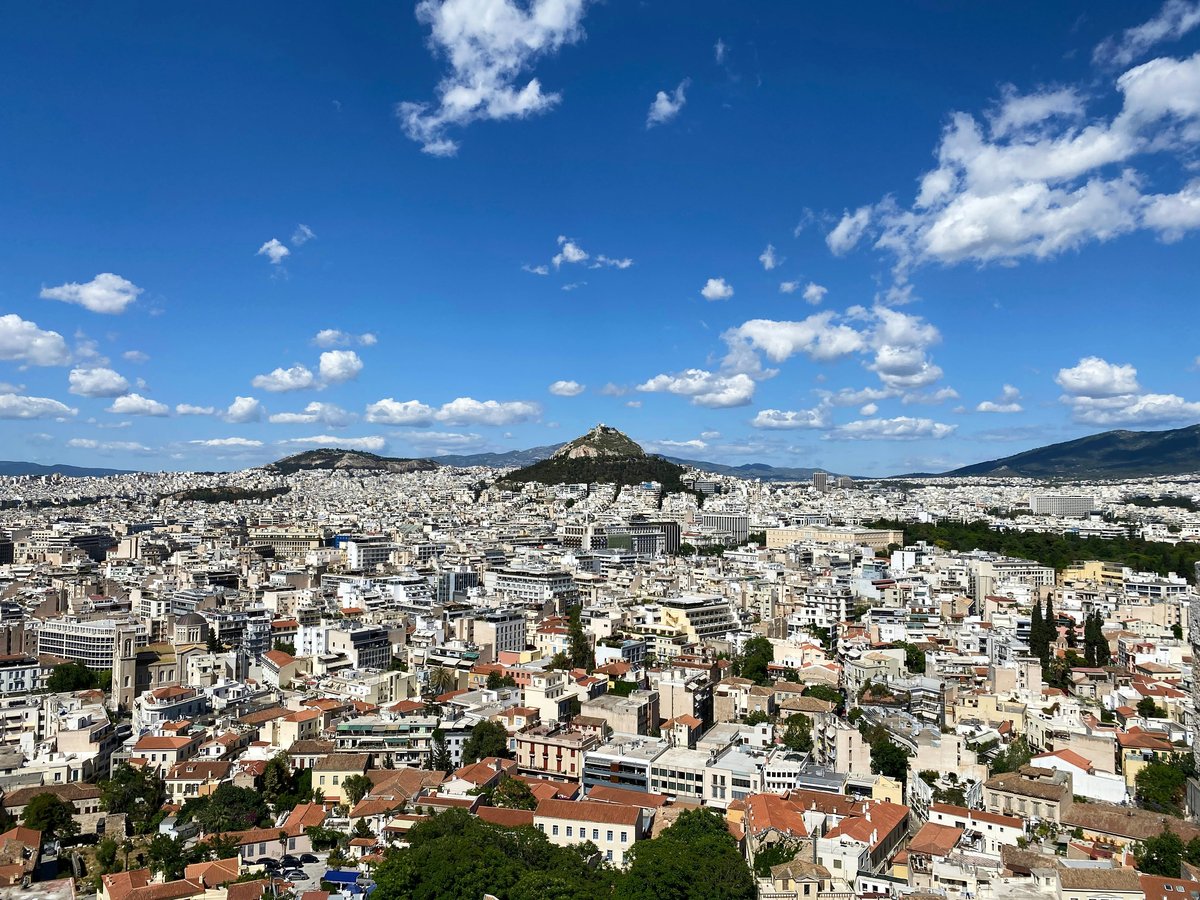
Athens sits in a basin ringed by mountains on three sides and the Saronic Gulf to the southwest. The Acropolis hill anchors the center, and most neighborhoods worth knowing fan out from its base within a 3-kilometer radius. The city reads like a series of villages pressed together. Plaka wraps around the north slope of the Acropolis, Monastiraki spills west toward Thissio, and Syntagma sits northeast as the civic and commercial heart. South of the Acropolis, Koukaki and Makrygianni feel quieter, more residential. Head further out and you'll find Pangrati to the east, Exarchia to the north, and Kolonaki climbing up Lycabettus Hill. The Metro's three lines connect most of these in under 15 minutes. Walking works well too, since the 2004 Olympics pedestrianized Dionysiou Areopagitou and linked it to a 3-kilometer walkway that ties the southern neighborhoods together. One thing to know before choosing a base. Athens is loud. Even the "quiet" neighborhoods have motorbikes at midnight and construction at 8am. The trade-off is proximity to ancient sites, and nearly everything worth seeing sits within a 30-minute walk of the center.
Neighborhoods
-
Plaka
The oldest continuously inhabited neighborhood in Athens, built directly on the ruins of the ancient city. Neoclassical houses from the 1830s line narrow pedestrian streets that climb the north face of the Acropolis. Bougainvillea spills over limestone walls. The pace is slow, almost small-town, though Kydathineon and Adrianou streets fill with foot traffic by mid-morning. You'll hear church bells from Agios Nikolaos Ragavas, a Byzantine church from the 11th century, and smell grilled halloumi drifting from the tavernas on Mnisikleous steps. The architecture shifts as you climb. Lower Plaka has restored mansions and tourist shops. Upper Plaka, near Anafiotika, feels like a Cycladic island transplanted onto a hillside, with whitewashed cubic houses built by stonemasons from the island of Anafi in the 1840s.
- Best for
- First-time visitors, couples, and anyone who wants to walk to the Acropolis, the Ancient Agora, and the Roman Forum without catching the Metro
- Key streets
- Adrianou Street runs the full length and has the most shops and restaurants. Kydathineon is narrower, less commercial. Mnisikleous steps lead up toward Anafiotika. Lysikratous passes the Choragic Monument of Lysicrates from 335 BC, which Lord Byron reportedly used as a writing desk in 1810.
-
Monastiraki
Monastiraki runs on noise, crowds, and commerce. The flea market sprawls across Avyssinia Square and down Ifestou Street, where vendors sell copper pots, secondhand furniture, old army boots, and Soviet-era cameras. On Sundays the market triples in size and the haggling gets louder. The area around the square smells like roasting corn from the street carts and souvlaki from the shops lining Mitropoleos. Architecturally it is a collision. The Tzistarakis Mosque from 1759 faces the Metro station, the Stoa of Attalos sits 200 meters south, and 1960s concrete apartment blocks tower above both. The Monastiraki Metro station itself was built over a section of the ancient Eridanos River, visible through a glass floor in the station.
- Best for
- Budget travelers, vintage and antique hunters, and anyone who feeds on density and street energy rather than quiet
- Key streets
- Ifestou Street for the permanent flea market. Avyssinia Square for the Sunday market and for Café Avyssinia on the second floor overlooking the chaos. Normanou Street for secondhand vinyl records. Pandrossou runs toward Plaka and has more tourist-oriented shops, but the leather sandal makers at numbers 72 and 89 still make them by hand.
-
Psyrri
Psyrri sits between Monastiraki and Omonia, bounded roughly by Athinas, Ermou, and Evripidou streets. Until the mid-1990s it was a warehouse district and somewhat rough after dark. Now it is Athens's densest concentration of small bars, live music tavernas, and street art. The buildings are still 19th-century industrial, with exposed brick and iron balconies. During the day the streets feel half-asleep. By 10pm on a Friday the narrow lanes around Iroon Square and Agion Anargyron fill completely, and you'll hear rebetiko guitar from at least two or three doorways at once. The food tends toward mezedes and grilled meats rather than fine dining. Portions are large and prices remain lower than Kolonaki by 30-40%.
- Best for
- Nightlife seekers in their 20s and 30s, people who want live Greek music without a staged tourist show, and anyone comfortable with grittier neighborhoods that still feel safe
- Key streets
- Iroon Square is the social center after dark. Agion Anargyron street and Karaiskaki street have the densest cluster of bars. Evripidou street runs along the northern edge and doubles as Athens's spice market, where shops sell dried herbs, saffron, and Middle Eastern groceries.
-
Koukaki
Koukaki sits directly south of the Acropolis, on the other side of the Filopappou Hill walking path. It was a working-class residential area through the 1980s and still feels that way in parts. Low-rise apartment buildings from the 1950s and 60s line quiet streets, laundry hangs from balconies, and the neighborhood bakeries open by 6am. The area grew popular with Airbnb visitors after 2015, which brought more cafés and brunch spots, but it hasn't lost the residential quiet the way Plaka has. You'll hear birdsong from the Filopappou pine trees in the morning. The main commercial stretch along Veikou street has a butcher, a pharmacy, a gyros place, and a specialty coffee shop within 50 meters of each other.
- Best for
- Repeat visitors who know they want walkable Acropolis access but prefer sleeping somewhere that feels like a neighborhood, not a tourist zone. Good for families with strollers since the streets are flatter than Plaka.
- Key streets
- Veikou street is the main artery for shops and cafés. Drakou street runs parallel one block east and has several well-reviewed small restaurants. Olympiou street leads toward the entrance to Filopappou Hill, which connects to the Pnyx and the Acropolis pedestrian walkway.
-
Makrygianni
Makrygianni is small, sometimes folded into Koukaki in guidebooks, but it has a distinct feel. It sits between the Acropolis Museum on Dionysiou Areopagitou and Syngrou Avenue, covering about 6 square blocks. The streets are tidy, the buildings mostly 1950s residential, and the dominant presence is the Acropolis Museum itself, which opened in 2009 and drew foot traffic that hadn't existed here before. The glass floors on the museum's ground level reveal an excavated Roman-era neighborhood beneath the building. Makrygianni is quieter than Plaka, closer to the Acropolis entrance than Monastiraki, and has a neighborhood feel without being remote.
- Best for
- Museum-focused visitors, anyone who wants to be within a 5-minute walk of the Acropolis entrance on the south slope, and travelers who value quiet evenings over nightlife
- Key streets
- Dionysiou Areopagitou runs along the top edge and is one of the best pedestrian streets in Athens, lined with plane trees and offering unobstructed Parthenon views. Makrigianni street, one block south, has small hotels and restaurants at lower prices than the tourist strip above.
-
Syntagma & Kolonaki
Syntagma Square is the civic center. The Hellenic Parliament sits in the old Royal Palace from 1843 at the square's east end, and the changing of the Evzones guard happens every hour in front of the Tomb of the Unknown Soldier. From Syntagma, Kolonaki climbs eastward up the lower slopes of Lycabettus Hill. This is where Athens keeps its expensive shops, its gallery scene, and its political-class cafés. Tsakalof and Voukourestiou streets have designer boutiques and jewelry stores. The apartments here cost roughly double Koukaki per square meter, and that filters into restaurant prices. A coffee on Kolonaki Square currently runs 5-6 euros. The architecture is mostly interwar neoclassical, better maintained than in most Athenian neighborhoods. Lycabettus Hill rises 277 meters and has a funicular from Aristippou street, though the 20-minute walk up through pine forest is worth it for the shade and the views that open gradually.
- Best for
- Business travelers staying near Syntagma, art and gallery visitors heading to the Benaki Museum on Koumbari 1, and shoppers who want walkable access to Greek and international designer shops
- Key streets
- Voukourestiou for high-end shopping. Tsakalof for café culture and people-watching. Patriarchou Ioakim for a slightly quieter, more residential stretch. Skoufa street connects the lower and upper halves of Kolonaki and has good independent bookshops.
-
Exarchia
Exarchia is Athens's most politically charged neighborhood. It sits north of the National Archaeological Museum, centered on Exarchia Square. The walls are dense with political graffiti and large-scale murals. The neighborhood has been the center of Greek anarchist and student politics since the 1973 Polytechnic uprising against the military junta, and that history is still present in the atmosphere. Bookshops, record stores, and cooperatively run bars line Themistokleous, Kallidromiou, and Valtetsiou streets. The food here tends toward cheap, filling, and unpretentious. You'll find 2-euro souvlaki wraps, North African restaurants, and the kind of ouzeri where the owner picks your mezedes for you. The pace is slow during the day, livelier after dark. The neighborhood has changed since 2019 with increased policing and some gentrification, but Exarchia Square still has a distinct, self-governing character.
- Best for
- Independent travelers comfortable in counter-cultural neighborhoods, students, and anyone more interested in bookshops and street art than monuments and museums
- Key streets
- Kallidromiou street has a Saturday morning farmers' market and some of the neighborhood's best small restaurants. Themistokleous leads from Omonia Square uphill into the heart of Exarchia. Valtetsiou has a strip of bars that fill up after 11pm. Streffi Hill, accessible from Eressou street, is a rough-edged local park with a 360-degree view of Athens.
-
Pangrati
Pangrati sits east of the Panathenaic Stadium, the marble U-shaped structure where the first modern Olympics took place in 1896. The neighborhood is one of Athens's more genuinely residential districts, with families, university students, and longtime Athenians who've lived in the same apartment block for decades. The streets have plane trees and small squares where elderly neighbors sit on benches in the late afternoon. Tavernas here serve lunch menus priced for regulars, not visitors. A full meal with wine at a neighborhood taverna currently runs 12-15 euros per person. The architecture is mixed. Some streets have well-kept neoclassical houses from the early 1900s. Others have the typical Athenian 1960s polykatoikia apartment blocks with marble lobbies and iron balconies.
- Best for
- Long-stay visitors who want local-paced daily life, remote workers looking for café culture without tourist density, and anyone who wants easy walking access to the National Garden and the Zappeion
- Key streets
- Plateia Proskopon (Scouts' Square) has several cafés and a playground. Ymittou street runs the length of the neighborhood and has bakeries, small groceries, and tavernas. Archimidous street leads toward the Panathenaic Stadium. Plateia Varnava is the social hub, with outdoor café seating under trees.
-
Thissio
Thissio wraps around the western side of the Acropolis and the Ancient Agora. The pedestrianized stretch of Apostolou Pavlou runs along its northern edge, offering an uninterrupted view of the Parthenon from below. The Temple of Hephaestus from 449 BC, the best-preserved Greek temple in existence, sits inside the Agora boundary on the neighborhood's eastern side. Thissio itself is quieter than Monastiraki, which it borders. The streets south of the main walkway have small apartment buildings and local tavernas that haven't changed their menus in years. The Thissio open-air cinema, Cine Thission on Apostolou Pavlou 7, has been screening films since 1935 with the Acropolis lit up behind the screen.
- Best for
- Couples looking for evening atmosphere, film lovers who want the open-air cinema experience, and walkers who plan to use the Dionysiou Areopagitou pedestrian route daily
- Key streets
- Apostolou Pavlou is the main pedestrian promenade and connects Thissio Metro to the Acropolis walkway. Irakleidon street has the Herakleidon Museum and a cluster of small art spaces. Nileos street, one block south, is residential and quiet.
-
Gazi
Gazi takes its name from the old gasworks facility at Pireos 100, which operated from 1857 until 1984 and was converted into the Technopolis cultural center in 1999. The tall red-brick chimneys of the gasworks still dominate the skyline. The neighborhood around it was derelict through the 1990s and reinvented itself as a nightlife district in the early 2000s. Bars and clubs line Voutadon, Persefonis, and Dekeleon streets. On weekend nights the area fills with a younger crowd, and the bass from the clubs is audible from several blocks away. During the day Gazi feels empty and industrial. The Kerameikos archaeological site and museum sit at the neighborhood's eastern edge, marking the ancient cemetery and city gate.
- Best for
- Nightlife-focused visitors in their 20s and 30s, concertgoers interested in Technopolis events, and LGBTQ+ travelers, since Gazi has the highest concentration of LGBTQ+ bars and clubs in Athens, concentrated around Megalou Alexandrou street
- Key streets
- Voutadon street has the densest strip of bars. Persefonis runs parallel and has some larger club venues. Dekeleon has restaurants that lean Middle Eastern and Mediterranean. Pireos street connects Gazi to Omonia in one direction and runs toward the coast in the other.
FAQ
What is the best neighborhood to stay in Athens for first-time visitors?
Plaka or Makrygianni tend to work best for a first visit. Both are within a 10-minute walk of the Acropolis entrance, the Ancient Agora, and the Acropolis Museum. Plaka has more restaurants and shops but also more tourist foot traffic. Makrygianni is quieter and still sits directly on the Dionysiou Areopagitou pedestrian walkway. Hotels in both areas currently range from about 80 to 200 euros per night for a mid-range double room, depending on season.
Is Athens walkable between neighborhoods or do you need the Metro?
The central neighborhoods, from Monastiraki to Syntagma to Plaka to Koukaki, are all within a 15-to-20-minute walk of each other. The 2004 pedestrianization of Dionysiou Areopagitou and Apostolou Pavlou created a 3-kilometer car-free route linking Thissio, the Acropolis, and Makrygianni. The Metro is useful for reaching Piraeus (Line 1, about 25 minutes from Monastiraki), the airport (Line 3, about 40 minutes from Syntagma, 10 euros one way), and outer neighborhoods. A single Metro ticket costs 1.20 euros and is valid for 90 minutes across buses, trams, and Metro.
Which Athens neighborhoods are best for nightlife?
Psyrri, Gazi, and Exarchia cover different ends of the spectrum. Psyrri has live rebetiko music, small bars, and a crawlable layout around Iroon Square. Gazi has larger clubs and the densest cluster of LGBTQ+ venues around Megalou Alexandrou street. Exarchia has cooperative-run bars, indie music, and a politically charged atmosphere. Athens nightlife starts late by most European standards. Restaurants fill around 10pm, bars after midnight, and clubs rarely peak before 2am.
Where should budget travelers stay in Athens?
Koukaki and Pangrati currently offer the best balance of low accommodation costs and walkable access to central Athens. Koukaki is a 10-minute walk south of the Acropolis, and Airbnb studios there tend to run 40-60 euros per night in shoulder season. Pangrati is further from the main tourist sites but sits next to the Panathenaic Stadium, and studio apartments run 35-50 euros per night. Both neighborhoods have cheap local tavernas where a full meal with wine costs 12-15 euros per person. Monastiraki has several hostels with dorm beds starting around 15-20 euros per night.
How safe are the different neighborhoods in Athens at night?
The central tourist neighborhoods, Plaka, Makrygianni, Koukaki, Thissio, and Kolonaki, feel safe and well-lit after dark. Monastiraki and Psyrri are busy enough at night that the crowds themselves provide safety, though pickpocketing on the Metro and around Monastiraki station is common enough to warrant attention. Omonia Square and the blocks immediately around it, particularly Menandrou and parts of Patission south of the National Archaeological Museum, feel rougher after midnight. Exarchia has its own dynamic. Demonstrations and tear gas occasionally affect the area, though this is rarer since 2019 than in prior years. Syntagma Square itself is well-policed but is the gathering point for most political protests.
Last verified by automated review (v1.7.2) on . What is automated review?