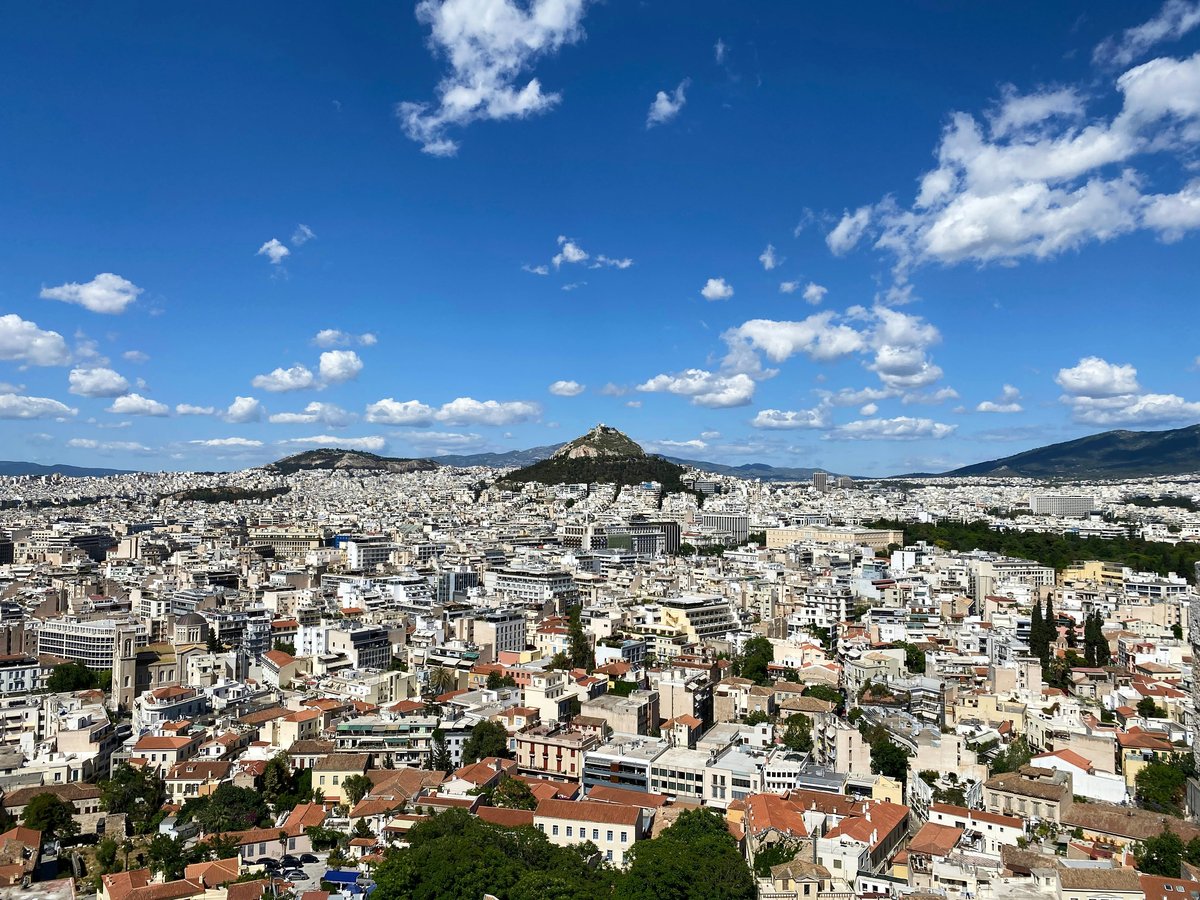
12 packing essentials every Athens visitor brings in 2026
Sturdy, broken-in walking shoes top this list because Athens demands constant foot travel across uneven marble, Plaka's cobblestones, and the steep Acropolis approach, where 40°C summer heat on exposed stone punishes flimsy footwear. The tie-breaker is ankle support on the slippery Dionysiou Areopagitou marble walkway.
Scoring here weights three factors. First, how specifically the item solves an Athens problem versus a generic travel problem. Second, quality relative to what you'd pay if you forgot it and had to buy a replacement at a Monastiraki tourist shop or the overpriced convenience stores near Syntagma Square. Third, how often travellers on Reddit and TripAdvisor report regretting its absence. Shoes score highest because Athens is a walking city with terrain-specific hazards. The Acropolis pathway consists of Pentelic marble worn smooth over 2,500 years, and the polished surface turns slippery above 35°C. The climb from Thissio metro station up to the Propylaea entrance gains roughly 150 metres in elevation over uneven steps. Flip-flops fail on the Propylaea steps daily. You'll see the proof at the first-aid station near the Odeon of Herodes Atticus.
The most common mistake is packing for a beach holiday when Athens is primarily an urban archaeological destination. Travellers arrive with sandals and tank tops, then discover that churches like Agios Eleftherios near Monastiraki Square enforce a dress code requiring covered shoulders. Another frequent regret is skipping sun protection for transit. That sounds contradictory, but Line 1 between Piraeus and Monastiraki runs above ground for several stops, and the platform at Thissio station has minimal shade at midday. People also underestimate Athens tap water. It is safe to drink throughout Attica. The supply comes from the Mornos reservoir, 200 kilometres northwest. A half-litre of bottled water costs 1.50 EUR near the Acropolis, so a refillable bottle and a tap solve that problem permanently.
That said, the top-scoring pick might not suit everyone. If your Athens trip centres on the Kolonaki gallery scene and rooftop bars in Psyrri, and you have no plans to climb the Acropolis or hike Lycabettus Hill, a rigid-sole hiking shoe is overkill. Flat leather shoes handle Kolonaki's paved sidewalks and the polished floors of the Benaki Museum on Koumbari Street fine. Travellers with mobility issues who plan to use the Acropolis elevator, opened in 2024 on the north slope, face different terrain than those taking the main path from the south. For a purely culinary trip focused on the Central Market at Varvakios Agora and tavernas in Pangrati, lightweight trainers with good arch support tend to be the better call.
Athens in summer 2026 means temperatures that reach 38-42°C through July and August, so heat management drives half this list. The X95 express bus from Eleftherios Venizelos Airport to Syntagma takes roughly 60 minutes with limited air conditioning on older vehicles. If you arrive without a hat and water bottle, that ride gets rough. Winter visitors, from November through March, face a different set. Rain is common, temperatures sit around 8-13°C, and a packable waterproof layer replaces the SPF 50 and electrolyte packets. Mind you, the Acropolis marble is even more treacherous when wet, so the shoe recommendation holds year-round. Worth noting, Athens pharmacy prices for forgotten sunscreen or adapters tend to run 30-50% above what you'd pay at a Sklavenitis supermarket in Pagrati or Nea Smyrni.
The full list
-
Broken-in walking shoes with ankle support
The Acropolis approach from Dionysiou Areopagitou is polished Pentelic marble that turns glass-smooth in heat. Add Plaka's uneven cobblestones and the 277 steps up Lycabettus Hill, and your feet take a beating that no sandal survives. Ankle support matters most on the steep descent from the Propylaea.
Shop Broken-in walking shoes with ankle support -
SPF 50+ broad-spectrum sunscreen
The Acropolis circuit has zero shade for 90 minutes, and the white marble reflects UV from below. Monastiraki Flea Market stalls sell emergency sunscreen at 3x pharmacy price. Apply before the Line 3 metro ride from the airport, since Doukissis Plakentias station has open-air platforms.
Shop SPF 50+ broad-spectrum sunscreen -
Refillable water bottle (750ml or larger)
Athens tap water from the Mornos reservoir is safe and cold. Refill stations sit at the Acropolis entrance and throughout the National Garden. Bottled water near Syntagma runs 1.50 EUR for 500ml. A 750ml bottle saves you 4-6 EUR daily over a week-long stay.
Shop Refillable water bottle (750ml or larger) -
Wide-brim packable sun hat
The Ancient Agora and Temple of Olympian Zeus offer almost no shade between 11:00 and 16:00 from May through September. The Panathenaic Stadium's marble seating radiates heat at 50°C+ surface temperature. A wide brim protects your neck on the exposed Filopappou Hill walk toward the Acropolis south slope.
Shop Wide-brim packable sun hat -
European Type C/F power adapter
Greece uses Type C and F sockets at 230V. The Germanos electronics shop at the airport charges 8-12 EUR for a basic adapter. Hotels in Plaka's older buildings sometimes have recessed sockets that reject bulky universal adapters, so a slim European-only plug fits better in those pre-war stone walls.
Shop European Type C/F power adapter -
Lightweight linen scarf or shawl
Agios Eleftherios cathedral near Monastiraki and dozens of smaller churches throughout Plaka require covered shoulders and knees. The Byzantine and Christian Museum on Vasilissis Sofias Avenue enforces the same rule. A linen scarf weighs under 100g and doubles as a picnic blanket on Filopappou Hill.
Shop Lightweight linen scarf or shawl -
Crossbody anti-theft bag with RFID blocking
Monastiraki Square and the Ermou Street pedestrian zone see peak pickpocket activity during summer tourist season. The Line 1 green metro between Piraeus and Omonia gets crowded at rush hour. A front-worn crossbody bag keeps your passport and cards secure on the packed X95 airport bus to Syntagma.
Shop Crossbody anti-theft bag with RFID blocking -
Portable battery pack (10,000mAh minimum)
A full day on foot from the Acropolis Museum through Plaka to Exarchia drains a phone by 15:00, especially with Google Maps running. Charging outlets are scarce at outdoor archaeological sites. The National Archaeological Museum on 28is Oktovriou Street has no public outlets in the exhibition halls.
Shop Portable battery pack (10,000mAh minimum) -
Electrolyte sachets or rehydration tablets
Athens regularly hits 40°C in July and August. The walk from Thissio metro up to the Acropolis takes 25 minutes in direct sun. Greek pharmacies sell rehydration salts for 3-5 EUR per box, but you'll want them on arrival, not after the dehydration headache starts at the Parthenon.
Shop Electrolyte sachets or rehydration tablets -
Lightweight breathable day pack (20L)
Day trips from Athens to Cape Sounion (70 km), Delphi (180 km), or the Saronic islands via Piraeus port need a pack for water, sunscreen, and layers. The KTEL bus to Delphi from Liosion terminal has limited overhead storage. A 20L pack fits under the seat and carries a full day's supplies.
Shop Lightweight breathable day pack (20L) -
Quick-dry microfiber towel
The ferry from Piraeus to Aegina takes 40 minutes, and Aegina's Marathonas Beach has no towel rental. Voula Beach on the Athens Riviera charges entry but not towel hire. A microfiber towel weighing 200g packs flat and dries in 30 minutes between the morning swim and the afternoon Acropolis visit.
Shop Quick-dry microfiber towel -
Packable rain jacket or wind shell
Athens gets 400mm of rain annually, mostly between October and March. Afternoon storms in spring catch visitors in the open at the Ancient Agora with nowhere to shelter. A packable shell under 200g fits in a day pack and doubles as a wind layer on the exposed cliffs at Cape Sounion.
Shop Packable rain jacket or wind shell
Last verified by automated review (v1.7.2) on . What is automated review?