Compare every Greece city in July →
Stay in Athens in July
111 hotels in the Trip.com pool for Athens, from US$15 a night.
Opens Trip.com on Fri 2 Jul to Sun 4 Jul 2027; change the dates there.
July in Athens is hot. Not metaphorically, not pleasantly warm. The average high reaches 34.8°C (95°F), and heatwaves push past 40°C (104°F) at least once most summers, turning the exposed marble of the Acropolis into something close to a griddle. The defining fact of this month is the heat, and everything you plan should work around it. That said, the humidity tends to hover around 38%, which is far more forgiving than southeast Asian or Gulf Coast summers at similar temperatures. The air is dry, the shade is cool, and the evenings bring genuine relief as temperatures drop to around 24°C (76°F).
This is also peak tourist season, and prices in neighborhoods like Plaka and Monastiraki reflect it. Hotel rates run 40-60% above the annual average, and the line to enter the Acropolis can hit 90 minutes by 10 a.m. on a busy Tuesday. Worth noting, though, many Athenians leave the city in July for the islands or the Peloponnese coast, which gives residential neighborhoods like Koukaki and Pangrati a quieter, almost languid feel.
The real argument for July, if you can tolerate the heat, is the Athens & Epidaurus Festival. Watching an opera or a Greek tragedy at the Odeon of Herodes Atticus, a 2nd-century Roman theater on the slope of the Acropolis, on a warm evening with the Parthenon lit up above you is one of those experiences that lives up to the anticipation. Combine that with the open-air cinema tradition, late-night dinners that don't start until 10 p.m., and the driest month of the year at 8mm of rain, and July becomes a defensible choice. You do need a plan, though. Wandering at noon without water or shade is how people end up in hospital.
Why visit in July
- The Athens & Epidaurus Festival brings world-class opera, theater, and music to the Odeon of Herodes Atticus and the Ancient Theatre of Epidaurus from June through August, with some of the strongest programming concentrated in July
- Virtually zero rain. July averages 8mm total, so plans are rarely disrupted by weather. You can count on clear skies for sunset at Cape Sounion or evening strolls through Thissio
- Long summer evenings with sunset around 8:45 p.m. give you a window from roughly 6-10 p.m. when the temperature drops below 30°C and the city comes alive for outdoor dining, rooftop drinks, and pedestrian promenades
- Easy same-day access to the Saronic Gulf islands. Ferries to Aegina (40 minutes), Hydra (90 minutes), and Poros (60 minutes) run frequently, and the calm July seas make for smooth crossings
- The open-air cinema season is in full swing, with historic venues like Cine Thission and Cine Paris screening films under the stars nightly through September
Worth knowing
- Daytime heat is a genuine physical challenge. The average high of 34.8°C (95°F) is the seasonal norm, not the extreme. Heatwaves pushing above 40°C (104°F) hit most summers, and in 2023 the Acropolis temporarily closed when temperatures exceeded 43°C. Walking between sites at midday is draining even for fit travelers
- Peak-season pricing across the board. Mid-range hotel rooms in Plaka or Syntagma typically run 40-60% above their shoulder-season rates in July. Flights from northern Europe are at their annual high
- Crowds at major archaeological sites are at their worst. The Acropolis, Acropolis Museum, and National Archaeological Museum all see maximum visitor density, and pre-booked timed tickets are now effectively required for the Acropolis
- Wildfire smoke is a recurring summer risk in the Attica region. Some July weeks bring a haze that settles over the city and drops air quality noticeably, particularly for anyone with respiratory sensitivity
Best for
Think twice if
July is Athens's hottest and driest month. The Attic basin traps heat, and by mid-morning the air shimmers over the concrete and limestone. The 38% humidity keeps it from feeling tropical, but the radiant heat off pavement, marble, and stone walls is intense. Rain is essentially nonexistent. You might see a brief thunderstorm late in the month, but most travelers will experience 30 consecutive dry days. Mornings feel warm by 8 a.m., the temperature typically crests between 1 and 4 p.m., and genuine relief doesn't arrive until after sunset around 8:45 p.m. Nights stay warm at 24.3°C (76°F), so accommodations without air conditioning are a problem.
Seasonal caution
- Extreme heat risk. Heatwaves exceeding 40°C (104°F) occur in most July seasons and have forced temporary closures of the Acropolis in recent years. The Greek national weather service (EMY) issues heat warnings with specific guidance. Monitor forecasts and carry at least 2 liters of water when walking between sites
- Wildfire smoke. Fires in the forests and scrubland surrounding Athens (Attica, Peloponnese, Evia) can send smoke into the Athens basin for several days. Air quality indices can spike above 150 (unhealthy) during active fire periods. Check aqicn.org/city/athens for real-time readings
- UV index consistently reaches 10-11 in July, which is classified as 'very high' to 'extreme.' Unprotected skin can burn in under 15 minutes. Marble and limestone surfaces reflect additional UV upward, so even shaded areas carry some exposure
Year-round climate
Averages from the last 5 years.
| Month | Avg high (°C) | Avg low (°C) | Rainfall (mm) |
|---|---|---|---|
| Jan | 13 | 6 | 62 |
| Feb | 14 | 6 | 45 |
| Mar | 16 | 8 | 34 |
| Apr | 20 | 11 | 38 |
| May | 25 | 16 | 36 |
| Jun | 31 | 21 | 25 |
| Jul | 35 | 24 | 8 |
| Aug | 33 | 24 | 16 |
| Sep | 29 | 20 | 18 |
| Oct | 23 | 15 | 27 |
| Nov | 19 | 12 | 85 |
| Dec | 15 | 9 | 101 |
Headline events
Athens & Epidaurus Festival
Throughout July (festival runs mid-June to mid-August)
Greece's premier performing arts festival, running since 1955, stages opera, ancient Greek drama, contemporary theater, and orchestral concerts at the 2nd-century Odeon of Herodes Atticus on the south slope of the Acropolis and the 4th-century-BC Ancient Theatre of Epidaurus in the Peloponnese. July typically holds the densest cluster of headline performances. The Odeon seats around 5,000, and the Epidaurus amphitheater holds roughly 14,000 with acoustics so precise you can hear a coin drop on stage from the top row.
Best things to do in July
Evening performance at the Odeon of Herodes Atticus
performing artsThe 161 AD Roman theater seats roughly 5,000 under the open sky on the southwest slope of the Acropolis. Performances typically start at 9 p.m., when the marble has cooled and the Parthenon glows above with golden floodlights. The repertoire in July leans toward Greek tragedy, opera, and symphonic concerts. The stone seats are original, so bring a cushion.
July holds the peak programming weeks of the Athens & Epidaurus Festival, with headline acts concentrated in the first 3 weeksBooking tipTickets go on sale roughly 3-4 weeks before each performance through the festival's official site. Popular shows sell out within days.
Open-air cinema at Cine Thission
entertainmentOne of the oldest outdoor cinemas in Athens, operating since 1935, Cine Thission sits in the Thissio neighborhood with the Acropolis visible above the screen. Films screen nightly at 9 p.m. and 11 p.m. The projector hum, the cicadas, and the warm night air make the setting as memorable as whatever's playing. They screen a mix of new releases (often in English with Greek subtitles) and classics.
Open-air cinemas run May through September, but July's dry skies and warm nights make it the most reliable month for uninterrupted screeningsDawn visit to the Acropolis
sightseeingThe Acropolis opens at 8 a.m. in July, and the first hour is the only window when the marble isn't scorching, the crowds haven't built, and the light on the Parthenon columns is low and golden rather than washed-out white. By 9:30 a.m. the tour buses arrive. By 10:30 a.m. the heat becomes the dominant experience. The walk up from the Dionysiou Areopagitou entrance takes about 10 minutes at a comfortable pace.
July's extreme midday heat makes the 8-9 a.m. window the only comfortable time. In April or October you could visit at noon without difficultyBooking tipPre-book timed entry tickets online. The 8 a.m. slot fills days in advance during July.
Day trip to Hydra by ferry
day tripThe car-free island of Hydra sits 90 minutes by conventional ferry or 75 minutes by catamaran from Piraeus port. No cars, no motorbikes. The harbor town's stone mansions and waterfront tavernas have barely changed since Leonard Cohen lived there in the 1960s. The water along the rocky swimming spots at Vlychos and Kaminia is transparent and still warm from the June buildup, typically around 25-26°C.
July seas in the Saronic Gulf are calm and warm, ferry frequency is at its peak, and the island's swimming spots are at their best water temperatureSunset walk along the Dionysiou Areopagitou pedestrian promenade
sightseeingThe 1.5 km marble-paved walkway curves along the south face of the Acropolis from the Acropolis Museum to Thissio. By 7:30 p.m. in July, the shadow of the hill covers most of the path, the temperature drops noticeably, and the Parthenon catches the last orange light above you. Street musicians set up near the Herodion theater entrance. The walk connects seamlessly to the Apostolou Pavlou path through the Ancient Agora area.
The 8:45 p.m. sunset in July gives you over an hour of golden-hour walking in bearable temperatures, a window that shrinks significantly by OctoberExploring the Central Market (Varvakios Agora) on Athinas Street
food and cultureThe 1886 covered market hall spans an entire block between Athinas and Evripidou streets. The meat hall has the raw, copper-tang smell of a working butcher market, with whole lambs and goat carcasses hanging from hooks. The fish wing smells of brine and seawater. The surrounding streets hold spice shops, olive merchants, and the produce stalls of the open-air laiki agora. Go before 10 a.m. while the vendors are still stocking and the July heat hasn't settled into the unconditioned halls.
July's peak produce season means the stalls overflow with Attic tomatoes, Aegean figs, Peloponnese watermelons, and stone fruit at their bestSwimming at Vouliagmeni Lake
natureA collapsed limestone cave system 25 km south of central Athens along the Apollo Coast. The thermal-mineral lake maintains a year-round temperature of 22-29°C, fed by underground hot springs. The water is brackish and slightly sulfuric, with a silky mineral feel on the skin. The lake sits in a natural rock amphitheater surrounded by pine trees. Small fish nibble at your feet if you sit still in the shallows.
In July, the lake temperature reaches its upper range near 29°C, and the surrounding pine canopy provides shade that's in desperately short supply elsewhere in AthensBooking tipArrive before 10 a.m. on weekdays. Weekend afternoons in July fill to capacity and the entrance queue builds.
Late-night taverna crawl through Psyrri
food and nightlifeThe Psyrri neighborhood, north of Monastiraki Square, has a concentration of small tavernas and mezedopolia (meze restaurants) along Iroon Square and the surrounding alleys. In July, tables spill onto the cobblestones after 9 p.m. The smell of grilled octopus and lamb chops on charcoal drifts between the buildings. Dinner here rarely starts before 10 p.m. and winds down around 1 a.m. The adjacent streets hold a scattering of natural wine bars and live rebetiko music venues.
July's heat pushes dinner culture later than any other month. The 10 p.m. to midnight window has an energy and atmosphere that cooler months can't replicateWhat to eat in July
In season: fruit
Karpouzi (watermelon)
Greek watermelons from the Peloponnese and Crete flood the laiki agora (street markets) in July. Sold by the kilo from truck beds parked on side streets. You'll smell the cut halves from a block away. Traditionally served with feta as a dessert course.
Syka (fresh figs)
Early-season Kalamata and Kymi figs start appearing at the Central Market on Athinas Street and neighborhood laiki markets in mid to late July. Green or purple, still slightly firm, with a honey-sweet interior. A brief window before the August glut.
On menus now
Horiatiki (Greek village salad)
Peak tomato season in Attica, July and August. The tomatoes you'll get in a horiatiki now are a different thing entirely from what shows up in winter. Firm, sweet, still warm from the vine. Paired with barrel-aged feta and Kalamata olives from the Peloponnese harvest.
Melitzanosalata
Smoky eggplant dip made from fire-roasted aubergines, now at peak season in the Attic plains. The charred-skin smell drifts out of taverna kitchens across Psyrri and Exarcheia on summer evenings. Served with warm pita as a meze starter.
Pagoto kaimaki
Mastic-flavored ice cream, a Greek specialty using resin from Chios island mastic trees. Chewy, stretchy texture unlike any Western gelato. The old-school parlors in Plaka and around Syntagma Square serve it in cups or sandwiched in brioche.
What to drink
Freddo espresso
Not seasonal in the calendar sense, but July is when you'll understand why Athens runs on freddo espresso and freddo cappuccino. Double shot of espresso shaken with ice until frothy. Every kafeneio and coffee chain serves them, and they're the default order in 35°C heat.
Regular events in July
Technopolis Jazz FestivalFree
Free open-air jazz concerts held at the Technopolis industrial heritage complex in Gazi, a former gasworks turned cultural center. The red-brick buildings and open courtyards host Greek and international jazz acts across multiple stages.
Mid to late JulyEjekt Festival
A large outdoor rock and alternative music festival held at Plateia Nerou (Water Plaza) in the Faliro coastal zone. The lineup typically features 4-6 international headliners alongside Greek acts. The venue sits on the waterfront near the Stavros Niarchos Foundation Cultural Center.
Usually one day in mid-JulyAthens Open Air Film FestivalFree
A citywide program screening classic and contemporary films at various outdoor locations across Athens, from archaeological sites to neighborhood squares. The screenings rotate through unexpected venues each week, and the program listings appear on the festival's site.
Throughout July (runs June through September)Full Moon events at archaeological sitesFree
The Greek Ministry of Culture sometimes opens select archaeological sites and museums for free evening visits during the July full moon. The Acropolis and the Roman Agora have both participated in past years, though the specific sites vary annually and are confirmed only 1-2 weeks in advance.
The night of the July full moonBest places this July
Acropolis and Parthenon
archaeological siteVisit at 8 a.m. sharp in July. By 10 a.m. the marble radiates enough heat to feel through shoe soles, and the exposed hillside offers no shade. The morning light on the Erechtheion's Caryatid porch is worth the early alarm.
AcropoliAcropolis Museum
museumThe Bernard Tschumi-designed glass and concrete museum at the base of the Acropolis hill opened in 2009. The top-floor Parthenon Gallery aligns with the temple itself, visible through the floor-to-ceiling windows. The air conditioning alone makes it a July refuge between 11 a.m. and 5 p.m.
MakrigianniNational Garden
parkThe 15.5-hectare former royal garden behind the Hellenic Parliament on Syntagma Square. Dense canopy of Mediterranean pines, palms, and cypress trees drops the temperature noticeably under the shade. The duck pond and small botanical garden sit at the southern end near the Zappeion Hall. One of the few places in central Athens where July midday feels bearable.
SyntagmaCape Sounion and the Temple of Poseidon
archaeological siteThe 5th-century BC temple sits on a cliff 70 meters above the Aegean at the southern tip of the Attica peninsula, about 70 km from central Athens. The sunset here, with the columns silhouetted against the water, is one of the most photographed views in Greece. Go in the late afternoon in July. The bus from the KTEL Attikis terminal takes about 90 minutes.
Sounion (day trip)Stavros Niarchos Foundation Cultural Center
cultural centerRenzo Piano's 2016 complex in the Faliro Bay area houses the Greek National Opera and the National Library. The 21-hectare park on the elevated green roof has a canal, running paths, and Mediterranean plantings. The park stays open late in summer and catches a sea breeze that central Athens rarely gets.
KallitheaAnafiotika
neighborhood walkA cluster of around 45 whitewashed Cycladic-style houses clinging to the north slope of the Acropolis rock, built by stonemasons from Anafi island in the 1840s-1860s. Bougainvillea spills over the walls, and the narrow stepped paths feel like an island village dropped into the city center. Quieter than the Plaka streets below, even in July.
PlakaLykavittos Hill
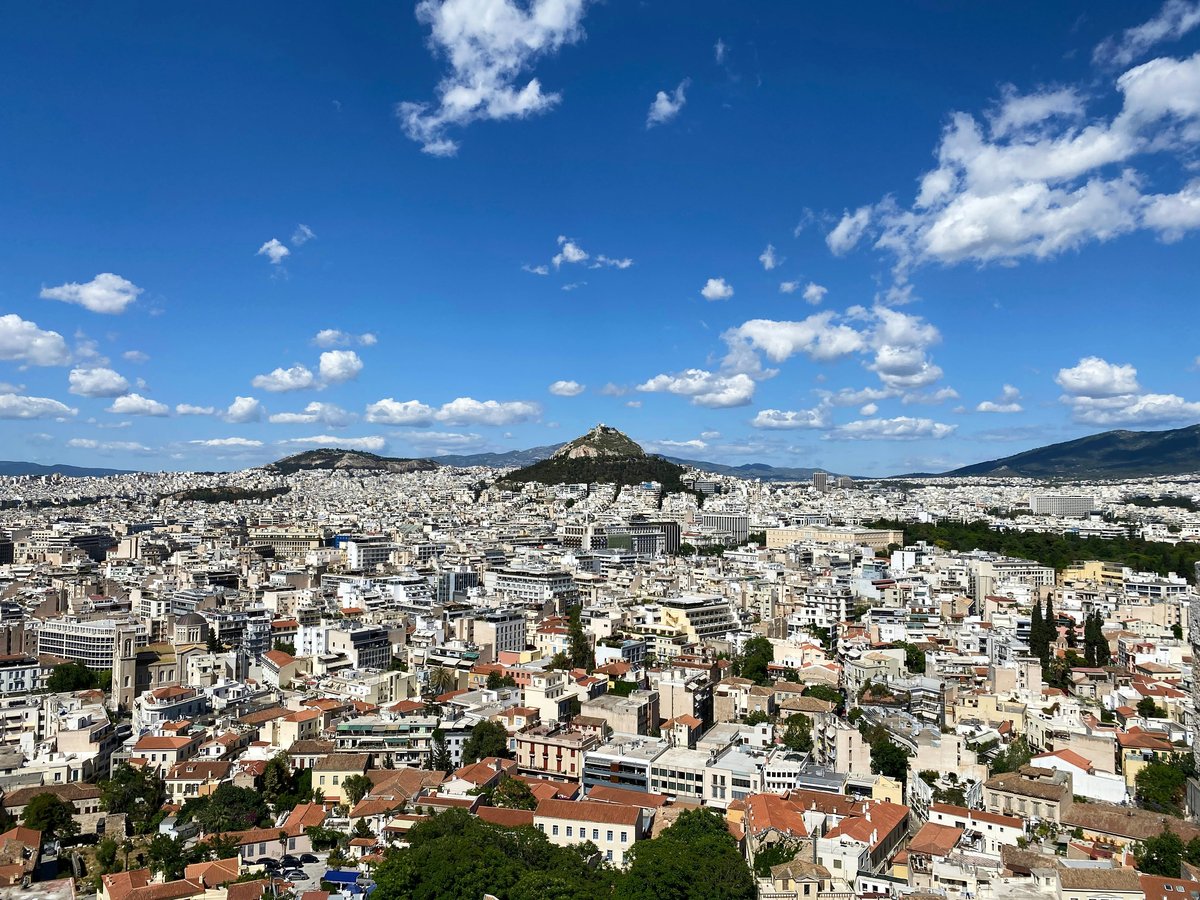
viewpointThe 277-meter limestone hill is the highest point in central Athens. The open-air Lykavittos Theatre near the summit hosts concerts in July. Walk up at sunset via the path from Kolonaki, or take the funicular. The 360-degree view covers the Acropolis, Piraeus port, the Saronic Gulf, and on clear days, the mountains of the Peloponnese.
KolonakiHammam Baths Athens
wellnessA restored Ottoman-era bathhouse in the Monastiraki area. The marble steam rooms and cold plunge pools offer a midday escape from July heat. The vaulted stone ceilings and dim lighting feel cool and quiet after the brightness outside. Book ahead in July.
Monastiraki
Your packing checklist
Tick items off as you pack. Your progress saves in this browser.
All packed — have a great trip.
Insider tips
The Acropolis ticket office opens at 8 a.m., but the online timed-entry system means you can skip the booth entirely. Pre-book the 8 a.m. slot 5-7 days ahead. By 8:15 a.m. you'll have the Caryatid porch nearly to yourself. By 9:30 a.m. it's a different place.
The pedestrianized Ermou Street connecting Syntagma to Monastiraki empties out after 9 p.m. in July, while the parallel backstreets of Psyrri fill up with taverna tables and live music. Walk one block north from Ermou and the tourist-to-local ratio flips.
Athens tap water is excellent. It comes from the Mornos reservoir in the mountains of central Greece, and locals drink it without filtering. The refill stations near the Acropolis and in the National Garden are clean. Bottled water is a waste of money and plastic here.
The KTEL intercity bus to Cape Sounion (about 90 minutes) departs from the terminal on Mavromateon Street near Pedion tou Areos park. The 4 p.m. departure gets you to the Temple of Poseidon in time for sunset. The last bus back leaves around 9 p.m., but check the schedule the day you go as it shifts seasonally.
Rooftop bars near Monastiraki Square advertise Acropolis views, and they deliver, but the drinks tend to be unremarkable and the seats cramped. For the same view with better atmosphere, walk 15 minutes south to the rooftop spots in Koukaki or Makrigianni, where the locals sit.
If a heatwave pushes past 40°C, the Acropolis may close temporarily. The Greek Ministry of Culture announces closures through the EMY weather service and social media. Have a backup plan. The air-conditioned Acropolis Museum, the Benaki Museum on Koumbari Street, and the National Archaeological Museum on 28is Oktovriou Street all remain open.
Avoid these mistakes
- Walking the Acropolis at midday. The exposed hilltop has no shade, the marble reflects heat upward, and the temperature on the site can run 5-8°C above the city reading. Heatstroke cases peak between 11 a.m. and 3 p.m. in July. Go at 8 a.m. or after 5 p.m.
- Underestimating water needs. Two liters per person is the minimum for a half-day of walking between sites in July. Greek pharmacies sell oral rehydration salts, but dehydration symptoms (headache, dizziness) set in before most tourists think to stop.
- Booking accommodation without air conditioning. Some older guesthouses in Plaka and the Monastiraki area rely on fans or thick-wall cooling that worked before heatwaves intensified. In July, with nighttime lows of 24°C, a room without proper AC means poor sleep and miserable mornings.
- Planning a full-day outdoor itinerary. The comfortable sightseeing window in July runs from about 8 a.m. to 11 a.m. and again from 6 p.m. to 10 p.m. The 5-7 hours in between are for the Acropolis Museum, the National Archaeological Museum, lunch, or a swim at Vouliagmeni. Trying to walk between the Ancient Agora, the Roman Agora, and Kerameikos at 2 p.m. is genuinely dangerous.
- Ignoring the siesta rhythm. Many smaller shops, galleries, and non-tourist businesses in Pangrati, Koukaki, and Exarcheia close between 2 p.m. and 5:30 p.m. in summer. This isn't laziness. It's how the city has handled 35°C afternoons for centuries. Plan errands and shopping for morning or evening.
Practical tips for July
Pre-book timed Acropolis tickets online for the 8 a.m. slot, ideally 5-7 days ahead in July. The combined ticket covers 7 sites (Acropolis, Ancient Agora, Roman Agora, Kerameikos, Temple of Olympian Zeus, Hadrian's Library, Aristotle's Lyceum) and is valid for 5 days, so you can spread visits across early mornings. Carry at least 2 liters of water per person when walking between sites. The Athens metro (Lines 1, 2, and 3) connects Syntagma, Monastiraki, and Piraeus port efficiently and runs air-conditioned trains. For Cape Sounion day trips, the KTEL bus from Mavromateon Street is more practical than renting a car. Athens & Epidaurus Festival tickets appear on the festival website about 3-4 weeks before each performance. Restaurant reservations are not typically needed except at high-end rooftop spots in Monastiraki and Plaka on weekend evenings. Greek pharmacies (look for the green cross sign) stock sunscreen, electrolytes, and basic medications without prescription, and at least one stays open 24 hours per neighborhood on a rotating schedule posted on the door.
FAQ
Is July a good time to visit Athens?
It depends on your heat tolerance. July is the hottest month, with average highs of 34.8°C and frequent heatwaves above 40°C. The tradeoff is near-zero rain, the Athens & Epidaurus Festival at the Odeon of Herodes Atticus, and the liveliest late-night dining and bar scene of the year. If you can restructure your days around early mornings and late evenings, and spend midday in museums or at the coast, July works. If sustained heat is a dealbreaker, October or May offer similar cultural access with 10-15°C lower temperatures.
How do I avoid the worst crowds at the Acropolis in July?
Book a timed-entry ticket online for the 8 a.m. opening slot, ideally a week ahead. The site is manageable until about 9:30 a.m. when tour groups begin arriving. Late afternoon after 5 p.m. is a second option, though the light is harsher. Avoid 10 a.m. to 3 p.m. entirely in July. Both the heat and the crowds peak in that window.
Is the wildfire smoke in Athens bad in July?
It varies year to year. Some Julys pass with clear skies. Others, particularly when fires burn in the Attica hills, the Peloponnese, or Evia, bring 2-5 days of visible haze and elevated particulate levels. The air quality index for Athens is available in real-time on aqicn.org. If you have asthma or respiratory sensitivity, pack an N95 mask and monitor the forecast. Most visitors without pre-existing conditions notice the haze but aren't physically affected.
What are the best day trips from Athens in July?
Hydra (90-minute ferry from Piraeus, no cars, stone harbor town, swimming at Vlychos beach), Aegina (40-minute ferry, the Temple of Aphaia, pistachio orchards), and Cape Sounion (90-minute KTEL bus, the Temple of Poseidon at sunset) are the three most practical. All are doable as same-day returns. The Saronic Gulf ferries run frequently in July, and the calm seas make crossings comfortable.
Can I swim near Athens in July?
Yes. The Apollo Coast beaches along the southern Attica shoreline (Glyfada, Vouliagmeni, Varkiza) are accessible by tram or bus from central Athens in 30-50 minutes. Vouliagmeni Lake, a thermal mineral lake 25 km south of the center, is swimmable year-round but reaches its warmest in July at around 29°C. The Saronic Gulf islands (Aegina, Hydra) offer clearer water and are 40-90 minutes by ferry from Piraeus.
How late do restaurants stay open in Athens in July?
Most tavernas and restaurants in tourist areas like Plaka, Monastiraki, and Psyrri take last orders around midnight to 1 a.m. in July. Locals rarely sit down for dinner before 9:30 or 10 p.m. in summer. Some mezedopolia in Psyrri and Exarcheia keep serving until 1:30 a.m. on weekends. Rooftop bars typically stay open until 2 a.m. or later.
Things to Do in Athens in July
 Free cancellation
 Best of Athens Half Day Private Tour
Day trip: free cancellation.
via Viator Free cancellation
 All Day Cruise -3 Islands to Agistri,Moni, Aegina with lunch and drinks included
Day trip: 10 hours, free cancellation.
via Viator Free cancellation
 Cape Sounion and Temple of Poseidon Half-Day Small-Group Tour from Athens
Day trip: free cancellation.
via Viator Free cancellation
 Athens Full Day Private Tour
Day trip: 8 hours, free cancellation.
via Viator Free cancellation
 Athens All Included: Acropolis and Museum Guided Tour with Ticket
Day trip: 3 hours, free cancellation.
via Viator Free cancellation
 Athens cruise: Agistri, Moni/Metopi, Aegina with lunch & drinks
Day trip: 10 hours, free cancellation.
via ViatorFind a flight to Athens
Live fares to Athens appear here once cookies are accepted.
Last verified by automated review (v1.7.2) on . What is automated review?