Compare every Greece city in January →
Stay in Athens in January
111 hotels in the Trip.com pool for Athens, from US$15 a night.
Opens Trip.com on Fri 1 Jan to Sun 3 Jan 2027; change the dates there.
January is the quietest month in Athens. Daytime temperatures average 13°C (56°F), and nights drop to around 6°C (44°F). That's not freezing, but the 76% humidity and occasional wind off the Saronic Gulf can make it feel colder than the thermometer suggests. You'll see rain on about 7 days through the month, usually arriving in short bursts rather than all-day downpours.
The tradeoff is worth considering seriously. The Acropolis, which handles over 20,000 daily visitors in July, might have a few hundred on a January weekday morning. You can stand in the Parthenon's shadow in near-silence. The National Archaeological Museum on Patission Street, the Benaki Museum in Kolonaki, the Museum of Cycladic Art on Vasilissis Sofias. All of them feel like private galleries in January. Hotel rates across Plaka, Koukaki, and Monastiraki tend to run 40-60% below their summer highs.
The city's one genuinely dramatic January event falls on January 6. Theophania, the Feast of the Epiphany, sends young men diving into the cold Piraeus harbor to retrieve a wooden cross thrown by a bishop. Crowds line the waterfront for the ceremony. Earlier in the month, winter sales begin across Ermou Street and the Kolonaki boutiques, drawing Athenian bargain hunters who largely stay away from tourist areas the rest of the year. Beyond those draws, January Athens runs at a local pace. Cafes in Pagrati fill with students and retirees nursing thick Greek coffee. Tavernas in Psyrri serve slow-braised stews to half-empty rooms, and the whole city smells faintly of roasted chestnuts from the street vendors' carts.
Why visit in January
- Hotel rates hit their annual low, running 40-60% below July-August peaks across neighborhoods like Plaka, Koukaki, and Syntagma
- Archaeological sites are nearly empty. The Acropolis, Ancient Agora, and Temple of Olympian Zeus might have a few dozen visitors instead of thousands
- Walking temperatures around 13°C (56°F) make the steep uphill paths to the Acropolis and Philopappou Hill far more comfortable than the 35°C summer alternative
- State-run museums and archaeological sites offer free admission on the first Sunday of the month from November through March
Worth knowing
- Daylight lasts about 10 hours, with sunset around 5:30pm, cutting outdoor sightseeing short
- Roughly 7 rainy days and 62mm of rainfall can disrupt open-air plans. The Acropolis marble and limestone paths get slippery when wet
- Many rooftop bars and seasonal tavernas in Monastiraki and Plaka close entirely for winter, including some of the most photographed Acropolis-view terraces
- Ferry schedules to the Cycladic islands run at reduced frequency, and most tourist businesses on Mykonos and Santorini are shuttered until April
Best for
Think twice if
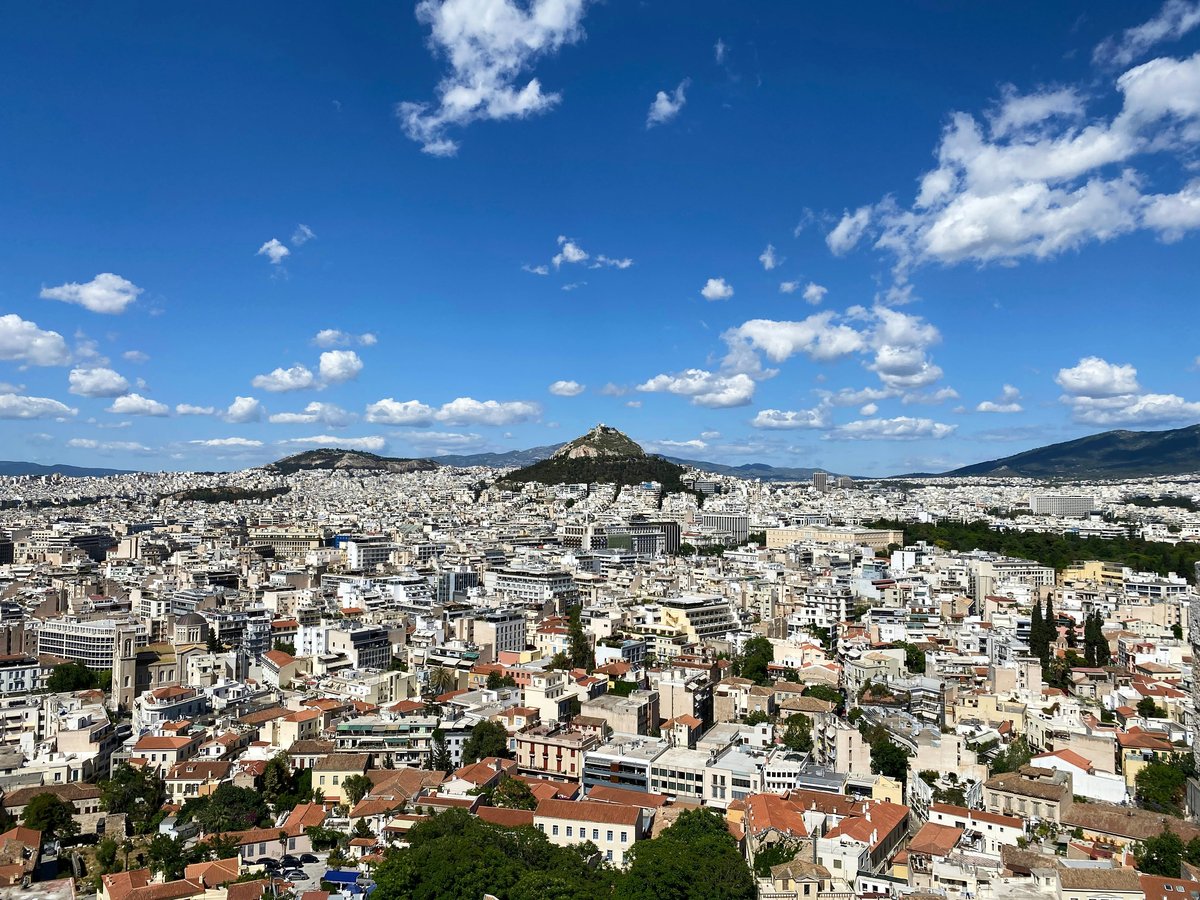
Athens in January feels like a mild but damp European winter. Highs tend to sit around 13°C (56°F) under partly cloudy skies, while lows near 6°C (44°F) make evenings feel properly cold once the humidity kicks in at 76%. About 62mm of rain falls across roughly 7 days, usually in 2-3 hour spells rather than all-day soaks. North winds from the Balkans can sharpen the cold on exposed hilltops like Lycabettus and the Acropolis summit. Daylight runs from about 7:30am to 5:30pm, shorter than most visitors expect from a Mediterranean city. On clear days, though, the winter light over the Attic Basin is low and golden, and you can see across to the Saronic Gulf from Lycabettus Hill.
Seasonal caution
- Occasional cold fronts from the Balkans can drop temperatures to near 0°C (32°F) for 2-3 days, with rare snowfall on higher ground. Athens experienced significant snowfall in late January 2022, which disrupted transit and closed the Acropolis for several days.
Year-round climate
Averages from the last 5 years.
| Month | Avg high (°C) | Avg low (°C) | Rainfall (mm) |
|---|---|---|---|
| Jan | 13 | 6 | 62 |
| Feb | 14 | 6 | 45 |
| Mar | 16 | 8 | 34 |
| Apr | 20 | 11 | 38 |
| May | 25 | 16 | 36 |
| Jun | 31 | 21 | 25 |
| Jul | 35 | 24 | 8 |
| Aug | 33 | 24 | 16 |
| Sep | 29 | 20 | 18 |
| Oct | 23 | 15 | 27 |
| Nov | 19 | 12 | 85 |
| Dec | 15 | 9 | 101 |
Holidays and festivals in January
Public holidays
- New Year's Day(Πρωτοχρονιά)1 January 2027
- Epiphany(Θεοφάνεια)6 January 2027
Best things to do in January
Walk the Acropolis without crowds
sightseeingIn January, you can spend over an hour on the Acropolis with a fraction of the usual crowd. The Parthenon, Erechtheion, and Temple of Athena Nike are all approachable without the roped queuing lines of summer. The cool air makes the steep uphill walk from the entrance gate comfortable rather than grueling, and the low winter sun casts long shadows across the marble that photograph differently from the flat overhead light of July.
Summer daily visitors exceed 20,000. January weekday mornings might see 200-300. The temperature gap alone, 13°C versus 35°C, changes the experience entirely.Booking tipBuy tickets online through the Hellenic Ministry of Culture site to skip the short winter queue. The combined ticket covering 7 archaeological sites is valid for 5 days.
Museum day at the National Archaeological Museum
cultureThe National Archaeological Museum on Patission Street holds one of the world's largest archaeological collections. In January, you can stand alone in front of the Mask of Agamemnon or the Antikythera Mechanism without a tour group at your elbow. The Mycenaean gold collection, the Egyptian wing, and the bronze sculptures all benefit from the kind of slow, quiet attention that summer crowds make impossible.
The first Sunday of each month from November through March is free admission at state-run museums and sites. In January, that means you can visit for nothing, and even on paid days the halls are nearly empty.Booking tipArrive by 9:30am on free Sundays, as locals and students fill the halls by late morning.
Attend Theophania at Piraeus harbor
cultural eventOn January 6, the Feast of the Epiphany plays out at Piraeus harbor with a bishop's blessing and the throwing of a wooden cross into the cold water. Young men dive in to retrieve it, and the one who surfaces with the cross earns a year of good fortune according to tradition. The waterfront fills with spectators, the smell of incense drifts from the nearby cathedral, and the whole ceremony takes about an hour.
Theophania falls only on January 6. The Piraeus ceremony is one of the largest in Greece and draws thousands of spectators along the harbor.Booking tipNo booking needed. Arrive at the Piraeus waterfront by 9:30am for a good viewing spot. The Piraeus metro (Line 1) runs from central Athens in about 25 minutes.
Winter sales shopping on Ermou Street
shoppingGreece's winter sales period begins in early January and runs through mid-February. Ermou Street, the main pedestrian shopping strip connecting Syntagma to Monastiraki, fills with discount signs. The Kolonaki boutiques on Voukourestiou and Tsakalof streets also participate, with Greek leather goods, jewelry, and clothing at 30-50% off regular prices.
The cheimones ekptoseis (winter sales) are regulated by Greek law and typically begin the second Monday of January. Early January offers the widest selection before popular sizes sell out.Hike Philopappou Hill at sunset
outdoorThe path up Philopappou Hill from the Dionysiou Areopagitou pedestrian walkway takes about 15-20 minutes and delivers one of the best views of the Acropolis and the city stretching to the sea. In January, the hilltop is almost empty. The low sun drops behind the Saronic Gulf islands, and the Parthenon turns golden against a grey-blue sky. Bring a warm layer. The wind picks up on the exposed summit.
Summer sunsets here draw hundreds of people who crowd the hilltop. January evenings are nearly private. The cleaner winter air also means better visibility toward Piraeus and Aegina island.Explore Varvakios Agora central market
food and marketThe covered central market on Athinas Street is at its most aromatic in winter. Fishmongers lay out catches from the Aegean, butchers display whole lambs, and the fruit stalls pile up with seasonal citrus from the Peloponnese. The indoor halls keep you warm while the sensory overload holds your attention. Grab a bowl of patsas (tripe soup) from one of the small counters inside the meat hall, a traditional Athenian hangover cure served around the clock.
January is peak citrus season, and the fish selection benefits from winter Aegean catches. The market is less tourist-oriented in winter, so prices and interactions feel more local.Booking tipGo before 11am for the best selection. The market is closed on Sundays.
Day trip to Cape Sounion and the Temple of Poseidon
day tripThe 5th-century BCE Temple of Poseidon sits on a cliff 70 meters above the Aegean at the southern tip of Attica, about 70km from central Athens. In January, the site is nearly deserted, the winter sea below is dark and rough, and the columns stand against a sky that changes color every few minutes. The drive along the coastal road from Glyfada takes about 90 minutes.
Summer tour buses pack the site heavily. In January, you might share the temple platform with 5 other people. The dramatic winter seascape adds a mood the calm summer Aegean cannot match.Booking tipCheck winter opening hours on the Ministry of Culture site before driving out. The site typically closes by 3:30pm in January, much earlier than summer.
Greek cooking class focused on winter dishes
foodSeveral cooking schools in Plaka and Thissio offer winter-menu classes covering dishes like fasolada, lahanodolmades (cabbage rolls with rice and herbs), and youvarlakia (egg-lemon meatball soup). The classes typically include a market visit to Varvakios Agora to select ingredients, followed by 3-4 hours of cooking and eating. A solid indoor activity for a rainy January day.
Winter Greek cuisine is a separate tradition from summer grilling. Many of these slow-cooked, broth-heavy dishes only appear on menus from November through March.Booking tipBook at least a week ahead. Winter class sizes tend to be small, around 6-8 people, and fill quickly with fewer total offerings than summer.
What to eat in January
In season: fruit
Navel oranges
January is peak citrus season in Greece. The Varvakios Agora central market overflows with Argolida and Laconia oranges sold by the kilo. Bitter Seville oranges also hang from street trees across Plaka and the National Garden, though those are ornamental.
On menus now
Horta (wild greens)
Winter is peak foraging season for wild greens in Attica. Tavernas across Exarchia and Psyrri serve boiled horta dressed with lemon and olive oil as a side dish. The slightly bitter taste pairs well with grilled fish. January horta tends to be the most tender of the winter months.
Fasolada
Greece's unofficial national dish appears on nearly every taverna menu in winter. This slow-cooked white bean soup with tomato, celery, and olive oil is the kind of warming, thick bowl you want after a rainy afternoon walking the Ancient Agora. Better in January than any other month.
Street food peaks
Roasted chestnuts
Street vendors with small charcoal grills sell paper cones of roasted chestnuts near Syntagma Square, along Ermou Street, and outside Monastiraki metro station. The smell of charring chestnut shells is one of the defining scents of winter Athens.
What to drink
Rakomelo
Warm raki or tsipouro mixed with honey, cinnamon, and cloves. Bars and ouzeries in Psyrri and Monastiraki serve it as a winter drink, and the warm, spiced sweetness takes the edge off a damp January evening. Some places add orange peel, which works well with the seasonal citrus.
Festival food
Vasilopita
The traditional New Year's cake, a sweet bread or semolina cake with a coin baked inside. Bakeries across Athens fill their windows with Vasilopita through the first 2 weeks of January. Every household cuts one on New Year's Day, and finding the coin in your slice is supposed to bring a year of good luck.
Regular events in January
Theophania (Feast of the Epiphany)Free
A public holiday across Greece. The Blessing of the Waters ceremony at Piraeus harbor features young men diving into the cold sea to retrieve a cross. Churches hold special liturgies and holy water is distributed. Schools and most businesses close for the day.
January 6Protochronia (New Year's Day)Free
Greece rings in the New Year with fireworks over the Acropolis visible from Syntagma Square and Philopappou Hill. Families cut the Vasilopita cake at midnight. January 1 is a public holiday with most shops and sites closed.
January 1Winter sales period (Cheimones Ekptoseis)Free
Greece's regulated winter sales period begins in early-to-mid January and runs through mid-February. Discounts of 30-50% appear on Ermou Street, the Attica department store near Syntagma, and the Kolonaki boutiques.
Early January through mid-FebruaryFree Sunday at state museums and sitesFree
The first Sunday of each month from November through March grants free admission to state-run archaeological sites and museums, including the Acropolis, the National Archaeological Museum, and the Ancient Agora. Lines are longer than a typical winter day but still short by summer standards.
First Sunday of JanuaryBest places this January
Anafiotika
neighborhoodThis tiny cluster of whitewashed Cycladic-style houses clings to the northeast slope of the Acropolis rock, built by stonemasons from Anafi island in the 19th century. In January, you might walk through its narrow stepped alleys without seeing another tourist. Cats doze on doorsteps, potted geraniums still bloom in sheltered corners, and the silence is striking given that the noise of Plaka sits 2 minutes downhill.
PlakaStavros Niarchos Foundation Cultural Center
cultural centerRenzo Piano's glass-and-steel complex in Kallithea houses the Greek National Opera and the National Library of Greece. In January, the indoor spaces offer warmth and free exhibitions, while the rooftop park gives open views across Athens to the sea. The center often runs free winter concerts and film screenings. The surrounding 210,000 square-meter park stays green year-round.
KallitheaLycabettus Hill
viewpointAt 277 meters, Lycabettus is the highest point in central Athens. On clear January days, the visibility from the summit stretches past Piraeus to the islands of Aegina and Salamis. The funicular runs year-round, or the walk up from Kolonaki takes about 30 minutes through pine forest that smells sharp and clean after rain. The small Chapel of Agios Georgios at the top is often empty in winter.
KolonakiVarvakios Agora
marketAthens's central market on Athinas Street sits halfway between Omonia and Monastiraki. The covered halls stay warm and noisy regardless of weather. The fish hall, meat hall, and surrounding fruit and vegetable stalls are at their most local in January. The small soup counters inside serve patsas and other warming broths from early morning.
OmoniaNational Garden
parkThe 15.5-hectare park behind the Greek Parliament stays green and walkable in January, with paths shaded by palms, cypresses, and a mix of subtropical plants. The duck pond, small zoo, and botanical sections are quiet on winter weekdays. You'll likely hear birdsong louder than traffic, which is unusual for central Athens.
SyntagmaKerameikos Archaeological Site and Museum
archaeological siteThe ancient cemetery and potters' quarter northwest of Monastiraki rarely makes the tourist shortlist even in summer. In January you may have the site entirely to yourself. The Street of Tombs, with its 4th-century BCE marble grave markers still standing in situ, is one of the most atmospheric spots in Athens. The small on-site museum displays funerary sculpture and pottery. Wild poppies sometimes appear in the grass as early as late January.
Kerameikos
Your packing checklist
Tick items off as you pack. Your progress saves in this browser.
All packed — have a great trip.
Insider tips
The Sunday flea market at Monastiraki Square is smaller in January, but that's when locals browse. The regular vendors along Adrianou and Ifestou streets have more time to chat and more willingness to negotiate prices on antiques and vintage finds when tourist traffic is low.
Tavernas in Exarchia and Pagrati that require a 90-minute wait in summer have open tables and noticeably warmer service in January. Ask for the daily specials board rather than the English menu. The winter specials at neighborhood places tend to be the kitchen's best work, the slow-braised dishes that take 4 hours and are never worth making in the heat.
The combined archaeological sites ticket covers 7 sites. In summer you might use 2-3 before crowd fatigue sets in. In January you can comfortably visit all 7 in a few unhurried days. The Acropolis, Ancient Agora, Roman Agora, Kerameikos, Temple of Olympian Zeus, Hadrian's Library, and Aristotle's Lyceum are all on it.
Check whether your accommodation has proper heating before booking. Many older Athenian apartments and budget hotels rely on small space heaters or split-unit AC in reverse mode, which struggles when nighttime temperatures drop to 6°C. Mid-range hotels in Koukaki and Syntagma tend to have reliable central heating. Ask directly.
Avoid these mistakes
- Packing for 'the Mediterranean' and arriving in a T-shirt. January evenings at 6°C with 76% humidity feel colder than the same temperature in a dry climate. First-time visitors who picture Athens as perpetually sunny end up buying overpriced jackets near Syntagma Square.
- Planning a Cycladic island-hopping extension. Ferry services to Mykonos, Santorini, and the smaller Cyclades run at reduced frequency in January, often 2-3 sailings per week instead of daily. Most hotels, restaurants, and car-rental agencies on those islands close from November through April. Hydra and Aegina in the Saronic Gulf are the realistic winter day-trip options.
- Booking a rooftop Acropolis-view dinner for the first evening. Many of the famous rooftop restaurants in Plaka and Monastiraki close for winter entirely. The ones that stay open often move dining indoors, which changes the experience. Check operating status before reserving.
- Skipping the Acropolis on a rainy morning and then running out of clear-weather days. January rain tends to arrive in short spells. If the forecast shows a 2-hour window of dry weather, take it. The site drains quickly, and a rain-washed Acropolis under broken clouds produces some of the best light you'll ever photograph it in.
Practical tips for January
January 1 and January 6 are both public holidays in Greece. Most shops, some restaurants, and all banks close on those days. The Acropolis and major museums typically open on holidays but check the Hellenic Ministry of Culture website for updated winter hours, as some sites close by 3:00-3:30pm rather than the summer 7:00-8:00pm. Restaurant reservations are rarely needed in January. Walk-in seating is available almost everywhere, though a handful of popular spots in Psyrri and Koukaki still fill on Friday and Saturday evenings. Tipping in Athens is typically 5-10% at sit-down restaurants, left in cash on the table. The metro runs until about midnight, with trains every 5-10 minutes during the day. Taxis are affordable and generally easy to find. Download the BEAT app (Greece's local ride-hailing service) as a backup for rainy evenings when street hails get competitive. The airport express bus X95 runs 24 hours from Eleftherios Venizelos Airport to Syntagma Square. If you plan to visit active churches during Theophania services on January 6, cover shoulders and knees. Casual dress is fine everywhere else in winter Athens.
FAQ
Is January a good time to visit Athens?
It depends on your priorities. If you want archaeological sites without crowds, low hotel prices, and you're comfortable with cool, occasionally rainy weather around 13°C (56°F), January is surprisingly rewarding. The Acropolis, National Archaeological Museum, and Ancient Agora are essentially private experiences at this time of year. If you want beach weather, outdoor rooftop dining, island-hopping, or the summer nightlife scene, January is the wrong month. The best all-around months for Athens are typically May and October, which combine good weather with moderate crowds.
What is the weather like in Athens in January?
Expect daytime highs around 13°C (56°F) and nighttime lows near 6°C (44°F), with about 7 rainy days totaling 62mm of rainfall through the month. Humidity sits around 76%. It's not freezing, but the damp cold can feel penetrating, especially in the wind on hilltop sites like the Acropolis and Lycabettus. Clear days do happen regularly, and when they do, the low winter sun produces golden light across the marble of the ancient sites. Pack layers, a waterproof jacket, and shoes with good grip for wet marble surfaces.
Is Athens crowded in January?
No. January is the lowest tourist season in Athens. Major sites that draw 15,000-20,000 daily visitors in July might see a few hundred on a January weekday. You won't queue for the Acropolis, you won't fight for a table in Plaka, and you won't share the National Archaeological Museum with tour groups. Some visitors find this refreshing. Others find certain blocks of Monastiraki feel a bit empty, with some seasonal shops and restaurants closed for winter.
Can I visit the Greek islands from Athens in January?
With some limitations, yes. Ferries to the Saronic Gulf islands, specifically Hydra, Aegina, and Poros, run year-round with reasonable frequency. Hydra is the best winter day-trip option, about 90 minutes by ferry from Piraeus, car-free, and atmospheric even in grey weather. Cycladic routes to Mykonos and Santorini drop to 2-3 sailings per week, and most tourist businesses on those islands close entirely from November through April. If islands are a major part of your trip, January is not the month.
What should I budget for a January trip to Athens?
January is the cheapest month to visit Athens. Mid-range hotel rooms in Plaka or Koukaki that cost 150-200 euros per night in July tend to drop to 60-90 euros. A sit-down taverna meal with wine runs 15-25 euros per person in most neighborhoods. Budget travelers can get by on 60-80 euros per day including accommodation. The biggest savings come on accommodation and flights, which are both at or near annual lows from most European departure cities.
Things to Do in Athens in January
 Free cancellation
 Best of Athens Half Day Private Tour
Day trip: free cancellation.
via Viator Free cancellation
 Cape Sounion and Temple of Poseidon Half-Day Small-Group Tour from Athens
Day trip: free cancellation.
via Viator Free cancellation
 Athens Full Day Private Tour
Day trip: 8 hours, free cancellation.
via Viator Free cancellation
 Athens All Included: Acropolis and Museum Guided Tour with Ticket
Day trip: 3 hours, free cancellation.
via Viator Free cancellation
 Athens cruise: Agistri, Moni/Metopi, Aegina with lunch & drinks
Day trip: 10 hours, free cancellation.
via Viator Free cancellation
 Delphi Experience With live Official Guide in the museum and site
Day trip: 10 hours, free cancellation.
via ViatorFind a flight to Athens
Live fares to Athens appear here once cookies are accepted.
Last verified by automated review (v1.7.2) on . What is automated review?