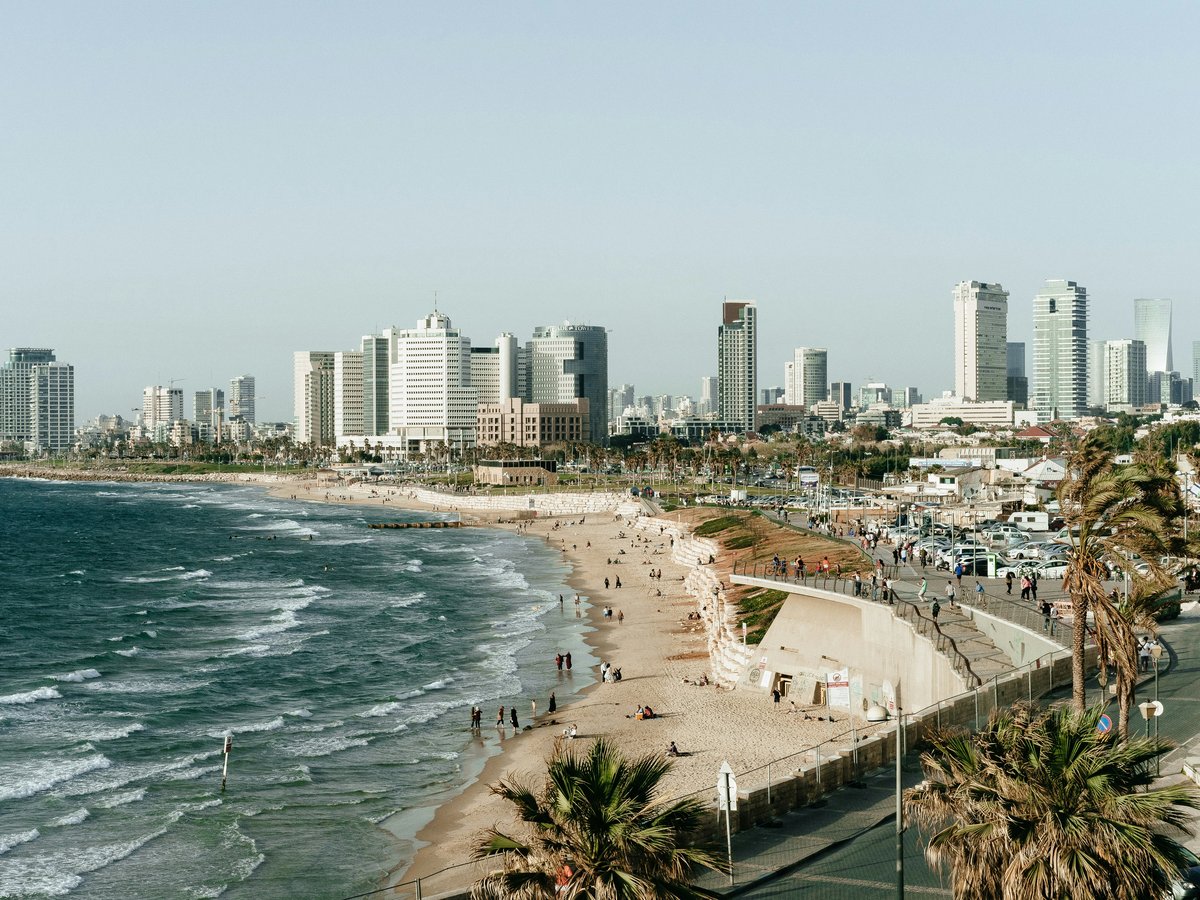
Stay in Tel Aviv in March
75 hotels in the Trip.com pool for Tel Aviv, from US$30 a night.
Opens Trip.com on Fri 5 Mar to Sun 7 Mar 2027; change the dates there.
Purim is the headline. This Jewish carnival holiday, which shifts between late February and mid-March on the Hebrew calendar, turns Tel Aviv into Israel's largest open-air costume party. Costumed revelers take over Rothschild Boulevard and Florentin for nights of street DJs, dancing, and general mayhem. If you don't know it's coming, the sheer scale is startling. If you are expecting it, it might be the reason you came.
March also marks the moment Tel Aviv shakes off winter. Temperatures climb into the low twenties Celsius (high sixties Fahrenheit) during the day, and the persistent rains of January and February ease considerably. Cafe tables reappear on sidewalks along Dizengoff Street. The salt-tinged breeze off the Mediterranean feels warm enough by mid-afternoon to sit outside without a jacket. Park HaYarkon fills with wildflowers. The first sunbathers of the year show up at Gordon Beach, though the water is still too cold for most.
Pricing works in your favor here. The summer peak is still months away, Passover crowds haven't arrived, and hotel rates reflect this shoulder positioning. You'll share the city with locals rather than tour groups, and central neighborhoods move at a noticeably calmer pace than they will 6 weeks later.
Why visit in March
- Purim transforms the city into a multi-day street festival, with free outdoor celebrations across central neighborhoods that rival European carnivals in energy and scale.
- Comfortable walking temperatures in the low twenties Celsius allow full days exploring Neve Tzedek, Old Jaffa, and the Bauhaus streets without summer's punishing heat and humidity.
- Shoulder-season hotel rates sit well below the July-August peak and the April Passover spike, with strong availability across most neighborhoods.
- Wildflower season peaks across city parks and nearby nature reserves, with red anemones and cyclamens carpeting green spaces from late February through March.
Worth knowing
- Rain hasn't fully stopped. You'll still encounter several wet days through the month, enough to scramble an outdoor-only itinerary or beach plans.
- Mediterranean water temperature hovers around 17-18°C (63-64°F), too cold for comfortable swimming for most visitors.
- Shabbat closures from Friday afternoon to Saturday evening shut down public buses and many businesses, requiring advance planning for weekend activities.
- Sharav wind events can strike once or twice, briefly pushing temperatures above 30°C (86°F) with dusty, hazy conditions that irritate eyes and lungs.
Best for
Think twice if
March sits at the tail of the Mediterranean rainy season. You'll likely see precipitation on about 8 of the 30 days, though showers tend to be brief compared to the heavy winter storms of January. Afternoons feel mild and pleasant for walking. Mornings carry a chill, especially near the waterfront where onshore breezes pick up. Humidity is noticeable but, to be fair, nothing like the sticky summer months ahead. By late March, the shift toward the bone-dry Israeli summer becomes tangible, with longer stretches of uninterrupted sunshine.
Seasonal caution
- Sharav (khamsin) wind events may occur once or twice in March. Hot, dry easterly winds from the desert can temporarily push temperatures 10-15°C above normal, filling the air with fine dust and haze. Episodes typically last 1-3 days before the westerly sea breeze reasserts itself. Drink extra water and avoid extended outdoor activity during a sharav.
Year-round climate
Averages from the last 5 years.
| Month | Avg high (°C) | Avg low (°C) | Rainfall (mm) |
|---|---|---|---|
| Jan | 18 | 10 | 119 |
| Feb | 18 | 10 | 83 |
| Mar | 20 | 12 | 54 |
| Apr | 24 | 14 | 30 |
| May | 27 | 18 | 4 |
| Jun | 29 | 21 | 2 |
| Jul | 31 | 24 | 2 |
| Aug | 32 | 25 | 1 |
| Sep | 31 | 23 | 3 |
| Oct | 28 | 20 | 9 |
| Nov | 25 | 16 | 50 |
| Dec | 20 | 12 | 108 |
Headline events
Purim
Early to mid-March (14 Adar on the Hebrew calendar, shifts annually)
Israel's carnival holiday fills Tel Aviv with massive outdoor costume parties, particularly along Rothschild Boulevard and in Florentin. DJs set up on balconies and intersections, bars spill onto sidewalks, and the atmosphere runs from family-friendly in the afternoon to full nightlife energy after dark. The city's secular culture gives the celebration a distinctly party-forward character compared to more observant communities elsewhere in the country.
Best things to do in March
Purim street celebrations
culturalThe city's biggest annual street party takes over central neighborhoods with outdoor DJs, costumed crowds, and improvised dance floors on closed-off streets. The atmosphere runs from family-friendly in the afternoon to nightclub energy after dark. Costumes are expected, not optional.
Purim occurs once a year, typically in March, and Tel Aviv's celebration is the largest and most secular in Israel.Booking tipNo tickets needed for the street parties. Book restaurants near Rothschild Boulevard at least a week ahead for Purim evening.
White City Bauhaus walking tour
architectureTel Aviv has over 4,000 buildings in the International Style, the world's largest concentration, recognized by UNESCO in 2003. A 2-3 hour walk through the grid between Rothschild, Dizengoff, and Ben Yehuda reveals an open-air architecture museum of rounded balconies, horizontal window bands, and raised pilotis.
Summer heat makes midday architectural walking tours punishing. March temperatures are ideal for 2-3 hours of extended outdoor exploration.Wildflower walk at Park HaYarkon
natureTel Aviv's largest urban park stretches 3.5km along the Yarkon River. March brings peak bloom, with red anemones, cyclamens, and wild irises covering grassy banks. Pedal boats operate on the river, and the botanical garden section is particularly colorful this time of year.
Peak wildflower bloom in the central coastal plain occurs from late February through March. By May, the heat has burned most of it off.Old Jaffa and Shuk HaPishpeshim exploration
cultureThe Jaffa Flea Market and surrounding galleries occupy one of the oldest continuously inhabited port cities in the Mediterranean. Stone alleyways climb to a hilltop viewpoint overlooking the sea, and the narrow streets below hold antique dealers, vintage shops, and small galleries.
Pre-summer crowd levels mean shorter waits at popular Jaffa restaurants. The mild weather suits uphill walks through ancient stone streets.Tayelet promenade cycling
outdoorThe 5km beachfront promenade from Tel Aviv Port south to Jaffa passes a string of beaches, seaside cafes, and outdoor fitness stations. The Tel-O-Fun bike-share network has docking stations every few hundred meters along the route.
March temperatures around 20°C are the sweet spot for coastal cycling, before summer heat and humidity make midday rides impractical.Tel Aviv Museum of Art
cultureFounded in 1932, the museum houses Israeli and international collections across two buildings, including the Herta and Paul Amir Building with its geometric concrete facade. The collection spans Impressionism through contemporary Israeli art.
Variable March weather means you'll want at least one strong indoor option. The museum tends to launch new spring exhibitions during this period.Booking tipTuesday evenings often have extended hours. Check the schedule before visiting on Friday, as the museum closes early for Shabbat.
Friday at Nahalat Binyamin Arts and Crafts Fair
shoppingThe open-air fair runs on Tuesdays and Fridays along Nahalat Binyamin Street, a pedestrian strip adjacent to Shuk HaCarmel. Local artisans sell jewelry, ceramics, Judaica, and leather goods. The adjacent market streets add food stalls and fresh produce vendors.
The fair operates year-round, but March conditions are more pleasant for outdoor browsing than summer's 31°C heat or January's rainy chill.Evening at Habima Theatre
performing artsIsrael's national theatre, founded in 1917, anchors Habima Square alongside the Charles Bronfman Auditorium. The modernist plaza in front has become a social gathering point, with skateboarders and families sharing the open space after performances let out.
The spring theatre season launches new Israeli productions in March, before the international festival circuit draws attention elsewhere.Booking tipPerformances are in Hebrew. Some productions offer English surtitles. Check the schedule online before booking.
What to eat in March
In season: fruit
Israeli strawberries
Peak season runs from February through March, with Negev-grown fruit at its sweetest and most fragrant. You'll find overflowing cartons at Shuk HaCarmel for a fraction of what imported berries cost the rest of the year.
Blood oranges
The tail end of Israel's citrus season still delivers blood oranges in early March. Their deep crimson flesh tends to be sweeter and less acidic than standard varieties. They vanish from market stalls by mid-month.
On menus now
Braised artichokes
Fresh artichokes arrive at Tel Aviv markets in spring. Sephardic Jewish cooking favors them braised slowly with lemon and olive oil, a preparation you'll find on menus across Kerem HaTeimanim.
In markets
Green almonds (Luz Yarok)
Available for a few weeks in early spring only, these fuzzy, tart almonds are eaten whole, often dipped in coarse salt. Market vendors sell them by the bag, and they disappear from stalls by mid-April.
Festival food
Oznei Haman (Hamantaschen)
Triangular filled pastries that appear in every Tel Aviv bakery during the weeks before Purim. Fillings range from traditional poppy seed and date to chocolate, halva, and pistachio. Bakeries in Neve Tzedek and along Sheinkin Street tend to produce the most inventive seasonal versions.
Regular events in March
Adloyada Purim Parade in HolonFree
The largest organized Purim parade in the Tel Aviv metropolitan area takes place in neighboring Holon, about 20 minutes south by car. Floats, marching bands, and costumed performers draw families from across the region. The parade route passes near the Design Museum Holon, founded in 2010.
Same day as Purim (14 Adar), typically early to mid-MarchInternational Women's Day events
March 8 brings panel discussions, art exhibitions, and public gatherings at venues across the city, with the Suzanne Dellal Centre in Neve Tzedek among the common hosts.
March 8Pre-Passover preparations at Shuk HaCarmelFree
Late March sees the Carmel Market shift into Passover mode, with vendors stocking matzah, macaroons, dried fruits, and specialty kosher-for-Pesach items. The atmosphere becomes noticeably busier as the holiday approaches in April.
Final 2 weeks of March (varies with Passover timing)Best places this March
Park HaYarkon
parkTel Aviv's largest urban park is at peak wildflower bloom in March. The 3.5km stretch along the Yarkon River includes botanical gardens, pedal boat rentals, and grassy picnic banks covered in red anemones.
North Tel AvivOld Jaffa (Yafo)
historic neighborhoodOne of the world's oldest port settlements, with stone alleyways climbing to a hilltop overlooking the Mediterranean. March draws smaller crowds than summer, and the mild weather suits the steep walks. Artists' studios and galleries occupy restored Ottoman-era buildings throughout.
JaffaRothschild Boulevard
boulevardA tree-lined boulevard running from Habima Square toward Neve Tzedek, flanked by Bauhaus-era buildings and sidewalk cafes. The outdoor cafe culture returns in full force in March as temperatures allow comfortable sitting without shade.
City CenterSarona Market
marketA covered food market in a restored Templar colony complex, with stalls selling Israeli cheeses, spices, fresh juices, and prepared foods. March's shift to warmer weather brings the outdoor seating areas in the surrounding garden back to life.
SaronaEretz Israel Museum
museumFounded in 1958 in Ramat Aviv, this campus of pavilions covers Israeli archaeology, ethnography, and natural history. The outdoor grounds include excavated ruins from the ancient mound of Tel Qasile, and March weather suits the indoor-outdoor layout well.
Ramat AvivNeve Tzedek
neighborhoodTel Aviv's oldest neighborhood, established in 1887, predating the city itself. Narrow streets lined with restored Ottoman-era houses, boutique galleries, and the Suzanne Dellal Centre for dance. March weather makes wandering the quiet, low-rise streets a genuine pleasure.
Neve TzedekGordon Beach
beachThe first beach days of the year arrive in March. The sand fills with locals on warm afternoons, even though the water remains cold. The promenade cafes and beach volleyball courts come back to life after the winter quiet.
Central WaterfrontMuseum of the Jewish People at Beit Hatfutsot
museumOpened in 1978 on the Tel Aviv University campus, the museum traces Jewish communities across four millennia through multimedia installations and personal stories. The spring semester fills the surrounding campus with life and energy.
Ramat Aviv
Your packing checklist
Tick items off as you pack. Your progress saves in this browser.
All packed — have a great trip.
Insider tips
Shuk HaCarmel vendors drop prices on Friday afternoons as Shabbat approaches. Arrive between 14:00 and 15:00 for the best deals on produce, spices, and halva before stalls start closing for the weekend.
If you're here during Purim, the Florentin party draws a more local crowd than the tourist-heavy Rothschild scene. The bars along Vital Street and the side streets south of Florentin Street stay lively past 3:00 AM.
The Azrieli Center observation deck gives a 360-degree view of Tel Aviv and the coastline. It tends to be less crowded than the Jaffa hilltop viewpoint and is particularly clear on March mornings before afternoon haze builds.
Rent a Tel-O-Fun bike from one of the docking stations along the promenade. The dedicated cycling lanes on Rothschild Boulevard connect all the way to the beachfront, and March is the last comfortable month before summer heat makes midday riding impractical.
Avoid these mistakes
- Booking a hotel on Rothschild Boulevard during Purim weekend without knowing about the street party. The bass from outdoor DJs rattles windows well past 2:00 AM for 2-3 nights running.
- Packing only warm-weather clothing. The gap between a warm afternoon and a cool, breezy evening catches visitors who packed for the Mediterranean summer they saw on social media.
- Planning a full Saturday itinerary without accounting for Shabbat. Public buses stop running Friday afternoon and don't resume until Saturday evening. Most shops outside central tourist areas close entirely.
- Assuming the beach is fully swimmable in March. The water hasn't warmed from winter yet, and locals rarely go in before May. March is for sunbathing and promenade walks, not open-water swimming.
Practical tips for March
Shabbat shapes the weekly rhythm. From Friday afternoon to Saturday evening, the Dan bus network shuts down, most shops outside central areas close, and restaurant options narrow to the more secular neighborhoods like Florentin and the beachfront. Sherut shared taxis still operate on some routes. Book Purim-weekend accommodation 3-4 weeks ahead, as central hotels fill quickly. The shekel currently trades at roughly 2.95 ILS per 1 USD. Restaurants generally expect 10-15% tips. Worth noting, March sunsets fall around 17:45-18:15, earlier than many Northern European visitors anticipate. Solo travelers should note the city scores 5.8/10 for solo-traveler safety (see the TTDI Solo-Safety Index), with standard urban precautions advisable after dark, particularly around the southern end of the old Central Bus Station. Ben Gurion Airport sits about 20km southeast of the city center, with train connections running to HaHagana and HaShalom stations in central Tel Aviv.
FAQ
Is March a good time to visit Tel Aviv?
March ranks 5th out of 12 months for visiting Tel Aviv. You get comfortable daytime temperatures, fading winter rain, lower prices than the summer or Passover periods, and potentially the city's biggest street party if Purim falls during your visit. October and April typically edge it out on consistent weather. That said, March's combination of pleasant conditions, moderate prices, and cultural activity makes it a strong shoulder-season choice.
What is the weather like in Tel Aviv in March?
Expect mild, variable conditions. Daytime feels pleasant for walking in a light shirt, while evenings call for a sweater or fleece. Rain still turns up on a handful of days, though showers tend to pass within an hour or so. The air carries noticeable humidity, but nothing like the heavy summer months. The occasional sharav wind event can temporarily bring hot, dry desert air for a day or two.
Is Tel Aviv crowded in March?
Moderately. March sits between the quiet winter months and the Passover crowds that arrive in April. You won't face the queue times or beach density of July and August. The exception is Purim weekend, when central neighborhoods fill with locals and the party district population effectively doubles for several nights.
Can you swim in the sea in Tel Aviv in March?
Technically yes, but most visitors find the water uncomfortably cold. The Mediterranean hasn't warmed up from winter, and lifeguard-staffed beach hours may be limited. Most people stick to sunbathing and promenade walks in March. Comfortable swimming conditions don't typically arrive until May.
What should I budget for a day in Tel Aviv in March?
Tel Aviv is expensive relative to most Mediterranean cities. A mid-range day including meals at casual restaurants, public transit, and one museum entry likely runs 400-600 ILS (roughly 135-200 USD at current rates). Shoulder-season hotel rates help, but food and drink prices don't change with the calendar. Street food and market meals at Shuk HaCarmel offer the best value for keeping daily spending down.
Things to Do in Tel Aviv in March
 Free cancellation
 Masada and the Dead Sea Day Trip from Tel Aviv
Day trip: 12 hours, free cancellation.
via Viator Free cancellation
 Nazareth and the Sea of Galilee Day Trip from Tel Aviv
Day trip: 10 hours, free cancellation.
via Viator
Jerusalem Private Tour | Official Licensed Guide
Day trip: 8 hours.
via Viator Free cancellation
 Best of Tel Aviv, Jaffa & Carmel Market Tour
Day trip: 6 hours, free cancellation.
via Viator Free cancellation
 From Tel Aviv/Jerusalem: Galilee, Nazareth, Jordan River Tour
Day trip: 12 hours, free cancellation.
via Viator Free cancellation
 Best of the West Bank Tour from Tel Aviv
Day trip: 12 hours, free cancellation.
via ViatorFind a flight to Tel Aviv
Live fares to Tel Aviv appear here once cookies are accepted.
Last verified by automated review (v1.7.2) on . What is automated review?