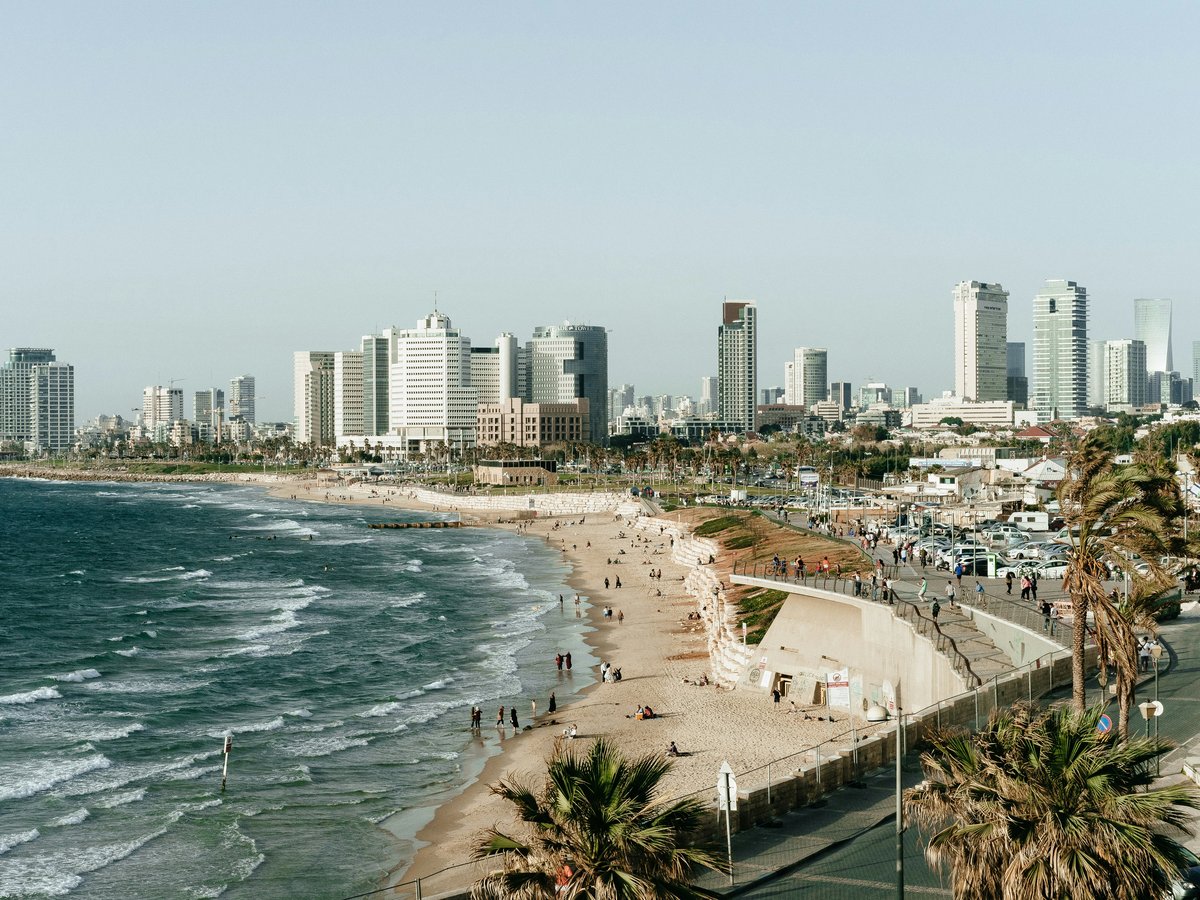
Stay in Tel Aviv in September
75 hotels in the Trip.com pool for Tel Aviv, from US$30 a night.
Opens Trip.com on Fri 3 Sep to Sun 5 Sep 2027; change the dates there.
September in Tel Aviv is shaped by the Jewish High Holidays more than by anything else. Rosh Hashanah falls on September 12-13 in 2026, Yom Kippur on September 21, and the first night of Sukkot on September 25. Each holiday halts public transit, closes most restaurants and shops, and transforms a city that normally runs around the clock into something unnervingly quiet. If you don't study the Hebrew calendar before booking flights, you might arrive to find half the city shut down for 25-48 hours at a stretch.
The heat is still summer-grade. Daytime highs average 30.7°C (87°F) with 69% humidity, the kind that clings to your skin the moment you step outside an air-conditioned lobby. Nights drop to around 22.8°C (73°F), warm enough that the Tayelet promenade fills with locals after 20:00. Rain barely registers at 3mm for the entire month. The Mediterranean sits at roughly 28-29°C, likely its warmest point all year, which makes Gordon Beach and the quieter coves south of Jaffa excellent for long swims.
Mind you, September has one experience that makes the holiday logistics worthwhile. As Yom Kippur begins at sunset, every car in Tel Aviv disappears. The Ayalon Freeway, a 6-lane motorway that divides the city, fills with thousands of cyclists and families walking down the center line. Children ride bicycles at midnight under the highway lights. For travelers willing to work around the closures, September provides a window into Israeli culture that no other month can match. For those who need reliable daily restaurant and transit access, November or April will serve better.
Why visit in September
- The Mediterranean reaches its annual peak temperature in September, making Gordon Beach and Frishman Beach ideal for extended swims. Weekday mornings clear out once the Israeli school year starts around September 1.
- Yom Kippur turns Tel Aviv into the world's largest car-free zone for 25 hours. Cycling the Ayalon Freeway with thousands of locals is an experience that exists nowhere else on earth.
- The cultural season opens after the summer pause. Habima Theatre, the Cameri Theatre, and galleries across Florentin schedule premieres and exhibition openings for late September.
- International tourist numbers tend to drop from the July-August peak, so accommodations outside the holiday nights themselves are often easier to book than midsummer.
Worth knowing
- Three major holidays land within 14 days, each shutting down restaurants, transit, and shops for 25-48 hours. An itinerary that doesn't account for these closures loses 3-4 full days of access.
- The heat remains significant at 30.7°C (87°F) average highs with 69% humidity, making midday walking tours through exposed neighborhoods genuinely uncomfortable between 11:00 and 16:00.
- Sharav (hamsin) episodes can arrive in early September, pushing temperatures past 38°C (100°F) for 2-3 consecutive days with hot, dusty wind from the Negev.
- Hotel rates spike around the specific nights of Rosh Hashanah and Yom Kippur, driven by domestic rather than international demand.
Best for
Think twice if
September carries the tail end of Tel Aviv's long dry season. Humidity makes the measured temperatures feel several degrees hotter, particularly between 11:00 and 16:00 when direct sun bakes the concrete of the White City's Bauhaus facades. Nights bring mild relief, warm enough for open-air dining on Rothschild Boulevard without a layer. Rain is functionally absent. The occasional sharav (hamsin), a hot wind from the Negev desert, can push conditions well past comfortable for 2-3 consecutive days, typically in the first half of the month.
Seasonal caution
- Sharav (hamsin) events can push temperatures above 38°C (100°F) for 2-3 days with hot, dry wind from the Negev desert. These episodes are more common in early September and difficult to predict more than 3-4 days in advance. Stay indoors, hydrate aggressively, and postpone outdoor plans when one hits.
- The UV index remains at 8-9 through September. The coastal breeze creates a misleading sense of coolness while the sun exposure is still intense enough to cause burns within 20 minutes of unprotected skin. This is especially deceptive on the beachfront promenade.
Year-round climate
Averages from the last 5 years.
| Month | Avg high (°C) | Avg low (°C) | Rainfall (mm) |
|---|---|---|---|
| Jan | 18 | 10 | 119 |
| Feb | 18 | 10 | 83 |
| Mar | 20 | 12 | 54 |
| Apr | 24 | 14 | 30 |
| May | 27 | 18 | 4 |
| Jun | 29 | 21 | 2 |
| Jul | 31 | 24 | 2 |
| Aug | 32 | 25 | 1 |
| Sep | 31 | 23 | 3 |
| Oct | 28 | 20 | 9 |
| Nov | 25 | 16 | 50 |
| Dec | 20 | 12 | 108 |
Headline events
Yom Kippur (Car-Free Tel Aviv)
Evening of September 20 through nightfall September 21 (in 2026)
The entire city of Tel Aviv goes car-free for 25 hours. Streets, highways, and the Ayalon Freeway fill with cyclists, rollerbladers, and families on foot. Observant Jews fast and attend synagogue services, while secular Tel Avivians treat the day as the world's largest pedestrian and cycling event. The silence across a city that normally runs on traffic noise is genuinely disorienting. No public transit, no taxis, no ride-hailing apps. It is the single most unusual day of the year to be in Tel Aviv.
Best things to do in September
Cycling the car-free streets on Yom Kippur
outdoorThe Ayalon Freeway and every street in Tel Aviv become a cycling and walking route for 25 hours. Thousands of residents take to the roads on bicycles, rollerblades, and scooters. The experience is peaceful, communal, and entirely unique to Israel.
Yom Kippur falls in September in 2026, the only day of the year when this happens.Booking tipRent a bicycle from a shop near Tel Aviv Port the day before. Rental shops close at sunset when the holiday begins. The pre-dawn hours (05:00-06:00) offer the best riding before families fill the lanes by mid-morning.
Swimming at Gordon Beach
beachGordon Beach, one of Tel Aviv's most popular swimming spots, has lifeguards, changing facilities, showers, and a mix of locals and visitors. The breakwater creates relatively calm conditions for less confident swimmers. The sand is clean and well-maintained.
The sea reaches its annual peak temperature in September. Weekday mornings empty out once the school year starts around September 1.Pre-Rosh Hashanah food shopping at Carmel Market
foodShuk HaCarmel hits a yearly peak of intensity in the days before Rosh Hashanah. Stalls pile high with pomegranates, fresh dates, honey jars, and round challah loaves. The smells of roasting nuts, fresh herbs, and ripe fruit fill the covered aisles. Vendors shout prices. Shoulders brush against shoulders.
The holiday shopping rush concentrates in the 3-4 days before Rosh Hashanah, a rhythm that doesn't repeat elsewhere in the calendar year.Booking tipNo booking needed, but arrive before 09:00 to navigate comfortably. The Friday morning before Rosh Hashanah is the most intense day.
Visiting the Tel Aviv Museum of Art
cultureFounded in 1932, the museum on Shaul HaMelech Boulevard houses Israeli and international art from the 19th century to the present, including significant impressionist and post-impressionist collections. The air-conditioned galleries are a welcome contrast to the heat outside.
September's heat makes indoor cultural activities between 11:00 and 16:00 far more comfortable than outdoor touring. New exhibitions frequently open for the autumn cultural season.Booking tipBuy tickets online to skip the line on Friday mornings, the busiest slot.
Sunset walks along the Tayelet promenade
outdoorThe 5-km beachfront promenade stretches from Tel Aviv Port in the north to Jaffa in the south, passing through some of the city's best beach areas. The concrete path is flat and accessible, with benches and outdoor fitness stations at regular intervals. Street musicians set up near the Dolphinarium site.
September sunsets drop to around 18:45 and the air temperature falls to the mid-20s°C by that hour. The warm sea breeze, golden light on the Mediterranean, and smell of salt are at their best in the late-summer shoulder.Exploring Old Jaffa during Yom Kippur quiet
cultureOld Jaffa's narrow stone alleys, galleries, and the hilltop park looking north toward the Tel Aviv skyline are rewarding any day. But the Yom Kippur period strips away all the traffic noise and tour-bus exhaust. You hear your own footsteps on the stone. The port area smells of salt and old wood.
The car-free period removes the usual traffic noise and tour-bus congestion from Jaffa, making the ancient port neighborhood feel closer to its historical character.Attending opening-season performances at Habima Theatre
cultureIsrael's national theatre, founded in 1917, sits at the head of Rothschild Boulevard in central Tel Aviv. The repertoire leans toward Hebrew-language drama, though some productions offer English surtitles. The building's distinctive brutalist architecture, renovated in the 2000s, is worth seeing on its own.
The Israeli theatre season traditionally opens in September or October after the summer recess, with premiere productions and gala nights on the calendar.Booking tipPremiere nights sell quickly. Check the Habima website in late August for the season schedule and surtitle availability.
What to eat in September
In season: fruit
Pomegranates (rimonim)
Israeli pomegranate harvest peaks in September. Vendors at the main market split them open to show the deep crimson seeds, and street carts press them into tart, ruby-colored juice on the spot. The fruit is also the centerpiece of Rosh Hashanah symbolism, representing abundance. Expect to see pomegranate in salads, over hummus, and staining fingers at every market stall.
Fresh Medjool dates (tmarim)
The Medjool date harvest in the Jordan Valley sends fresh, soft fruit to Tel Aviv markets in September. Unlike the dried dates sold year-round, the September crop has a caramel-like texture and a mild sweetness that pairs well with the salty cheeses at market cheese stalls.
Late-season figs
Black Mission and Kadota fig varieties reach the tail end of their season in September. They tend to be sweeter and softer than the July crop, often split open and eaten with labneh at breakfast. Buy them early in the week; by Friday they sell out at most stalls.
What to drink
Fresh-pressed grape juice
The Israeli grape harvest runs through September, bringing sweet, thick, unfermented juice to market stalls and juice bars. Often served over ice, it tastes nothing like the pasteurized bottled version. Several Carmel Market vendors press it to order.
Festival food
Round Rosh Hashanah challah
Bakeries across the city switch from the standard braided loaf to the round, raisin-studded Rosh Hashanah shape in early September. The sweetened dough is denser than the weekday version, often brushed with honey glaze. Lines at neighborhood bakeries grow long by September 10.
Honey cake (lekach)
The dense, spice-laced honey cake appears in bakery windows from September 1 onward. Variations range from the dark, almost gingerbread-like traditional recipe to lighter versions with citrus zest. It keeps well for days, making it a practical gift and a reliable breakfast when restaurants close for the holidays.
Regular events in September
Rosh Hashanah (Jewish New Year)Free
A 2-day national holiday when nearly all businesses, public transit, and services close. Synagogues hold services, families gather for multi-course meals featuring apples dipped in honey, and the shofar (ram's horn) sounds across neighborhoods. Non-observant visitors should plan around the closures rather than assuming limited operations.
September 12-13 (in 2026)Beginning of Sukkot (Festival of Tabernacles)Free
Sukkot brings temporary wooden-and-fabric structures (sukkot) to balconies, restaurant patios, and public parks across Tel Aviv. The first night and day are a holiday with closures similar to Rosh Hashanah. The intermediate days (Chol HaMoed) see partial business operations and families spending time outdoors.
Begins evening of September 25 (in 2026)Selichot midnight prayer servicesFree
Penitential prayers recited at midnight or in the early morning hours in the week leading up to Rosh Hashanah. Several Tel Aviv synagogues, including the Great Synagogue on Allenby Street, hold atmospheric late-night services open to visitors. The chanting in the dark is a distinctive auditory experience even for non-religious observers.
Approximately September 5-11 (in 2026, the week before Rosh Hashanah)Best places this September
Jaffa Flea Market (Shuk HaPishpeshim)
marketThe flea market in Old Jaffa sells antiques, secondhand furniture, vintage clothing, and Judaica. On Fridays, the surrounding streets fill with additional vendors. The covered market building stays relatively cool even in September's heat. Worth combining with a walk through the narrow alleys of Old Jaffa and the view from the hilltop park.
JaffaEretz Israel Museum
museumFounded in 1958, the museum campus in Ramat Aviv covers archaeology, ethnography, and crafts across multiple pavilions set in a landscaped garden. The outdoor sections include a reconstructed ancient glass workshop and a planetarium. A solid option for families with children old enough to handle the walking between pavilions in the heat.
Ramat AvivHilton Beach
beachThe stretch of beach below the Hilton hotel in northern Tel Aviv has a designated LGBTQ+ section and a separate dog-friendly area. Tel Aviv rates 7.5/10 for LGBTQ+ friendliness (sourced from TTDI's editorial rubric). The beach is slightly less packed than Gordon Beach and has a reliably good atmosphere among regular locals. The reef-protected swimming area is calm.
North Tel AvivNeve Tzedek
neighborhoodTel Aviv's oldest neighborhood, built in the 1880s outside the walls of Jaffa, is home to boutique galleries, design shops, and independent cafes. September sees gallery openings and pop-up exhibitions as the cultural season begins. The Suzanne Dellal Centre for Dance and Theatre sits at its heart, and its courtyard is pleasant in the cooler evening hours.
Neve TzedekSarona Market
marketThe indoor food market in the restored Templar-era Sarona compound offers Israeli and international food stalls, a wine bar, and specialty grocery shops. It tends to reopen earlier than most establishments after each holiday closure, making it a reliable food source when the rest of the city stays dark.
Central Tel AvivANU - Museum of the Jewish People (formerly Beit Hatfutsot)
museumFounded in 1978 on the Tel Aviv University campus and recently renovated under the name ANU, the museum traces global Jewish history through multimedia exhibits, personal stories, and interactive installations. The High Holiday context makes its narratives about diaspora, tradition, and return feel especially resonant in September. The campus grounds are green and relatively shaded.
Ramat AvivDizengoff Square and surroundings
landmarkThe renovated Dizengoff Square sits at the intersection of Dizengoff Street and Pinsker Street, surrounded by cafes with sidewalk seating. On Friday afternoons before Shabbat, the energy around the square reaches a weekly peak as locals finish errands before everything closes. In September, the holiday grocery rush amplifies this rhythm to near-fever pitch.
Central Tel Aviv
Your packing checklist
Tick items off as you pack. Your progress saves in this browser.
All packed — have a great trip.
Insider tips
Stock up on food the day before each holiday. Even the 24-hour convenience stores close for Yom Kippur. The supermarkets near Dizengoff Center start to thin out noticeably from September 9 as locals buy for the Rosh Hashanah table. Non-perishables, snacks, and bottled water are the priority.
The pomegranate and honey vendors near the Kerem HaTeimanim entrance to Carmel Market tend to offer better prices than the tourist-facing stalls along the main corridor. Arrive before 09:00 on any market day in September to navigate without getting swept along by the pre-holiday shopping rush.
If you want to cycle the freeway on Yom Kippur, secure your bicycle before the holiday starts. Rental shops close at sunset. The pre-dawn hours, around 05:00-06:00, offer the best riding before families with small children fill the intersections and the pace slows to a walking crawl by 10:00.
A handful of restaurants in Florentin and along Dizengoff Street tend to stay quietly open on Rosh Hashanah evening, though they won't advertise it publicly. Your hotel's front desk usually knows which ones. On Yom Kippur itself, assume that nothing is open. Plan accordingly.
Avoid these mistakes
- Booking a tightly scheduled 5-day trip without studying the Hebrew calendar. The holiday closures are spaced close enough in September 2026 that an unlucky arrival window could lose 2-3 full days to shutdowns. Check dates before choosing flight days, not after.
- Planning outdoor walking tours between 11:00 and 16:00. The humidity compounds the heat index well beyond what the thermometer reads, and neighborhoods like the White City and Neve Tzedek have limited tree shade. Schedule walking for before 09:00 or after 17:00.
- Driving a rental car on Yom Kippur. The roads are physically occupied by pedestrians and cyclists, and driving is socially unacceptable even for non-observers. Attempting it risks genuine confrontation. Return your rental before sunset on the eve of the holiday.
Practical tips for September
The three High Holidays require advance accommodation booking, particularly because domestic Israeli travelers fill hotels that international visitors rarely compete for. Ben Gurion Airport runs reduced schedules on holiday eves and the holidays themselves; confirm your flight time with your airline 48 hours ahead. Egged and Dan bus services stop entirely from each holiday's eve to the following evening, and the Rav-Kav transit card won't help during those hours. Sherut (shared taxi) vans are your main alternative when buses stop running. Sarona Market and Tel Aviv Port area restaurants tend to be among the first to reopen after each closure. Dress code is minimal in secular Tel Aviv, but covering shoulders and knees is expected at synagogues and preferred at some Jaffa restaurants near the Clock Tower mosque. Tipping at restaurants runs 10-15% year-round. For getting around, see https://en.wikivoyage.org/wiki/Tel_Aviv#Get_around for transit options and walking distances between neighborhoods.
FAQ
Is September a good time to visit Tel Aviv?
September works well if you plan around the holiday closures and genuinely don't mind persistent heat. The swimming conditions are arguably the year's best, the international crowds thin from their summer peak, and the Yom Kippur car-free experience is unlike anything in any other city. Travelers who need predictable daily access to restaurants and transit will find spring or October less complicated. The month ranks roughly 7th out of 12 for general tourism, behind the more temperate spring and autumn months but ahead of the peak-heat summer and the rainy winter.
What is the weather like in Tel Aviv in September?
Hot and sticky, with conditions similar to August. Humidity compounds the heat, making midday hours between 11:00 and 16:00 genuinely draining for outdoor sightseeing. Pack as you would for a Southeast Asian city in the dry season. Rain is not a factor at all. The wild card is the sharav (hamsin), a hot desert wind that can spike conditions well above average for 2-3 consecutive days. The Mediterranean is excellent for swimming, sitting at roughly its annual warmest.
Is Tel Aviv safe for solo travelers in September?
Tel Aviv scores 5.8/10 for solo-traveler safety (see the TTDI Solo-Safety Index). The city is generally walkable and well-lit at night, particularly along the beachfront and in central neighborhoods like Florentin and Neve Tzedek. Standard urban precautions apply. September adds one unique dimension. During the holiday evenings and especially on Yom Kippur, streets become very quiet. Some solo travelers find the emptiness peaceful; others find it unsettling. Keep your hotel address saved offline, as transit apps and ride-hailing services are unavailable during the closures.
Is Tel Aviv crowded in September?
The international summer tour groups thin out after August, but the holiday calendar brings domestic travelers from across Israel. Beaches empty on weekday mornings once the school year starts. During the holidays themselves, restaurants close, so the question shifts from 'are there too many people?' to 'can I find anywhere open?' The Yom Kippur car-free period fills streets with local residents, but the mood feels communal rather than hectic.
Can I eat at restaurants during the High Holidays in Tel Aviv?
It depends on which holiday. During Rosh Hashanah, a number of restaurants in secular neighborhoods quietly stay open, though they may not advertise it. Your hotel front desk usually has a current list. On Yom Kippur, expect virtually everything to close for the full 25-hour period. Your hotel may offer room service, but do not count on it. The practical move is to stock up on food and water the day before each holiday. For a broader sense of Tel Aviv's food landscape, see https://en.wikivoyage.org/wiki/Tel_Aviv#Eat for neighborhood breakdowns.
Things to Do in Tel Aviv in September
 Free cancellation
 Masada and the Dead Sea Day Trip from Tel Aviv
Day trip: 12 hours, free cancellation.
via Viator Free cancellation
 Nazareth and the Sea of Galilee Day Trip from Tel Aviv
Day trip: 10 hours, free cancellation.
via Viator
Jerusalem Private Tour | Official Licensed Guide
Day trip: 8 hours.
via Viator Free cancellation
 Best of Tel Aviv, Jaffa & Carmel Market Tour
Day trip: 6 hours, free cancellation.
via Viator Free cancellation
 From Tel Aviv/Jerusalem: Galilee, Nazareth, Jordan River Tour
Day trip: 12 hours, free cancellation.
via Viator Free cancellation
 Best of the West Bank Tour from Tel Aviv
Day trip: 12 hours, free cancellation.
via ViatorFind a flight to Tel Aviv
Live fares to Tel Aviv appear here once cookies are accepted.
Last verified by automated review (v1.7.2) on . What is automated review?