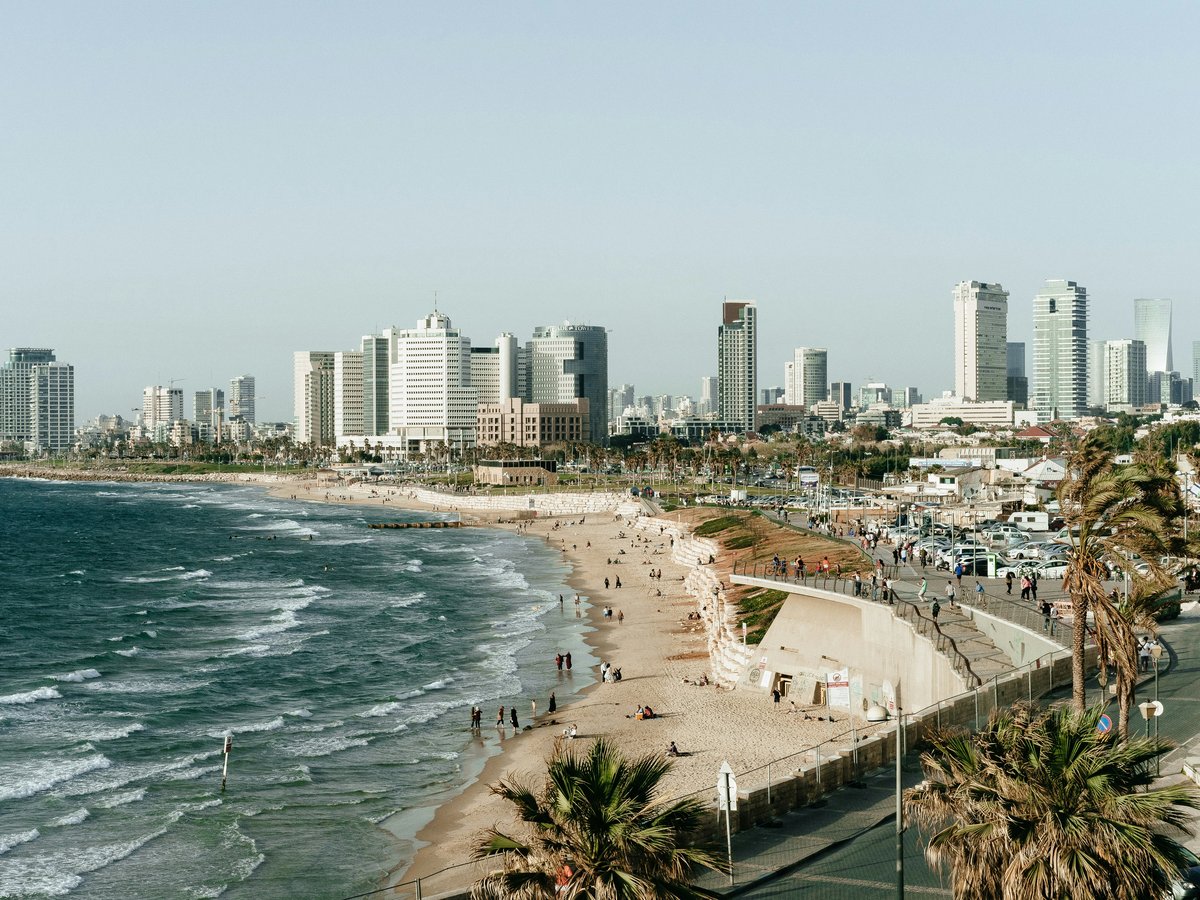
Tel Aviv stretches about 14 kilometers along the Mediterranean coast, with Old Jaffa's ancient port at the southern tip and the Yarkon River marking the informal northern boundary. The layout runs in parallel north-south bands, from Jaffa through Neve Tzedek and the White City center up to Ramat Aviv beyond the Yarkon. Walk inland from the beach and you pass through the hotel strip on HaYarkon Street, then the commercial core around Allenby and King George, then quieter residential blocks toward Ayalon Highway to the east. Most visitors find that a 4-kilometer radius around Rothschild Boulevard covers the beach, the Carmel Market, Neve Tzedek, and Habima Square on foot in 20 minutes or less. In mid-August the temperature currently sits around 31°C with 55% humidity, which pushes the felt temperature closer to 34°C. The Mediterranean breeze helps along the Tayelet promenade but fades around Ben Yehuda Street, two blocks inland. The city scores 7.5/10 for LGBTQ+ friendliness (sourced from TTDI's editorial rubric), and that openness is visible from the beach clubs north of the marina to the neighborhood bars in Florentin. For general orientation and practical logistics, the Wikivoyage Tel Aviv article (https://en.wikivoyage.org/wiki/Tel_Aviv) remains a solid starting reference.
Neighborhoods
-
Old Jaffa (Yafo)
A port settlement with roughly 4,000 years of continuous habitation, now folded into Tel Aviv's southern edge. The hilltop cluster around the Clock Tower and St. Peter's Church has narrow stone lanes, a handful of galleries, and restaurants with unobstructed sea views westward across the Mediterranean. The Jaffa Flea Market on Olei Zion Street sells secondhand furniture, vintage vinyl, and oddities from estate clearances. The smell of roasting coffee from the Turkish coffee vendors mixes with salt air off the harbor. The architecture is rough-cut limestone, arched doorways, and painted iron gates. Bloomfield Stadium sits a short walk east, straddling the border with Florentin. After about 22:00, the streets get noticeably quiet.
- Best for
- History-focused travelers, photographers, couples wanting quieter evenings away from the main bar districts
- Key streets
- Yefet Street (the main commercial road running south from the Clock Tower), Olei Zion Street and the flea market, Kedumim Square on the hilltop, the port boardwalk below
-
Neve Tzedek
The first Jewish neighborhood built outside Old Jaffa, founded in 1887. Low-rise buildings here are a mix of Ottoman-era stone houses and early-20th-century plaster facades, most restored over the last 30 years. Shabazi Street is the main commercial spine, with independent galleries, small restaurants, and a gelato shop that always has a line on weekends. The Suzanne Dellal Centre for dance and theatre anchors the southern end of the neighborhood. Sidewalks are narrow, cars move slowly, and the foot traffic thins noticeably on weekday mornings. The whole neighborhood covers maybe 8 blocks.
- Best for
- Couples, design-conscious travelers, anyone who wants walking access to both the beach and Jaffa
- Key streets
- Shabazi Street (the commercial center), Rokach Street, Pines Street, the pedestrian path connecting south to Jaffa's flea market
-
Kerem HaTeimanim (Yemenite Quarter)
A tight grid of narrow streets wedged between the Carmel Market to the north, Neve Tzedek to the south, and the seafront to the west. This is the food neighborhood. The Yemenite restaurants here serve jachnun (slow-baked flaky dough), malawach (pan-fried flatbread), and kubaneh bread that has been baking overnight in a sealed pot. The buildings are low, the streets feel like alleys in places, and laundry lines cross overhead between second-floor balconies. The Carmel Market's southern entrance is a 2-minute walk north. At lunch, the smell of cumin and fenugreek from the restaurant kitchens reaches you before the signage does.
- Best for
- Food-focused travelers, anyone wanting a central location without the hotel-strip atmosphere
- Key streets
- Ge'ula Street, the alleys leading to HaCarmel Market's southern gate, Nachalat Binyamin pedestrian mall (arts and crafts market on Tuesdays and Fridays)
-
Florentin
Tel Aviv's scruffier quarter, south of Allenby Street and east of Neve Tzedek. Street art covers nearly every available wall, especially along Florentin Street and the alleys off Vital Street. The restaurants lean toward cheap Balkan and Middle Eastern spots where a full meal might cost 40-50 ILS. Buildings are 3-4 story walk-ups with peeling paint and iron balconies. The nightlife concentrates on Florentin Street itself and the bars around the intersection with Abarbanel Street. During the day, the area has a half-asleep quality. The noise picks up around 22:00 on Thursdays and Fridays.
- Best for
- Budget travelers, solo travelers, people who want nightlife on their doorstep
- Key streets
- Florentin Street (the main bar and restaurant strip), Vital Street for street art, Abarbanel Street, Levinsky Market to the northeast for spices and dried goods
-
Lev Ha'ir (White City Center)
The geographic and commercial center of Tel Aviv, built around Rothschild Boulevard and the blocks radiating north and east from it. This district holds the densest concentration of Bauhaus and International Style buildings on earth, roughly 4,000 of them, which earned UNESCO World Heritage status in 2003 as the White City. Habima Theatre, founded in 1917 as what became Israel's national theater, sits at the boulevard's northeast end. The Tel Aviv Museum of Art, which opened in 1932, occupies Shaul HaMelech Boulevard to the north. Rothschild Boulevard itself is wide and tree-shaded, with a pedestrian path down the center where people walk dogs, sit on benches with laptops, and run in the early morning. Independence Hall, where David Ben-Gurion declared statehood in 1948, is at 16 Rothschild Boulevard.
- Best for
- First-time visitors, architecture enthusiasts, business travelers who want proximity to everything
- Key streets
- Rothschild Boulevard (the central spine), Allenby Street heading southwest to the beach, Bialik Street and Bialik Square for early Tel Aviv architecture, Habima Square, Shaul HaMelech Boulevard toward the museum quarter
-
Sarona
A cluster of restored sandstone buildings from a German Templar colony established in the 1870s, now surrounded by the glass towers of Tel Aviv's financial district. Sarona Market, inside one of the restored structures, is an indoor food hall with about 90 vendors selling everything from craft beer to artisan chocolate to fresh sashimi. The Azrieli Center's three towers (round, triangular, square) stand directly across Kaplan Street. The area between Sarona and Azrieli has a corporate lunch-hour energy on weekdays and fills with families on Saturdays. The complex is free to walk through and open daily, including Saturdays when much of the city slows down.
- Best for
- Families wanting a contained eating and shopping area, business travelers near the Azrieli transit hub
- Key streets
- The Sarona complex pedestrian paths, Kaplan Street connecting to the Azrieli Center, Begin Road along the eastern edge
-
Dizengoff and North-Central
The stretch of Dizengoff Street between Dizengoff Square and Arlozorov Street captures everyday residential Tel Aviv better than anywhere else. Cafes occupy the ground floors of 4-5 story apartment blocks, and the afternoon heat pools between buildings on the side streets where the coastal breeze doesn't reach. Dizengoff Square was renovated in 2018, bringing Yaacov Agam's kinetic Fire and Water fountain back to street level after decades on a raised platform. Ben Yehuda Street runs parallel, one block closer to the beach, with a similar mix of cafes and small shops. Tel Aviv's digital-nomad suitability sits at 7.2/10 (sourced from TTDI's editorial rubric), and this is the neighborhood where that population concentrates. Cafes with reliable Wi-Fi and power outlets line both streets.
- Best for
- Long-stay visitors, digital nomads, travelers who want daily Tel Aviv life rather than the tourist circuit
- Key streets
- Dizengoff Street (the main north-south artery), Ben Yehuda Street one block west, King George Street cutting east-west, Dizengoff Square at the junction with Pinsker Street
-
Ramat Aviv
The residential university district north of the Yarkon River, quieter and greener than anything south of it. Tel Aviv University's campus holds the Museum of the Jewish People at Beit Hatfutsot, which opened in 1978 and was renovated into a fully interactive exhibition space in 2016. The Eretz Israel Museum on Haim Levanon Street, founded in 1958, spreads archaeological pavilions across an open park with olive trees and ancient glass collections. The neighborhood itself is leafy apartment blocks, wide sidewalks, and a noticeably slower pace. Tel Aviv scores 8.2/10 for family friendliness (see the TTDI Family-Friendliness Index), and Ramat Aviv is the neighborhood that earns much of that mark. Yarkon Park runs along the southern edge with bike paths, rowboat rentals, and a botanical garden.
- Best for
- Families with children, museum visitors, anyone who prefers residential quiet over nightlife proximity
- Key streets
- Haim Levanon Street (the museum corridor), Einstein Street along the campus perimeter, the Yarkon Park trails and bike paths, Ramat Aviv Mall for practical shopping
FAQ
How much does a typical meal cost in Tel Aviv in local currency?
At the current rate of 1 USD to 2.9513 ILS, a main course at a mid-range restaurant costs roughly 70-90 ILS (about 24-30 USD). Street food from the Carmel Market or Levinsky Market runs 25-40 ILS for a shawarma or falafel plate. Sit-down restaurants in Neve Tzedek and the Sarona complex tend to charge 15-25% more than equivalent places in Florentin or the Yemenite Quarter. For more on food districts and specific dietary considerations, see the Wikivoyage food section (https://en.wikivoyage.org/wiki/Tel_Aviv#Eat).
Which neighborhood is best for first-time visitors to Tel Aviv?
Lev Ha'ir around Rothschild Boulevard puts you within a 15-minute walk of the beach, the Carmel Market, Habima Square, and the museum quarter on Shaul HaMelech Boulevard. Hotels along HaYarkon Street, one block from the beach, are the conventional tourist base, but a rental apartment on a Rothschild side street tends to give better access to restaurants and nightlife without the hotel markup. The trade-off is that HaYarkon rooms are closer to the water for morning beach runs, while Rothschild puts you at the center of evening activity.
Is Tel Aviv safe for solo travelers?
Tel Aviv scores 5.8/10 for solo-traveler safety (see the TTDI Solo-Safety Index). The main tourist areas between Jaffa and the Yarkon River are generally well-lit and patrolled, and most neighborhoods feel walkable after dark. Standard urban precautions apply. The southern end of the Central Bus Station area and parts of Neve Sha'anan south of Levinsky Market tend to feel less comfortable at night. For more detailed safety notes, see the Wikivoyage safety section (https://en.wikivoyage.org/wiki/Tel_Aviv#Stay_safe).
How do you get between neighborhoods without a car?
Most central neighborhoods sit within 20-30 minutes of each other on foot. The Red Line light rail, which began operating in 2023, connects the eastern suburbs to the center along Begin Road. Buses run frequently on Allenby, King George, and Ibn Gabirol streets. Electric scooters from rental apps are everywhere, though the sidewalk riding can feel aggressive. For route specifics and transit passes, the Wikivoyage transit section covers the main options (https://en.wikivoyage.org/wiki/Tel_Aviv#Get_around).
Is the Design Museum Holon worth a day trip from Tel Aviv?
The Design Museum Holon, which opened in 2010, is about 15 minutes by taxi or 30 minutes by bus from central Tel Aviv. Ron Arad designed the building itself, and the exterior's curved weathering-steel ribbons are worth seeing even if the current exhibition does not interest you. Holon is a separate city to the south, so pair the visit with lunch in Jaffa on the way back to avoid an otherwise single-purpose trip.
What should visitors expect during Shabbat in Tel Aviv?
Shabbat runs from Friday sunset (roughly 19:30 in summer, 16:30 in winter) to Saturday night. Tel Aviv is more relaxed about Shabbat observance than most Israeli cities. Restaurants and cafes in secular neighborhoods like Florentin, the Dizengoff area, and the Namal Tel Aviv port district typically stay open, and the beach is full on Saturdays. Public buses stop Friday afternoon and resume Saturday evening. Taxis and ride-hailing apps like Gett continue operating throughout.
Last verified by automated review (v1.7.2) on . What is automated review?