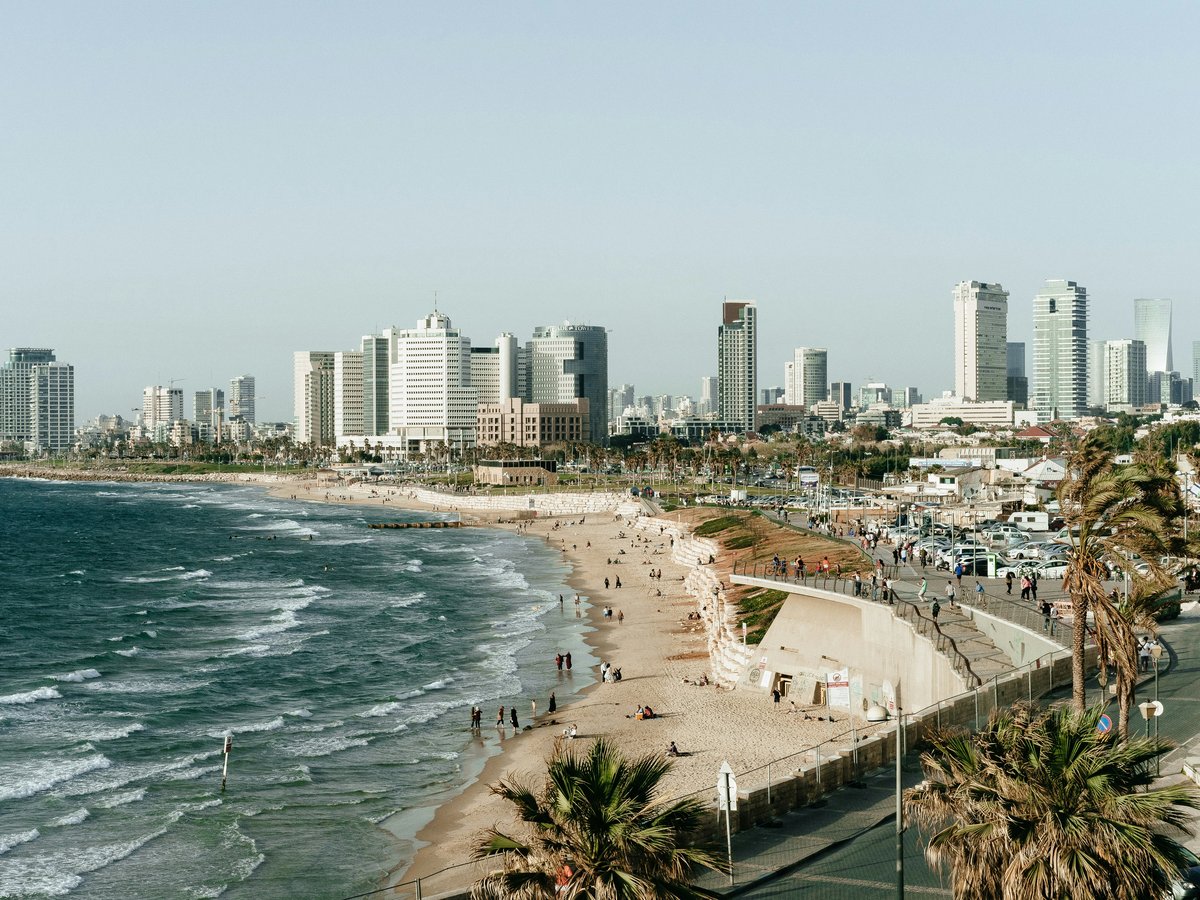
Tel Aviv stretches along roughly 14 kilometers of Mediterranean shoreline. The Yarkon River cuts east-to-west through the city's northern neighborhoods and empties into the sea near the Reading power station. Mid-August evenings currently sit around 28.3°C with 74% humidity, which translates to a sticky, salt-heavy warmth that clings to your skin well after sundown. That moisture is standard from June through September. The upside is about 300 days of sunshine per year, which keeps outdoor activity going through December and picks back up by March. The city rates 8.2 out of 10 for family friendliness (see the TTDI Family-Friendliness Index), and a large share of that comes down to how walkable the parks and beaches are. Flat coastal geography means most green spaces, trails, and swimming spots sit within biking distance of the city center. Tel Aviv's outdoor character tends to revolve around 3 poles. The beaches, obviously. The Yarkon corridor, which functions as the city's green lung. And the network of day-trip trails within 45 to 90 minutes by car, reaching into the Judean foothills and up the Sharon coast toward Haifa.
Outdoor activities
-
Coastal cycling from Tel Aviv Port to Jaffa
A dedicated bike path runs the length of the tayelet (promenade) from the Tel Aviv Port area south to the Old Jaffa lighthouse, covering roughly 7 kilometers each way. The route is flat, paved, and shared with joggers and pedestrians, so weekday mornings tend to be less congested. Tel-O-Fun bike-share docking stations appear every few hundred meters along Rothschild Boulevard and the beachfront. You can rent road bikes from shops on Ben Yehuda Street for longer rides north toward Herzliya, adding another 12 kilometers of mostly separated path. The salt breeze keeps things bearable even in May heat.
- Difficulty
- Easy
- Duration
- 1-3 hours depending on distance
- Best season
- October through May, before the summer heat peaks
-
Beach volleyball at Gordon Beach
Gordon Beach, near the corner of Gordon and HaYarkon streets, has permanent volleyball nets set up in the sand. Pick-up games run most afternoons from about 16:00 onward, when the sun drops low enough to make the sand bearable underfoot. The courts are free. Friday afternoons before Shabbat tend to draw the largest crowds. If the Gordon nets are full, Frishman Beach about 400 meters south has additional courts that are usually less packed. You will notice the sand here is soft and deep, which makes for a serious leg workout compared to grass courts.
- Difficulty
- Moderate (sand running is harder than it looks)
- Duration
- 1-2 hours
- Best season
- Year-round, though summer midday heat makes late-afternoon play more comfortable
-
Running the Tayelet promenade
The paved promenade stretches about 5 kilometers from Charles Clore Park near Jaffa up to the Hilton Beach area. Runners share it with walkers and cyclists, but before 07:00 it thins out considerably. The flat, sea-level route follows the shoreline with no elevation gain. Most locals run the southern half, from Alma Beach past the Dan Panorama hotel to Banana Beach, then loop back. Friday mornings see organized running groups gathering near the old Dolphinarium lot. The sound of waves and the smell of salt air make this a more pleasant loop than any treadmill, even in summer.
- Difficulty
- Easy
- Duration
- 30-60 minutes for a 5-10 km out-and-back
- Best season
- October through April for comfortable temperatures; summer runners start before 06:30
-
Kitesurfing north of the Tel Aviv marina
The stretch of beach north of the Tel Aviv marina, near the Sheraton hotel, is the city's primary kitesurfing zone. Wind conditions are most reliable from May through October, with thermal sea breezes picking up around midday and blowing 15-20 knots from the west-southwest. Several schools operate from the beach, offering 2-day beginner courses for approximately 1,500-2,000 ILS. Mind you, the water stays warm enough for a rash guard alone until November. The afternoon wind tends to gust and shift around 16:00, which makes sessions choppy but exciting for experienced riders.
- Difficulty
- Moderate to advanced (beginners need instruction)
- Duration
- 2-4 hours per session
- Best season
- May through October for consistent afternoon thermals
-
Sportek fitness complex in Yarkon Park
The Sportek area on the southern side of Yarkon Park has outdoor basketball courts, a climbing wall, fitness stations, and the Galit Chait skate park with concrete bowls and a half-pipe section. All facilities are free to use and open from morning to late evening. Weekday mornings tend to be quiet. The shaded sections are limited, so summer afternoons get punishing on exposed concrete. The climbing wall is small but functional for bouldering practice, and the basketball courts fill up with competitive pick-up games most evenings after 18:00.
- Difficulty
- Varies by activity
- Duration
- 1-3 hours
- Best season
- Year-round; mornings in summer to avoid direct sun on exposed courts
Day hikes
-
Apollonia National Park (Arsuf crusader ruins)
About 20 kilometers north of Tel Aviv, near the coast at Herzliya. The park sits on sandstone cliffs above the sea and contains the remains of Arsuf, a castle ruin from the Crusader period. A trail loops the cliff edge with views down to the rocky shore, passing through fortress walls, a dry moat, and a crushed-stone pathway. The total loop covers around 2 kilometers. To be fair, it is more of a historical walk than a serious hike, but the cliff scenery and the sound of waves crashing below earn the trip. Wildflowers cover the clifftop in late February and March.
- Difficulty
- Easy
- Duration
- 1-2 hours including the ruins
- Best season
- Year-round; February-March for wildflower displays along the cliffs
-
Tel Afek (Antipatris) at the Yarkon headwaters
Tel Afek National Park sits at the source of the Yarkon River, roughly 15 kilometers east of central Tel Aviv near Rosh HaAyin. Antipatris is an ancient settlement mound with occupation layers reaching back to the Bronze Age. The main trail circles the tel and the spring pools where the Yarkon begins, passing an Ottoman-era fortress and eucalyptus groves. The spring water here flows cool and clear, a real contrast to the murkier river downstream in the city. The loop covers about 3 kilometers with minimal elevation change.
- Difficulty
- Easy
- Duration
- 1.5-2 hours
- Best season
- October through April; summer heat is unrelieved on the exposed tel
-
Nahal Taninim Nature Reserve
About 70 kilometers north of Tel Aviv, near Zichron Ya'akov. The reserve follows Nahal Taninim (Crocodile River), named for the Nile crocodiles that lived here until the early 1900s. A trail runs along ancient aqueducts, dam remnants, and spring-fed pools. Parts of the path cross water on stepping stones, so you will want waterproof sandals or shoes with grip. The main circuit covers around 3 kilometers. The reserve's pools are swimmable in designated sections during summer months. The sound of flowing water and the shade from overhanging trees make this feel cooler than the surrounding countryside.
- Difficulty
- Easy to moderate (uneven terrain, water crossings)
- Duration
- 2-3 hours
- Best season
- March through May for full pools and moderate temperatures
-
Sataf spring trail in the Judean Hills
About 75 minutes from Tel Aviv by car, in the Jerusalem Hills. Sataf is a restored agricultural terrace site with two springs, Ein Sataf and Ein Bikura. The upper trail passes through reconstructed stone terraces, fig groves, and olive trees, with the thick herbal scent of wild za'atar along the path edges. The lower loop descends more steeply through rocky terrain into a small valley. Both loops combined run about 4 kilometers with roughly 150 meters of elevation change. The terraces and stone water channels date back approximately 2,000 years.
- Difficulty
- Moderate (rocky footing, steep descents on the lower loop)
- Duration
- 2.5-3.5 hours for both loops
- Best season
- November through April; summer heat on the exposed upper terraces is serious
-
Ein Hemed (Aqua Bella) National Park
A small, shaded valley park about 60 minutes from Tel Aviv, off Route 1 near Abu Ghosh. The site has a 12th-century Crusader farmhouse ruin and a spring-fed stream that creates small wading pools. The main trail loop is only about 1 kilometer, making it more of a half-day picnic spot than a proper hike. That said, you might combine it with a walk through nearby Abu Ghosh, known for its hummus restaurants along the main road. The thick tree canopy keeps the temperature noticeably lower than the surrounding hillsides.
- Difficulty
- Easy (flat, shaded, mostly paved paths)
- Duration
- 1-1.5 hours for the trail, longer if picnicking
- Best season
- Year-round; the shade and water make it tolerable even in deep summer
Water activities
-
Mediterranean swimming at Tel Aviv's city beaches
Tel Aviv has roughly a dozen named beaches along its coastline, each with a slightly different personality. Gordon Beach near the marina is the most tourist-visited. Hilton Beach further north has a section popular with the LGBTQ community and a separate area for surfers. Metzitzim Beach near the Yarkon River mouth tends to be family-oriented with calmer water behind a breakwater. Lifeguards operate from roughly April through October at most official beaches, typically 07:00 to 17:00 on weekdays and later on weekends. Water temperature reaches about 28-29°C by mid-August.
- Difficulty
- Easy (stay within flagged swimming zones)
- Duration
- As long as you like
- Best season
- May through October for warm water and active lifeguard service
-
Kayaking and rowing on the Yarkon River
The section of the Yarkon running through the city's main park offers kayak and rowboat rentals from a dock near the eastern entrance off Rokach Boulevard. Single and tandem kayaks run about 80-120 ILS per hour. The river is flat and slow here, with no rapids, so it suits beginners and families. You paddle under low bridges and past thick vegetation on both banks, with pelicans and egrets sometimes visible along the quieter upstream stretches. Water quality has improved significantly since the 1990s rehabilitation, though it still is not swimming-grade. The faintly marshy smell is strongest near stagnant bends on hot days.
- Difficulty
- Easy (flat water, essentially no current)
- Duration
- 1-2 hours
- Best season
- Year-round; mornings are best in summer to avoid headwinds off the sea
-
Surfing at Hilton Beach and the Dolphinarium break
Hilton Beach, at the base of Independence Park, has a reef break that works on west and northwest swells. The Dolphinarium spot further south picks up similar swell directions over a sandier bottom. Wave height rarely exceeds 1.5 meters in summer, making these spots forgiving for intermediate surfers. Winter storms from November through February bring bigger, less consistent swells that occasionally reach 2-3 meters. Board rentals from shops on Frishman Street run about 100-150 ILS for a half day. A wetsuit is needed from December through March, when sea temperatures drop to around 17-18°C.
- Difficulty
- Beginner to intermediate in summer; intermediate to advanced in winter swells
- Duration
- 2-3 hours per session
- Best season
- Summer for beginners (small, consistent waves); November-February for experienced surfers
-
Stand-up paddleboarding off the Tel Aviv marina
The sheltered water near the Tel Aviv marina provides a calm launch point for stand-up paddleboarding. Several rental outfits operate from the marina area, with boards available for about 80-100 ILS per hour. If you head south along the coast toward Jaffa, you get a different perspective on the city skyline and the Old Jaffa headland. Morning sessions before 10:00 usually mean flatter water, before the afternoon onshore breeze chops up the surface. You might spot schools of mullet in the shallows off the Jaffa rocks.
- Difficulty
- Easy to moderate (balance and core strength needed)
- Duration
- 1-2 hours
- Best season
- April through November; winter can be too choppy for beginners
-
Snorkeling off the Jaffa rocks
The rocky shoreline below Old Jaffa, particularly south of the old port, has underwater rock formations that attract small fish, sea urchins, and the occasional octopus. Visibility varies from 3 meters on stirred-up days to 10 or more meters when conditions are calm. No boat needed. You enter from the rocks, so water shoes with hard soles are essential to protect against urchin spines and sharp stone. The best visibility tends to come on still mornings after several calm days. Not a Red Sea reef by any measure, but the marine life is more varied than most visitors expect from an urban coastline.
- Difficulty
- Easy to moderate (rocky entry, mild currents possible)
- Duration
- 1-2 hours
- Best season
- June through September for warmest water and calmest conditions
Parks & gardens
-
Yarkon Park (Park HaYarkon)
FreeThe largest urban park in Tel Aviv covers about 3,500 dunams (350 hectares) along the northern bank of the Yarkon River. It connects the Rokach Boulevard area in the east to the river mouth near the Reading neighborhood in the west. The park has 6 distinct botanical gardens. The tropical garden smells lush and damp even in dry months, and the cactus garden is worth a slow walk for its sheer variety. Pedal boats and kayaks are available at the boating lake near the eastern entrance. Bird-watching along the quieter upstream stretches sometimes turns up kingfishers and egrets.
Highlights: Tropical garden, cactus garden, rock garden, boating lake, Yarkon River bird-watching corridor
-
Gan Meir
FreeA compact 2.5-hectare park in central Tel Aviv, bordered by King George Street and Tchernikhovsky Street. Gan Meir has a small artificial lake with turtles, shaded lawns under old ficus trees, and a dog-friendly section that fills up on Friday mornings. The park reopened after renovation in 2010 with new pathways and a children's playground. Worth noting, it sits next to the Tel Aviv LGBTQ center, and the neighborhood around it forms the core of the city's LGBTQ scene. The city scores 7.5 out of 10 for LGBTQ+ friendliness (sourced from TTDI's editorial rubric).
Highlights: Turtle lake, shaded ficus canopy, children's playground, adjacent LGBTQ community center
-
Charles Clore Park
FreeA beachfront park on the southern edge of Tel Aviv, stretching from the old Dolphinarium area south toward Jaffa. The park sits on a slight rise above the sand, giving clear sightlines north along the coastline. The grass areas are large enough for frisbee or picnics without crowding. Bloomfield Stadium, home to both Hapoel Tel Aviv and Maccabi Tel Aviv football clubs, stands at the park's southern edge. On warm evenings, the breeze off the water carries the faint smell of grilled corn from the beach vendors below.
Highlights: Elevated coastline views, large open lawns for sports, Bloomfield Stadium proximity, direct walking access to Old Jaffa
-
Park HaMesila (The Railway Park)
FreeA linear park built along the old Jaffa-Jerusalem railway line, running about 1 kilometer from Kaufmann Street near the Neve Tzedek neighborhood southeast toward Florentine. The park opened in 2014 and preserves sections of original rail track embedded in the path. It is narrow but pleasant, with benches, small gardens, and scattered art installations. The Neve Tzedek end connects to the Hatachana compound, a restored Ottoman-era railway station from 1892 that now houses cafes and galleries.
Highlights: Preserved rail tracks, Hatachana compound (1892 Ottoman station), Neve Tzedek street access, public art
-
Independence Park (Gan HaAtzmaut)
FreeA hilltop park overlooking the Mediterranean, between the Hilton Beach promenade and the Dan Tel Aviv hotel. Old ficus and eucalyptus trees provide genuine shade here, which is rarer than you might expect in Tel Aviv's coastal parks. The western edge drops down to the beach. It is quieter than Yarkon Park and less manicured than Gan Meir, with a slightly wilder, unkempt feel. Early morning is the best time, when dog walkers and joggers have the paths mostly to themselves and the air still carries cool dampness from the sea.
Highlights: Mediterranean overlook, mature ficus and eucalyptus shade, direct Hilton Beach stair access
Practical tips
- Sun protection
- The UV index in Tel Aviv regularly reaches 10-11 between May and September. Apply SPF 50+ before going out and reapply every 90 minutes if sweating. A hat with a brim is not optional for hikes. Sunstroke cases spike at area hospitals every July and August. Plan strenuous outdoor activity before 10:00 or after 16:00 in summer months. Sunglasses with UV400 protection matter more here than in northern Europe.
- Hydration
- Carry at least 1 liter of water per hour of hiking in summer. Tap water in Tel Aviv is drinkable, and free water fountains appear in most parks and along the tayelet. For day hikes outside the city, fill up before you leave. The thick summer humidity accelerates dehydration faster than most visitors expect. Electrolyte tablets are sold at SuperPharm pharmacies for about 30 ILS per tube.
- Currency and costs
- The Israeli new shekel (ILS) currently trades at roughly 2.95 per US dollar. National park entry fees run 22-29 ILS per adult. Beach chair and umbrella rental costs 30-40 ILS at most beaches. Budget roughly 80-120 ILS per hour for kayak or SUP board rentals. Tipping is expected at sit-down restaurants (10-15%) but not for outdoor equipment rentals.
- Trail conditions and footwear
- Trails within Tel Aviv itself are paved or packed gravel. Day hikes at reserves like Nahal Taninim or Sataf involve rockier terrain with loose limestone. Sturdy sandals with ankle straps work for easy trails and water crossings. Closed-toe hiking shoes are better for the Judean Hills, where thorny scrub reaches onto paths. After winter rains from December through February, some creek trails flood temporarily. Check the Israel Nature and Parks Authority site for reserve closures after storms.
- Shabbat scheduling
- Shabbat runs from Friday evening sundown to Saturday evening sundown. Public transport largely stops during this window. National parks remain open on Saturday but close earlier on Friday. Plan day hikes for Saturday morning if you have a rental car. Beaches stay accessible, but lifeguard hours may shift. Restaurants in secular neighborhoods like Florentin and the Tel Aviv Port area stay open through Shabbat. See the Wikivoyage transit overview (https://en.wikivoyage.org/wiki/Tel_Aviv#Get_around) for local transport specifics.
- Safety for solo outdoor exploration
- Tel Aviv scores 5.8 out of 10 for solo-traveler safety (see the TTDI Solo-Safety Index). Beaches and the promenade feel safe during daylight. After dark, stick to lit, populated stretches. The Yarkon Park interior gets very dark at night and is best avoided after sunset. Day-hike trails at national parks are well-marked with the Israel Trail's standard 3-stripe blazes in orange, blue, and white. Let someone know your route if hiking alone in the more remote Judean Hills reserves. See the Wikivoyage safety section (https://en.wikivoyage.org/wiki/Tel_Aviv#Stay_safe) for broader city safety context.
FAQ
What is the best time of year for outdoor activities in Tel Aviv?
October through April offers the most comfortable temperatures for hiking and cycling, with daytime highs around 18-25°C. Beach and water sports peak from May through October, when the Mediterranean reaches 24-29°C. February and March bring wildflower season to the coastal hills. The shoulder months of October and April give the best overlap between comfortable hiking weather and swimmable sea temperature.
Can I hike year-round near Tel Aviv?
Yes, but summer hiking from June through September requires early starts and extra water. Temperatures in the Judean Hills reach 34-36°C by midday in July. Coastal trails near Herzliya get a sea breeze that helps. Winter rains occasionally close creek-level trails for a day or two. The flat routes along the Yarkon and the tayelet work in any season without weather concerns.
Is it safe to swim at Tel Aviv beaches?
Official beaches with lifeguards are generally safe during service hours, which run roughly April through October. Swim between the flags, as currents shift, particularly near the Jaffa rocks and the river mouth area. Jellyfish appear in unpredictable pulses, most commonly in June and July. Lifeguard stations post condition flags each morning.
Do I need a car to reach day hikes from Tel Aviv?
For most worthwhile hikes, yes. Apollonia National Park near Herzliya is reachable by bus (line 90 from Tel Aviv) plus a 15-minute walk, but Sataf, Nahal Taninim, and Ein Hemed effectively require a car. Rental cars in Israel start around 120-180 ILS per day. Within the city itself, the bike-share network and buses cover nearly every park and beach.
Are there outdoor activities suitable for families with young children?
Several good options. Yarkon Park has pedal boats, playgrounds, and flat cycling paths. Metzitzim Beach has a protected swimming area behind a breakwater, which keeps the water calmer for small children. Ein Hemed National Park is shaded, flat, and has wading pools. The tayelet promenade works well for stroller walks along the coastline. Most of these need no car or special equipment to reach.
What should I wear for outdoor activities in Tel Aviv?
Lightweight, moisture-wicking clothing works for most of the year. Shorts and a technical shirt cover beach walks, park visits, and easy hikes. Bring a light long-sleeve layer for sun protection on exposed trails. For winter months from December through February, pack a rain jacket, as Mediterranean storms roll in fast. Water shoes are useful at rocky beach entries near Jaffa and at creek-crossing hikes like Nahal Taninim.
Last verified by automated review (v1.7.2) on . What is automated review?