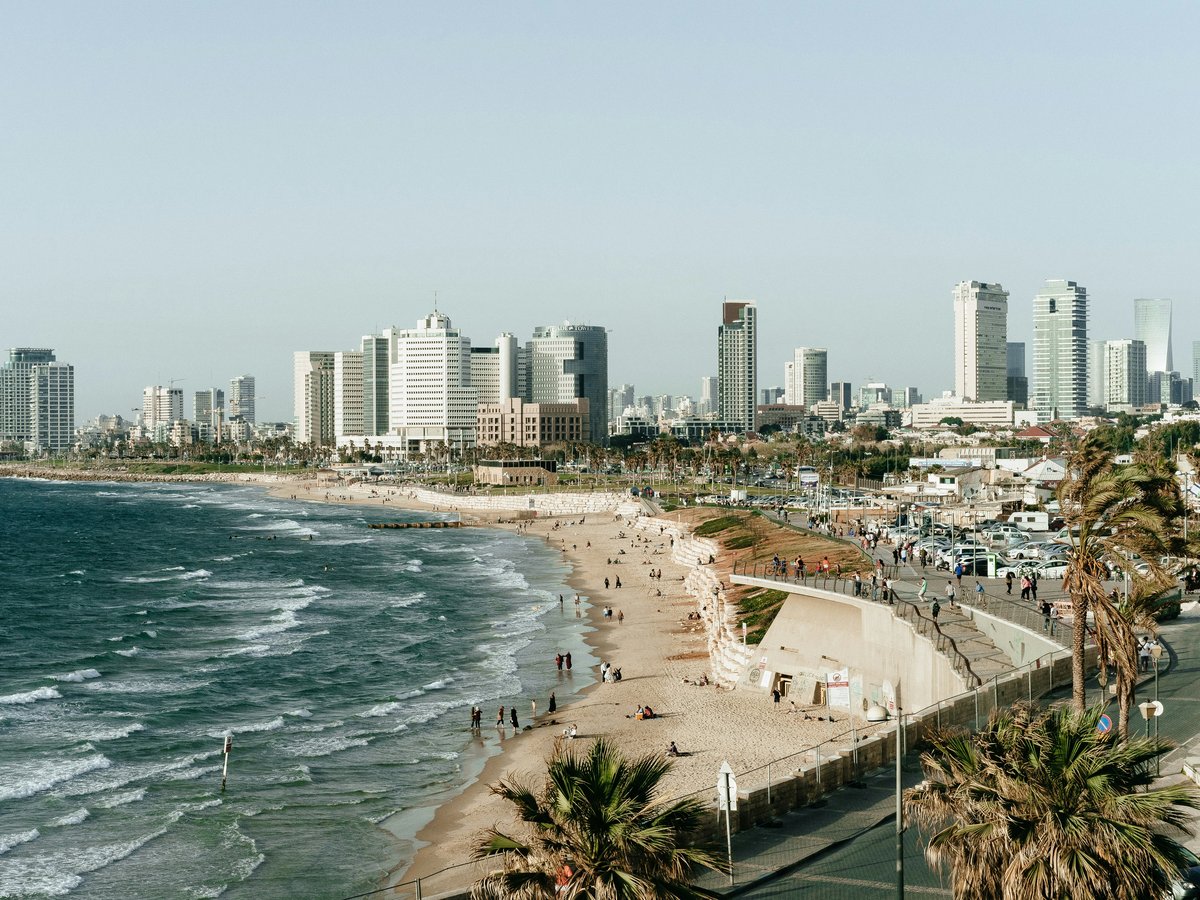
Stay in Tel Aviv in July
75 hotels in the Trip.com pool for Tel Aviv, from US$30 a night.
Opens Trip.com on Fri 2 Jul to Sun 4 Jul 2027; change the dates there.
July in Tel Aviv means humidity. At 75%, the coastal air turns a 31.2°C (88°F) afternoon into something that feels closer to 37°C on your skin. Rain is a non-issue, with about 2mm across the entire month and rarely a cloud in sight between sunrise at 5:45 a.m. and sunset past 7:45 p.m. The 14 hours of daylight sound generous until you realize that roughly 6 of them are too hot for comfortable walking.
This is the city's peak beach season, and Tel Aviv commits to it. The Mediterranean reaches roughly 27°C, warm enough for swimming at any hour. Florentin's sidewalk cafes fill by 9 p.m. The scent of jasmine along Neve Tzedek's stone alleys reaches you before you turn the corner. The Tayelet promenade stays populated well past midnight. Tel Aviv becomes a genuinely nocturnal city in July, with dinner reservations before 9 p.m. feeling oddly early.
That said, July is also the most expensive stretch of Tel Aviv's calendar. At roughly 2.95 ILS to 1 USD, the city already runs costly by global standards, and European summer holidays push hotel rates and flights higher still. If your dates are flexible, May and October deliver similar sunshine with fewer crowds and meaningfully lower costs.
Why visit in July
- Not a single rainy day on average across all of July, which makes outdoor planning completely reliable for beach days and evening events alike.
- Mediterranean water temperature peaks near 27°C (81°F), ideal for swimming, snorkeling, and paddleboarding without a wetsuit at any hour of the day.
- Daylight extends past 7:45 p.m., which opens a 45-minute golden-hour window along the Tayelet promenade most evenings.
- Tel Aviv's outdoor dining and nightlife scene peaks in July, with restaurants and rooftop bars along Rothschild Boulevard operating extended summer hours until well after midnight.
Worth knowing
- Coastal humidity makes the air feel substantially warmer than the thermometer reads, and perspiration barely evaporates outdoors between 10 a.m. and 5 p.m.
- Peak-season hotel rates run well above the annual average, and popular beachfront properties along HaYarkon Street often book out weeks ahead.
- Midday heat between Jaffa and the northern beaches limits outdoor sightseeing to early mornings and late afternoons, effectively cutting active exploring hours by a third.
- Shabbat closures from Friday sunset to Saturday sunset affect public transit, most shops in central Tel Aviv, and some restaurants, which catches first-time visitors off guard.
Best for
Think twice if
The defining feature is the combination of coastal heat and trapped moisture. Mornings before 8 a.m. provide the most comfortable window for walking or running. By 11 a.m. the air feels heavy and the UV index climbs into the extreme range. Afternoons on typical days rarely push past 34°C (93°F), but the humidity makes shade only marginal relief. Evenings cool by a few degrees yet remain sticky enough that lightweight fabric clings to skin. Sea breezes from the Mediterranean provide the one reliable natural coolant, strongest along the beachfront between Jaffa and the Old Port.
Seasonal caution
- The UV index in Tel Aviv consistently reaches 10-11 throughout July, which is 'very high' to 'extreme' on the WHO scale. Unprotected skin can burn within 15-20 minutes of direct exposure, even with a sea breeze masking the intensity.
- The combination of high humidity and sustained heat creates a meaningful heat-stress risk for visitors not acclimatized to Mediterranean summers. Drink at least 2-3 liters of water per day, more if spending time on the beach.
- Occasional hamsin (sharav) wind events can push temperatures above 38°C (100°F) for 1-2 days at a time. These hot, dry wind episodes are less frequent in July than in May or September, but they do occur.
Year-round climate
Averages from the last 5 years.
| Month | Avg high (°C) | Avg low (°C) | Rainfall (mm) |
|---|---|---|---|
| Jan | 18 | 10 | 119 |
| Feb | 18 | 10 | 83 |
| Mar | 20 | 12 | 54 |
| Apr | 24 | 14 | 30 |
| May | 27 | 18 | 4 |
| Jun | 29 | 21 | 2 |
| Jul | 31 | 24 | 2 |
| Aug | 32 | 25 | 1 |
| Sep | 31 | 23 | 3 |
| Oct | 28 | 20 | 9 |
| Nov | 25 | 16 | 50 |
| Dec | 20 | 12 | 108 |
Best things to do in July
Beach day along Tel Aviv's Mediterranean coastline
outdoorTel Aviv's 14 km of beachfront offers distinct stretches for different crowds. Gordon Beach near the center has the densest facilities and lifeguard stations. Frishman Beach tends to draw a slightly younger crowd. Hilton Beach, near the Independence Park bluff, has long been the LGBTQ+-welcoming stretch. Each section has rental chairs, shade structures, and cafes within a few steps of the sand.
Mediterranean water temperature peaks near 27°C (81°F) in July, the warmest of the year. Zero-rain conditions mean no washed-out beach days.Booking tipArrive before 9 a.m. on Saturdays to claim a good spot at Gordon or Frishman. By 10 a.m. on weekends, prime sand fills up.
Evening walk through Old Jaffa and the Jaffa Flea Market
cultureOld Jaffa's stone alleyways, art galleries, and Ottoman-era architecture feel noticeably cooler once the sun drops past the port. The Shuk HaPishpeshim (flea market) stays open late on summer evenings, with vendors selling everything from vintage Judaica to mid-century furniture. The port area looks back across the Tel Aviv skyline from the south.
Summer heat makes Old Jaffa's thick stone walls a genuine asset after 6 p.m. Vendors extend their hours, and the fading light over the Mediterranean is at a low, warm angle.Morning visit to Carmel Market (Shuk HaCarmel)
foodTel Aviv's largest open-air market runs through the Kerem HaTeimanim neighborhood with stalls selling produce, spices, halva, cheeses, fresh juice, and street food. In July, summer stone fruits, figs, herbs, and melons pile high across the produce stalls.
July is peak summer produce season at the stalls. The variety of ripe fruit is at its annual best. Arrive before 9 a.m. to browse in relatively comfortable temperatures.Air-conditioned museum afternoon
cultureThe Tel Aviv Museum of Art, founded in 1932, houses Israeli and international collections across multiple wings. The Eretz Israel Museum, opened in 1958, covers regional archaeology and history on a campus that includes an ancient excavation site. Both provide a genuine escape from the midday heat while offering substantive cultural content. For a broader list of cultural sites, Wikivoyage's guide (https://en.wikivoyage.org/wiki/Tel_Aviv#See) covers the full range.
July's midday hours between 11 a.m. and 4 p.m. are effectively too hot for outdoor sightseeing. Museums become a practical necessity, not a rainy-day fallback.Booking tipBuy tickets online for the Tel Aviv Museum of Art to skip the lobby queue, which tends to grow after 11 a.m. when visitors retreat from the heat.
Sunrise paddleboarding off the coast
outdoorRental outfits along the central beach offer stand-up paddleboards starting at first light. The Mediterranean in early-morning July is typically flat calm, with water warm enough that no wetsuit is needed. The view of the city skyline from 200 meters offshore at sunrise is worth the 5:30 a.m. alarm.
July has the calmest average sea conditions of the year along the Tel Aviv coast. The 5:30 a.m. sunrise gives paddlers over an hour of cool, flat water before wind picks up.Booking tipBook the evening before for weekend sunrise slots. Weekday mornings are typically available as walk-ups.
Evening at Namal Tel Aviv (the Old Port)
nightlifeThe renovated Old Port area north of central Tel Aviv hosts restaurants, bars, and weekend market vendors along the waterfront. The undulating wooden boardwalk is distinctive, and sunset views looking north stretch toward Herzliya on clear evenings. The sea breeze tends to be strongest here.
Summer evenings at the port benefit from the strongest Mediterranean breeze along Tel Aviv's coast, which drops the perceived temperature noticeably compared to inland streets.Booking tipWaterfront restaurant terraces book up on Thursday and Friday evenings. Reserve by Wednesday for a sea-facing table.
Friday morning Nachalat Binyamin Arts and Crafts Fair
shoppingThis twice-weekly outdoor fair along Nachalat Binyamin Street features Israeli artisans selling jewelry, ceramics, glass, leather goods, and prints. The Friday edition runs adjacent to the Carmel Market, making it easy to combine both in a single morning loop through the stalls.
Summer Fridays draw the largest vendor turnout of the year. Go before 10 a.m. to browse in relatively comfortable temperatures before the heat settles in.Habima Square evening performance
cultureHabima Theatre, Israel's national theater founded in 1917, anchors the cultural square that bears its name. The surrounding plaza hosts outdoor summer performances and screenings, and the square's geometric garden with fountains makes it a natural evening gathering point.
July's extended daylight and warm evenings bring the most consistent outdoor programming to the square, with performances typically starting after sunset around 8 p.m.Booking tipCheck Habima's summer calendar online for outdoor shows. Indoor performances tend to sell through faster in summer as visitors seek air-conditioned evening plans.
What to eat in July
In season: fruit
Watermelon (avatiach)
Israeli watermelon hits its seasonal peak in July. Beach vendors sell thick red wedges for 5-10 ILS, and the Carmel Market stalls tend to stock sweeter, better-quality whole melons than the supermarket chains.
Sabra (prickly pear / tzabar)
The cactus fruit season runs July through September. Street vendors along the Jaffa waterfront peel and sell them fresh. The flavor sits somewhere between kiwi and melon, mild and faintly sweet.
On menus now
Malabi
Rose-water milk pudding topped with crushed pistachios, shredded coconut, and sweet red syrup. A warm-weather street dessert sold from kiosks along the Tayelet and in the Levinsky Market area. The texture is cool and silky.
Street food peaks
Sabich
The Iraqi-Jewish eggplant sandwich is a year-round staple, but summer eggplant is at its richest in July. Fried eggplant, hard-boiled egg, hummus, tahini, and amba (pickled mango sauce) layered in a pita. Kerem HaTeimanim is the neighborhood for the best versions.
What to drink
Gazoz
An Israeli sparkling fruit drink made with seasonal syrups, fresh herbs like mint or lemongrass, and soda water. Summer brings the widest variety of fruit combinations. Cafes across Florentin serve their own riffs on the formula.
Regular events in July
Tisha B'AvFree
Jewish national day of mourning commemorating the destruction of the First and Second Temples. Restaurants, bars, and entertainment venues close from sundown the evening before through sundown of the fast day. In secular Tel Aviv the closures are less uniform than in Jerusalem, but expect reduced dining options and no nightlife for roughly 24 hours.
Late July or early August, depending on the Hebrew calendar year. Falls on 9 Av.Tel Aviv Cinematheque outdoor summer screenings
The Tel Aviv Cinematheque on HaArba'a Street runs outdoor film screenings through July and August, featuring a mix of Israeli cinema, international art-house titles, and retrospectives. Screenings start after dark, typically around 8:30 p.m.
Multiple evenings per week throughout JulyPark HaYarkon summer concerts
Tel Aviv's largest urban park hosts outdoor concerts through the summer months, with acts ranging from Israeli pop and rock to international touring artists. The park's amphitheater area typically runs shows starting around sunset.
Various dates throughout July, mostly weekendsBest places this July
Gordon Beach
beachThe central stretch of Tel Aviv's beachfront with the most developed facilities, lifeguard stations, and adjacent cafes. July's calm, warm Mediterranean water makes this the prime swimming spot. The beach gets crowded on weekends by mid-morning, but weekday mornings are quieter.
Central Tel AvivOld Jaffa (Yafo)
historic districtThe ancient port city south of central Tel Aviv, with stone alleyways, galleries, and restaurants. The thick-walled historic quarter retains less heat than the modern city center, making it noticeably more comfortable for evening exploration in July.
JaffaSarona Market
marketAir-conditioned indoor food hall in the restored Sarona complex, a former German Templar colony from the 1870s. The climate-controlled environment and dozens of food stalls make it a practical midday refuge from July's heat.
Central Tel AvivPark HaYarkon
parkTel Aviv's largest urban park, with mature shade trees, cycling paths, and the Yarkon River running through it. Early morning visits before 8 a.m. offer the coolest and most pleasant experience in July. The tree canopy provides genuine shade that is hard to find elsewhere in the city.
North Tel AvivNeve Tzedek
neighborhoodTel Aviv's oldest neighborhood, with narrow streets, restored Ottoman and early-20th-century buildings, boutique shops, and sidewalk cafes. Summer evenings here carry the smell of jasmine and grilled food. The pedestrian scale and shaded alleys make it more comfortable than the wider modern boulevards.
Neve TzedekRothschild Boulevard
streetThe tree-lined boulevard running through central Tel Aviv, flanked by Bauhaus-era White City architecture. The canopy of mature ficus trees provides some of the best natural shade in the city center. Evening strolling picks up around 7 p.m. when the heat starts to break.
White City
Your packing checklist
Tick items off as you pack. Your progress saves in this browser.
All packed — have a great trip.
Insider tips
Locals eat dinner between 9 and 10 p.m. in summer. Show up at a popular restaurant at 7 p.m. and you'll likely walk right in. The same table will have a 45-minute wait at 9:30.
The beaches north of Metzitzim, past the Old Port, are noticeably less crowded than the central Gordon-Frishman stretch. Same water quality, same lifeguard coverage, roughly half the density on a Saturday morning.
The late-afternoon sea breeze typically arrives between 3 and 5 p.m. along the beachfront. Timing outdoor activities to coincide with that window makes the humidity significantly more bearable than fighting it at noon.
Many secular-neighborhood restaurants stay open on Shabbat, but their hours shift and the menu sometimes changes. A 30-second check on Google Maps before walking over in the heat saves a wasted trip and a sweaty return.
Avoid these mistakes
- Scheduling a White City architecture walking tour for midday. The UNESCO-listed Bauhaus buildings are worth seeing, but July sun and humidity turn a 2-hour walk into an endurance test by 11 a.m. Book the earliest morning slot, or explore independently at dawn when the light is better for photographs anyway.
- Not carrying water constantly. Dehydration in humid conditions creeps up faster than visitors expect because sweat barely evaporates, masking how much fluid you're losing. By the time you feel thirsty in Tel Aviv's July air, you're already behind.
- Assuming everything operates on a normal schedule during Shabbat. Public transit stops from Friday evening to Saturday evening. Tel Aviv is more relaxed about this than Jerusalem, but getting caught without a ride plan on a Friday night is a common first-timer error.
- Spending the entire first beach day without reapplying sunscreen frequently enough. The UV intensity in July is deceptive because the sea breeze masks how strong the sun is. Severe burns on day one can sideline you for the rest of the trip.
Practical tips for July
Shabbat runs from Friday sundown (roughly 7:30 p.m. in July) to Saturday sundown. Public buses stop, many shops close, and some restaurants shift hours. Tel Aviv is more secular than most Israeli cities, so you will find open restaurants and cafes in the Dizengoff area and the port district, but plan ahead for Friday evening and Saturday daytime.
Religious sites require modest dress. Shoulders and knees should be covered when visiting synagogues or historic sites in Jaffa's Old City quarter.
The city scores 5.8/10 for solo-traveler safety (see the TTDI Solo-Safety Index), which reflects standard urban precautions. Keep aware of your surroundings on the beach at night and in quieter side streets after dark, the same as in any Mediterranean city of this size.
Airport transfers from Ben Gurion Airport to central Tel Aviv take 20-40 minutes by taxi or train, depending on traffic. The train runs until late evening but stops for Shabbat. If you arrive on a Friday evening, arrange a taxi or Gett (the local ride-hailing app) in advance. For transit details and neighborhood orientation, Wikivoyage's guide (https://en.wikivoyage.org/wiki/Tel_Aviv#Get_around) is a reliable resource.
FAQ
Is July a good time to visit Tel Aviv?
It depends on what you're after. July works well for beach-focused visitors who don't mind heat and humidity, and the nightlife scene is at its peak. It's not ideal for extensive walking tours or outdoor sightseeing during the day. Spring (April-May) and autumn (October-November) offer more comfortable conditions for exploring the city on foot at lower prices. For general logistics and orientation, Wikivoyage's overview (https://en.wikivoyage.org/wiki/Tel_Aviv) covers the basics well.
What is the weather like in Tel Aviv in July?
Hot and humid with effectively no precipitation. The heat is real but not extreme by Middle Eastern standards. The bigger challenge is the coastal humidity, which makes the air feel substantially warmer than the readings suggest. Nights remain warm enough for comfortable outdoor dining without a jacket. The Mediterranean sea reaches its annual warmest, making conditions ideal for swimming at any time of day.
Is Tel Aviv crowded in July?
Yes. July is peak tourist season, driven by European summer holidays and Israeli domestic beach travel. The central beaches fill up by late morning on weekends. Popular restaurants in Neve Tzedek and Florentin need reservations for weekend dinners. That said, it's a large city with room to spread out. The beaches past the Old Port are considerably quieter, and weekday mornings feel noticeably more relaxed.
Can you swim in the sea at Tel Aviv in July?
The water is warm, calm, and comfortable without any exposure protection. Lifeguard stations operate along the main beaches from early morning through early evening. Jellyfish occasionally appear along the coast in summer, though their presence varies week to week. Always check the beach flags before entering the water. For safety context, Wikivoyage's safety section (https://en.wikivoyage.org/wiki/Tel_Aviv#Stay_safe) covers beach-specific guidance.
What should I budget per day for Tel Aviv in July?
Tel Aviv is one of the more expensive cities in the Middle East. A mid-range traveler eating out twice daily and visiting one attraction should expect daily costs in line with Western European capitals, excluding accommodation. Budget travelers in hostels who cook some meals can manage on less. Peak-season pricing in July affects lodging costs more than food or transit. Check current exchange rates before your trip, as the ILS-to-USD rate fluctuates.
Things to Do in Tel Aviv in July
 Free cancellation
 Masada and the Dead Sea Day Trip from Tel Aviv
Day trip: 12 hours, free cancellation.
via Viator Free cancellation
 Nazareth and the Sea of Galilee Day Trip from Tel Aviv
Day trip: 10 hours, free cancellation.
via Viator
Jerusalem Private Tour | Official Licensed Guide
Day trip: 8 hours.
via Viator Free cancellation
 Best of Tel Aviv, Jaffa & Carmel Market Tour
Day trip: 6 hours, free cancellation.
via Viator Free cancellation
 From Tel Aviv/Jerusalem: Galilee, Nazareth, Jordan River Tour
Day trip: 12 hours, free cancellation.
via Viator Free cancellation
 Best of the West Bank Tour from Tel Aviv
Day trip: 12 hours, free cancellation.
via ViatorFind a flight to Tel Aviv
Live fares to Tel Aviv appear here once cookies are accepted.
Last verified by automated review (v1.7.2) on . What is automated review?