Compare every Spain city in February →
Stay in Segovia in February
23 hotels in the Trip.com pool for Segovia, from US$48 a night.
Opens Trip.com on Fri 5 Feb to Sun 7 Feb 2027; change the dates there.
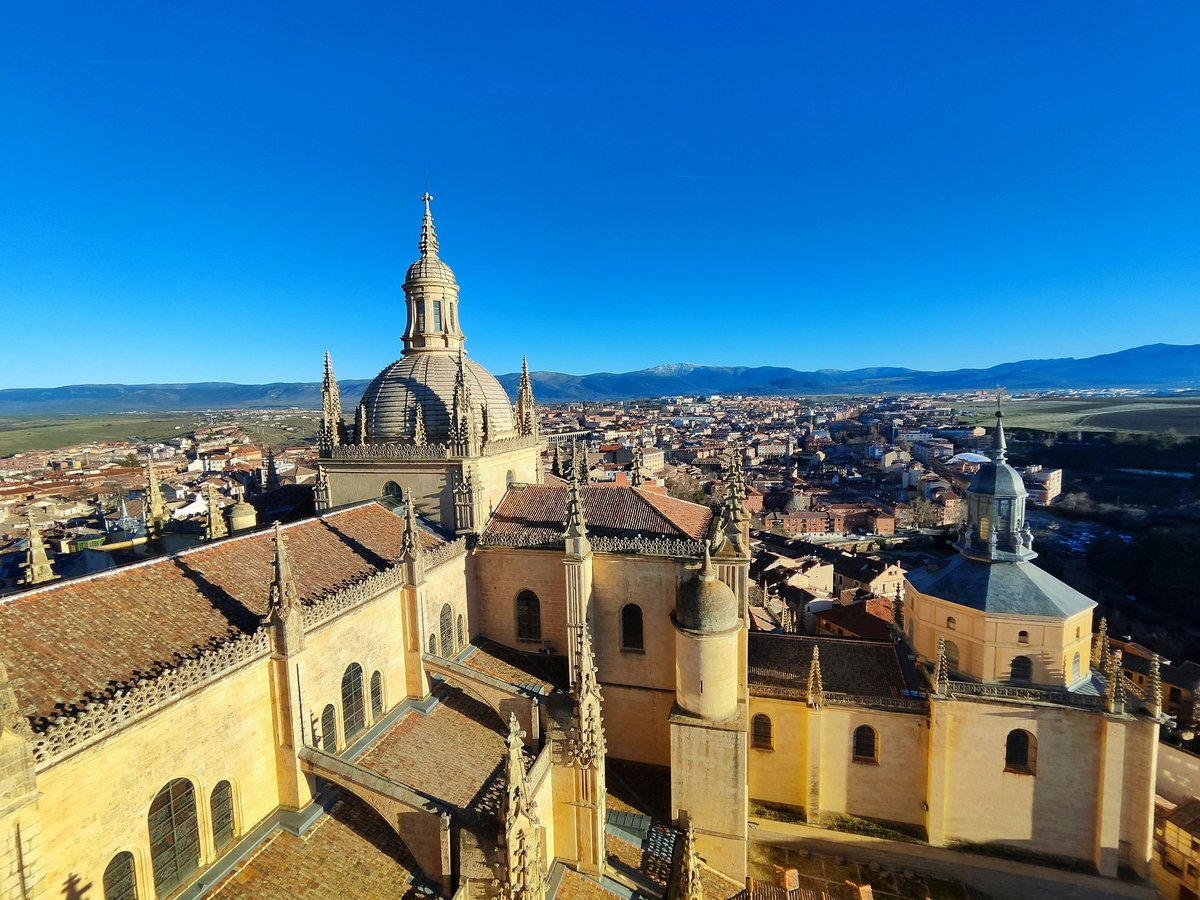
February in Segovia is cold, quiet, and honestly rewarding if you dress for it. Daytime temperatures sit around 10°C (50°F), and nights regularly fall to 1°C (34°F), with occasional dips below freezing that leave frost on the granite walls of the old quarter. Snow blankets the Sierra de Guadarrama to the southeast, visible from nearly every high point in the city, framing the medieval skyline in white. This is deep low season. The Roman Aqueduct on Calle del Azoguejo stands in near-solitude most mornings, and restaurants along the Plaza Mayor have open tables at Sunday lunch without reservations.
The month carries two distinctive local celebrations that make it more interesting than a generic winter visit. On February 5, the Fiesta de Santa Águeda fills the streets of La Judería and the old town with women in traditional Segovian dress, marking a centuries-old ritual where married women symbolically govern the city for the day. Then around mid-February, Carnaval de Segovia brings parades and comparsas to the Plaza Mayor, though on a far smaller scale than Cádiz or Santa Cruz de Tenerife.
The trade-off is real. Shorter days give you roughly 10.5 hours of light. Rain falls on about 8 days, totaling around 78mm, though that's drier than January's 124mm or November's 130mm. Some smaller museums and restaurants keep reduced winter hours or close Mondays entirely. But the combination of Castilian winter cooking at its peak, with cochinillo asado and judiones de La Granja and sopa castellana warming you from the inside, alongside rock-bottom accommodation prices and zero crowds, makes February a legitimate time to visit for 2 or 3 days. The 27-minute AVE train from Madrid Chamartín to Segovia-Guiomar makes an overnight trip almost effortless.
Why visit in February
- Accommodation prices drop to annual lows. Hotels in the old town that charge 120-150 EUR per night in June or September often list rooms for 60-80 EUR in February.
- The Alcázar de Segovia, Cathedral, and Roman Aqueduct are virtually crowd-free. You might have the Sala del Trono in the Alcázar to yourself on a Tuesday morning.
- Peak season for Castilian comfort food. Cochinillo asado, judiones de La Granja, and sopa castellana are at their best when eaten against cold February weather.
- The Fiesta de Santa Águeda on February 5 is one of Segovia's most distinctive traditions, and visitors rarely plan around it, so you'll experience it alongside locals rather than tour groups.
- Snow-covered Sierra de Guadarrama creates striking views from the Mirador de la Pradera de San Marcos and the Alcázar tower that you simply cannot get in summer months.
Worth knowing
- Cold is persistent. Temperatures rarely climb above 12°C (54°F) even on sunny afternoons, and exposed spots like the Aqueduct plaza and the Clamores valley walkway get a biting wind off the meseta.
- Shorter daylight hours limit outdoor sightseeing. Sunset falls around 18:30, and the golden light on the Aqueduct's granite arches that photographers prize lasts maybe 40 minutes in the late afternoon.
- Some restaurants and smaller museums operate on reduced winter schedules. Monday closures are common in the Barrio de San Millán and San Lorenzo areas.
- Icy cobblestones in the old town, especially on the steep Calle de la Almuzara and the paths around the Alcázar, can be treacherous after a frost.
Best for
Think twice if
February in Segovia feels like proper Castilian winter. Cold, dry-ish, and breezy. Mornings typically start around 1°C (34°F), and even on clear days the temperature tends to reach only 10°C (50°F) by early afternoon. The meseta wind is the factor that weather apps understate. It sweeps across the open plateau and funnels through the old town streets, making 10°C feel closer to 5°C on exposed ridgelines. Sunshine is common between rain spells, and Segovia sits at about 1,000 meters (3,280 feet) elevation, so the UV can catch you off guard on clear days. Fog sometimes settles in the Eresma valley below the Alcázar during early mornings, burning off by 10 or 11.
Seasonal caution
- Overnight temperatures regularly dip below 0°C (32°F), and black ice forms on the cobblestone streets of the old town, particularly on the steep descents toward the Eresma river and around the Puerta de San Andrés. Watch your footing in early morning.
- Wind chill on the meseta plateau can drop the perceived temperature 5-8°C below the actual reading. The Aqueduct plaza and the Alcázar's upper terraces are fully exposed.
- Occasional snowfall hits Segovia 1-3 times in a typical February. Accumulation in the city center rarely exceeds 5cm, but the roads from La Granja de San Ildefonso over the Puerto de Navacerrada pass sometimes close temporarily.
Year-round climate
Averages from the last 5 years.
| Month | Avg high (°C) | Avg low (°C) | Rainfall (mm) |
|---|---|---|---|
| Jan | 8 | 0 | 124 |
| Feb | 10 | 1 | 78 |
| Mar | 11 | 3 | 119 |
| Apr | 15 | 5 | 78 |
| May | 19 | 8 | 59 |
| Jun | 24 | 13 | 52 |
| Jul | 29 | 15 | 3 |
| Aug | 29 | 16 | 5 |
| Sep | 22 | 11 | 34 |
| Oct | 19 | 10 | 100 |
| Nov | 11 | 4 | 130 |
| Dec | 9 | 2 | 87 |
Holidays and festivals in February
Public holidays
- Day of Andalucía(Día de Andalucía)28 February 2027
Best things to do in February
Explore the Alcázar de Segovia without crowds
sightseeingThe Alcázar, perched on a rocky crag above the confluence of the Eresma and Clamores rivers, is one of Spain's most striking castles. In February, you can walk through the Sala de los Reyes, the Sala del Trono, and climb the 152 steps of the Torre de Juan II at your own pace. Summer queues of 30-60 minutes for the tower shrink to nearly nothing. The views from the top over the snow-dusted Sierra de Guadarrama and the bare poplar-lined Eresma valley below are worth the climb.
Visitor numbers drop to a fraction of summer levels. The tower and interior rooms are accessible without queuing, and snow on the surrounding mountains adds to the views.Booking tipTickets cost 9 EUR for the full visit including the tower. No advance booking needed in February. The castle opens at 10:00 and closes at 18:00 in winter.
Walk the Roman Aqueduct at dawn
sightseeingThe Acueducto de Segovia, built in the 1st or 2nd century AD with roughly 20,400 granite blocks and zero mortar, stands 28.5 meters tall at its highest point above the Plaza del Azoguejo. In February, the low winter sun hits the eastern face of the arches around 8:30-9:00am, lighting up the stone in warm orange tones while the plaza below sits empty. The cold morning air tends to be crisp and still before the meseta wind picks up.
February's low sun angle creates the best morning light on the Aqueduct's stone face. The absence of tour groups means you can photograph the full 167-arch structure from the Plaza del Azoguejo without people in frame.Booking tipFree and always accessible. Arrive by 8:30am for the best light. The viewpoint from Calle de San Juan, slightly uphill to the east, gives an elevated perspective.
Eat a cochinillo lunch on Calle de Cervantes
foodA proper cochinillo asado lunch in Segovia is a 2-hour event. The restaurants along Calle de Cervantes and the streets radiating from the Plaza Mayor serve the city's signature dish, slow-roasted in clay ovens until the skin crackles and the meat pulls apart. A quarter cochinillo typically runs 22-28 EUR per person. The ritual of breaking the cooked piglet with a plate edge, then tossing the plate to the floor, happens at most traditional restaurants if you ask.
February cold makes this the most satisfying month for heavy Castilian roast meat. Weekend lunch tables, which require 1-2 week advance booking in peak season, are available with a day or two notice.Booking tipBook 2-3 days ahead for Saturday lunch. Weekday tables are usually available same-day. Most cochinillo restaurants serve lunch from 13:00-16:00.
Attend the Fiesta de Santa Águeda
culturalOn February 5, married women in Segovia dress in traditional Castilian costume and symbolically take over the city's governance for the day. The tradition reportedly dates to the medieval era. Women process through the old town streets, particularly around La Judería and the Plaza Mayor. There is folk music, dancing, and a ceremonial handover of symbolic authority. It's a genuinely local celebration, not staged for tourists.
Santa Águeda falls on February 5 every year. Segovia's version of this celebration is considered one of the most notable in all of Castilla y León.Booking tipFree to attend. Processions typically move through the old town starting mid-morning. No tickets or reservations needed.
Day trip to La Granja de San Ildefonso
day tripThe Real Sitio de San Ildefonso sits 11km southeast of Segovia at the foot of the Guadarrama mountains. The Bourbon palace, modeled on Versailles, houses the Museo de Tapices with its Flemish tapestry collection and the Real Fábrica de Cristales (Royal Glass Factory). The formal gardens are brown and dormant in February, but the palace interior and glass factory are open and uncrowded. The town's restaurants are where judiones de La Granja originated, and eating the dish at its source feels right.
Low season means the palace and glass factory have minimal visitors. The restaurants in town serve judiones in clay cazuelas sized for cold weather. Snow on the surrounding peaks adds drama to the mountain setting.Booking tipLocal bus L-1 from Segovia's bus station runs roughly every hour and takes 25 minutes. Palace entry is about 9 EUR. Closed Mondays.
Visit the Catedral de Segovia in winter light
sightseeingThe last major Gothic cathedral built in Spain, consecrated in 1768, sits at the highest point of the old town near the Plaza Mayor. The interior in February catches pale winter light through the stained glass in ways that summer's harsh overhead sun does not replicate. The cloister, originally from the earlier cathedral destroyed in 1520, holds a particular stillness when empty. The attached Museo Catedralicio contains Flemish triptychs and a silver monstrance by Juan de Arfe.
Winter's low sun angle sends colored light across the nave floor from the south-facing windows, an effect lost in summer when the sun is nearly overhead. Visitor numbers in February are a tenth of August's.Booking tipEntry is 4 EUR, free on Sunday mornings during mass (though access to the museum is restricted during services). Open 9:30-18:30 in winter.
Hike the Eresma valley to Monasterio de Santa María del Parral
outdoorThe path follows the Eresma river from below the Alcázar northeast to the Hieronymite monastery, a 15th-century complex still inhabited by a small community of monks. The walk is about 2km each way, mostly flat along the riverbank. In February, the poplars lining the river are bare, the water runs high from winter rain, and you'll likely see the path to yourself. The monastery church contains the alabaster tomb of the Marqués de Villena.
The high winter water level in the Eresma gives the river valley a different character than the dry summer months. Bare trees open sightlines to the monastery and the rear walls of the Alcázar that foliage hides from May to October.Booking tipFree to walk. The monastery church is open for visits on Sunday mornings and some weekday afternoons. Check hours locally as they vary. Wear shoes with grip for potentially muddy or icy sections.
Catch the Carnaval de Segovia parade
culturalSegovia's Carnival falls in mid-February, typically the weekend before Ash Wednesday. Comparsas (costumed groups) parade through the Plaza Mayor and down toward the Aqueduct. The Entierro de la Sardina, the symbolic burial of a sardine marking the end of Carnival and start of Lent, takes place on Ash Wednesday evening. It's a local affair, not a spectacle on the level of Tenerife or Cádiz, but the energy in the Plaza Mayor on Carnival Saturday night is genuine.
Carnival dates shift yearly with Easter. In 2026, the main Carnival weekend likely falls around February 14-15, with the Entierro de la Sardina on February 18.Booking tipFree to watch. Events concentrate in the Plaza Mayor and along the Calle Real. Dress warmly. Evening temperatures in mid-February hover around 2-4°C (36-39°F).
What to eat in February
On menus now
Judiones de La Granja
These oversized white butter beans, grown in the fields around La Granja de San Ildefonso 11km southeast of Segovia, get slow-cooked with chorizo, morcilla, and pig ear in a rich broth. February is peak season for this dish. The beans soften into something almost creamy, and the pork fat renders into the stew during hours of simmering. Most traditional restaurants in Segovia serve their own version, and a cazuela of judiones with crusty bread is likely the most warming meal you'll eat all winter.
Cochinillo asado
Segovia's signature roast suckling pig is available year-round, but there's something about eating it in February's cold that makes the crackling skin and tender meat feel like the right meal. The piglets, typically 3-4 weeks old and milk-fed, are slow-roasted in wood-fired clay ovens for about 2 hours. Tradition holds that the cook splits the finished cochinillo with the edge of a plate to prove its tenderness. Restaurants along Calle de Cervantes and around the Plaza Mayor compete fiercely over their versions.
Sopa castellana
Castilian garlic soup is peasant food elevated to something deeply satisfying in cold weather. Stale bread, garlic cloves, pimentón, olive oil, and a poached egg, all baked in an individual clay cazuela until the bread absorbs the smoky broth. The garlic hits you first, then the warmth of the pimentón settles in. Bars in the Barrio de los Caballeros serve it as a starter on their menú del día for 3-4 EUR.
Ponche segoviano
Segovia's own cake, and you'll find it in nearly every pastelería in town. A sponge base soaked in liquor syrup, layered with pastry cream, and sealed under a thin shell of marzipan that gets torched until it blisters slightly golden. The Confitería Limón on Calle de Isabel la Católica is often credited with one of the better versions. A slice runs about 3-4 EUR. The marzipan crackles when you press through it with a fork.
What to drink
Chocolate con churros
February mornings at 1°C (34°F) in Segovia call for thick Spanish hot chocolate, which has the consistency closer to warm pudding than a drink. The churros come freshly fried, ridged, and still crackling with oil. Cafés around the Plaza Mayor and the Azoguejo plaza below the Aqueduct serve them from about 8am, and the breakfast crowd of Segovianos dipping churros before work is a reliable 9am scene.
Festival food
Lazos de San Blas
These anise-flavored pastry rings appear in Segovia's bakeries around February 3 for the Festividad de San Blas. The tradition holds that eating one protects against throat ailments for the year. They're simple, lightly sweet, and dusted with sugar. Panaderías in the old town sell them for 1-2 EUR each, and they tend to disappear from shelves by February 5 or 6.
Regular events in February
Festividad de San BlasFree
On February 3, Segovia celebrates San Blas, patron saint of throats and wool workers. Bakeries across the old town sell lazos de San Blas, anise-flavored pastry rings traditionally eaten to ward off throat ailments. A small mass and blessing of throats takes place at several parish churches, including San Millán.
February 3Fiesta de Santa ÁguedaFree
One of Segovia's most distinctive annual traditions. On February 5, married women in Segovia don traditional Castilian dress and symbolically assume governance of the city for the day. Processions wind through La Judería and the streets around the Plaza Mayor. Folk music, regional dances, and a festive atmosphere in the old town. The tradition has roots stretching back to the medieval period and is recognized across Castilla y León.
February 5Carnaval de SegoviaFree
Segovia's Carnival brings costumed parades, comparsas, live music, and street performances to the Plaza Mayor and Calle Real. The celebrations typically span the weekend before Ash Wednesday. The finale is the Entierro de la Sardina on Ash Wednesday evening, a mock funeral procession for a sardine symbolizing the end of indulgence before Lent. In 2026, the main weekend likely falls around February 14-15, with the Entierro on February 18.
Mid-February (weekend before Ash Wednesday)Best places this February
Mirador de la Pradera de San Marcos
viewpointThis viewpoint across the Eresma valley gives you the full profile of the Alcázar perched on its rocky promontory, with the Cathedral's tower rising behind it. In February, with snow on the Guadarrama range behind and bare poplars in the valley, the view has a stark, almost cinematic quality. Late afternoon light, around 17:00-17:30, paints the Alcázar's limestone walls gold. The meadow itself is usually empty on winter weekdays.
San MarcosReal Casa de Moneda
museumSpain's first mechanized mint, built in 1583 on the banks of the Eresma river below the Alcázar. The restored industrial complex now houses a museum tracing Segovia's minting history, with the original hydraulic machinery powered by the river. In February, the building's thick stone walls and indoor exhibits make it a good refuge from the cold. Entry is about 7 EUR, and winter visits rarely overlap with other groups.
San MarcosIglesia de la Vera Cruz
historic churchA 12-sided Romanesque church built in 1208, traditionally associated with the Knights Templar, though more likely built by the Order of the Holy Sepulchre. It sits on a small hill across the Eresma valley from the Alcázar, in the San Marcos area. The inner chapel with its two-story apse is unusual in Spanish architecture. February visits have the advantage of approaching the church through a quiet winter landscape with the Alcázar framed behind you.
San MarcosBarrio de la Judería
neighborhoodSegovia's former Jewish quarter, in the southwestern corner of the walled old town, is a tangle of narrow streets around the former synagogue (now the Corpus Christi church) and the Centro Didáctico de la Judería. In February, the neighborhood is particularly quiet, and you'll hear your own footsteps echoing off the stone walls. The Puerta de San Andrés, the old gate in the southern wall, gives access to paths down toward the Clamores valley.
La JuderíaPlaza de San Martín
plazaThis sloping plaza in the Barrio de los Caballeros holds the Romanesque Iglesia de San Martín, the 14th-century Torreón de Lozoya, and a statue of Juan Bravo, the comunero leader executed in 1521. The cafés on the plaza's upper terrace are a good mid-morning stop for coffee after walking down from the Cathedral. Winter foot traffic is light, and the Romanesque portico of San Martín church is worth a close look.
Los CaballerosIglesia de San Millán
historic churchThis 12th-century Romanesque church in the barrio of the same name, outside the city walls on the eastern side, is one of Segovia's finest and often overlooked. The exterior galleries with carved capitals deserve a slow walk around the full perimeter. February's bare trees and low sun make the carvings easier to see than in summer, when foliage and harsh light obscure details.
San MillánBarrio de San Lorenzo
neighborhoodThis working-class neighborhood north of the Aqueduct, centered around the Plaza de San Lorenzo and its Romanesque church, feels distinctly local. A small market operates on the plaza on some weekday mornings. The bars here serve cheaper menú del día options than the tourist-facing places in the old town, often 11-13 EUR for a full 3-course lunch with wine.
San Lorenzo
Your packing checklist
Tick items off as you pack. Your progress saves in this browser.
All packed — have a great trip.
Insider tips
Sunday lunch is sacred in Segovia. Families from Madrid drive up for cochinillo, and the best restaurants fill their 13:30-14:00 seatings even in February. Book Sunday lunch by Thursday. Weekday lunches, by contrast, are wide open.
The bus from Madrid run by La Sepulvedana (Moncloa station, about 75 minutes, 8-9 EUR) drops you at the Segovia bus station, which is a 15-minute walk downhill to the Aqueduct. The AVE train (27 minutes from Chamartín, about 13 EUR) arrives at Segovia-Guiomar, 5km from the city center, and you'll need the connecting bus (line 11) or a taxi. Factor the last-mile transit into your choice.
The menú del día in the Barrio de San Lorenzo runs 3-5 EUR cheaper than equivalent meals inside the walled old town. The food is the same quality or better. Locals eat there. Tourists rarely wander past the Aqueduct.
If you're visiting the Alcázar, go to the tower first. The 152-step climb is easier on fresh legs, and the morning light on the Sierra de Guadarrama from the top is better before noon haze builds. Work your way down through the palace rooms afterward.
The Acueducto is illuminated after dark, usually from about 19:00. February's early sunset means you can see it lit up without staying out late. The view from the Postigo del Consuelo stairway, slightly east and above the plaza, avoids the streetlights that wash out photos from ground level.
Avoid these mistakes
- Underestimating the cold at elevation. Segovia sits at 1,000 meters on an exposed plateau. Visitors checking a forecast that says 10°C (50°F) dress for mild weather and regret it at the Aqueduct by 9am when the wind chill drops the feel to 3-4°C (37-39°F). Layer up.
- Arriving too late for cochinillo. Most traditional Segovian restaurants serve lunch from 13:00 to 15:30 or 16:00 and close until dinner. Showing up at 16:30 expecting a roast suckling pig lunch is a common Madrid day-tripper error. Plan your meal around the Spanish lunch window.
- Skipping the valley viewpoints. Many visitors see the Aqueduct, walk up to the Cathedral, visit the Alcázar, and leave. The walk down to the Eresma valley and across to the Mirador de la Pradera de San Marcos gives you the iconic postcard view of the Alcázar from below, and in February you'll have it to yourself.
- Not checking Monday closures. Several museums, the Real Casa de Moneda, the palace at La Granja de San Ildefonso, and some restaurants close on Mondays in winter. A Monday day trip can leave you locked out of half your planned stops.
Practical tips for February
Book the AVE train from Madrid Chamartín to Segovia-Guiomar 3-5 days ahead for the best fares, typically 12-14 EUR each way. Trains run roughly every hour from 6:30 to 21:30. At Segovia-Guiomar station, line 11 bus connects to the city center in about 15 minutes for 2 EUR. If you prefer the bus from Madrid, La Sepulvedana operates from Moncloa station, takes 75 minutes, and drops you closer to the Aqueduct. Winter opening hours at the Alcázar are 10:00-18:00 (last entry 17:30). The Cathedral opens 9:30-18:30. Both close slightly earlier than their summer schedules, so plan your indoor visits before 17:00 to have enough time. Most cochinillo restaurants serve lunch from 13:00-16:00 and dinner from 20:30-23:00, with a dead zone from 16:00-20:00 when finding a hot meal in the old town is difficult. Cafés stay open for coffee and pastry. For the Fiesta de Santa Águeda on February 5, no special booking is needed. Events concentrate in the morning and early afternoon in the streets between La Judería and the Plaza Mayor. Carnival events in mid-February are free and focused on the Plaza Mayor. Dress warmly for any evening outdoor events, as temperatures after sunset typically fall to 2-4°C (36-39°F).
FAQ
Is February a good time to visit Segovia?
February is a fair time to visit. It's cold, with highs around 10°C (50°F) and lows near 1°C (34°F), and daylight hours are limited to about 10.5 hours. That said, the major attractions, the Roman Aqueduct, the Alcázar, the Cathedral, and the old town restaurants, are all open and virtually crowd-free. Hotel prices drop 40-50% from summer, and Castilian comfort food like cochinillo asado and judiones de La Granja is at its most satisfying against the cold. If you layer up properly and focus your itinerary on a 2-3 day visit or a day trip from Madrid, February works well. It's not the best month, that would be June or September, but it's far from the worst.
What is the weather like in Segovia in February?
Cold and variable. The average high is 10.1°C (50°F) and the average low is 1.3°C (34°F), with about 8 rainy days totaling 78mm of precipitation. Frost is common overnight, and temperatures can dip below freezing. The meseta wind is the X-factor. It blows across the plateau and makes exposed spots like the Aqueduct plaza and the Alcázar terraces feel significantly colder than the thermometer reads. Snow is possible but usually light, maybe 1-3 times during the month. Clear days between rain bring surprisingly bright sunshine at Segovia's 1,000-meter elevation.
Is Segovia crowded in February?
Not at all. February is deep low season. The summer months of July and August, plus holiday weekends in May and June, are when Segovia fills with day-trippers from Madrid. In February, you'll find short or nonexistent queues at the Alcázar, empty rooms in the Cathedral, and open tables at cochinillo restaurants that require week-ahead booking in September. The exception is Sunday lunch, which draws Madrid families year-round and can fill the top restaurants even in winter.
Can I visit Segovia as a day trip from Madrid in February?
Yes, and February is one of the easier months to do it. The AVE high-speed train from Madrid Chamartín reaches Segovia-Guiomar in 27 minutes, with fares around 13 EUR each way. From the station, bus line 11 takes 15 minutes to the city center. An 8:30 departure from Madrid gives you a full day. You could see the Aqueduct, walk the old town to the Cathedral, have a cochinillo lunch, visit the Alcázar, and catch a 17:30 or 18:30 train back. With February's low crowds, this schedule has plenty of breathing room.
What food should I try in Segovia in February?
Five dishes define a February visit to Segovia. Cochinillo asado, the slow-roasted suckling pig, is the city's signature and hits hardest in cold weather. Judiones de La Granja, a white bean stew with chorizo and morcilla, comes from the nearby town of La Granja de San Ildefonso and is peak winter comfort food. Sopa castellana, a garlic soup with bread and egg, costs 3-4 EUR at bars in the Barrio de los Caballeros. Ponche segoviano, a marzipan-topped sponge cake, is the local pastry. And chocolate con churros at a café near the Plaza Mayor is the right way to start a cold February morning.
Things to Do in Segovia in February
 Free cancellation
 Hot-Air Balloon Ride over Segovia with Optional Transport from Madrid
Outdoor experience: free cancellation.
via Viator Free cancellation
 Hot Air Balloon Flight Over Segovia or Toledo
Outdoor experience: 4 hours, free cancellation.
via Viator Free cancellation
 Hot Air Balloon over Segovia with Optional Transfers from Madrid
Outdoor experience: 4 hours, free cancellation.
via Viator Free cancellation
 Segovia from the Skies: Sunrise Balloon Ride
Outdoor experience: free cancellation.
via Viator Free cancellation
 Segovia Balloons
Outdoor experience: 4 hours, free cancellation.
via Viator Free cancellation
 Balloon flight at sunrise in Segovia
Outdoor experience: 3 hours, free cancellation.
via ViatorFind a flight to Segovia
Live fares to Segovia appear here once cookies are accepted.
Last verified by automated review (v1.7.2) on . What is automated review?