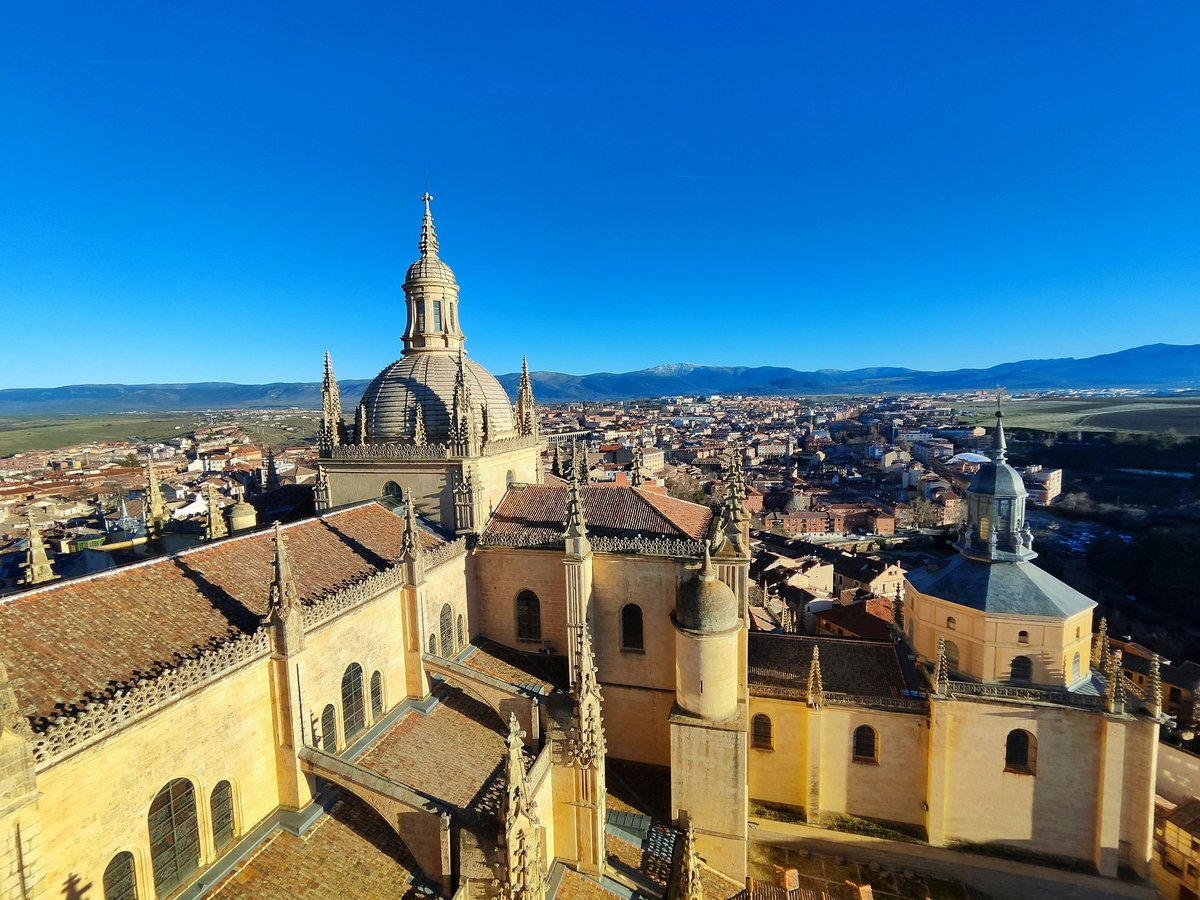
Segovia sits at roughly 1,000 meters on a narrow limestone ridge where the Eresma and Clamores rivers meet, about 90 kilometers northwest of Madrid. The Sierra de Guadarrama rises to the south and east, with peaks above 2,000 meters visible from the city walls on clear days. That proximity to real mountains, combined with two river valleys cutting through the old town itself, gives the place a different feel from most Castilian plateau cities. The air tends to be dry and thin, noticeably cooler than Madrid even in July. You'll hear swifts screaming around the Aqueduct in summer and smell wet pine from the Valsaín forests after a spring rain. The Parque Nacional de la Sierra de Guadarrama, designated in 2013, starts less than 20 kilometers away. To the northeast, the Hoces del Río Duratón natural park holds some of the best kayaking in central Spain. Mind you, Segovia still gets properly hot in July and August, with temperatures reaching 34 or 35°C on the meseta, though mornings tend to stay comfortable enough for a 7 a.m. start.
Outdoor activities
-
Rock climbing at La Pedriza
La Pedriza, in the Manzanares section of the Sierra de Guadarrama about 50 kilometers southeast of Segovia, is one of central Spain's most developed climbing areas. The granite formations range from beginner-friendly slabs to serious multi-pitch routes on towers like El Yelmo (1,717m). There are likely 1,000-plus routes catalogued across all grades. The rock is coarse-grained granite with good friction when dry, though it gets slippery surprisingly fast in damp conditions. Spring and autumn feel ideal. Summer mornings work if you start early, but the south-facing walls become punishing by noon.
- Difficulty
- Varies, grades 3 to 8b+ (French scale)
- Duration
- Full day
- Best season
- March through May, September through November
-
Road cycling on the Meseta and Guadarrama foothills
The roads south of Segovia toward La Granja de San Ildefonso and the Puerto de Navacerrada climb steadily through Valsaín pine forest, gaining about 600 meters over 30 kilometers. The CL-601 toward La Granja is popular with local cycling clubs on weekend mornings. Traffic tends to be light outside of holiday weekends. The meseta roads north of Segovia are flat and exposed, good for distance but brutal in summer heat. Water fountains appear in most villages, but the 15-kilometer stretches between them feel long on a 38°C afternoon. The Vuelta a España has passed through Segovia province multiple times, and you'll see why on the Guadarrama climbs.
- Difficulty
- Moderate to hard depending on route
- Duration
- 2 to 5 hours
- Best season
- April through June, September through October
-
Mountain biking in Valsaín
The forest tracks around Valsaín, roughly 12 kilometers south of Segovia's center, run through one of the best-preserved Scots pine forests in Spain. The Montes de Valsaín cover about 10,800 hectares and the forestry roads are wide and well-maintained, though some single-track sections get rocky and rooty. The smell of warm pine resin on a June morning is reason enough. You'll share trails with hikers and the occasional horse, so bells help. Some tracks connect through to the gardens at La Granja de San Ildefonso, which makes for a satisfying endpoint with a fountain to refill bottles.
- Difficulty
- Easy to moderate
- Duration
- 2 to 4 hours
- Best season
- May through October
-
Via Ferrata in the Sierra de Guadarrama
Several via ferrata routes have been established in the Guadarrama range within an hour's drive of Segovia. The one near Prádena, about 45 kilometers northeast, is currently among the more accessible options, with iron rungs and cable sections on limestone. A harness and via ferrata set are required. Some local guiding companies in Segovia and La Granja rent gear and run guided half-day trips for around 40 to 60 EUR per person. The exposure on some sections might unsettle you if heights are a problem, but the physical difficulty stays moderate.
- Difficulty
- Moderate (K2-K3 scale)
- Duration
- 3 to 5 hours including approach
- Best season
- April through November
-
Birdwatching at Hoces del Río Duratón
The Duratón river gorges, about 50 kilometers northeast of Segovia near Sepúlveda, hold one of Europe's largest colonies of griffon vultures. Estimates from recent censuses put the colony at 500 to 700 breeding pairs. You'll likely spot Egyptian vultures too between April and September, along with peregrine falcons, eagle owls, and alpine swifts nesting in the cliff faces. The Ermita de San Frutos viewpoint, perched on a limestone peninsula above the gorge, offers sightlines where vultures soar at eye level or below. The sound of their wingbeats in still air is something you don't forget. The park's interpretation center in Sepúlveda has maps and current sighting information.
- Difficulty
- Easy
- Duration
- Half day to full day
- Best season
- April through September
Day hikes
-
Senda de los Molinos (Eresma River Walk)
This riverside path follows the Eresma downstream from the area near the Monasterio del Parral, passing old flour mills that gave the trail its name. The route stays mostly flat along the valley floor through poplar woodland and meadows. It's the default recommendation for families or anyone wanting a gentle walk close to the city. Several of the mill ruins still have their stone channels visible. The path surface is a mix of packed earth and gravel, muddy in spring after rain.
- Difficulty
- Easy
- Duration
- 1.5 to 3 hours depending on turnaround point
- Best season
- Year-round, though spring and autumn are most pleasant
-
Ruta de la Senda Real (Valsaín to La Granja)
This forest route connects the village of Valsaín with the Royal Palace grounds at La Granja through Scots pine forest, following historic paths that the Spanish royals used. The terrain is gently undulating with a few steeper pitches, mostly on forest track. Pine scent saturates the air, especially on warm afternoons. The Valsaín sawmill, still operating, marks one end. Total distance is roughly 6 to 8 kilometers one way depending on the variant. You can catch a bus back from La Granja to Segovia if you don't want the return walk.
- Difficulty
- Easy to moderate
- Duration
- 2 to 3 hours one way
- Best season
- April through November
-
Peñalara summit from Puerto de Cotos
Peñalara, at 2,428 meters, is the highest point in the Sierra de Guadarrama and reachable as a day hike from the Puerto de Cotos pass (1,830m), about 55 kilometers from Segovia by road. The route gains roughly 600 meters over about 6 kilometers. Above the treeline, the landscape opens into alpine meadow and glacial cirque terrain, with the Laguna Grande de Peñalara sitting in its cirque below the summit ridge. Snow lingers into May or June some years, and the wind at the top can be fierce. The trail is well-marked and heavily used on weekends, so solitude isn't the draw here. The views from the summit, though, reach the Madrid skyline on haze-free days.
- Difficulty
- Moderate to hard
- Duration
- 5 to 7 hours round trip
- Best season
- June through October (snow dependent)
-
Hoces del Río Duratón rim walk from Villaseca
Starting from the village of Villaseca, about 55 kilometers northeast of Segovia, this trail follows the canyon rim of the Duratón gorges to the Ermita de San Frutos, a Romanesque hermitage perched dramatically above the river. The path crosses open scrubland with aromatic thyme and lavender underfoot, and the gorge drops away steeply to the left. Griffon vultures wheel below the rim almost constantly. The terrain is mostly flat with some rocky sections near the hermitage. Bring sun protection, as there is essentially no shade on the plateau.
- Difficulty
- Easy to moderate
- Duration
- 3 to 4 hours round trip
- Best season
- March through June, September through November
-
La Mujer Muerta ridge traverse
The Mujer Muerta (Dead Woman) is a distinctive ridge profile visible from Segovia itself, forming the skyline to the southeast. The ridge walk connects several peaks above 2,100 meters and involves sustained above-treeline exposure. The terrain is rocky and the route is not always clearly marked in poor visibility, so a GPS track or good map is worth having. Wind can be a real problem on the ridge, even on otherwise calm days. That said, on a still October morning with the meseta spread out below, the solitude up there feels earned. The approach from Puerto de Navacerrada or the area near Valsaín adds 1 to 2 hours each way.
- Difficulty
- Hard
- Duration
- 7 to 9 hours for the full traverse
- Best season
- June through October
Water activities
-
Kayaking the Hoces del Río Duratón
The Duratón river gorges between the Embalse de Burgomillodo and the area near Sepúlveda offer roughly 25 kilometers of flat-water kayaking through limestone canyons that reach 100 meters deep. The water is still and green, reflecting the cliff faces above. Griffon vultures nest on the walls and you'll hear their calls echoing off the rock. Several operators in Sepúlveda rent kayaks and canoes, typically for around 15 to 25 EUR per person for a 2 to 3 hour session. Worth noting, the park limits daily boat numbers to protect the vulture colony, so booking a day ahead in summer is wise. The restricted nesting zone (roughly the upstream section) closes to boats from January through July.
- Difficulty
- Easy (flat water)
- Duration
- 2 to 4 hours
- Best season
- August through October (nesting restrictions lift in late July)
-
Swimming at Embalse de Pontón Alto
This small reservoir sits about 8 kilometers south of Segovia on the road toward La Granja, fed by the Eresma. Locals swim here in summer, though it's not an official swimming area and has no lifeguards. The water stays cold, likely 16 to 19°C even in August, because the feed comes straight off the Guadarrama. The banks are pine-shaded on the south side, which helps on hot days. Access is straightforward from the road, but parking fills up fast on July and August weekends. The water level drops noticeably by late summer in dry years.
- Difficulty
- Easy
- Duration
- Half day
- Best season
- June through August
-
Eresma river wading and splash pools
In summer, shallow sections of the Eresma below the old town, particularly in the Alameda del Parral area, attract families wading and children playing in the cool water. It's not swimming in any serious sense, more like ankle-to-knee depth cooling off. The water temperature runs maybe 14 to 17°C in summer. The riverbed is rocky in places, so water shoes help. This is a decidedly local scene, not a tourist activity, and feels more like a Spanish village tradition than anything organized.
- Difficulty
- Easy
- Duration
- 1 to 2 hours
- Best season
- July and August
-
Canoeing at Embalse de las Vencías
The Vencías reservoir, near the Duratón gorges about 50 kilometers northeast of Segovia, is another flat-water option for canoe and kayak outings. It tends to be less crowded than the Duratón gorges proper, partly because it lacks the dramatic canyon scenery. The water is calm and the setting is open scrubland rather than cliffs. A few outfitters based in Sepúlveda offer rentals here as well. The reservoir sits at roughly 900 meters elevation, so evenings cool down fast even in July.
- Difficulty
- Easy
- Duration
- 2 to 3 hours
- Best season
- May through September
Parks & gardens
-
Alameda del Parral
FreeThis linear park follows the Eresma river valley below the north face of Segovia's old town, stretching from the Monasterio de Santa María del Parral toward the Convento de los Carmelitas. The path runs under tall poplars and willows along the water, and in autumn the leaf color reflects off the Eresma in a way that stops you mid-stride. It feels surprisingly wild for being 10 minutes on foot from the Aqueduct. The monastery ruins appear through the trees as you walk, and the sound of the river masks city noise almost completely.
Highlights: Views of the Monasterio del Parral from the riverside path, autumn poplar color, birdsong from the riparian canopy
-
Jardines del Alcázar (Paseo del Salón and surrounding terraces)
FreeThe terraced gardens and walkways around the western end of the old city, near the Alcázar, sit on the cliff edge where the Eresma and Clamores valleys converge. The views north toward the Sierra de Guadarrama from these terraces cover maybe 60 kilometers on a clear winter day. Benches line the Paseo del Salón, and local families use the green areas in the evening. The light here around 7 p.m. in September turns the Alcázar's stone from grey to gold.
Highlights: Panoramic views of the Eresma valley, sunset light on the Alcázar walls, Sierra de Guadarrama skyline on clear days
-
Jardines de La Granja de San Ildefonso
The formal gardens at the Royal Palace of La Granja, about 12 kilometers south of Segovia, cover roughly 146 hectares. Philip V modeled them on Versailles in the 1720s, and the 26 monumental fountains remain the main draw. The fountains run on gravity-fed water from the mountains above, and the palace activates selected groups on certain days, typically Wednesdays, Saturdays, and the feast of San Luis (25 August). The water display at the Fuente de la Fama shoots about 40 meters high. The surrounding chestnut and lime allées feel 10 degrees cooler than Segovia's sun-baked plaza on a July afternoon.
Highlights: 26 monumental fountains (check activation schedule), the Fuente de la Fama, the Parterre, chestnut allées, and the Cascada Nueva
-
Parque de la Dehesa
FreeA public park on the eastern approach to the old town, near the Aqueduct, where Segovianos walk dogs and children play on the grass under umbrella pines. It lacks the drama of the cliff-edge terraces but offers shade and flat ground, which matters when the rest of the city is uphill. The park connects to the Paseo del Conde de Sepúlveda, a tree-lined promenade that runs along the base of the old town walls.
Highlights: Umbrella pine shade, proximity to the Aqueduct, connection to the Paseo del Conde de Sepúlveda promenade
-
Huertas del Eresma
FreeThe vegetable gardens and green spaces along the Eresma below the old Jewish quarter have been cultivated for centuries. The area still has an agricultural feel, with small plots tended by locals alongside the riverbank path. You'll find fig trees, walnut trees, and kitchen gardens backed by the old city walls rising above. It connects with the Alameda del Parral walk and the path toward the Fuencisla sanctuary. The soil smells rich and damp here even in dry spells, fed by the Eresma's proximity.
Highlights: Historic kitchen gardens beneath the city walls, fig and walnut trees, path connection to the Fuencisla sanctuary
Practical tips
- Sun protection on the meseta
- Segovia sits above 1,000 meters with thin, dry air and very little shade on the plateau. UV intensity is high from May through September. Bring SPF 50+, a wide-brimmed hat, and sunglasses with good coverage. The gorge hikes at Duratón and the Mujer Muerta ridge have zero shade for hours. Sunburn happens faster here than people expect.
- Water and hydration
- Carry at least 2 liters per person for any hike over 2 hours in summer. Segovia's tap water is clean and comes from the Guadarrama watershed. Village fountains along trails are generally reliable, but some dry up by August. The Valsaín forest routes have streams, though treating water is still advisable. Dehydration at altitude sneaks up on you because the dry air wicks sweat away before you notice it.
- Footwear and trail conditions
- The Senda de los Molinos and Valsaín forest routes are fine in trail runners. The Duratón gorge rim walk and Peñalara need proper hiking boots with ankle support, as the terrain is rocky and uneven. The Mujer Muerta ridge is loose scree in places. After rain, the clay paths around the Eresma valley become slippery. Gaiters help on Peñalara if there's lingering snow.
- Seasonal timing
- July and August bring 34 to 36°C on the meseta, making midday hiking miserable. Start before 8 a.m. or wait until after 6 p.m. in summer. Spring (April and May) and early autumn (September and October) are the sweet spot for most activities. Winter brings snow above 1,800 meters and temperatures around -2 to 5°C in the city. The Duratón kayaking season effectively runs August through October due to nesting restrictions.
- Getting to trailheads without a car
- La Sepulvedana runs regular buses from Segovia to La Granja de San Ildefonso (about 25 minutes, under 3 EUR). Buses to Sepúlveda (for the Duratón gorges) run a few times daily and take about an hour. Puerto de Cotos and Navacerrada are harder by bus, with limited schedules mainly on weekends. A rental car opens up the Guadarrama trailheads significantly. Taxis from Segovia to La Granja run about 15 to 20 EUR.
- Permits and park regulations
- The Parque Nacional de la Sierra de Guadarrama requires no entry permit for hiking, but some areas have seasonal access restrictions. The Hoces del Río Duratón limits boat numbers daily, and the upstream nesting zone closes January through July. La Pedriza sectors may close during high fire risk in summer. Check the park websites or the interpretation centers in Sepúlveda and Valsaín before heading out, especially in summer.
FAQ
What is the best day hike near Segovia for someone with moderate fitness?
The walk from Villaseca to the Ermita de San Frutos along the Duratón gorge rim is probably the best balance of effort and reward. It takes 3 to 4 hours round trip, the terrain is mostly flat with a few rocky stretches, and the views into the gorge with vultures circling below are genuinely striking. Bring water and sun protection, as there's no shade. The drive from Segovia takes about 50 minutes.
Can you kayak the Duratón gorges year-round?
No. The upstream section of the gorge closes to boats from January through July to protect the griffon vulture nesting colony. The downstream sections near the Burgomillodo dam tend to stay open, but the most scenic stretches are restricted during nesting season. August through October is the reliable window for paddling the full route. Book through operators in Sepúlveda, as they handle the permit logistics.
Is Segovia too hot for outdoor activities in summer?
The meseta plateau hits 34 to 36°C in July and August, which makes midday hiking unpleasant. But mornings before 9 a.m. are often still around 20 to 22°C, and the Valsaín forests at 1,200 meters stay noticeably cooler. The Eresma valley in the city itself has good shade. Locals shift their schedules, exercising early or in the evening. If you're flexible on timing, summer still works.
Are there outdoor gear shops in Segovia?
Segovia has a few sports shops near the Avenida de Fernández Ladreda that stock basic hiking and cycling gear. For technical climbing equipment or specialized mountain gear, the selection is limited. Madrid, 90 minutes by bus, has Barrabés, Desnivel, and several other dedicated mountain shops with much wider stock. If you're planning a Peñalara or Mujer Muerta trip, gear up before arriving.
How do I get from Segovia to the Sierra de Guadarrama trailheads?
La Granja and Valsaín are the easiest to reach, with regular La Sepulvedana buses from Segovia taking about 25 minutes. Puerto de Cotos and Puerto de Navacerrada have limited weekend bus service from Madrid's side but are easier by car from Segovia, roughly 45 minutes on the CL-601 and then connecting roads. A rental car is the most practical option if you want to hit multiple trailheads. Taxis to La Granja cost around 15 to 20 EUR.
Is the Duratón gorge walk suitable for children?
The rim walk from Villaseca to the Ermita de San Frutos works for children over about 7 or 8 who are used to walking. The trail is mostly flat but crosses exposed terrain with cliff edges, so you'll want to keep younger children close. There are no guardrails at the hermitage viewpoint. The total distance is around 6 to 7 kilometers round trip. Bring snacks and water, as there are no facilities along the route. The vultures tend to fascinate kids.
Outdoor experiences in Segovia
 Free cancellation
 Hot-Air Balloon Ride over Segovia with Optional Transport from Madrid
Outdoor experience: free cancellation.
via Viator Free cancellation
 Hot Air Balloon Flight Over Segovia or Toledo
Outdoor experience: 4 hours, free cancellation.
via Viator Free cancellation
 Hot Air Balloon over Segovia with Optional Transfers from Madrid
Outdoor experience: 4 hours, free cancellation.
via Viator Free cancellation
 Segovia from the Skies: Sunrise Balloon Ride
Outdoor experience: free cancellation.
via Viator Free cancellation
 Segovia Balloons
Outdoor experience: 4 hours, free cancellation.
via Viator Free cancellation
 Balloon flight at sunrise in Segovia
Outdoor experience: 3 hours, free cancellation.
via Viator Free cancellation
 Balloon Rides in Segovia with Optional transportation from Madrid
Outdoor experience: free cancellation.
via ViatorLast verified by automated review (v1.7.2) on . What is automated review?