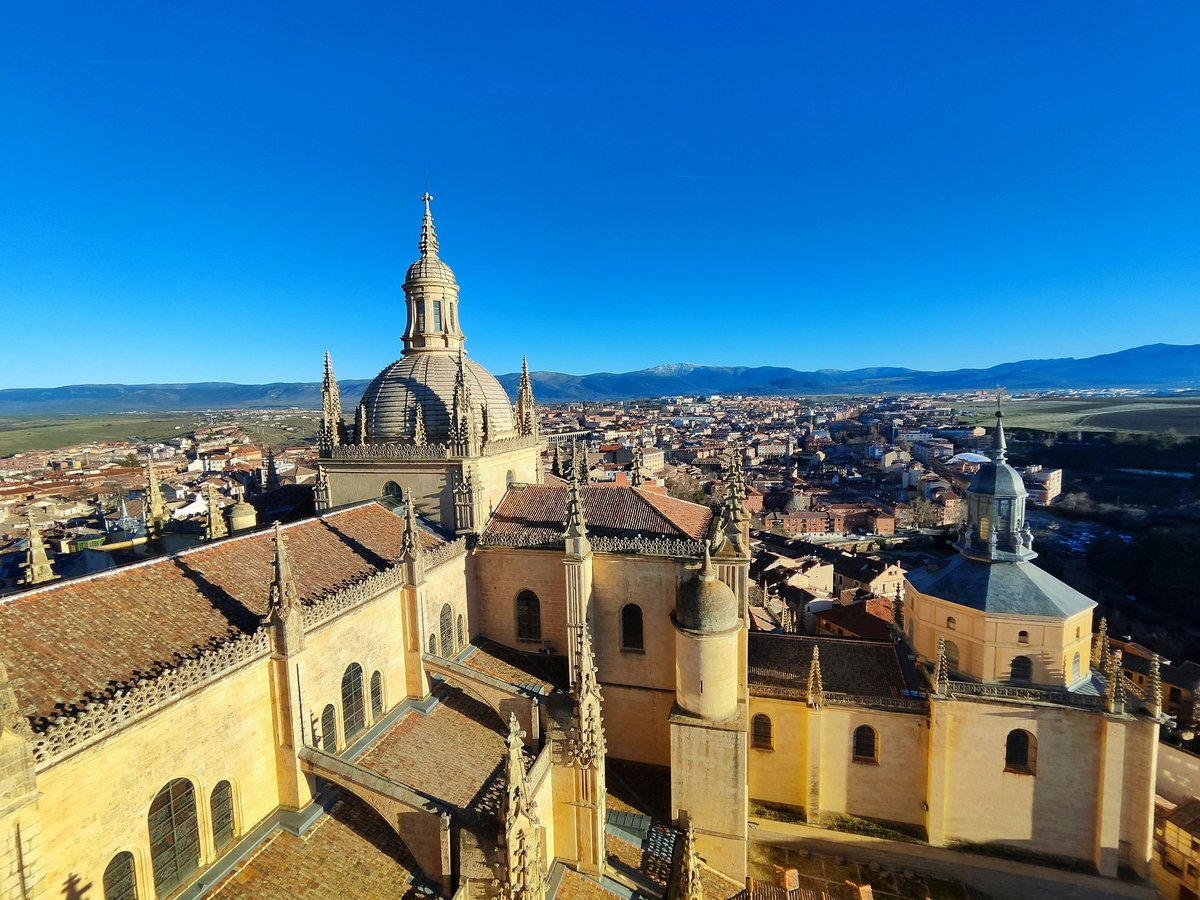
Segovia occupies a rocky promontory about 90 kilometers northwest of Madrid, at the point where the Eresma and Clamores rivers meet, roughly 1,000 meters above sea level. The old quarter earned its UNESCO inscription in 1985, and most of what earned that designation is free to experience. The Roman aqueduct towers nearly 29 meters above Plaza del Azoguejo with its 167 granite arches, and you can stand beneath it as long as you like without paying anything. Romanesque churches appear every few blocks through the old town, their honey-colored stone warm in the late afternoon light. The cliff-edge miradores along the city's southern rim look across the Clamores valley toward the Sierra de Guadarrama. The Alcázar and the Catedral both charge admission, but the city between and around those monuments, the narrow streets, the river walks, the monastery churches, the market squares, rewards a visitor who has nothing to spend. Segovia's scale helps too. The old town measures roughly 1 kilometer from the aqueduct to the Alcázar, so you can cover most of it on foot in a single day.
Free attractions
-
Acueducto de Segovia
The Roman aqueduct dates to the late 1st or early 2nd century AD and still stands at its full height of nearly 29 meters in Plaza del Azoguejo. The structure runs about 800 meters through the city on 167 arches built from unmortared granite blocks. It carried water from the Río Frío, some 17 kilometers away, until well into the 20th century. You can walk beneath it, alongside it, and climb the stairs on the east side for a closer look at the upper tier. The stone surface has a warm, rough texture that changes color noticeably between morning and late afternoon. Always free and always accessible.
Plaza del Azoguejolandmark -
Museo de Segovia (Casa del Sol)
The provincial museum sits in the Casa del Sol, a medieval building near the Puerta de San Andrés in the old Jewish Quarter. Collections span prehistoric artifacts from the province, Roman mosaics, medieval sculpture, and a small painting gallery. Under the Junta de Castilla y León's current policy, entry is free on Saturdays and Sundays. On weekdays, general admission has been running around 1 euro, which still makes it one of the cheapest museum visits in Spain. Worth checking hours before you go, as they tend to shift seasonally.
Juderíamuseum -
Museo de Arte Contemporáneo Esteban Vicente
The museum occupies the 15th-century Palacio de Enrique IV near Plaza de las Sirenas. It holds the permanent collection of Esteban Vicente, a Segovia-born painter who became part of the New York Abstract Expressionist circle alongside Rothko and de Kooning. The museum has offered free entry on Thursdays, though it is worth confirming the current schedule before visiting. The building itself, with its Gothic vaulting and contemporary gallery spaces, might be the best free architecture in the old town on those days.
Centromuseum -
Monasterio de Santa María del Parral
This Hieronymite monastery was founded in 1447 in the Eresma valley below the northern walls. The church has a notable late-Gothic retablo and the tombs of the Marquis of Villena. A small community of monks still lives here. The church is open to visitors at no charge during set hours, typically mornings and late afternoons, though the schedule follows monastic rhythms rather than tourist ones. The walk down from the old town through poplar trees along the Eresma is half the experience. On autumn mornings, the mist tends to settle in the valley and the monastery's stone facade appears through it gradually.
Valle del Eresmamonastery -
Iglesia de San Millán
A 12th-century Romanesque church in the Arrabal neighborhood, outside the old walls on the road from the aqueduct. The exterior galleries on three sides are some of the finest Romanesque arcading in Castile, with carved capitals showing animals and foliage. The Mudéjar-influenced tower is visible from much of the lower town. The interior has three apses with original frescoes, though lighting is limited and you might need a moment for your eyes to adjust. Entry has traditionally been free, though opening hours can be inconsistent outside of summer.
Arrabalchurch -
Iglesia de San Martín
San Martín sits at the center of the old town near Plaza de Medina del Campo. This 12th-century Romanesque church has a distinctive covered atrium of arched galleries that you can walk through freely. The atrium served as a public meeting space in the medieval period and still feels like one. The carved capitals are worth close inspection. The church tower, with its warm stone and Romanesque windows, is one of the most photographed structures in Segovia after the aqueduct.
Centrochurch -
Mirador de la Canaleja
A stone-railed terrace on the southern cliff edge of the old town, a few steps off Calle Real. The view drops sharply into the Clamores valley and extends south toward the Sierra de Guadarrama. On clear days, you can make out individual peaks. Late afternoon light tends to hit the valley floor and the scattered houses below in a way that rewards patience. The terrace fits maybe 15 people comfortably, so early morning or late evening visits are quieter.
Centroviewpoint -
Santuario de la Virgen de la Fuencisla
The sanctuary of Segovia's patron saint sits at the bottom of the Eresma valley, reachable by a steep footpath from the old town or a longer road route. The current Baroque building dates to the 17th century and replaced an earlier hermitage. The interior is cooler than the city above, even in July, and the scent of old stone and candle wax is immediate when you step inside. Free to enter. The surrounding area along the river has picnic spots that locals use on weekends.
Valle del Eresmachurch -
Iglesia de San Esteban
This Romanesque church in the northwest of the old town has what is sometimes called the finest Romanesque bell tower in Spain. The tower rises over 50 meters in six tiers of paired arches. You can see it from many points in the city and from the valley below. The exterior and the small plaza in front are always accessible. Interior access has been limited in recent years due to restoration work, so check locally before counting on going inside.
Centrochurch
Free activities
-
Walk the Judería (Jewish Quarter)
Segovia's Jewish Quarter stretches south of the old town center toward the Puerta de San Andrés. The community here was among the largest in Castile before the 1492 expulsion, with perhaps 300 to 400 families at its peak. The narrow streets between Calle de la Judería Vieja and the old synagogue (now the church of Corpus Christi) still follow their medieval layout. You can trace the quarter in about 45 minutes. Some doorways still show marks from mezuzot. The Centro Didáctico de la Judería charges a small fee, but the streets themselves and their history are free.
Juderíawalking -
Romanesque Churches Walking Route
Segovia has more than 20 Romanesque churches and chapels, most built in the 12th and 13th centuries. You can walk a circuit through San Millán, San Martín, San Esteban, La Trinidad, San Andrés, and San Clemente in about 2 hours at a slow pace. The exteriors, with their carved portals, arched galleries, and towers, are freely accessible. Each church has a different approach to Romanesque decoration, from the intricate capitals at San Martín to the simpler geometry at La Trinidad. The Arrabal district outside the walls has several more, including San Justo, which has notable 12th-century frescoes if you can get inside during open hours.
Variouswalking -
Alameda del Eresma and Valley Walk
The Eresma river valley below the northern and western walls of the old town has a network of paths through poplar groves, gardens, and riverside meadows. The main Alameda del Eresma path runs from near the Monasterio de Santa María del Parral west toward the Convento de los Carmelitas Descalzos, where San Juan de la Cruz was buried in 1591. The total walk is about 3 kilometers one way. In spring, the poplars are bright green and the river runs full. In October, the leaves turn gold and the light through them is warm and low. You'll hear woodpigeons and the steady sound of the river. On summer evenings, the valley is noticeably cooler than the old town above.
Valle del Eresmawalking -
Circunvalación (Old Walls Circuit)
You can walk most of the perimeter of the old town, partly along the surviving medieval walls and partly on paths below them. The full loop is roughly 4 kilometers and takes about 90 minutes without stops. The route passes the Puerta de San Andrés, follows the southern cliff along the Clamores valley, rounds the prow of the promontory below the Alcázar, drops into the Eresma valley, and climbs back to the aqueduct from the northeast. The views shift constantly. The stretch below the Alcázar, where the fortress rises from bare rock above you, gives a sense of the fortification's scale that you miss from the tourist entrance.
Variouswalking -
Pradera de San Marcos
A broad meadow across the Eresma from the old town, directly below the Alcázar. This is the classic panoramic viewpoint of Segovia, where you can see the full profile of the city on its ridge with the Alcázar at one end, the Catedral in the middle, and the aqueduct faintly visible at the far end. Locals use the meadow for picnics, dog-walking, and running. On weekday mornings it tends to be nearly empty. The grass smells of thyme in summer, and the sound of the Eresma is steady in the background.
Pradera de San Marcosviewpoint and park -
Plaza Mayor People-Watching
Segovia's Plaza Mayor sits at the high point of the old town, with the Catedral on one side, the Teatro Juan Bravo on another, and cafe terraces around the edges. You don't need to buy anything to sit on the stone benches or the Catedral steps and watch the square. On Saturday mornings, local families, tourists, street musicians, and the occasional procession all share the space. The bandstand in the center hosts occasional free performances, particularly during summer weekends and fiestas. The plaza catches full sun until late afternoon.
Centropeople-watching
Free events
-
Titirimundi (International Puppet Festival)
Mid-May, annually (typically 4-5 days)Segovia's international puppet and street theater festival has been running since 1985 and typically takes place over 4 to 5 days in mid-May. Many of the outdoor performances in plazas and parks are free, with ticketed shows in indoor venues. Companies come from across Europe, Latin America, and beyond. The atmosphere in the old town during Titirimundi changes noticeably. Plaza Mayor and the streets around the aqueduct fill with temporary stages, and you'll find yourself walking into performances between neighborhoods.
Various plazas and streets throughout the old town -
Fiestas de San Juan y San Pedro
Late June, annually (approximately June 20-29)Segovia's main annual fiestas run for about 10 days in late June, centered on the feast days of San Juan (June 24) and San Pedro (June 29). Free events include outdoor concerts in Plaza Mayor, traditional dances, a parade of gigantes y cabezudos through the old town, and fireworks over the aqueduct. The peñas (local festival clubs) set up outdoor bars and stages, and much of the nighttime activity is free. The smell of grilled chorizo and the sound of brass bands fill the streets after dark.
Plaza Mayor, Plaza del Azoguejo, and throughout the old town -
MUSEG (Festival de Segovia)
July-August, annuallyA summer cultural festival that typically runs through July and into August, with concerts, theater, and dance performances in historic venues across the city. Some outdoor events are free, particularly those staged in plazas and courtyards. The festival has featured classical music, jazz, and contemporary dance. Free events are usually listed separately on the festival program, so check the schedule for the current year's offerings before planning around specific dates.
Various historic venues, plazas, and courtyards -
Semana Santa (Holy Week) Processions
March or April, annually (dates follow Easter)Segovia's Holy Week processions move through the old town streets from Palm Sunday through Easter Sunday. The cofradías carry elaborate pasos (floats bearing religious sculptures) on their shoulders through the narrow streets. The processions are free to watch from anywhere along the route. The evening processions, particularly on Holy Thursday and Good Friday, pass through streets lit by candlelight, and the sound of processional drums echoes off the stone walls. Crowds gather early along Calle Real and in Plaza Mayor for the best sightlines.
Old town streets, especially Calle Real and Plaza Mayor
What Used to Be Free but Now Charges Admission
The Catedral de Segovia currently charges a general admission of around 4 euros, which includes the cloister and museum. Free entry for worship services is still available at limited times, typically early morning, but the tourist visit is ticketed. The Alcázar de Segovia has charged admission for decades, currently around 9 euros for the palace and an additional 3 euros for the tower climb. The Real Casa de Moneda, a large industrial museum by the Eresma, charges around 6 euros. The Centro Didáctico de la Judería has a small admission fee, currently around 2 to 3 euros. All prices here are approximate and may have shifted. The pattern in Segovia, as in most of Castile, has been toward ticketing formerly free monuments, though the pace has been slower here than in Madrid or Barcelona.
Free Water and Rest Stops
Segovia has public drinking fountains throughout the old town, and the tap water is clean and drinkable. You'll find fountains in Plaza Mayor, near the aqueduct, and at several points along the Alameda del Eresma. The water tends to be cold and slightly mineral-tasting, drawn from the Sierra de Guadarrama watershed. Public benches are scattered along the cliff-edge viewpoints on the south side of the old town and throughout the valley parks below. The Jardines del Alcázar, a small formal garden near the Alcázar entrance, has benches in the shade of mature trees and tends to be quieter than the main tourist areas. The Pradera de San Marcos meadow across the Eresma has open grass for sitting or stretching out.
Best Free Views of the City
Segovia's elevated position creates viewpoints in every direction, and the best ones are all free. The Mirador de la Canaleja on the south side of the old town looks across the Clamores valley toward distant foothills. The Pradera de San Marcos, across the Eresma to the northwest, gives the postcard panorama of the full city profile with the Alcázar at the prow. The path below the Monasterio de Santa María del Parral frames the old town from the north with the Catedral tower prominent against the sky. For the aqueduct specifically, the stairs on Calle de San Juan east of Plaza del Azoguejo put you at eye level with the upper tier. Late afternoon, when the granite takes on a warm amber tone, is the best light for the aqueduct. For the Alcázar, the path below the western walls shows the fortress rising from bare rock in a way that the main entrance plaza does not reveal.
FAQ
Is the Acueducto de Segovia free to visit?
The aqueduct is an outdoor structure in the middle of the city, centered on Plaza del Azoguejo. There is no ticket, no gate, and no restricted hours. You can walk along it, beneath it, and climb the adjacent stairways at any time of day or night. It has been freely accessible for the entire 2,000-odd years it has stood here.
Which museums in Segovia are free, and on what days?
The Museo de Segovia in the Casa del Sol has been free on Saturdays and Sundays under the Junta de Castilla y León's regional museum policy. The Museo de Arte Contemporáneo Esteban Vicente has offered free entry on Thursdays, though you should confirm the current schedule directly with the museum as policies shift. On paid days, both museums tend to charge modest fees, typically around 1 to 3 euros. Other museums in the city, including the Alcázar and Real Casa de Moneda, are ticketed without regular free days.
Can you visit the inside of Segovia's Romanesque churches for free?
Most of Segovia's Romanesque churches are free to enter when they are open, but opening hours vary and many are closed outside of service times. Iglesia de San Millán, San Martín, and La Trinidad have generally been accessible during daylight hours in the tourist season, roughly April through October. In winter, you might find them locked except for morning and evening Mass. The exteriors, with their carved portals and arcaded galleries, are always accessible and are arguably the main attraction. Iglesia de San Justo has notable 12th-century frescoes but tends to keep limited hours.
How much time do you need to see Segovia's free sights?
A full day is enough to walk the old town's Romanesque churches, the aqueduct, the cliff-edge viewpoints, and the Eresma valley path. If you add the Pradera de San Marcos viewpoint and the walk down to the Monasterio de Santa María del Parral and the Santuario de la Fuencisla, plan for 6 to 8 hours of walking. The old town is compact, roughly 1 kilometer from the aqueduct to the Alcázar, but the valley walks add distance and elevation change. Comfortable shoes matter more than a budget here.
Is Segovia a good day trip from Madrid on a zero budget?
Segovia is about 90 kilometers from Madrid. The Avanza bus from Moncloa station currently runs around 8 to 9 euros each way, taking about 75 minutes. The AVE high-speed train from Chamartín takes 28 minutes but costs more, currently around 13 to 14 euros, and the Segovia-Guiomar station is about 5 kilometers outside the city center, so you'll need local bus 11 to reach the old town. Neither option is free, but once you arrive, you can fill an entire day without spending another euro. The aqueduct, the Romanesque churches, the viewpoints, and the valley walks all cost nothing. If you pack a lunch and fill a water bottle at one of the public fountains, the transport fare is your only cost.
Last verified by automated review (v1.7.2) on . What is automated review?