What's the must-see thing in Segovia?
The Aqueduct of Segovia. Built around 200 AD from roughly 20,400 granite blocks with no mortar, the 28-metre Roman structure still stands in Plaza del Azoguejo. Walk west along the walled ridge to the Alcázar, passing the Cathedral on Plaza Mayor. All three fit inside a 1.2 km walk on the same granite spur.
The Aqueduct, without question. Stand in Plaza del Azoguejo at 8am on a weekday and look up. The structure rises 28.5 metres above the cobblestones, 167 arches of pale granite stacked without mortar since approximately the year 200. The stone feels warm to the touch by mid-morning, weathered tawny across 18 centuries of Castilian sun and frost. Pigeons nest between the upper arches while traffic passes through the lower ones. It is the kind of Roman engineering that makes you think about 20,400 blocks overhead, held in place by nothing but gravity and geometry. No ticket, no queue, no reservation. The Aqueduct carried water to Segovia until 1973, and that plain, functional persistence is what separates it from every ruin behind a velvet rope.
From the Aqueduct, walk west along Calle Real through the walled city. The route runs about 1.2 km along a narrow granite ridge between the Eresma and Clamores rivers. You pass through Plaza Mayor, hear the Cathedral bells if the timing is right, and then the ridge narrows to a rocky point where the Alcázar stands above the river confluence. The castle dates to around 1200. It burned in 1862, and most of what you see is a reconstruction completed by the 1890s. That said, the rebuilding was faithful to the original Mudéjar and Gothic forms. The Torre de Juan II has narrow spiral stairs that echo under your feet, the walls close enough to brush your shoulders. From the top, the view runs north across the Eresma valley to the Sierra de Guadarrama. General admission is €9, the tower an additional €3. Worth the extra €3 if your knees allow it.
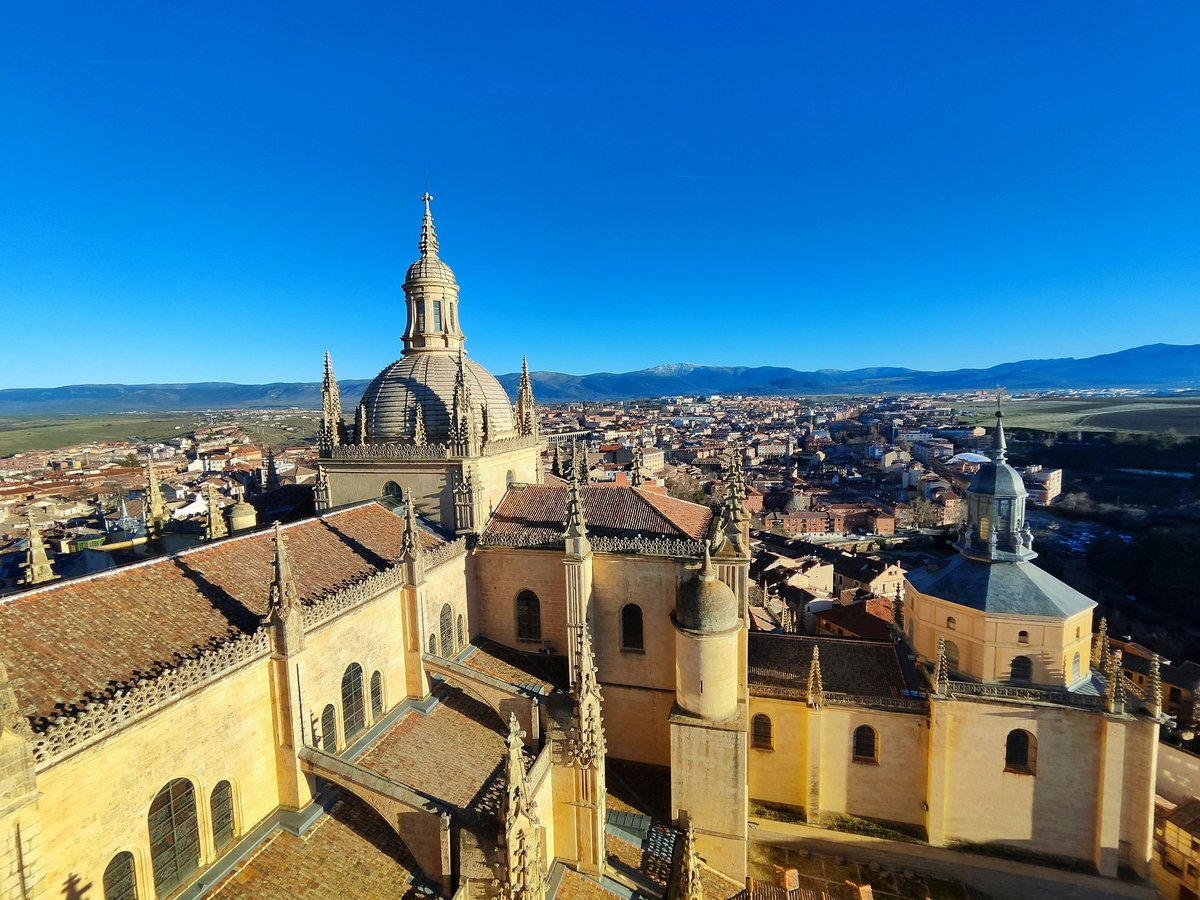
Segovia Cathedral, started in 1525 on Plaza Mayor, was the last major Gothic cathedral built in Spain. The interior stays cool even in June, a solid 8 or 9 degrees below the 24°C street temperature, and your footsteps on the limestone floor echo in a way that makes you lower your voice. The cloister was moved stone by stone from the earlier cathedral that stood near the Alcázar. Admission is about €3. To be fair, if you are choosing between the three, the Cathedral is the one you could skip without real regret. The 16th-century stonework is clean, the proportions severe. But the Aqueduct and the Alcázar are the two that stay with you after Segovia. The Cathedral is best experienced as a pause on the 1.2 km walk between them, not as a destination on its own.
Segovia sits 90 km northwest of Madrid and works well as a day trip. The bus from Madrid's Moncloa interchange runs roughly every 30 minutes, takes about 75 minutes, costs around €8 each way, and drops you at the Aqueduct in Plaza del Azoguejo. The AVE high-speed train from Madrid-Chamartín reaches Segovia-Guiomar station in 27 minutes, but that station sits about 5 km outside the old city, and you need a connecting bus for the last stretch. For a first visit, the Moncloa bus is the better option. If you stay for dinner, order the cochinillo asado at Mesón de Cándido beside the Aqueduct, where they have served it since 1884. The waiter carves the roast suckling pig with the edge of a ceramic plate to show the skin snaps and the meat yields without a knife, then smashes the plate on the tiled floor. Half a pig feeds two and currently runs about €25-28 per person.
The top three
Aqueduct of Segovia
The 28-metre, 167-arch Roman structure has stood in Plaza del Azoguejo since roughly 200 AD with no mortar. Free to visit, no reservation needed, and it carried water to the city until 1973. Still standing in a working city rather than behind a museum rope.
Royal Alcázar of Segovia
The castle sits at the tip of Segovia's granite ridge above the confluence of the Eresma and Clamores rivers. Dating to around 1200, with a tower climb that gives you the best panorama of the Sierra de Guadarrama. €9 admission, plus €3 for the tower.
Segovia Cathedral
The last major Gothic cathedral built in Spain, started in 1525 on Plaza Mayor. The coolest room in the city on a hot day, with a cloister transplanted stone by stone from the older cathedral near the Alcázar. About €3 admission.
Verified attractions
Sourced from Wikidata and OpenStreetMap: each entry links to its authoritative page.
-
Aqueduct of Segovia
bridgeaqueduct bridge in Segovia, Spain
View on Wikidata -
Royal Alcázar of Segovia
castlecastle and museum of the Old City of Segovia (Spain), UNESCO World Heritage Site
View on Wikidata -
Segovia Cathedral
churchcathedral in Segovia, Spain
View on Wikidata -
Guadarrama National Park
parknational park in Spain
View on Wikidata -
Royal Palace of La Granja de San Ildefonso
museumformer royal summer palace near Madrid
View on Wikidata -
Royal Palace of Riofrío
museumhistoric site
View on Wikidata -
Monasterio de El Paular
place of worshipCarthusian monastery in Rascafría, Spain
View on Wikidata -
old main synagogue
place of worshipreligious edifice in Segovia, Spain
View on Wikidata -
Monastery of Santa Cruz la Real, Segovia
place of worshipcultural property in Segovia, Spain
View on Wikidata -
Monastery of Santa María del Parral
monumentcultural property in Segovia, Spain
View on Wikidata -
La Vera Cruz Church
churchbuilding in Segovia
View on Wikidata -
Museo de Segovia
monumentcultural property in Segovia, Spain
View on Wikidata -
Old prison of Segovia
monumentPrison converted into a cultural center
View on Wikidata -
Puerta de Santiago
castleMedieval gate in the walls of Segovia, Spain
View on Wikidata -
Casa de los Picos
historic houseView on Wikidata -
Church of San Esteban
churchchurch building in Segovia, Spain
View on Wikidata -
Church of San Juan de los Caballeros
churchchurch building in Segovia, Spain
View on Wikidata -
Church of San Miguel, Sotosalbos
churchSotosalbos
View on Wikidata -
city walls of Segovia
castlemedieval fortification that surrounds the historic center of Segovia
View on Wikidata -
Monastery of Santa María de la Sierra
place of worshipcultural property in Collado Hermoso, Spain
View on Wikidata -
Museo Zuloaga
monumentcultural property in Segovia, Spain
View on Wikidata -
Puerta de San Andrés
castleCity gate in Castile and León, Spain
View on Wikidata -
The Coining House, Segovia
museumformer currency house and current museum in Segovia, Spain
View on Wikidata -
Casa de los Marqueses de Moya
palaceView on Wikidata -
Casa-Museo de Machado
museumView on Wikidata -
Church of El Salvador
churchchurch building in Segovia, Spain
View on Wikidata -
Church of San Andrés
churchbuilding in Segovia
View on Wikidata -
Church of San Clemente
churchbuilding in Segovia
View on Wikidata -
Church of San Lorenzo
churchbuilding in Segovia
View on Wikidata -
Church of San Martín
churchchurch in Segovia, Spain
View on Wikidata -
Church of San Millán
churchcultural property in Segovia, Spain
View on Wikidata -
Church of San Quirce
churchchurch building in Segovia, Spain
View on Wikidata -
Church of the Santísima Trinidad
churchchurch building in Segovia, Spain
View on Wikidata -
Cueva de la Vaquera
archaeological sitecave in Losana de Pirón, Segovia
View on Wikidata -
Daoiz and Velarde
monumentmonument in Segovia, Spain
View on Wikidata -
Fuenfría Roman road
archaeological siteRoman architectural remains in Spain
View on Wikidata -
Monastery of San Vicente el Real
monumentcultural property in Segovia, Spain
View on Wikidata -
plaza de toros de Segovia
theaterbullring in Segovia, Spain
View on Wikidata -
Plaza del Azoguejo
plazasquare of Segovia, Spain
View on Wikidata -
Plaza Mayor
plazaView on Wikidata
Last verified by automated review (v1.7.2) on . What is automated review?