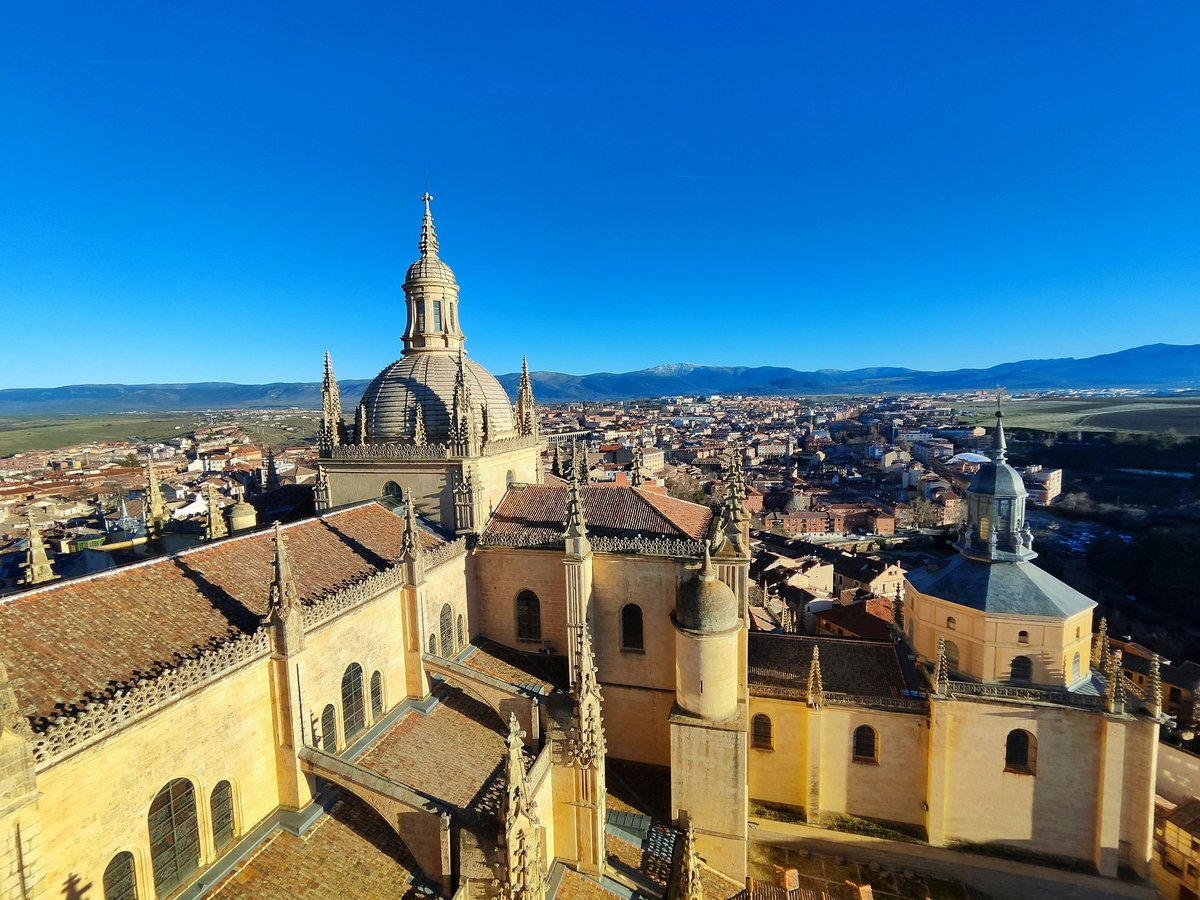
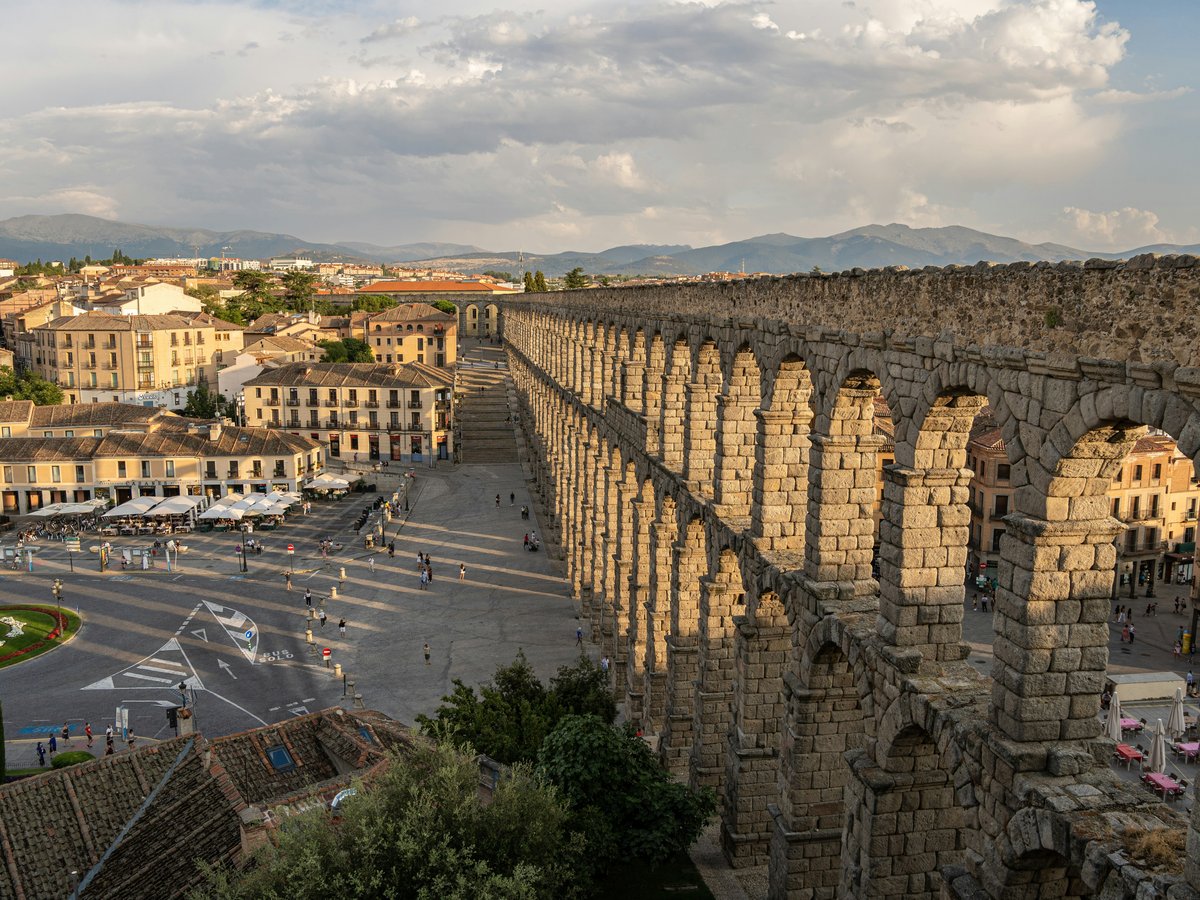
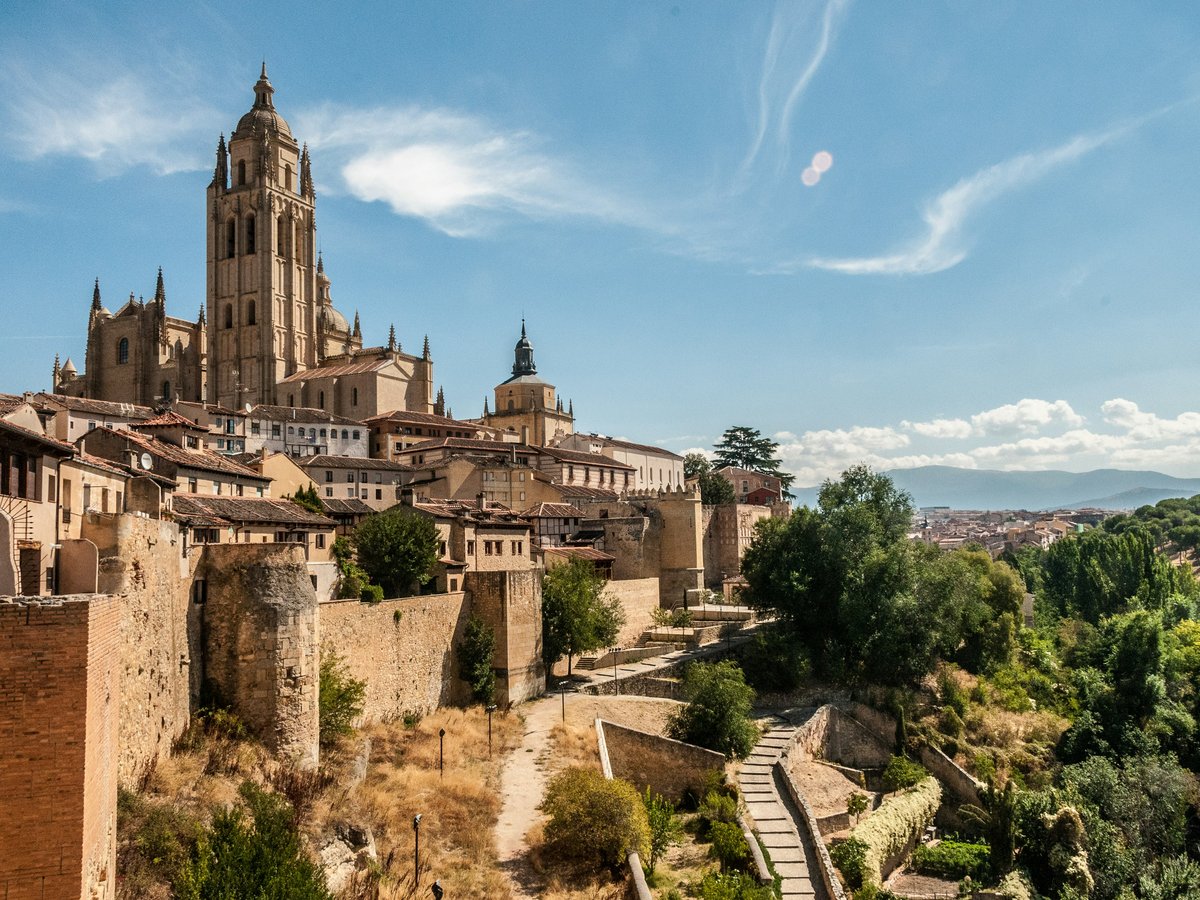
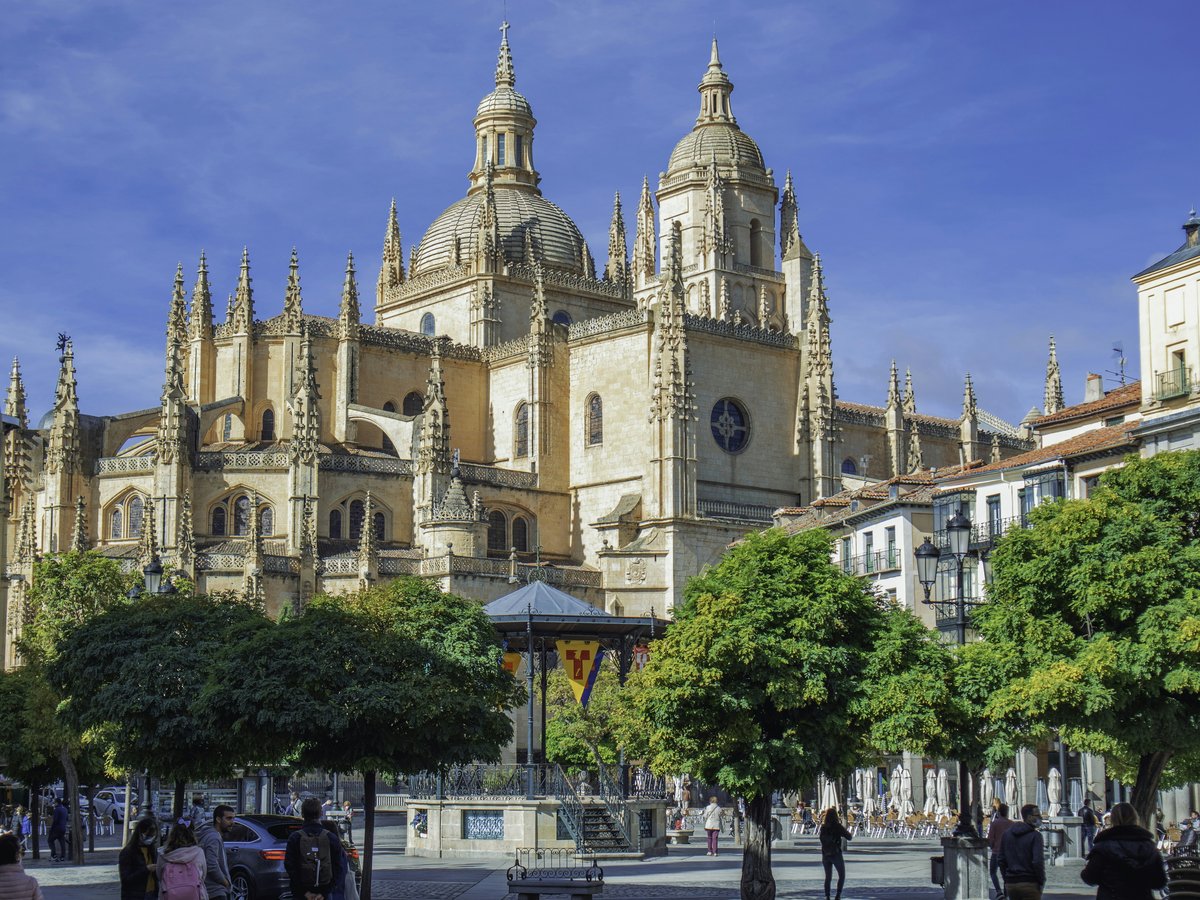
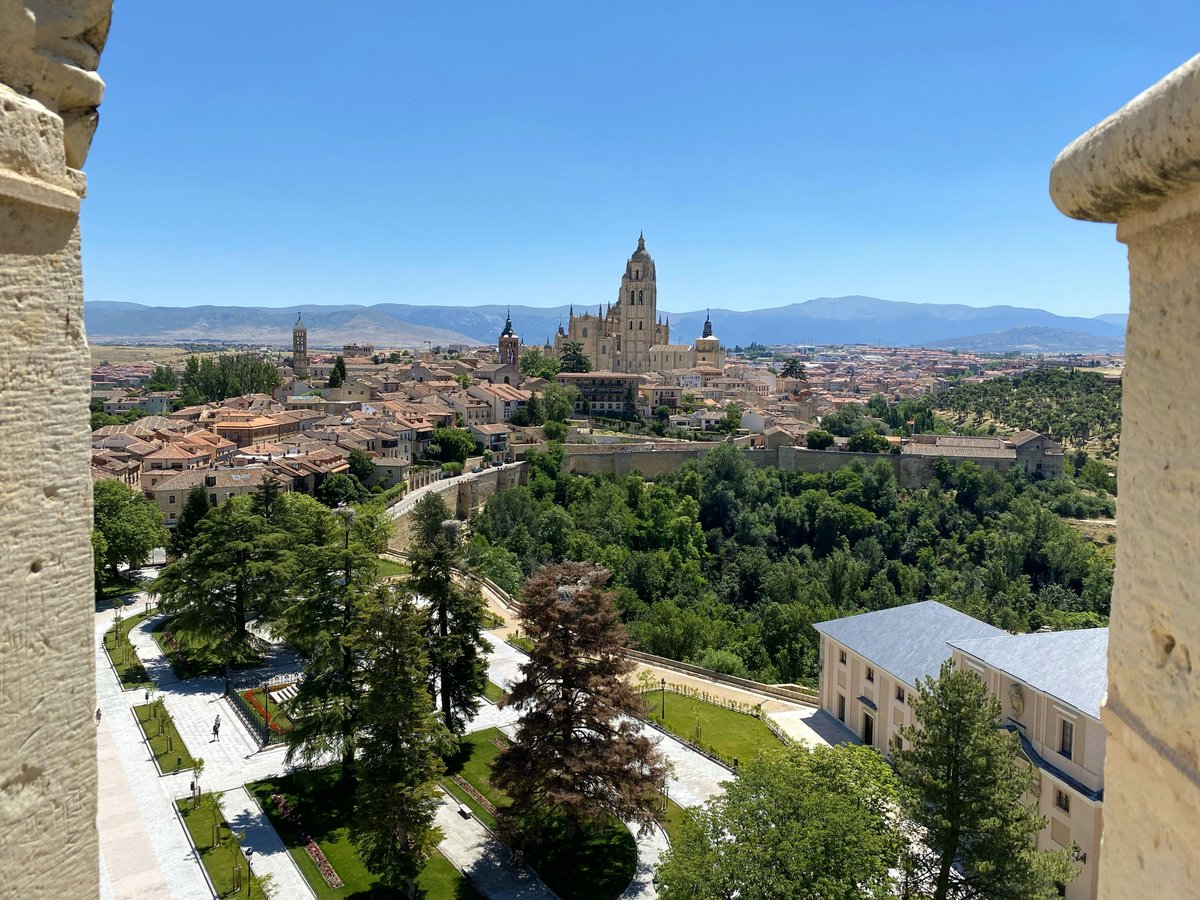
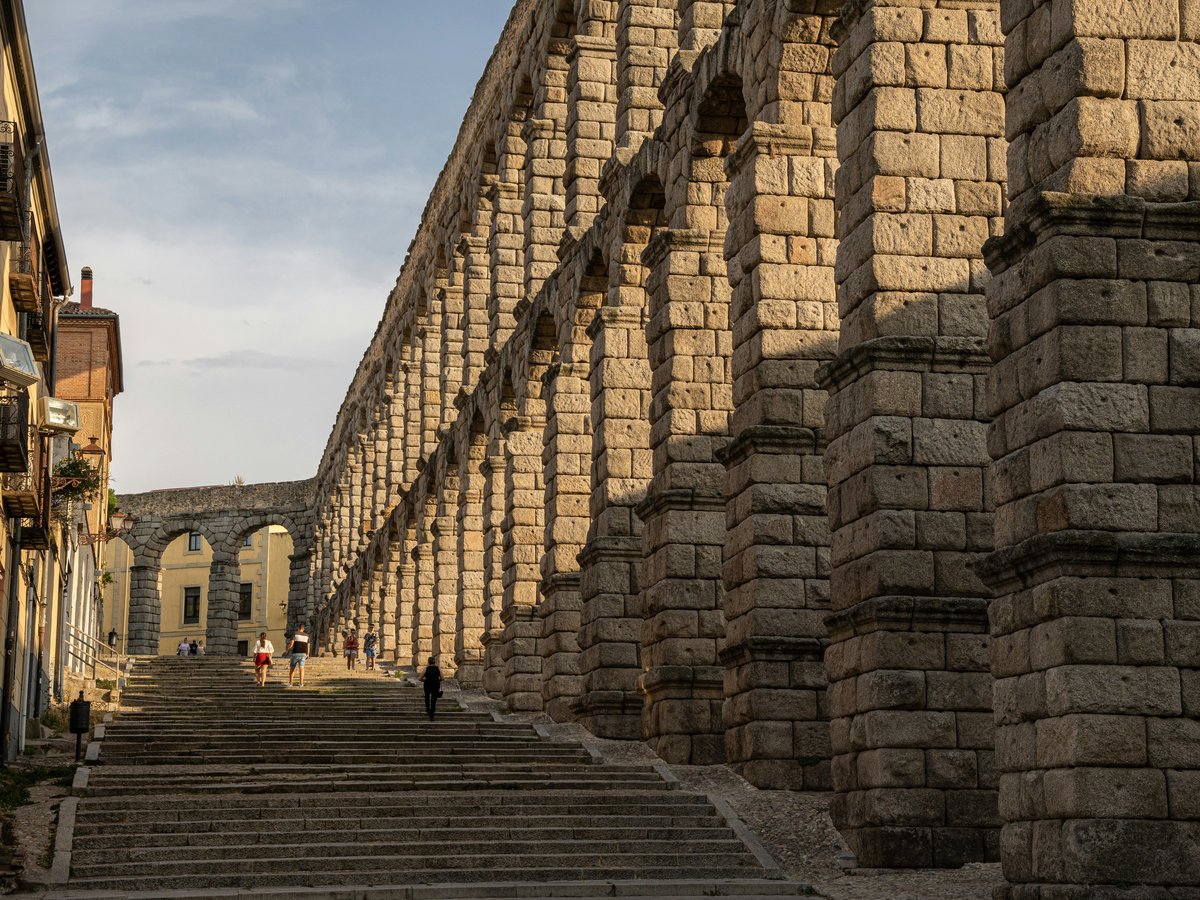
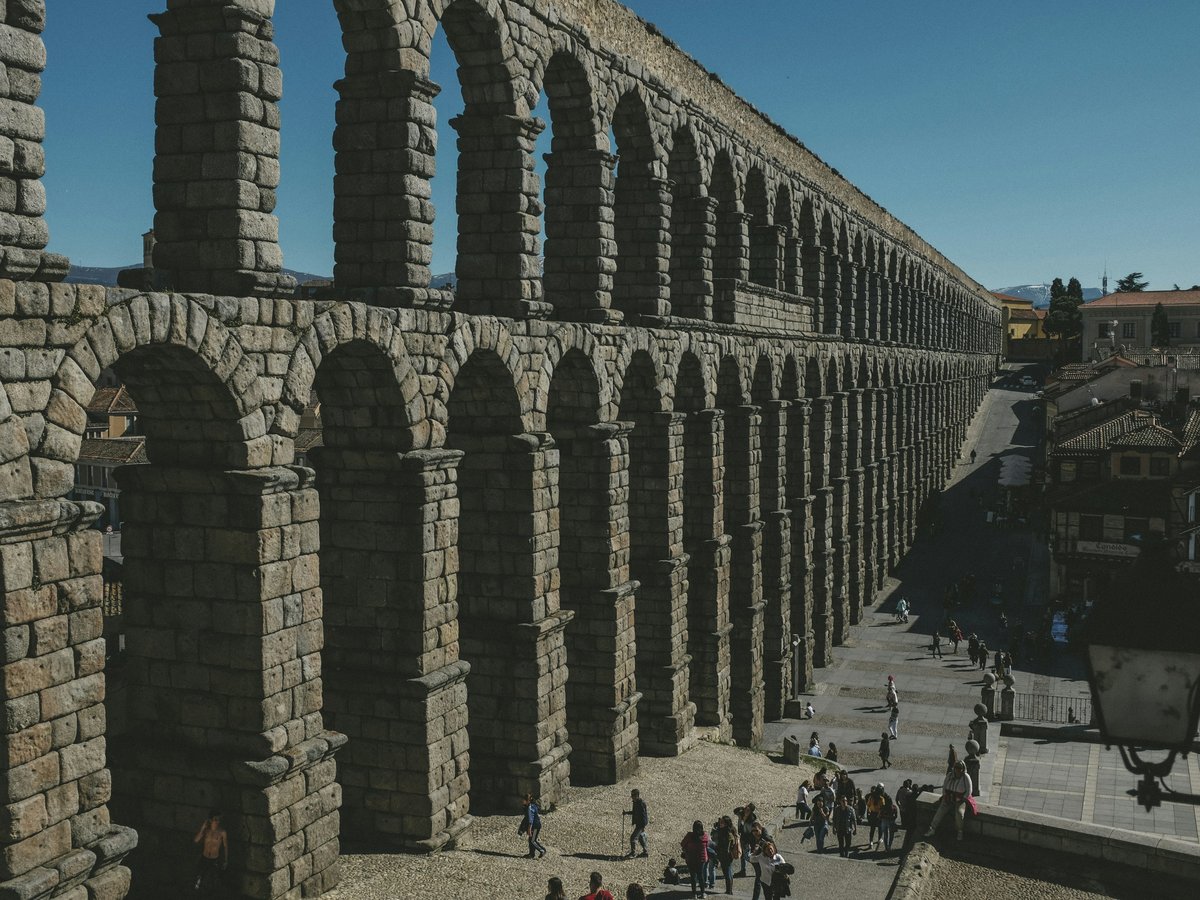
The Roman aqueduct stands at the eastern edge of Segovia's old town without a single drop of mortar holding its granite blocks together, and it has stood that way since the first or second century. That fact (a hundred and sixty-odd arches held in place by nothing but geometry and weight) sets the tone for a city where permanence is the organizing principle. Segovia sits on a narrow rocky promontory where the Eresma and Clamores rivers converge, about ninety kilometres northwest of Madrid, and the landform dictates the layout: a single ridgeline of medieval stone running west from the aqueduct to the sharp prow of the Alcázar, with steep green valleys falling away on either side. The old town, a UNESCO World Heritage Site since 1985, is compact enough to cross on foot in twenty minutes, though doing so that quickly would mean skipping the cathedral: the last major Gothic cathedral built in Spain, finished in the sixteenth century when the rest of the country had moved on to Renaissance tastes. Below the ridge, the barrio of San Millán and the old Judería keep a quieter rhythm, their streets mostly residential, their churches older and less restored than anything on the main drag. A typical first visit falls into a natural pattern: morning around the aqueduct and cathedral, a long midday lunch of cochinillo asado (roast suckling pig, the dish Segovia has built a local identity around) then an afternoon walk to the Alcázar and along the Eresma valley trails. The population sits around fifty-two thousand, small enough that the same waiter may serve you twice, and close enough to Madrid that day-trippers fill the Plaza Mayor by noon and leave by dark, giving the old town back to its residents and the few visitors who had booked a room.
Segovia in photos
Segovia right now
Answers about Segovia
-
Airport to city
Segovia has no airport. From Madrid-Barajas (MAD), take the Cercanías C1 train to Chamartín (25 minutes, €2.60), then the AVE high-speed train to Segovia-Guiomar (27 minutes, €12-15). Bus 11 runs from Guiomar to the Aqueduct at Plaza del Azoguejo for €2. Door-to-door time runs about 90 minutes.
Read the full answer → -
Best time to visit
May and October are Segovia's best months. Daytime temperatures hover around 20-22°C at the city's 1,000-metre elevation, the Aqueduct plaza is not yet packed with Madrid day-trippers, and cochinillo restaurants on Calle Real take walk-ins. July and August bring 32°C afternoons on exposed granite, and January drops below freezing after dark.
Read the full answer → -
Cost per day
Budget €35/day ($41) covers a hostel dorm near Plaza del Azoguejo, menú del día lunches at €10-13, and free entry to the Aqueduct of Segovia. Midrange €110/day ($128) adds a three-star hotel on Plaza Mayor and a cochinillo asado lunch. Luxury starts around €300/day ($348) at the Parador de Segovia. The walled city is 1 km end to end, so transit costs stay near zero.
Read the full answer → -
Cultural etiquette
Segovia runs on Castilian formality. Greet shop owners with 'buenos días' before asking anything. Two-cheek kisses between acquaintances start on the right. Lunch begins at 2pm, dinner after 9pm. Tipping is minimal, €1-2 at restaurants. Cover shoulders and knees at Segovia Cathedral and the Alcázar. Segovians are reserved but warm once you follow the rhythm.
Read the full answer → -
Best day trips
La Granja de San Ildefonso (11 km southeast, 25-minute La Sepulvedana bus, around €2) is the strongest single-day pick from Segovia. The 1721 Bourbon palace gardens have more than 20 gravity-fed fountains across 146 hectares. Pedraza (37 km, car needed) adds a medieval walled village with candlelit summer concerts. The Duratón River gorges near Sepúlveda (58 km) bring griffon vultures and cliff-edge hermitages into a half-wild hiking day.
Read the full answer → -
Digital nomads
Segovia scores 6.2/10 for digital nomads (sourced from TTDI's editorial rubric). Fiber runs 300 Mbps in apartments outside the medieval walls, but coworking amounts to two or three small spaces and a public library. Monthly all-in runs about $1,500. The 27-minute AVE to Madrid Chamartín is the real infrastructure play here.
Read the full answer → -
Family-friendly
Segovia is family-friendly, 7 out of 10. The Alcázar looks like a storybook castle, and kids under 6 enter free. The city is small enough to walk in a morning. The catch is cobblestones everywhere, which defeat most strollers, and the signature dish, cochinillo asado, tends to weird out anyone under 10.
Read the full answer → -
Food culture
Segovia's food identity centers on cochinillo asado, whole suckling pig roasted in clay cazuelas until the skin cracks under a plate's edge. Asadores near Plaza del Azoguejo and along Calle Real serve it alongside cordero lechal and judiones de La Granja. Lunch from 2pm to 3:30pm is the main meal. Ponche segoviano and Ribera del Duero Tempranillo close the table.
Read the full answer → -
Getting around
Walk everywhere in Segovia's old city. The Aqueduct to the Alcázar is 1.5 km on cobblestone along Calle Real, about 25 minutes on foot. Bus Line 11 connects the AVE station at Segovia-Guiomar to Plaza del Azoguejo for €1.30. Taxis run on meters at €5-8 within the center. No metro, no ridehail apps.
Read the full answer → -
How to get there
Segovia has no airport. Fly into Madrid-Barajas (MAD), 95 km southeast, then take the Renfe AVE high-speed train from Madrid-Chamartín to Segovia-Guiomar in 27 minutes for €13-15 one way. La Sepulvedana buses from Moncloa station run every 30 minutes, take 75 minutes, and cost €9. Most visitors base in Madrid and day-trip.
Read the full answer → -
Is it safe?
Segovia is safe. It scores 7.5 out of 10 for solo-traveler safety (see the TTDI Solo-Safety Index). Violent crime against visitors is close to nonexistent in this Castilian city of 52,000. The real risks are uneven cobblestones after dark and the isolated Eresma valley path below the Alcázar, where foot traffic drops to zero by sunset. Emergency: 112.
Read the full answer → -
Language basics
Spanish, specifically Castilian. Segovia sits in Castilla y León, where standard Spanish originated. English proficiency around the Aqueduct and Alcázar is roughly 4 out of 10 (per Spain's EF English Proficiency Index). Hotel staff and ticket counters at major monuments handle basic English, but waiters at most mesones and shopkeepers on side streets off Calle Real rarely speak more than a few words.
Read the full answer → -
Layover guide
Segovia sits about 90 minutes from Madrid-Barajas by high-speed train plus metro, making it a realistic layover detour only with 8+ hours between flights. The Roman aqueduct, the Alcázar, and a plate of cochinillo fit a 3-hour ground window. Schengen passport holders skip immigration; non-Schengen travelers should add 20-40 minutes each way.
Read the full answer → -
LGBTQ-friendly
Segovia scores 8.5/10 for LGBTQ+ friendliness (sourced from TTDI's editorial rubric). Same-sex couples hold hands around the Plaza Mayor without turning a head. No dedicated queer venue exists, which reflects a city of 52,000 people rather than any hostility. Spain's legal framework is among Europe's strongest, and that protection extends fully here.
Read the full answer → -
Where locals go
Segovianos eat and drink below the aqueduct, not above it. The Calle de la Infanta Isabel tapas corridor south of Plaza del Azoguejo fills with local workers by 9:30pm on weeknights. Sunday vermut happens at Plaza Mayor and Plaza de San Martín between noon and 2pm. The walled casco antiguo is largely tourist territory after 11am.
Read the full answer → -
Must-see
The Aqueduct of Segovia. Built around 200 AD from roughly 20,400 granite blocks with no mortar, the 28-metre Roman structure still stands in Plaza del Azoguejo. Walk west along the walled ridge to the Alcázar, passing the Cathedral on Plaza Mayor. All three fit inside a 1.2 km walk on the same granite spur.
Read the full answer → -
Solo travel
Segovia works well for solo travelers on a 1-3 night stay, less so for a full week. The AVE to Madrid takes under half an hour, so you can retreat to the capital's social scene when evenings get quiet. Cochinillo restaurants seat solo diners without fuss. The walled city is walkable end-to-end in 20 minutes.
Read the full answer → -
This week
Segovia runs on Madrid's day-trip pulse. Weekday mornings before 10am give you the Aqueduct nearly empty. Sunday lunch is peak cochinillo season, when restaurants fill with families from the capital. Summer temperatures sit around 25°C at this altitude, noticeably cooler than Madrid. Stay one night for the quiet evenings the day-trippers miss.
Read the full answer → -
3-day itinerary
Day 1 covers the old city ridge from the Roman Aqueduct to the Alcázar, about 4 km end to end. Day 2 drops into the Eresma valley for the Monastery of El Parral and La Vera Cruz church, then loops through the Jewish Quarter. Day 3 is a half-day at the Royal Palace of La Granja de San Ildefonso, 11 km southeast by bus.
Read the full answer → -
What to avoid
Skip lunch at Mesón de Cándido beside the Aqueduct, where the plate-smashing cochinillo show costs more than better roast suckling pig at José María. Don't squeeze Segovia into a four-hour Madrid day trip, don't try to walk from Segovia-Guiomar station, and don't drive inside the walls. Pack a warm layer: the city sits near 1,000 metres.
Read the full answer → -
What to pack
Sturdy walking shoes for Segovia's granite cobblestones and the steep climb to the Alcázar. Layers for the 1,002-meter altitude, where June days hit 30°C but evenings drop below 15°C. A refillable water bottle, SPF 50 sunscreen for the exposed Castilian meseta, and a Type C plug adapter for Spain's 230V outlets.
Read the full answer → -
Where to stay
Stay inside Segovia's walled old town, between Plaza Mayor and the Aqueduct. The 800-meter walk along Calle Real connects the Cathedral, the Alcázar, and the best cochinillo restaurants. Hotels in converted medieval buildings run €80-140 ($92-162). After 7 PM, when day-trippers leave for Madrid, the old town empties and the floodlit Aqueduct is yours without a tour group in sight.
Read the full answer →
Deep guides for Segovia
Curated lists for Segovia
accommodation
-
Best boutique hotels
Segovia sits on a granite ridge above the Castilian meseta, its walled old town pinched between the Roman Aqueduct at the eastern gate and the Alcázar at the western prow. The city is small enough to walk end to end before lunch, but where you sleep shapes the trip: the walled core delivers cathedral bells and roast-lamb restaurants within minutes of your door, while the valley neighborhoods and ring-road periphery trade atmosphere for parking, quiet, and lower rates. Most visitors arrive by bus or AVE from Madrid. The bus station sits below the walls at San Millán; the AVE station, Segovia-Guiomar, is a shuttle ride southwest. Both drop you close enough that taxis feel optional on a clear day. Price tiers compress in a city this size. Mid-range rooms inside the walls ask $86 to $107 a night, and even the Parador on its ridge holds at $108. The real variable is not cost but proximity: a bed near the Aqueduct puts the old town at your feet, while a room across the valley puts the whole skyline in your window. The neighborhoods spread from the densest hotel clusters near the old town outward to the lakeside and the ridge, each one a different answer to how close you want to sleep to the stones.
See the picks → -
Best hostels
Segovia's old city sits on a narrow ridge between the Eresma and Clamores valleys, and the budget accommodation clusters along its length rather than spreading into the plains below. The Roman Aqueduct anchors the eastern approach, the Alcázar guards the western tip, and the cathedral fills the high ground between them. Three neighborhoods divide the walking city into distinct stays: El Sotillo catches the modern traffic below the Aqueduct's arches, Las Canongías tucks into the quiet lanes beneath the Alcázar's walls, and San Justo holds the middle ground near the cathedral plaza. Nightly rates run from $61 to $75 across the picks below, and the old city is small enough that any two of these areas connect in a comfortable walk. The choice is less about access and more about which end of the ridge you want to wake up on. Mornings below the Aqueduct start with tour buses; mornings near the Alcázar start with birdsong from the valley. The cathedral quarter splits the difference, louder by day and quieter than either end after the restaurants close. Segovia does not reward staying outside its walls; the inventory worth booking sits inside or just below them.
See the picks → -
Where to stay
Segovia's hotels spread across a compact footprint where the walled old city and its lower neighborhoods sit within walking distance of each other. The Roman Aqueduct anchors the eastern approach, the Alcázar guards the western tip, and the cathedral rises between them; most rooms cluster along this spine or in the valleys just below. Rates stay modest by European standards, with mid-range options regularly holding ratings above 8.5 on Trip.com for under $110 a night. The choice comes down to altitude versus convenience: stay inside the walls for cobblestone proximity to the monuments, or book in the lower neighborhoods for easier parking and quieter streets. Nine areas cover the practical choices, from the Aqueduct's doorstep to the reservoir fringe where the city thins into Castilian plateau. Segovia rewards the traveler who picks a neighborhood first and a hotel second, because the walk between areas is short but the character shift is sharp.
See the picks →
attractions
-
Best museums
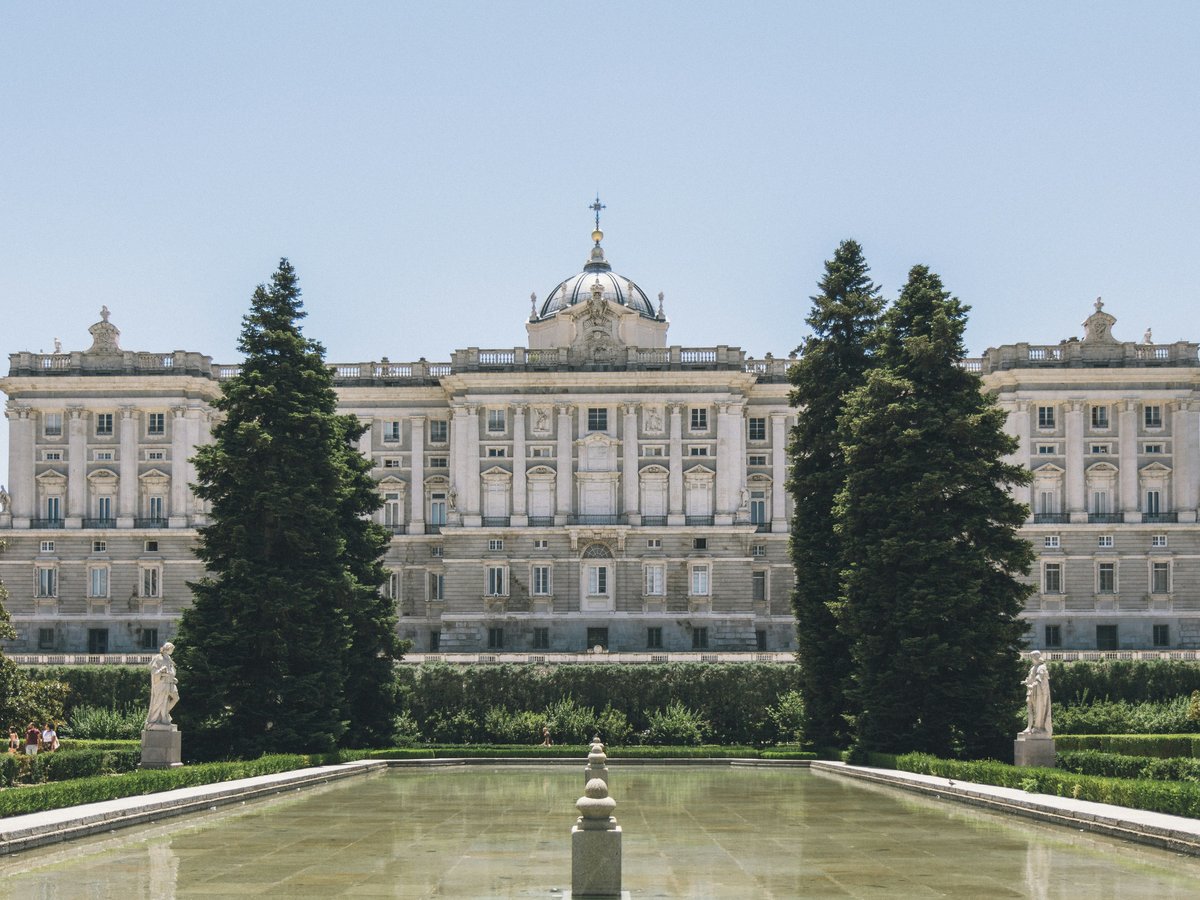
Segovia is a small city that punches far above its weight for museum-goers, and the seven listed here trade on very different kinds of attention. Two are Bourbon summer palaces on the outskirts, both under Patrimonio Nacional, and they reward visitors who want gardens, tapestries and dynastic history at walking pace. Three sit inside the old town within easy reach of the aqueduct, and they lean regional: an archaeology and fine-arts collection, a ceramics-and-painter house that carries the Zuloaga name, and a poet's residence that reads more like a room than a museum. One, the Coining House on Calle la Moneda, is a preserved mint that treats coin-making as the story. One, the Torreón de Lozoya on Plaza de Medina del Campo, is a tower that hosts changing exhibitions rather than a permanent hoard. Skip the checklist approach; pair a palace with a room-sized museum in town and give each the hour it deserves. The list runs in rank order, from the grand summer court at La Granja to the quiet Machado house near the cathedral.
See the picks → -
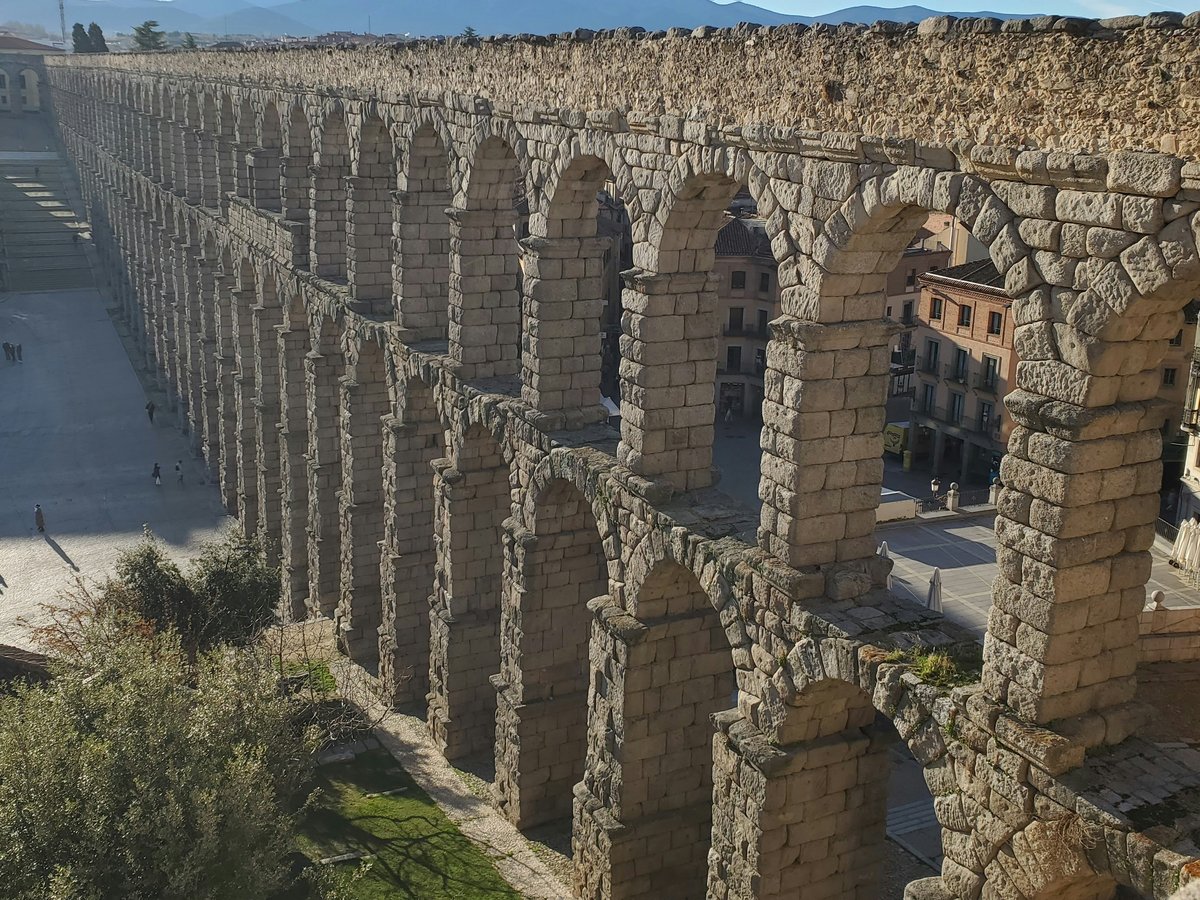
Must-see attractions
Segovia's must-sees are mostly stone: a Roman-engineered aqueduct bridge, a castle that doubles as a museum, a cathedral dating from 1525, a monastery from 1447, and several that fall inside a UNESCO World Heritage Site. Beyond the walls, the Crown left two palaces: La Granja, a former royal summer palace dating from 1721, and Riofrío, from 1751. The list reaches into the twentieth century too, with a prison from 1924 that now works as a cultural centre. These twelve are for visitors who would rather understand a place than tick it off, and most people give them far less time than they deserve, arriving for a single day, taking the same three photographs and leaving. Give the monuments a morning, the monasteries an afternoon and the palaces a day of their own, and Segovia stops looking like a postcard and starts reading like a history.
See the picks →
food
-
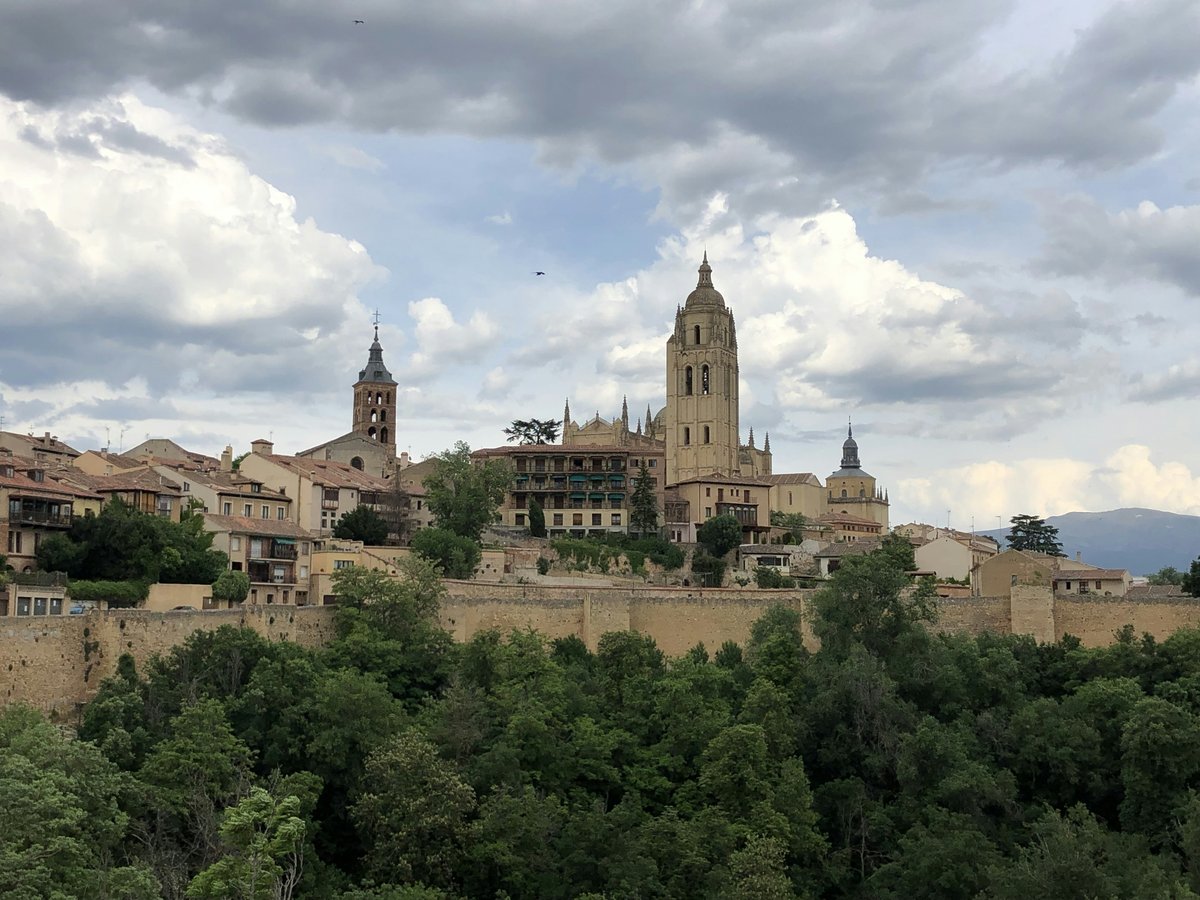
Best cafes
Segovia is a small city that lives at walking pace, and its cafes divide neatly into two constituencies: the ones strung along the Avenida del Acueducto, where the Roman arches funnel every visitor past the door, and the ones tucked into the residential grid east of the old town, where a coffee costs less and the conversation is in Spanish. This list favours the working cafe over the postcard cafe. Four of the seven sit within a short walk of the aqueduct, so you can plan a morning around them without a taxi; three are out in the Nueva Segovia district around the 40006 postal area, where locals go when they are not entertaining visitors. Hours range from a 07:00 opener that catches the commuter shift to rooms that hold their tables until 22:00. What follows is a working itinerary for a two-day trip, not a ranked leaderboard: pair the aqueduct-adjacent stops with a monument walk in the morning, then cross the ring road for a slower afternoon coffee once the tour buses have gone.
See the picks → -
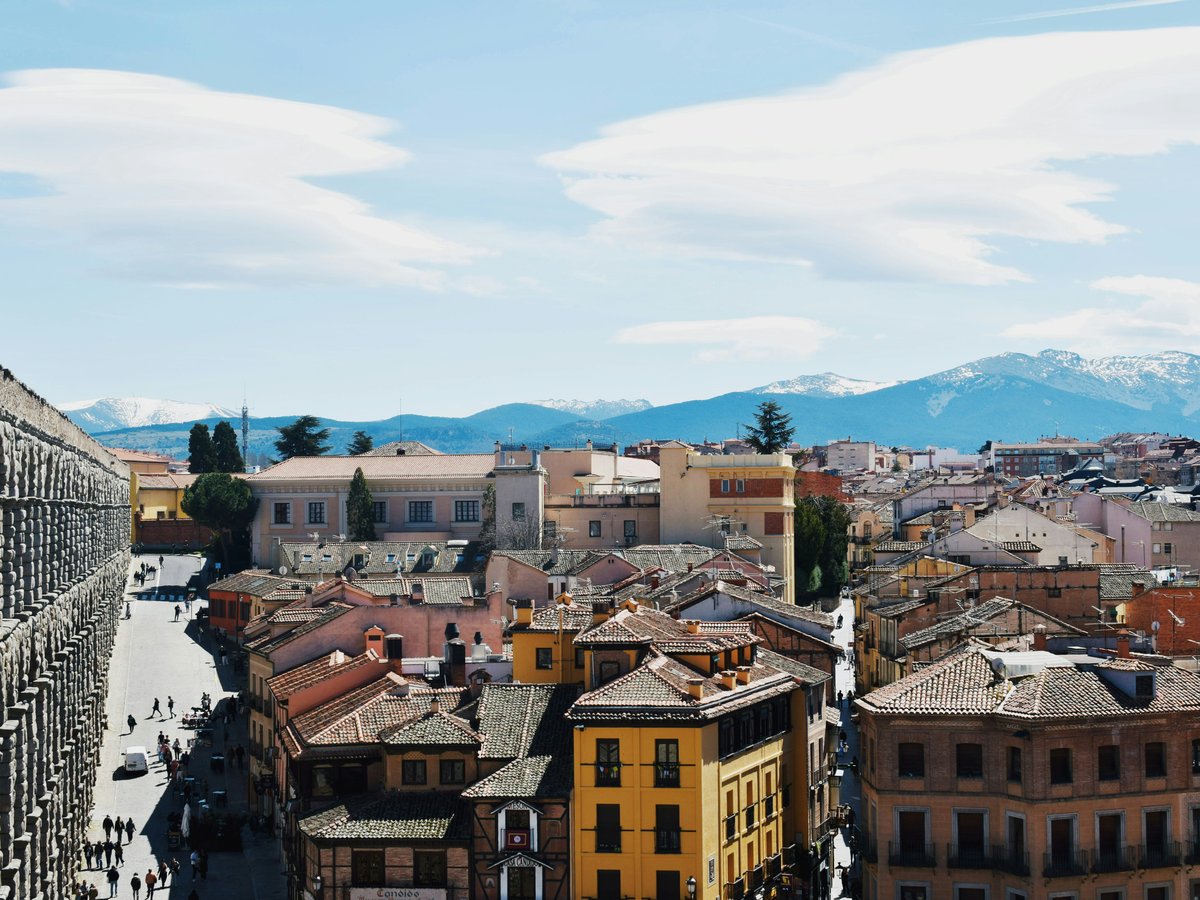
Best restaurants
Segovia eats the way it builds: slow, deliberate, and around a fire. The city sits under a Roman aqueduct that still splits its lower town, and the restaurants worth a visitor's afternoon are mostly the ones that took a position on cochinillo, cordero, and the regional grammar of Castilla y León and refused to drift. This list favors that grammar. It leans on the old asadores near Plaza del Azoguejo and the Acueducto, then walks out to the Padre Claret spine and the residential streets beyond the walls, where the locals book their birthdays. A few detours: a burger house, a late-night tavern, a pizzeria on the far edge of town. They earn their places on merit, not novelty. What follows is twelve addresses, ranked, cited to their OSM and Wikidata records and their own websites, with the hours and phone numbers a real evening needs. Read for the stance as much as the address; the point of a curated list is what it leaves out.
See the picks →
Browse by traveler type
Book experiences in Segovia
 Free cancellation
 Hot-Air Balloon Ride over Segovia with Optional Transport from Madrid
Outdoor experience: free cancellation.
via Viator Free cancellation
 Hot Air Balloon Flight Over Segovia or Toledo
Outdoor experience: 4 hours, free cancellation.
via Viator Free cancellation
 Hot Air Balloon over Segovia with Optional Transfers from Madrid
Outdoor experience: 4 hours, free cancellation.
via Viator Free cancellation
 Segovia from the Skies: Sunrise Balloon Ride
Outdoor experience: free cancellation.
via Viator Free cancellation
 Segovia Balloons
Outdoor experience: 4 hours, free cancellation.
via Viator Free cancellation
 Balloon flight at sunrise in Segovia
Outdoor experience: 3 hours, free cancellation.
via Viator Free cancellation
 Balloon Rides in Segovia with Optional transportation from Madrid
Outdoor experience: free cancellation.
via ViatorBrowse by interest
Find a flight to Segovia
Live fares to Segovia appear here once cookies are accepted.
Last verified by automated review (v1.7.2) on . What is automated review?