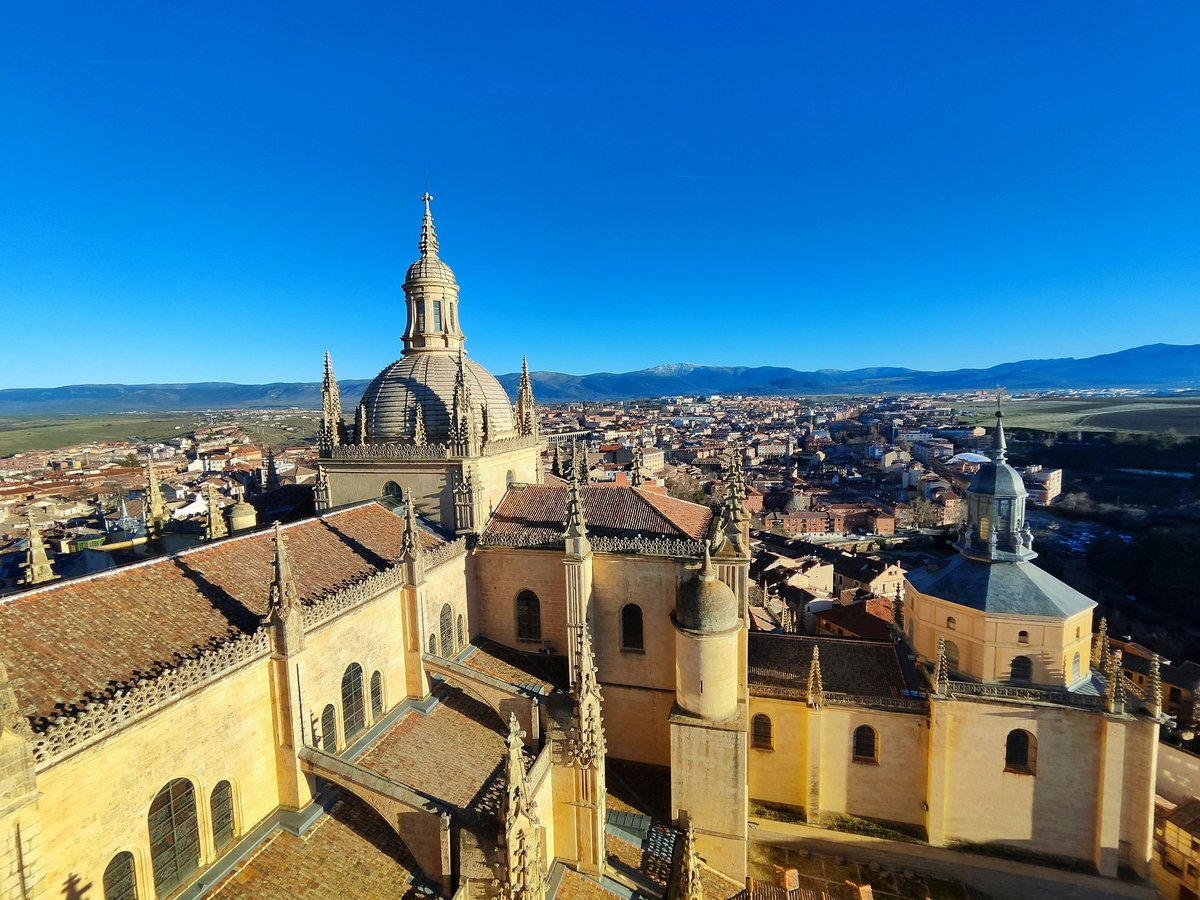
Segovia sits on a narrow limestone ridge between two river valleys, the Eresma to the north and the Clamores to the south. The Roman aqueduct marks the eastern entrance to the old town. From there, one main artery, Calle Real, runs about 800 meters west through the walled city to the Alcázar perched on the promontory's tip. That ridge is the spine. Everything else cascades downhill from it. The old town neighborhoods stack tightly along the top and sides of this rocky spur, while newer development spreads south and east beyond the aqueduct. It is a small city, around 52,000 people, and you can walk end to end in 20 minutes. But the steep terrain and the walls create distinct pockets that feel surprisingly separate from each other. The Eresma valley below the northern walls has a completely different atmosphere from the Plaza Mayor up top, even though they are maybe 5 minutes apart on foot. Worth noting, most visitors never leave the ridge. The neighborhoods below the walls tend to be quieter, cheaper, and honestly more interesting for longer stays.
Neighborhoods
-
Casco Antiguo (Walled Old Town)
This is the city on the ridge itself, contained within medieval walls that still stand on three sides. Stone towers, Romanesque church facades, and narrow alleys paved in granite. The noise level depends entirely on where you are. Near Plaza Mayor, tour groups cluster between 11:00 and 15:00, and the cathedral bells mark the quarter hours. Two blocks off the main street, the silence is almost rural. You'll hear pigeons, someone's television through an open window, the scrape of a chair on stone. The buildings are a mix of honey-colored limestone and the distinctive Segovian sgraffito plasterwork, geometric patterns scratched into the facade. Many date to the 15th and 16th centuries. The air smells like woodsmoke in winter, and roasting meat drifts from the mesones year-round.
- Best for
- First-time visitors who want to walk to everything, couples looking for atmosphere, and anyone staying 1 to 3 nights who prioritizes proximity to the cathedral, Plaza Mayor, and the Alcázar
- Key streets
- Calle Real is the main artery, though locals know it changes names three times. It starts as Calle Cervantes at the aqueduct, becomes Calle Juan Bravo at Plaza de Medina del Campo, then Calle Isabel la Católica before reaching Plaza Mayor. Calle Daoíz runs parallel one block south and tends to be emptier. Plaza de San Martín, with its church and the Torreón de Lozoya, is one of the finest small squares in Castilla y León.
-
Barrio de la Judería
The old Jewish quarter occupies the southern slope of the ridge between the cathedral and the city walls, roughly below Calle de la Judería Vieja. It is steep. The alleys drop sharply toward the Clamores valley, and the steps are worn smooth from centuries of foot traffic. The architecture here is more modest than the noble houses on Calle Real. Lower ceilings, smaller doorways, tighter turns. It currently feels like a residential neighborhood that happens to have a few small museums tucked into it. The old synagogue, now the church of Corpus Christi on Calle Juan Bravo, still has its original 13th-century columns inside. The pace is slow. Cats sleep in doorways. You might hear someone practicing piano through a shuttered window.
- Best for
- History-focused travelers, photographers drawn to narrow alleys and uneven stone, and anyone who wants the old town without the foot traffic of Calle Real
- Key streets
- Calle de la Judería Vieja is the main route through the quarter. It connects to Calle de la Judería Nueva further south. Travesaña Alta and Travesaña Baja cut across horizontally. The small Plaza del Socorro sits near the southern wall. The Centro Didáctico de la Judería on Calle de la Judería Vieja has a permanent exhibit on the medieval Jewish community.
-
Plaza del Azoguejo and Aqueduct Zone
The area around the base of the Roman aqueduct functions as Segovia's front door. The Plaza del Azoguejo sits directly beneath the highest arches, which reach about 28 meters at this point. The square is paved and open, surrounded by restaurants and souvenir shops. It is noisy, especially on weekends when day-trippers arrive from Madrid, about 90 minutes by car or 30 minutes on the AVE high-speed train to nearby Guiomar station. The restaurants here tend to be tourist-priced. A media ración of cochinillo at one of the terrace spots might run 18 to 22 euros, compared to 12 to 15 euros a few streets away. That said, sitting beneath a 2,000-year-old aqueduct with a glass of Ribera del Duero has a certain pull that is hard to argue with. The granite blocks are fitted without mortar, which still seems improbable when you stand beneath them.
- Best for
- Short-stay visitors, anyone arriving by bus (the station is a 5-minute walk east), and travelers who want the convenience of being at the city's main orientation point
- Key streets
- Plaza del Azoguejo is the anchor. Calle del Carmen and Calle de San Francisco run east from the square into the newer commercial area. Calle de Ochoa Ondátegui climbs steeply from Azoguejo up to the old town. The small streets south of the aqueduct toward San Millán are worth exploring for cheaper tapas bars.
-
San Millán
Below the southern walls and outside the old city, San Millán spreads along the Clamores valley floor. The 12th-century church of San Millán anchors the neighborhood. It is one of the finest Romanesque churches in the province, with a colonnaded gallery on three sides that catches afternoon light beautifully. The neighborhood itself is residential and working-class by Segovia standards. Small grocery shops, a couple of no-frills bars where a caña and a tapa might cost 2.50 euros. The buildings are mostly 3 to 5 stories, mid-20th-century construction, without the historic character of the old town above. But the rents are lower, the streets are flat, and you are still only a 10-minute uphill walk from Plaza Mayor. The Clamores stream runs through a small park nearby. In summer, the valley catches less wind than the exposed ridge, so it can feel 3 or 4 degrees warmer.
- Best for
- Budget-conscious travelers on longer stays, families who prefer flat terrain and proximity to parks, and anyone who finds the old town's steep cobblestones tiring after a day or two
- Key streets
- Avenida del Padre Claret runs along the base of the walls and has most of the neighborhood's shops and services. Calle José Zorrilla leads south toward the modern city. The small Plaza de la Artillería sits near the old walls. The church of San Millán is on its own small square at Calle de Fernández Ladreda.
-
San Lorenzo and the Eresma Valley
Drop down from the northern walls and you reach the Eresma river valley, a different world from the ridge above. San Lorenzo is a former working-class barrio built around another beautiful Romanesque church, San Lorenzo, with its distinctive brick tower visible from above. The valley floor is green. Poplar trees line the river. The Alameda del Parral, a tree-shaded walkway, follows the Eresma west toward the Monasterio del Parral, a 15th-century Hieronymite monastery that still has a small community of monks. The air down here is noticeably cooler in summer, sometimes by 5 or 6 degrees compared to the sun-baked ridge. You might hear the river, birdsong, church bells from above. The neighborhood has a village feel even though you are technically still in the city. A few restaurants serve roast lamb and judiones de La Granja, the large white butter beans that are a regional staple.
- Best for
- Walkers and nature lovers, anyone visiting in July or August who wants relief from the heat, and travelers interested in monastic history or Romanesque architecture
- Key streets
- Calle del Marqués de Villena descends from the old town's northern gate to the valley floor. The Alameda del Parral follows the Eresma west. Calle del Puente de la Sierra leads to the Monasterio del Parral. The Iglesia de la Vera Cruz, a 13th-century round church attributed to the Knights Templar, sits across the valley on the opposite slope. From the Calle Real above, the Puerta de Santiago gives access down to this area.
-
Barrio de los Caballeros
Wedged between the cathedral and the Alcázar on the western end of the ridge, this was historically the noble quarter. The name means "neighborhood of knights," and the architecture matches. You'll find 15th and 16th-century palaces with coats of arms carved above heavy wooden doors. The Casa de los Picos, with its facade of diamond-point granite blocks, sits at the eastern edge near Plaza de Medina del Campo. The streets here are quieter than the Calle Real corridor. Many of the old palaces now function as small hotels or institutional offices. The Torreón de Lozoya, a 14th-century tower house on Plaza de San Martín, hosts art exhibitions. The western end of this area narrows to a point where the Alcázar sits, and on clear days you can see the Sierra de Guadarrama from the gardens near the fortress. Wind funnels along the ridge here, especially in the colder months from November through March.
- Best for
- Architecture enthusiasts, couples seeking quieter old-town accommodations, and repeat visitors to Segovia who have already done the aqueduct-cathedral-Alcázar circuit
- Key streets
- Calle de Velarde and Calle del Marqués del Arco run through the heart of the quarter. Plaza de la Merced is a small, usually empty square. The Paseo del Salón leads to the approach of the Alcázar. Calle de Daoíz connects back east to the main route.
-
Nueva Segovia (Modern City)
South and east of the aqueduct, Segovia sprawls into the modern development that houses most of the city's 52,000 residents. This is where Segovianos live day to day. Apartment blocks from the 1960s through the 2000s, shopping on Calle José Zorrilla, a few chain stores, the Mercado de Abastos for fresh produce. The architecture is functional, not historic. It looks like any mid-sized Castilian city. The advantage is practical. Supermarkets, pharmacies, a cinema, parking that does not involve navigating medieval streets with a rental car. Hotel and apartment rental prices here tend to run 30 to 40 percent lower than equivalent accommodation inside the walls. You can catch the local bus (Line 8 or 11) up to the aqueduct in about 10 minutes.
- Best for
- Road-trippers who need parking, families on a budget, business travelers, and anyone staying more than 3 or 4 nights who wants the rhythms of a real Spanish city rather than a museum piece
- Key streets
- Calle José Zorrilla is the commercial spine. Avenida de Fernández Ladreda connects to the ring road. The area around Plaza de Artillería has several mid-range restaurants that cater to locals rather than tourists. Calle del Doctor Velasco has a cluster of pintxos-style bars that fill up on weekend evenings.
FAQ
Is it better to stay inside the old walled city or in the modern part of Segovia?
For a 1 to 2 night visit, staying inside the walls puts you within walking distance of the aqueduct, cathedral, and Alcázar without needing transport. The tradeoff is price and access. Hotels inside the walls tend to cost 90 to 150 euros per night for a double room, and driving in is restricted in parts of the old town. For stays of 3 nights or more, the modern city south of the aqueduct offers better value, easier parking, and a more local atmosphere. The walk from the modern center up to the aqueduct takes about 10 minutes, so you are never far from the historic sites.
How walkable is Segovia, and do you need a car to see the neighborhoods?
The old town is entirely walkable but steep. From the aqueduct to the Alcázar is about 800 meters along Calle Real, mostly flat along the ridge top. Dropping down to San Lorenzo or San Millán involves staircases and steep lanes. Comfortable shoes matter. A car is unnecessary for seeing the city itself but useful for day trips to La Granja de San Ildefonso (about 11 kilometers south) or Pedraza (37 kilometers northeast). Parking inside the walls is extremely limited. The Azoguejo area has a public garage beneath Plaza de la Artillería, and street parking in the modern city is generally available.
When is the best time of year to visit Segovia?
Late spring, from mid-April through early June, brings mild temperatures around 15 to 22 degrees Celsius and fewer crowds than summer. Segovia sits at about 1,000 meters elevation, so winters are cold. December through February regularly drops below freezing at night, and the ridge is exposed to wind. July and August bring day-trippers from Madrid, especially on weekends, and temperatures on the sun-exposed ridge can reach 33 to 35 degrees. The Eresma valley stays cooler. Autumn, particularly October, is quiet and the poplars along the river turn gold. The Fiesta de San Juan y San Pedro in late June is the city's main festival.
Where should I eat cochinillo asado, and what should I expect to pay?
Cochinillo asado, roast suckling pig, is Segovia's signature dish. The two most famous restaurants are Mesón de Cándido at Plaza del Azoguejo 5 and José María at Calle Cronista Lecea 11, both of which have served it for decades. A full cochinillo at either runs about 25 to 30 euros per person and is traditionally carved with the edge of a plate, which the waiter then drops to the floor. To be fair, both places are touristy, but the pig is genuinely good. For a less theatrical experience, Restaurante El Bernardino on Calle Cervantes or Restaurante Narizotas on Plaza de Medina del Campo serve comparable cochinillo at slightly lower prices, around 20 to 25 euros. Reservations are wise on weekends, especially at José María.
Is Segovia a good day trip from Madrid, or should I stay overnight?
The AVE high-speed train runs from Madrid Chamartín to Segovia Guiomar station in about 27 minutes, with tickets around 13 to 15 euros each way. A shuttle bus connects Guiomar to the aqueduct in 15 minutes. A day trip is feasible and popular. That said, Segovia's best hours are early morning and evening, when the day-trippers have left and the stone takes on warmer light. Staying one night lets you see the aqueduct illuminated after dark, walk the empty old town at 8:00 in the morning, and explore the valley neighborhoods that most day visitors never reach. Two nights is comfortable if you want to include La Granja or Pedraza.
Last verified by automated review (v1.7.2) on . What is automated review?