Compare every Spain city in January →
Stay in Segovia in January
23 hotels in the Trip.com pool for Segovia, from US$48 a night.
Opens Trip.com on Fri 1 Jan to Sun 3 Jan 2027; change the dates there.
January in Segovia is cold. Genuinely, bone-deep cold. The city sits at roughly 1,000 meters (3,280 feet) on the Castilian meseta, and nighttime temperatures regularly dip below 0°C (32°F). You'll wake to frost on the stone walls of the Barrio de la Judería, and the Sierra de Guadarrama to the south will likely carry a cap of snow. Average highs hover around 7.5°C (46°F), which sounds manageable until the wind picks up across the open plateau. This is not a month that flatters Segovia for the casual visitor.
That said, January has a specific appeal if you know what you're getting into. The first week brings the Cabalgata de Reyes Magos on the evening of January 5, when floats parade through the old city and children line Calle Real to collect thrown sweets. By January 7 the holiday crowds have gone and you'll have the Acueducto de Segovia, all 167 arches of it, more or less to yourself. Hotel rates drop to their annual low. The restaurants that made Segovia's reputation for cochinillo asado, the whole roast suckling pig, are still firing their wood ovens, and a table at peak lunch on a Saturday is possible without booking 3 weeks ahead.
Mind you, the roughly 33mm of rainfall spread over 5 or 6 days means January is one of the drier months, though some of that precipitation falls as snow, particularly in the second and third weeks. The short daylight, with sunset around 6pm, compresses your sightseeing window. But the Alcázar de Segovia, lit against a grey January sky with snow dusting the turrets, is a different kind of beautiful than the postcard version you see in June. If you travel for atmosphere over comfort, January delivers.
Why visit in January
- Lowest hotel prices of the year. Rates at hotels near the Acueducto and Plaza Mayor tend to drop 30-50% compared to the May-October high season, and last-minute weekend availability is common.
- Minimal crowds at major monuments. You can photograph the Acueducto de Segovia without 200 other tourists in the frame, and ticket lines at the Alcázar rarely exceed 10 minutes.
- Peak season for cochinillo asado and other hearty Castilian winter cooking. The wood-fired ovens at the city's famous asadores run hot through January, and Segovian ponche, a warm spiced drink, appears on cafe menus.
- The Cabalgata de Reyes Magos on January 5 is one of the city's most genuinely local celebrations, with a warmth and intimacy that larger Spanish cities can't match at the same festival.
- Snow on the Sierra de Guadarrama makes for striking views from the Mirador de la Pradera de San Marcos, and the nearby La Pinilla ski station offers day-trip skiing about 90 minutes northeast.
Worth knowing
- Temperatures regularly fall below freezing at night, and wind chill on the exposed meseta can make 5°C feel closer to -2°C. Extended outdoor walking requires serious layering.
- January is relatively dry at around 33mm over 5 or 6 days, but precipitation sometimes falls as sleet or wet snow, and cobblestones in the old town become slippery when wet.
- Daylight is short. Sunrise is around 8:40am and sunset near 6:00pm, giving you fewer than 10 hours of usable light for photography or walking.
- Some smaller museums, rural restaurants outside the city, and guided tour operators reduce hours or close entirely until February or March. The Monasterio de Santa María del Parral, for instance, has more limited visiting windows.
Best for
Think twice if
January is the coldest month in Segovia. Expect grey skies for much of the month, with the kind of damp chill that settles into your bones after an hour of walking. Mornings typically start at or below freezing, and afternoon highs rarely climb past 8°C. Precipitation is modest at around 33mm over 5 or 6 days, sometimes arriving as rain, sometimes as sleet or light snow, particularly in the second half of the month. Fog is common in the river valleys around the Eresma and Clamores, and it tends to linger until mid-morning. The air feels noticeably drier than coastal Spanish cities at 76% humidity, but the cold more than compensates. Clear days do happen, and when they do, the winter sun on the Acueducto's granite arches is genuinely lovely. Wind is the variable that catches people off guard. The meseta is exposed, and gusts funneling through the old town can drop the perceived temperature by several degrees.
Seasonal caution
- Overnight temperatures regularly drop below 0°C (32°F), with occasional lows near -5°C (23°F) during cold snaps. Black ice on cobblestones is a real hazard in the early morning, particularly on the steeper streets leading up to the Alcázar.
- Snow and sleet are possible throughout January, especially in the second and third weeks. Accumulation in the city center is usually light, around 2-5cm, but the roads to nearby towns like La Granja de San Ildefonso can require snow chains.
- Dense fog in the Eresma river valley can reduce visibility to under 100 meters on some mornings, affecting drivers arriving via the CL-601 from Madrid.
Year-round climate
Averages from the last 5 years.
| Month | Avg high (°C) | Avg low (°C) | Rainfall (mm) |
|---|---|---|---|
| Jan | 8 | 0 | 124 |
| Feb | 10 | 1 | 78 |
| Mar | 11 | 3 | 119 |
| Apr | 15 | 5 | 78 |
| May | 19 | 8 | 59 |
| Jun | 24 | 13 | 52 |
| Jul | 29 | 15 | 3 |
| Aug | 29 | 16 | 5 |
| Sep | 22 | 11 | 34 |
| Oct | 19 | 10 | 100 |
| Nov | 11 | 4 | 130 |
| Dec | 9 | 2 | 87 |
Holidays and festivals in January
Public holidays
- New Year's Day(Año Nuevo)1 January 2027
- Epiphany(Día de Reyes / Epifanía del Señor)6 January 2027
Headline events
Cabalgata de Reyes Magos de Segovia
January 5-6
The Three Kings parade on the evening of January 5, when elaborately decorated floats wind through the old city from San Millán up to the Plaza Mayor. Thousands of locals line Calle Real as the Reyes Magos throw sweets to children. It's followed by Día de Reyes on January 6, the traditional gift-giving day in Spain, when families gather to eat Roscón de Reyes. The whole first week of January has a festive energy, with nativity scenes still displayed in churches across the city.
Best things to do in January
Walk the Acueducto de Segovia without crowds
sightseeingThe Roman aqueduct, built in the 1st or 2nd century AD with roughly 167 arches and no mortar, stands up to 28.5 meters tall at the Plaza del Azoguejo. In January, you might have the entire eastern approach to yourself before 10am. The granite blocks catch the low winter sun differently than in summer, with longer shadows and warmer tones.
Low season means minimal crowds, and the low-angle winter light creates dramatic shadows on the granite blocks that photographers prize.Booking tipNo ticket needed. Free and open 24 hours.
Tour the Alcázar de Segovia
sightseeingThe fortress at the western tip of the old city, perched above the confluence of the Eresma and Clamores rivers. The Tower of Juan II rises 80 meters, and the 152 steps to the top reward you with views of the snow-dusted Sierra de Guadarrama. Inside, the Sala de los Reyes displays 52 polychrome statues of Castilian monarchs. Isabel I was proclaimed Queen of Castile here in 1474.
Ticket lines rarely exceed 10 minutes in January, compared with 45-minute waits in July and August. Snow on the turrets and surrounding pine forests adds a quality you won't see in warmer months.Booking tipOpen daily 10am to 6pm in January. The tower closes 30 minutes before the main building.
Eat cochinillo asado at a traditional asador
foodSegovia's asadores roast suckling pig in clay ovens dating, in some cases, to the 19th century. The ritual at Mesón de Cándido involves the chef cutting the pig with the edge of a plate to prove tenderness, then smashing the plate on the floor. José María on Calle Cronista Lecea is the other heavyweight, with a slightly more modern approach. Expect to pay around 25-30 euros per person for the cochinillo portion.
January is peak roasting season, and without summer tourist volume, you can often walk in for a 2pm Saturday lunch that would require 3 weeks' notice in August.Booking tipWeekday lunches are easiest. For Saturday lunch, calling the morning of usually works in January.
Visit the Catedral de Segovia
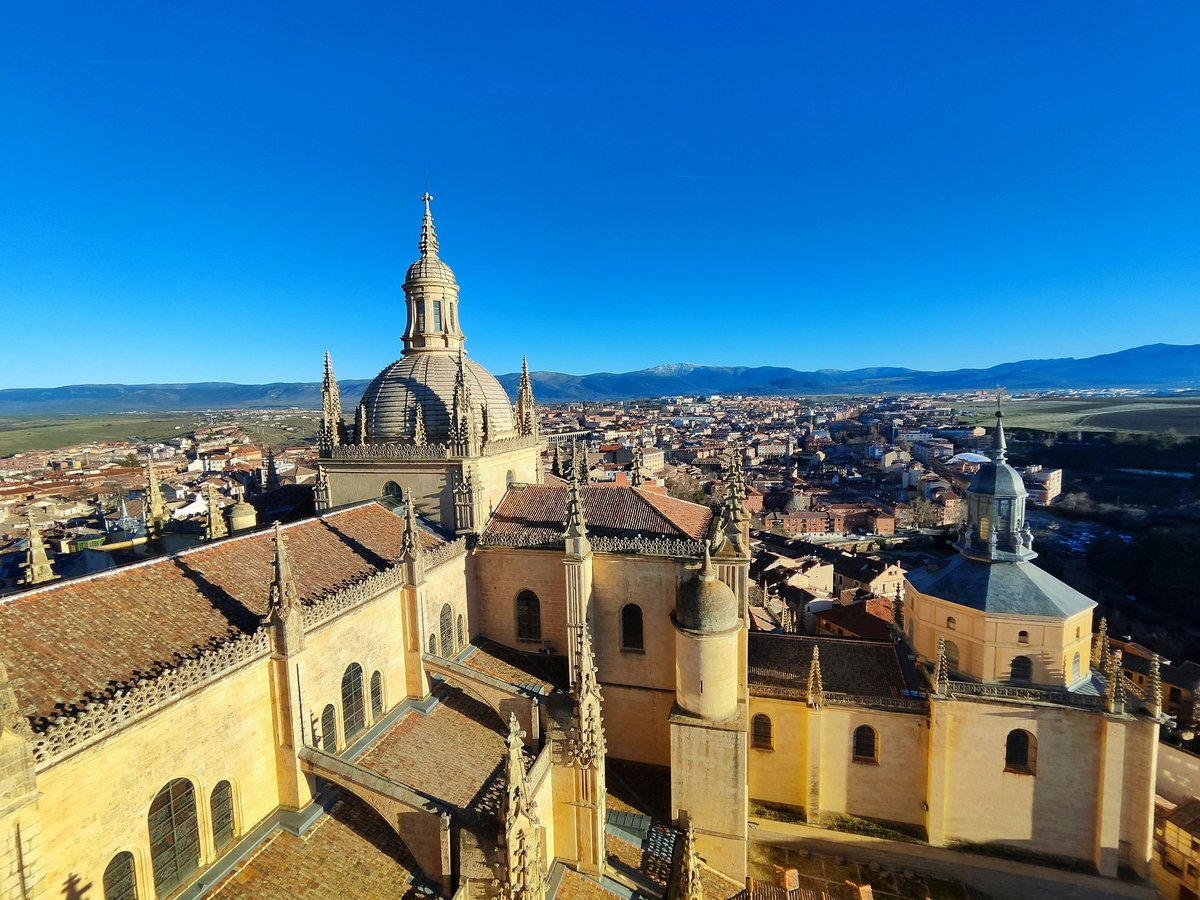
sightseeingThe last Gothic cathedral built in Spain, completed in 1577, sits on the Plaza Mayor. The interior is notably bright for a Gothic structure, with 18 chapels and a 16th-century cloister moved stone by stone from the old cathedral near the Alcázar. The Sala Capitular houses a 17th-century Brussels tapestry collection.
With few visitors, you can spend time in the chapels and cloister without being shuffled along. The low winter light through the stained glass windows creates color patterns on the limestone floors that are less visible in the higher summer sun.Booking tipOpen daily, typically 9:30am to 5:30pm in winter. Entry around 3-4 euros.
Day trip to La Granja de San Ildefonso
day_tripThe Royal Palace of La Granja sits 11km south of Segovia, built by Felipe V starting in 1721 as a Spanish Versailles. The palace has 26 rooms open to visitors, with original Flemish tapestries and ceiling frescoes. The gardens cover 146 hectares, though the famous fountains don't run in January. The town itself is quiet, with a handful of restaurants serving judiones and roast meats.
The palace grounds under frost or light snow feel appropriately regal, and you'll likely share the interior with fewer than a dozen other visitors. The lack of fountain displays is a trade-off, but the gardens have a stark winter beauty.Booking tipBus L-1 runs from Segovia's bus station roughly every hour. The ride takes about 25 minutes.
Explore the Barrio de la Judería
sightseeingSegovia's old Jewish quarter, between the cathedral and the city walls on the south side, retains its narrow medieval street plan. The Centro Didáctico de la Judería on Calle Judería Vieja occupies a 15th-century house and documents the Sephardic community that lived here until the 1492 expulsion. The Puerta de San Andrés, a 13th-century gate in the city walls, marks the quarter's southern boundary.
The narrow lanes are sheltered from the meseta wind, making this one of the more comfortable neighborhoods for a cold-weather walk. In January, you'll have the streets largely to yourself.Warm up in the Museo de Segovia
cultureHoused in a 15th-century slaughterhouse building near the Puerta de Santiago, this provincial museum covers archaeology from Celtic Segovia through the Roman period, with 2 Celtic verracos (stone boar sculptures) at the entrance. The collection includes Roman coins from the Segovia mint, medieval ceramics, and a small fine arts section.
A heated indoor option for the inevitable cold or wet afternoon. Low visitor numbers mean you can examine the archaeological collection at your own pace.Booking tipFree entry for EU citizens. Open Tuesday through Saturday, typically 10am to 2pm and 4pm to 7pm.
What to eat in January
On menus now
Cochinillo asado
Segovia's signature roast suckling pig, cooked in wood-fired clay ovens at around 200°C for 2 to 3 hours. January is peak season for it. The piglets, typically 3 to 4 weeks old, come from farms around Arévalo and Cuéllar. Mesón de Cándido near the Acueducto and José María on Calle Cronista Lecea are the 2 most well-known spots.
Judiones de La Granja
Large, creamy white beans stewed with chorizo, morcilla, and pig ear. The beans come from the fields around La Granja de San Ildefonso, about 11km south of Segovia. This is cold-weather food at its most satisfying, served in deep clay bowls.
Ponche segoviano
A layered cake of sponge, pastry cream, and marzipan, dusted with powdered sugar and caramelized on top. Traditionally from the Alcázar-area pastry shops, with Limón y Menta and El Bernardino among the better-known sources. Not to be confused with the warm drink also called ponche.
Sopa castellana
A garlic soup made with stale bread, pimentón de la Vera, poached egg, and sometimes thin slices of jamón. It costs almost nothing to make and appears on nearly every menú del día in January. The kind of thing that warms you from the inside after 2 hours walking in 3°C weather.
Festival food
Roscón de Reyes
A ring-shaped brioche flavored with orange blossom water, topped with candied fruit, and filled with cream or trufa. Eaten on January 6 for Día de Reyes. Bakeries across Segovia sell them from late December, but the best ones tend to sell out by January 4 or 5.
Regular events in January
Día de Reyes celebrationsFree
January 6 is a public holiday across Spain. In Segovia, families gather for the Roscón de Reyes and gift exchanges. Most shops and some restaurants close for the day. The nativity scenes (belenes) in the churches of San Martín and Corpus Christi remain on display through the first or second week of January.
January 6San Sebastián feast dayFree
January 20 marks the feast of San Sebastián, patron of one of Segovia's historic parishes. A small Mass and neighborhood gathering at the Iglesia de San Sebastián, though this has become more muted in recent decades compared with the bigger saints' days later in the year.
January 20Winter market stalls at Plaza MayorFree
Small-scale artisan vendors occasionally set up around the Plaza Mayor on weekends in early January, selling local cheeses, honey from the Sierra, and handmade ceramics. Not a formal Christmas market, more of a loose continuation of the holiday commercial season that winds down by mid-month.
Early January weekendsBest places this January
Acueducto de Segovia
monumentThe Roman aqueduct, with roughly 167 arches of unmortared granite blocks, is the city's defining landmark. Built in the 1st or 2nd century AD and still standing at its full height of 28.5 meters. Best viewed from the Plaza del Azoguejo at ground level, or from the staircase on Calle San Juan for an elevated perspective.
Plaza del AzoguejoAlcázar de Segovia
castleThe ship-shaped fortress at the western point of the old city, above the Eresma valley. Parts date to the 12th century, though the current appearance is largely a 19th-century reconstruction after an 1862 fire. The Tower of Juan II offers 360-degree views after 152 steps.
Old Town (west end)Catedral de Segovia
religiousLate Gothic cathedral on the Plaza Mayor, completed in 1577. Known as the 'Lady of Cathedrals' for its elegant proportions. The cloister was relocated from the old cathedral site near the Alcázar in the 16th century.
Plaza MayorIglesia de la Vera Cruz
religiousA 13th-century Romanesque church with a 12-sided plan, originally associated with the Knights of the Holy Sepulchre. Sits across the Eresma valley from the Alcázar, about a 15-minute walk downhill. The upper chapel has an unusual two-story central apse.
Zamarramala roadMonasterio de Santa María del Parral
religiousA 15th-century Hieronymite monastery in the Eresma valley below the city walls. The church has an unfinished facade and a series of Gothic-Plateresque altarpieces. Still an active monastery with a small community of monks. Visiting hours are more limited in January, typically mornings only.
Eresma valleyMirador de la Pradera de San Marcos
viewpointA viewpoint on the north side of the Eresma valley that frames the Alcázar with the Sierra de Guadarrama behind it. On a clear January day with snow on the mountains, this is likely the single best photo spot in Segovia.
North bank, EresmaCasa-Museo de Antonio Machado
museumThe boarding house where the poet Antonio Machado lived from 1919 to 1932 while teaching French at the Instituto de Segovia. A small, personal museum at Calle de los Desamparados 5, preserving his modest room and writing desk. Entry costs around 2.50 euros.
Old TownPlaza Mayor
plazaThe social center of the old town, ringed by cafes with covered terraces. The Catedral occupies the northeast side. In January, the outdoor terraces are bundled in plastic windbreaks and heated with gas lamps, and locals still sit outside for their morning coffee if the sun is out.
Old Town
Your packing checklist
Tick items off as you pack. Your progress saves in this browser.
All packed — have a great trip.
Insider tips
The Acueducto is most photogenic between 8:30am and 9:30am in January, when the low sun lights the eastern face and the plaza is empty. By 10:30am, tour buses from Madrid start arriving even in low season.
For cochinillo, the lesser-known Restaurante El Fogón Sefardí on Calle Judería Vieja serves it in a medieval cellar space with fewer tourists than Cándido or José María, and at slightly lower prices.
The walk along the Eresma valley from the Monasterio de Santa María del Parral to the Iglesia de la Vera Cruz is about 2km and relatively sheltered from wind. On a clear January morning, the frost on the riverside path and the Alcázar above you make it one of the most atmospheric walks in the city.
If you're arriving by AVE train, note that Segovia-Guiomar station is about 5km outside the old city. Bus 11 connects the station to the Acueducto in roughly 15 minutes, but it runs infrequently on Sundays. A taxi to the center costs around 7-8 euros.
The menú del día at most old-town restaurants includes 3 courses, bread, a drink, and sometimes coffee for a fixed price. Even in January, arriving after 2:15pm means you might find a full dining room at the popular places on Calle Cronista Lecea.
Avoid these mistakes
- Underestimating the cold. Visitors from Madrid sometimes assume that a 45-minute train ride north won't change the temperature much, but Segovia sits 350 meters higher and the wind chill is significantly worse. Pack for genuine winter.
- Skipping breakfast and walking to the Alcázar first thing. The old town slopes steeply uphill from the Acueducto, and the Alcázar doesn't open until 10am. Better to have a coffee and tostada at a Plaza Mayor cafe, then walk west once the sun has warmed the streets slightly.
- Assuming everything runs on a summer schedule. Some guided tours, smaller museums, and rural restaurants around Pedraza and Turégano close or cut hours between November and March. Check before you drive out.
- Trying to combine Segovia with Ávila in a single day trip from Madrid. Both cities deserve at least half a day each, and the 67km drive between them across the Sierra in January can be slow if there's snow or ice on the CL-601.
Practical tips for January
Book accommodation in the old town (casco antiguo) rather than near Segovia-Guiomar station. The old town is compact and walkable, roughly 1.5km from the Acueducto to the Alcázar, and staying here means you avoid the 5km commute from the train station. January evenings get cold fast after sunset around 6pm, so plan indoor activities, a long restaurant lunch, or an early return to your hotel for the last hours of the day. Most restaurants serve lunch from 1:30pm to 3:30pm and dinner from 8:30pm to 10:30pm. The menú del día is a lunch-only offering and typically the best value. Carry cash for smaller establishments, as some of the traditional bars near San Millán still prefer it. The Segovia tourist office at Plaza del Azoguejo 1, near the base of the Acueducto, can provide a printed map with walking routes and current museum hours.
FAQ
Is January a good time to visit Segovia?
It depends on what you're after. January is the coldest month, with average highs around 7.5°C and nights below freezing. But it's also the cheapest and least crowded month. You'll have the major monuments largely to yourself, and the cochinillo asado season is in full swing. If cold weather doesn't bother you and you're drawn to atmosphere over sunshine, January has a lot to offer. If you want warm outdoor dining and long daylight, wait until May or June.
How do I get to Segovia from Madrid in January?
The AVE high-speed train from Madrid Chamartín to Segovia-Guiomar takes about 28 minutes and runs several times daily. From the station, Bus 11 reaches the Acueducto in roughly 15 minutes, or a taxi costs around 7-8 euros. La Sepulvedana buses run from Madrid's Moncloa station directly to Segovia's bus station near the Acueducto, taking about 75 minutes. Driving takes roughly 90 minutes via the AP-6 and AP-61 toll motorways, though check for snow on the Guadarrama pass after heavy weather.
Does it snow in Segovia in January?
It can, though city-center accumulation is usually light, around 2-5cm when it does settle. The Sierra de Guadarrama to the south typically carries snow cover through January and into February. Roads to nearby towns like La Granja de San Ildefonso may require chains during or after snowfall. The city itself is generally well-cleared, but icy cobblestones in the early morning are a genuine hazard.
What should I eat in Segovia in January?
Cochinillo asado, the whole roast suckling pig, is the signature dish and January is its peak season. Judiones de La Granja, large white beans stewed with chorizo and morcilla, are a cold-weather staple. Sopa castellana, a garlic and bread soup with pimentón and a poached egg, appears on nearly every menú del día. For dessert, try ponche segoviano, a layered sponge and marzipan cake. The menú del día at most restaurants runs 3 courses with bread and a drink for a fixed price.
Are the major attractions open in January?
Yes. The Acueducto is outdoors and always accessible. The Alcázar typically opens daily from 10am to 6pm, and the Catedral keeps similar winter hours. Smaller sites like the Casa-Museo de Antonio Machado and the Monasterio de Santa María del Parral have more limited January schedules, often mornings only or closed on Mondays. The tourist office at Plaza del Azoguejo 1 has current hours for all sites.
Things to Do in Segovia in January
 Free cancellation
 Hot-Air Balloon Ride over Segovia with Optional Transport from Madrid
Outdoor experience: free cancellation.
via Viator Free cancellation
 Hot Air Balloon Flight Over Segovia or Toledo
Outdoor experience: 4 hours, free cancellation.
via Viator Free cancellation
 Hot Air Balloon over Segovia with Optional Transfers from Madrid
Outdoor experience: 4 hours, free cancellation.
via Viator Free cancellation
 Segovia from the Skies: Sunrise Balloon Ride
Outdoor experience: free cancellation.
via Viator Free cancellation
 Segovia Balloons
Outdoor experience: 4 hours, free cancellation.
via Viator Free cancellation
 Balloon flight at sunrise in Segovia
Outdoor experience: 3 hours, free cancellation.
via ViatorFind a flight to Segovia
Live fares to Segovia appear here once cookies are accepted.
Last verified by automated review (v1.7.2) on . What is automated review?