Compare every Spain city in May →
Stay in Segovia in May
23 hotels in the Trip.com pool for Segovia, from US$48 a night.
Opens Trip.com on Fri 7 May to Sun 9 May 2027; change the dates there.
May in Segovia is defined by altitude. The city sits at roughly 1,000 meters (3,280 feet) on the Castilian meseta, which means spring arrives here about 3 weeks later than in Madrid, 90 kilometers to the southeast. Daytime highs reach around 18.6°C (65°F), comfortable for walking the old town's granite streets, but evenings still drop to 7.7°C (46°F). That gap catches visitors off guard. You can eat lunch on a sunny terrace in the Plaza Mayor and need a proper jacket by 9pm.
This is also, most years, the month for Titirimundi, Segovia's international puppet theatre festival, which has drawn performers from over 20 countries since it started in 1985. For about 5 days in mid-May, the Plaza Mayor, the atrium of the Catedral de Segovia, and smaller plazas in the Barrio de la Judería fill with puppet shows, shadow theatre, and marionette performances. Roughly 50,000 visitors attend across the run. Outside Titirimundi week, May in Segovia feels noticeably quieter than July or August.
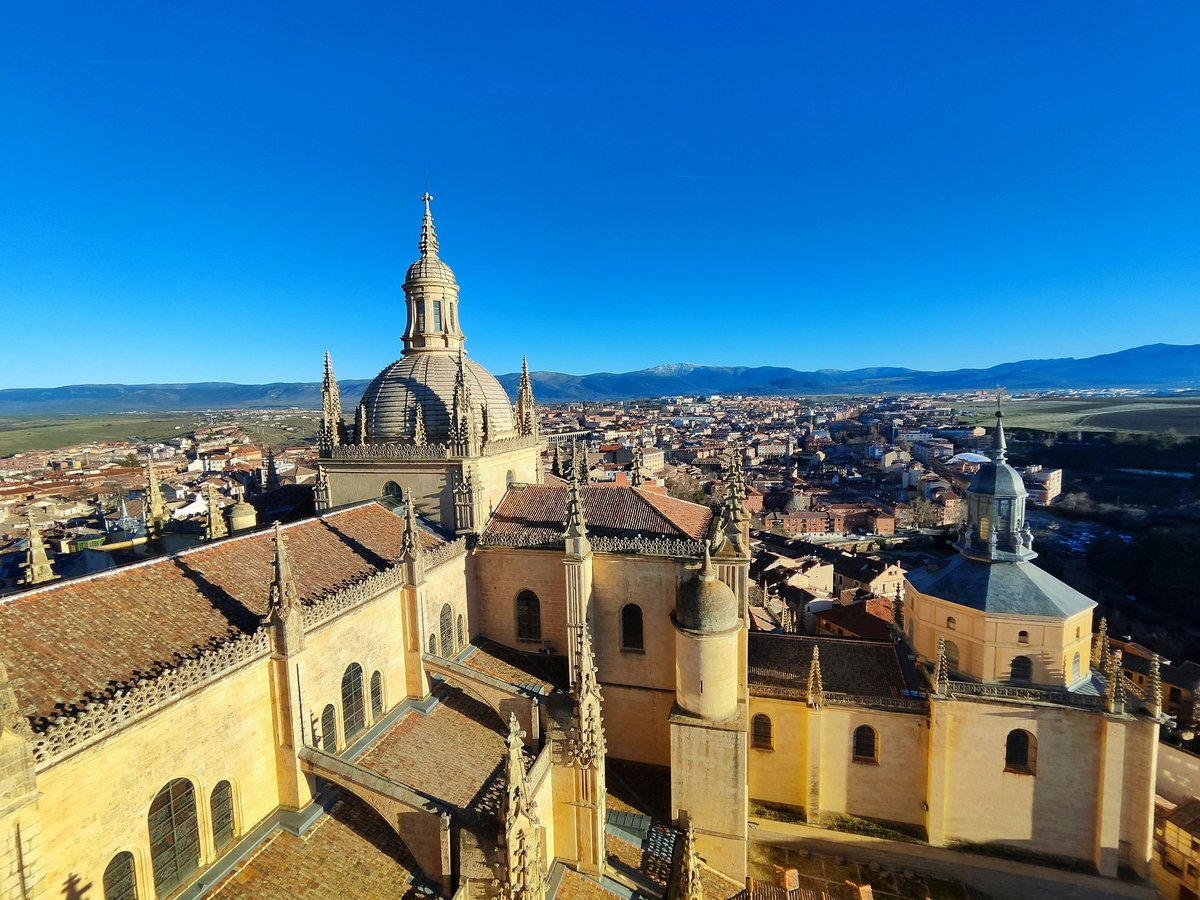
Segovia's old town follows a distinct daily rhythm in May. The Aqueduct's 167 granite arches stand mostly empty before 10am, with the first Madrid tour buses not arriving until around 11. By midday, the Calle de Juan Bravo fills with locals heading toward the Plaza Mayor, and the smell of oak-fired ovens drifts up from the asadores near the Plaza del Azoguejo. Afternoon showers arrive a couple of times per week. They tend to clear the narrow lanes of the Barrio de la Judería for an hour or so, but rarely last long enough to ruin a full walking day. The light turns golden on the Cathedral's limestone around 8pm, and the evening paseo picks up along the Calle Real, though it wraps up earlier than it will in the long June evenings.
Why visit in May
- Temperatures around 18-19°C (64-66°F) are close to ideal for spending full days walking Segovia's hillside streets and climbing the Alcázar's 152 tower steps without overheating.
- Titirimundi, one of Europe's longest-running puppet theatre festivals (since 1985), brings roughly 50,000 visitors and dozens of free outdoor performances across the old town's plazas.
- Hotel rates run 20-30% below July and August peaks, and midweek availability is strong enough that you can book 3-4 days ahead for most properties.
- The Sierra de Guadarrama trails south of the city are clear of snow below 2,000 meters by May, and wildflowers cover the lower meadows around Valsaín and La Granja de San Ildefonso.
- Spring lamb (cordero lechal) is at peak quality in May, and the cochinillo restaurants aren't yet running at summer capacity, so the service tends to be more attentive.
Worth knowing
- Evening temperatures around 7.7°C (46°F) make outdoor dining uncomfortable after sunset without a heavy layer. The terrace culture that defines summer Segovia hasn't fully arrived.
- The 59mm of monthly rainfall across roughly 9 rainy days means you'll hit at least a couple of afternoon showers. They pass, but they can interrupt a walking day in the old town.
- The Fuentes Monumentales at La Granja de San Ildefonso typically don't start their display season until May 30 (San Fernando). Visit before that date and the famous fountains sit dry.
- Some of the smaller Romanesque churches outside the walls keep reduced winter hours through May, closing by 2pm or opening only on weekends.
Best for
Think twice if
May on the Castilian meseta is transitional spring. Mornings start cool, around 7.7°C (46°F), and the sun warms the granite old town to about 18.6°C (65°F) by early afternoon. Humidity sits at a comfortable 62%, lower than the wet months of winter. The 59mm of rain falls across roughly 9 days, typically as afternoon showers that clear within an hour. Wind off the Sierra de Guadarrama can make shaded streets feel cooler than the thermometer suggests, especially in the narrow lanes of the Barrio de la Judería. By late May, highs occasionally touch 22-23°C (72-73°F), hinting at the warmer June ahead.
Seasonal caution
- UV intensity at 1,000 meters elevation is roughly 20% stronger than at sea level, even when temperatures feel cool. Sunburn happens fast on clear May afternoons, especially on the exposed walk between the Alcázar and the Iglesia de la Vera Cruz.
Year-round climate
Averages from the last 5 years.
| Month | Avg high (°C) | Avg low (°C) | Rainfall (mm) |
|---|---|---|---|
| Jan | 8 | 0 | 124 |
| Feb | 10 | 1 | 78 |
| Mar | 11 | 3 | 119 |
| Apr | 15 | 5 | 78 |
| May | 19 | 8 | 59 |
| Jun | 24 | 13 | 52 |
| Jul | 29 | 15 | 3 |
| Aug | 29 | 16 | 5 |
| Sep | 22 | 11 | 34 |
| Oct | 19 | 10 | 100 |
| Nov | 11 | 4 | 130 |
| Dec | 9 | 2 | 87 |
Holidays and festivals in May
Public holidays
- Labour Day(Fiesta del trabajo)1 May 2027
- Day of Madrid(Fiesta de la Comunidad de Madrid)2 May 2027
- Galician Literature Day(Día das Letras Galegas)17 May 2027
- Corpus Christi(Corpus Christi)27 May 2027
- Day of the Canary Islands(Día de Canarias)30 May 2027
- Day of Castilla-La Mancha(Día de la Región Castilla-La Mancha)31 May 2027
Headline events
Titirimundi - Festival Internacional de Teatro de Títeres de Segovia
Mid-May (usually the second or third week, Wednesday through Sunday)
One of Europe's premier puppet and visual theatre festivals, running since 1985. Over 5 days, companies from 20+ countries perform in the Plaza Mayor, inside the Catedral de Segovia, in courtyards across the Barrio de la Judería, and in smaller venues throughout the old town. Roughly half the performances are free and outdoors. Expect marionettes, shadow puppetry, object theatre, and experimental visual performance. The festival draws around 50,000 attendees and transforms the old town's atmosphere completely.
Best things to do in May
Walk the Roman Aqueduct to the Alcázar
sightseeingThe classic Segovia walk starts at the Plaza del Azoguejo, where the Aqueduct's 167 arches reach 28.5 meters at their tallest point. From there, the Calle Real climbs through the old town past the Plaza Mayor to the Alcázar at the western tip of the ridge. The full route covers about 2 kilometers and takes 90 minutes without stops. Along the way, you pass the 12th-century Iglesia de San Martín and the late Gothic Cathedral. The final stretch opens to views of the Eresma valley below.
Temperatures around 18°C make the uphill, sun-exposed walk between the Aqueduct and the Alcázar comfortable. The same route in July at 29°C in direct sun feels punishing.Climb the Torre de Juan II at the Alcázar
sightseeingThe Alcázar's keep offers the highest viewpoint in the city. The climb is 152 narrow stone steps in a tight spiral staircase with no elevator. At the top, the view stretches south to the Sierra de Guadarrama, north across the flat Castilian meseta, and east along the full roofline of the old town. The staircase narrows to about 70 centimeters in places, so passing other climbers takes some patience. You can feel the wind from the Guadarrama picking up as you near the top.
The air is typically clear enough in May for long views toward the Sierra de Guadarrama, about 15 kilometers to the south. Summer haze from the heated meseta often cuts visibility from July onward.Titirimundi puppet festival (mid-May only)
festivalFor 5 days in mid-May, Titirimundi fills the old town's plazas with puppet theatre from over 20 countries. About half the shows are free and outdoors, concentrated in the Plaza Mayor, the Cathedral atrium, and the Barrio de la Judería. Indoor paid performances at the Teatro Juan Bravo and smaller venues tend to sell out within days of the schedule's release. Shadow puppetry, marionettes, object theatre, and experimental visual performance all feature.
The festival runs only in May. It has taken place every year since 1985 and draws roughly 50,000 attendees across its 5-day run.Booking tipCheck the Titirimundi website for the schedule release, usually 3-4 weeks before the festival. Free outdoor shows need no ticket, but arrive 20-30 minutes early for popular plazas like the Plaza Mayor.
Hike the Camino Natural del Eresma
hikingThis riverside trail follows the Eresma from below the Alcázar through a valley of poplar and oak forest. The 12-kilometer route passes the Monasterio de Santa María del Parral, the Convento de los Carmelitas where San Juan de la Cruz is buried, and the 16th-century Casa de la Moneda, Spain's first mechanized royal mint. The path is flat to gently rolling, well-marked, and shaded for most of its length. You'll hear the river the whole way.
The poplars along the Eresma are fully leafed out by May, and the river runs strong from spring snowmelt off the Guadarrama. Wildflowers line the banks through the end of the month.Explore the gardens at La Granja de San Ildefonso
sightseeingThe 18th-century royal palace sits 11 kilometers southeast of Segovia in the foothills of the Sierra de Guadarrama. The formal gardens cover 146 hectares and hold 26 monumental fountains, though the fountains typically remain dry until May 30 at the earliest. Even without the water displays, the gardens are worth the trip. The parterre layouts, the clipped hornbeam allées, and the 40-meter Cascada Nueva staircase are all modeled on Versailles. Inside the palace, the Flemish tapestry collection holds over 100 pieces.
The gardens reach peak green in May. They tend to be nearly empty before the fountain season opens, so you can walk the hornbeam allées with few other visitors.Walk the Romanesque church circuit
cultureSegovia has more Romanesque churches per square kilometer than almost anywhere in Spain. The key stops include San Martín (12th century, with its atrium of paired columns on the Plaza de Medina del Campo), San Millán, San Esteban with its 56-meter bell tower, and the Iglesia de la Vera Cruz, a 13th-century round church attributed to the Knights of the Holy Sepulchre, about 15 minutes on foot outside the walls. Allow 3-4 hours for the full circuit.
Several of the smaller churches extend their opening hours from May onward, so you can see interiors that stay closed or weekend-only through the winter months.What to eat in May
In season: fruit
Fresas de Aranjuez
Strawberries from the Aranjuez valley, about 130 kilometers south of Segovia. The season runs from late April through June, and May tends to be peak flavor. They appear on dessert menus across central Castilla, served with whipped cream, in tartas, or alongside ponche segoviano. Smaller and more intensely flavored than supermarket varieties.
On menus now
Cordero lechal asado
Spring-born suckling lamb roasted in a wood-fired clay oven (horno de leña). May lamb tends to be at its most tender, fed on the fresh spring grasses of the Castilian meseta. The skin crisps to a dark gold while the meat stays soft enough to pull apart. Mesón de Cándido and Casa Duque both serve it as a half or quarter lamb, and you'll smell the oak smoke from the ovens drifting through the streets near the Aqueduct.
Habas con jamón
Broad beans stewed with chunks of cured jamón and a splash of olive oil. The habas peak across the Castilian meseta in April and May, showing up as a starter at restaurants like Casa Duque and the smaller taverns around the Plaza de la Merced. When fresh, they have a sweet, grassy flavor and a tender bite that dried versions can't match. Some kitchens top the dish with a runny poached egg.
In markets
Espárragos trigueros
Wild green asparagus foraged from the scrublands around the Sierra de Guadarrama and the Duero valley. The season peaks in April and May. They show up grilled with coarse salt, scrambled into revueltos with eggs, or served alongside the lamb. Thinner and more bitter than cultivated asparagus, with a slightly woody snap.
Ajetes (young garlic shoots)
Tender green garlic shoots harvested in spring before the bulb forms. They appear in revueltos (scrambled eggs), grilled alongside spring lamb, or sautéed with prawns in the tapas bars around the Plaza Mayor. The flavor is milder and sweeter than mature garlic, with a gentle crunch.
Regular events in May
Noche Europea de los MuseosFree
Free or reduced-price evening openings at Segovia's museums around May 18, part of the EU-wide International Museum Night. The Alcázar, Casa de la Moneda, and Museo de Segovia typically participate with extended hours into the late evening.
Saturday closest to May 18Best places this May
Acueducto de Segovia
landmarkRoman aqueduct from the 1st-2nd century AD. Its 167 arches reach 28.5 meters at the highest point above the Plaza del Azoguejo, built from roughly 20,400 granite blocks with no mortar. The best vantage is from the stone steps on the eastern side of the plaza, where the full double-arched section fills the frame.
Plaza del AzoguejoAlcázar de Segovia
landmarkFortress and royal palace at the western tip of the old town, perched above the confluence of the Eresma and Clamores rivers. The Torre de Juan II climb (152 steps, no elevator) offers the best panoramic view in the city. Entry is around 9 euros, tower access an additional 3 euros.
Old Town (western end)Catedral de Segovia
landmarkThe last major Gothic cathedral built in Spain, constructed between 1525 and 1577. The interior soars to about 33 meters under the main vault. The cloister was moved stone by stone from the original cathedral site near the Alcázar. Entry is around 4 euros.
Plaza MayorIglesia de la Vera Cruz
churchA 13th-century round church with a 12-sided exterior, built by the Knights of the Holy Sepulchre and often mistakenly attributed to the Templars. It sits across the valley from the old town, about 15 minutes on foot from the Alcázar. The two-story inner chapel is unusual in Iberian architecture.
Outside the walls (Zamarramala road)Real Sitio de San Ildefonso (La Granja)
palaceAn 18th-century royal palace and gardens 11 kilometers southeast of Segovia. The 146-hectare gardens hold 26 monumental fountains and formal parterres modeled on Versailles. The palace's Flemish tapestry collection and glass-making museum are less visited but worth the time.
San Ildefonso (11 km from Segovia)Monasterio de Santa María del Parral
monasteryA 15th-century Hieronymite monastery along the Eresma river, below the old town walls. The church interior has an ornate main altarpiece in the Plateresque style. Still an active monastery, so visiting hours tend to be limited to mornings.
Eresma valleyCasa de la Moneda (Royal Mint)
museumSpain's first mechanized mint, built in 1583 by order of Philip II beside the Eresma river. The hydraulic machinery used the river's current to drive the coin presses. Now a museum with the original minting equipment still in place.
Eresma valley
Your packing checklist
Tick items off as you pack. Your progress saves in this browser.
All packed — have a great trip.
Insider tips
The Aqueduct before 9am is a different place. Tour buses from Madrid don't start arriving until 10:30-11am, and the low morning sun hits the eastern face of the arches, turning the granite a warm orange.
For cochinillo on a Saturday, call by Wednesday. Mesón de Cándido and José María both fill their weekend seatings well in advance. Midweek lunch tables at either place rarely need more than a same-day reservation.
The walk from the Alcázar down to the Iglesia de la Vera Cruz and back along the Eresma takes about 90 minutes and gives you the best panoramic view of the old town walls. Most visitors miss it because it means leaving the walled city on foot.
La Granja's gardens are free to enter on Wednesday and Sunday afternoons for EU residents. The palace charges around 9 euros separately.
The Mirador de la Pradera de San Marcos, a 10-minute walk past the Vera Cruz, offers what might be the single best view of the Alcázar and the old town skyline. Worth bringing a camera around sunset.
Avoid these mistakes
- Packing for 'warm Spain.' Segovia sits at 1,000 meters on the meseta, and May evenings around 7-8°C feel nothing like the coast. Bring layers, not shorts and sandals.
- Planning a trip around La Granja's monumental fountains without checking the calendar. The fountain displays rarely start before May 30 (San Fernando) and don't run daily even after that date.
- Spending the entire visit on the Calle Real between the Aqueduct and the Alcázar. The lower town along the Eresma river and the quieter streets of the Barrio de la Judería are worth at least 2-3 hours.
- Leaving Segovia without seeing the Iglesia de la Vera Cruz. It's a 15-minute walk outside the walls and one of the most unusual Romanesque churches in Spain, but most visitors never leave the walled old town.
Practical tips for May
The AVE from Madrid Chamartín to Segovia-Guiomar takes 28 minutes and runs roughly every hour. From Segovia-Guiomar, bus 11 reaches the Aqueduct in about 15 minutes. The La Sepulvedana bus from Madrid's Moncloa interchange takes 75 minutes and drops you directly at the Plaza del Azoguejo, which tends to be more convenient for a day visit. Most old town restaurants close between 4pm and 8:30pm, so plan lunch before 3pm. Book weekend cochinillo tables at Mesón de Cándido or José María at least 3-4 days out. The tourist office on the Plaza del Azoguejo opens at 10am and keeps updated church opening hours, which change seasonally and can be difficult to track down online. If you're visiting La Granja, the bus from Segovia's station takes about 25 minutes and runs 5-6 times per day.
FAQ
Is May a good time to visit Segovia?
May is likely the best shoulder month for Segovia. Temperatures around 18-19°C sit in a comfortable range for the old town's steep, cobblestoned streets, and hotel rates tend to run 20-30% below the July-August peak. The main trade-off is cool evenings around 7-8°C and a handful of afternoon showers across the month. If Titirimundi falls during your dates, the city has a lively festival atmosphere without summer crowd density.
Can I visit Segovia as a day trip from Madrid in May?
Yes, and May is one of the better months for it. The AVE from Madrid Chamartín to Segovia-Guiomar takes 28 minutes. You can see the Aqueduct, Cathedral, and Alcázar in about 5-6 hours. Adding La Granja de San Ildefonso means a full day, and an overnight stay is worth considering if you want to catch the old town after the day-trippers leave. The last return AVE typically departs around 9:30pm.
When does Titirimundi take place in May?
Titirimundi typically runs for 5 days in mid-May, usually the second or third week, from Wednesday through Sunday. The exact dates are announced a few months ahead on the festival's website. About half the performances are free and outdoors in the Plaza Mayor and other old town plazas.
Do I need to book restaurants in advance in May?
For the well-known cochinillo and cordero restaurants like Mesón de Cándido, José María, or Casa Duque, weekend lunch reservations should be made 3-4 days ahead. Midweek tables are easier, often with a same-day call. Smaller tapas bars in the Barrio de la Judería and around the Plaza de la Merced rarely need reservations at all in May.
Things to Do in Segovia in May
 Free cancellation
 Hot-Air Balloon Ride over Segovia with Optional Transport from Madrid
Outdoor experience: free cancellation.
via Viator Free cancellation
 Hot Air Balloon Flight Over Segovia or Toledo
Outdoor experience: 4 hours, free cancellation.
via Viator Free cancellation
 Hot Air Balloon over Segovia with Optional Transfers from Madrid
Outdoor experience: 4 hours, free cancellation.
via Viator Free cancellation
 Segovia from the Skies: Sunrise Balloon Ride
Outdoor experience: free cancellation.
via Viator Free cancellation
 Segovia Balloons
Outdoor experience: 4 hours, free cancellation.
via Viator Free cancellation
 Balloon flight at sunrise in Segovia
Outdoor experience: 3 hours, free cancellation.
via ViatorFind a flight to Segovia
Live fares to Segovia appear here once cookies are accepted.
Last verified by automated review (v1.7.2) on . What is automated review?