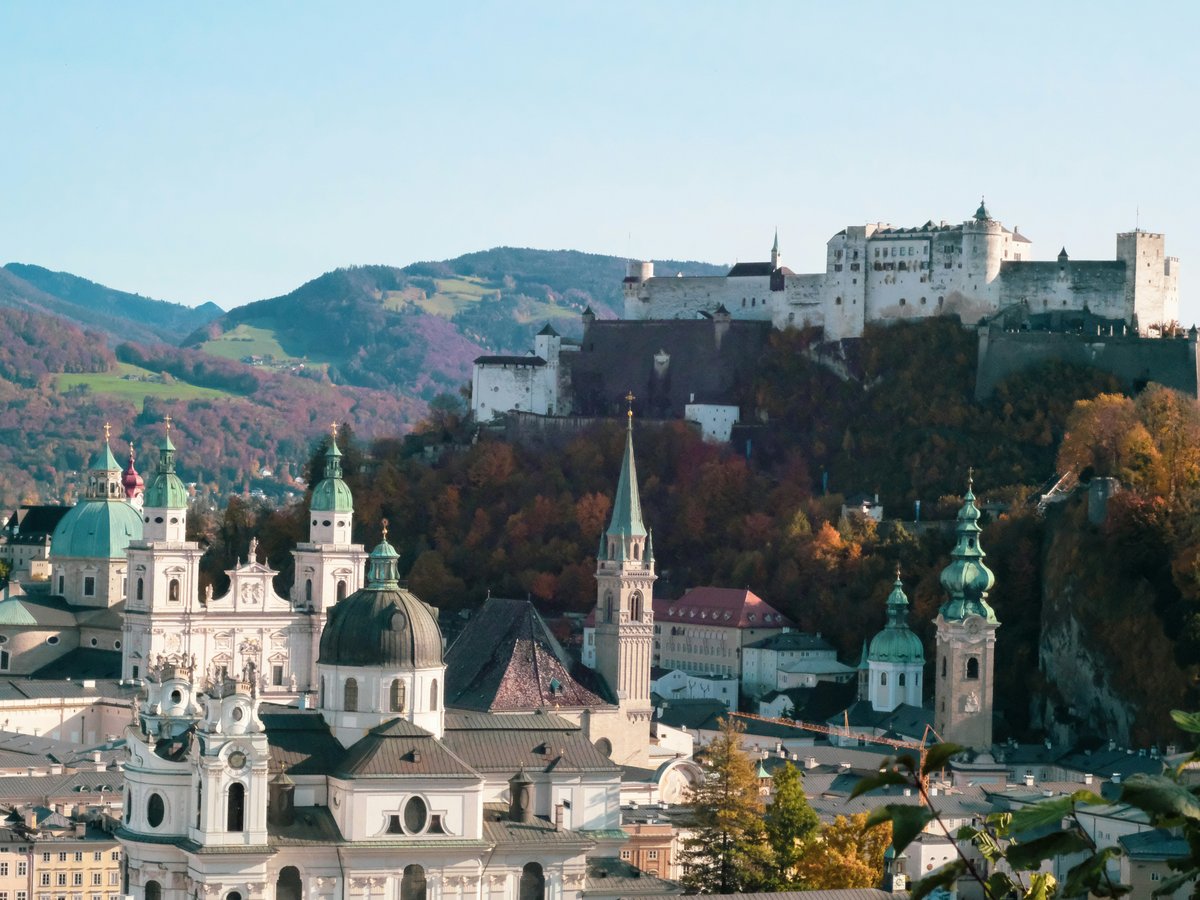
Stay in Salzburg in July
59 hotels in the Trip.com pool for Salzburg, from US$21 a night.
Opens Trip.com on Fri 2 Jul to Sun 4 Jul 2027; change the dates there.
July in Salzburg belongs to the Salzburger Festspiele. The world's most prestigious classical music and performing arts festival opens in the final third of the month, and the city reshapes itself around it. Hotel rates in the Altstadt climb 50-80% above their annual average, and restaurants that typically seat walk-ins start turning people away by 18:00. That is the trade-off, and you should know it before you book.
The weather tends to cooperate, mostly. Daytime highs sit around 24.7°C (76°F), warm enough for long afternoons along the Salzach but rarely oppressive. Mornings can still feel cool at 14.9°C (59°F), particularly if you are hiking the Kapuzinerberg before the crowds arrive. The catch is rain. July averages 166mm across roughly 18 rainy days, which makes it one of Salzburg's wettest months. These are typically Alpine afternoon thunderstorms, not all-day washouts, but they will interrupt an outdoor plan at least a few times during a week-long stay.
If you are coming specifically for the Festspiele, late July is non-negotiable. The opening performance of Jedermann on the Domplatz, with the cathedral facade as its stage, is one of those rare cultural moments that lives up to its reputation. If you are coming for the scenery, the hiking, and Mozart's birth city without a festival ticket in hand, June offers nearly identical temperatures with 60mm less rain and significantly lower prices. That said, even without attending a single performance, the energy the festival brings to the Altstadt, Nonntal, and the Universitätsviertel in late July is worth experiencing at least once.
Why visit in July
- The Salzburger Festspiele opens in late July, drawing world-class sopranos, conductors, and theatre directors to a city of 155,000 people. The ratio of artistic talent to city size is likely unmatched anywhere on earth during this period.
- Daylight stretches past 21:00, giving you 15+ hours to explore the Mönchsberg trails, Mirabellgarten, and the narrow lanes of the Altstadt without feeling rushed.
- Alpine lake swimming is at its best. Fuschlsee and Wolfgangsee, both under 30 minutes from the city center, reach swimmable temperatures of 21-23°C by mid-July.
- Marillen (Austrian apricots) and Eierschwammerl (chanterelle mushrooms) hit the Grünmarkt stalls in July, and seasonal menus across the city follow suit.
- The Salzburg Card covers fortress admission, museum entry, and public transit for 24, 48, or 72 hours, which tends to pay for itself in 2-3 stops during peak-price July.
Worth knowing
- July averages 166mm of rainfall across 18 rainy days. Alpine thunderstorms tend to roll in during the afternoon, often without much warning, and they can turn the Getreidegasse cobblestones slippery within minutes.
- Hotel prices in Altstadt and Nonntal reach their annual peak, particularly after the Festspiele opens in the second half of the month. Budget options below 120 EUR per night are scarce.
- Crowds concentrate heavily in the Old Town. The walk from Mozarts Geburtshaus to the Domplatz, normally 5 minutes, can take 15 in peak afternoon foot traffic.
- The combination of 77% humidity and afternoon rain can make the city feel muggy between storms, particularly in the valley floor around the Rudolfskai and Staatsbrücke.
Best for
Think twice if
July is warm and often humid in the Salzach valley, with temperatures that feel pleasant in the morning and can turn sticky by mid-afternoon. Expect sunshine interrupted by Alpine thunderstorms, which build over the mountains to the south and sweep through the city, sometimes with surprising intensity. The storms rarely last more than an hour, but they drop a lot of water. Mornings tend to be the most reliable window for outdoor plans. Evenings cool down enough to sit comfortably at an outdoor Gastgarten without a jacket, though you might want a light layer after 21:00.
Seasonal caution
- Alpine thunderstorms in July can produce sudden temperature drops of 8-10°C within 30 minutes, along with brief but intense downpours and occasional hail. If you are hiking on the Untersberg or Gaisberg, check the mountain weather forecast (bergfex.at) before setting out and do not ignore darkening skies to the south.
Year-round climate
Averages from the last 5 years.
| Month | Avg high (°C) | Avg low (°C) | Rainfall (mm) |
|---|---|---|---|
| Jan | 6 | -3 | 95 |
| Feb | 9 | 0 | 82 |
| Mar | 12 | 1 | 83 |
| Apr | 14 | 3 | 98 |
| May | 18 | 9 | 165 |
| Jun | 25 | 14 | 104 |
| Jul | 25 | 15 | 166 |
| Aug | 24 | 15 | 171 |
| Sep | 21 | 11 | 146 |
| Oct | 17 | 7 | 89 |
| Nov | 10 | 1 | 113 |
| Dec | 6 | -1 | 100 |
Headline events
Salzburger Festspiele
Late July through late August. The opening ceremony and first Jedermann performance typically fall between July 18-22.
The Salzburger Festspiele is one of the world's foremost performing arts festivals, founded in 1920 by Hugo von Hofmannsthal, Richard Strauss, and Max Reinhardt. Opera, theatre, and orchestral concerts fill the Grosses Festspielhaus, Haus für Mozart, Felsenreitschule, and smaller venues across the city for roughly 6 weeks. The traditional opening is the performance of Jedermann (Everyman) on the Domplatz, staged against the cathedral's baroque facade. Over 200 performances draw around 250,000 attendees each summer. Premium opera tickets can exceed 400 EUR, though standing-room and fringe events are more accessible.
Best things to do in July
Attend the Jedermann opening on the Domplatz
cultureHugo von Hofmannsthal's morality play Jedermann (Everyman) has opened the Salzburger Festspiele on the Domplatz since 1920. The cathedral facade serves as the set, and when the calls of 'Jedermann!' echo from the church towers across Residenzplatz, the effect is unlike any indoor theatre. Even if you do not have tickets, the atmosphere around the Domplatz on opening night is charged with anticipation.
The Jedermann premiere falls in the final 10 days of July, marking the official start of the Festspiele season.Booking tipTickets go on sale in January and premium seats sell out within weeks. Check the Festspiele website for returns and last-minute availability starting 2 days before the performance.
Swim in the Salzkammergut lakes
outdoorFuschlsee, Wolfgangsee, and Mondsee all sit within 30-45 minutes of Salzburg by car or regional bus. By mid-July, water temperatures reach 21-23°C, warm enough for a comfortable swim. Fuschlsee tends to be less crowded than Wolfgangsee, where the St. Wolfgang tourist crowds concentrate. Pack a towel and claim a grassy spot along the shore before 10:00 on weekends.
Lake temperatures peak in July and August. Earlier months are too cold for swimming without a wetsuit.Booking tipPostbus 150 runs to Fuschl am See roughly hourly. No booking needed, but weekend services fill up. Drive if you want flexibility.
Hike the Untersberg via the Untersbergbahn cable car
outdoorThe Untersbergbahn lifts you to 1,776m in about 9 minutes. From the top station, panoramic trails cross the high plateau with views into Bavaria and toward the Hohe Tauern on clear days. The alpine meadows are thick with wildflowers in July, and the temperature at the summit runs 8-12°C cooler than the valley floor.
July is the safest month for high-altitude hiking. Snow has melted from all but the most sheltered north-facing gullies, and the wildflower bloom peaks mid-month.Booking tipThe cable car opens at 08:30. Arrive for the first or second car to avoid the 30-45 minute queue that builds by 10:30 on sunny days.
Walk the Mönchsberg trail from Museum der Moderne to Festung Hohensalzburg
outdoorThe ridgeline trail along the Mönchsberg connects the Museum der Moderne at its northern end to Festung Hohensalzburg at the southern tip, roughly 2km of shaded forest path above the city. The views over the Altstadt rooftops and the Salzach valley open up at several points along the way. In July, the tree canopy provides welcome shade when the valley floor gets warm.
Long July daylight means you can walk the ridge in the golden hours before sunset, around 20:00-21:00, when the light on the fortress and cathedral is at its warmest.Browse the Grünmarkt at Universitätsplatz
foodSalzburg's daily produce market fills the square in front of the Kollegienkirche with stalls selling seasonal fruit, cheese from Pinzgau dairies, bread, flowers, and Bauernspeck (smoked bacon). July brings the Marillen and berry harvest, and you will smell the ripe stone fruit before you see the stalls. The market runs Monday through Saturday, typically 07:00 to 13:00.
The July Marillen and Ribisel harvest makes the market noticeably more colorful and fragrant than at other times of year. Eierschwammerl start appearing at the mushroom stalls in the second half of the month.Booking tipArrive before 09:00 on Saturday mornings for the best selection. By 11:00, popular stalls start packing up.
Evening drinks at the Augustiner Bräustübl
foodThe Augustiner brewery complex in the Mülln quarter has been pouring since 1621. You collect a stone mug, fill it from a barrel, and sit in the chestnut-shaded beer garden, which holds roughly 1,400 people. The food stalls in the ground-floor arcade sell roast pork, cheese, pretzels, and pickled salads. On a warm July evening, the garden fills with a genuine cross-section of Salzburgers, not a tourist-only crowd.
July's long warm evenings make the outdoor beer garden viable until past 21:30. In cooler months, you are pushed into the indoor halls.Booking tipNo reservations. The beer garden operates on a first-come basis. Weekday evenings are less crowded than Friday or Saturday.
Visit the trick fountains at Schloss Hellbrunn
cultureThe 17th-century Wasserspiele at Hellbrunn are table-mounted water jets, hidden sprays in garden seats, and mechanical water-driven theatres built by Archbishop Markus Sittikus, apparently for the sole purpose of soaking his dinner guests. The 40-minute guided tour runs every 30 minutes and you will get wet, which in July is a relief rather than a hardship.
In 24°C heat, the surprise water jets feel playful rather than punishing. The same experience in a 6°C November is significantly less fun.Booking tipLate afternoon tours, around 16:00-17:00, tend to have shorter queues than the midday slots.
Climb to Festung Hohensalzburg without the funicular
cultureThe 15-minute footpath from Festungsgasse up to Europe's largest fully preserved medieval fortress is steep but shaded. Most tourists take the Festungsbahn funicular. Walking up means you arrive at the fortress without queuing for the cable car, and the views over the Altstadt and toward Untersberg improve with every switchback. The fortress interior includes the medieval state rooms, a marionette museum, and a panoramic terrace.
July's warm, long days make the uphill walk comfortable. In winter, the cobbled path can be icy and the fortress closes earlier.What to eat in July
In season: fruit
Marillen
Austrian apricots from the Wachau valley and local orchards reach peak ripeness in July. Smaller and more intensely flavored than supermarket apricots, they appear at the Grünmarkt and in jams, Schnaps, and pastries across the city. A paper bag of fresh Marillen from a market stall costs around 3-5 EUR.
On menus now
Marillenknödel
Apricot dumplings made with fresh Wachau marillen, which hit their peak sweetness in July. The dumplings are rolled in buttered breadcrumbs and dusted with powdered sugar. You will find them on nearly every traditional restaurant menu in the city during this window.
What to drink
Radler
A 50/50 mix of lager and lemon soda, the Radler is Austria's default summer drink. At the Augustiner Bräustübl in Mülln, where the beer comes from stone barrels, a half-liter Radler costs around 4 EUR and pairs well with the salty Brezen from the food stalls in the courtyard.
Ribiselsaft
Fresh currant juice, pressed from red and black Ribisel that ripen in July gardens across the Salzburg region. Some Konditoreien use the tart berries in cakes and Topfenstrudel during the brief 3-4 week harvest window.
Holunderblütensirup
Elderflower syrup, made from blossoms harvested in June, is mixed into sparkling water or white wine as a Hugo cocktail throughout July. The floral, slightly sweet flavor is distinctive. Café Tomaselli on Alter Markt serves it as a spritzer.
In markets
Eierschwammerl
Wild chanterelle mushrooms appear in Austrian forests from July onward. Restaurants in the Mülln and Altstadt quarters serve them sautéed with butter and parsley, folded into Knödel, or scattered over Tafelspitz. The Grünmarkt stalls at Universitätsplatz carry them fresh on market mornings.
Regular events in July
Sommerszene Salzburg
A contemporary performing arts festival presenting dance, theatre, and performance art in venues across the city, often in unexpected outdoor locations. Runs from late June into the first week of July, bridging the gap before the Festspiele opens.
Late June to early JulySalzburg Summer Night Concert (Siemens Fest>Spiele Nachte)Free
Free open-air screenings of past Festspiele opera and concert performances on a large screen in Kapitelplatz, at the foot of Festung Hohensalzburg. The screenings run through July and August and draw locals with picnic blankets and wine.
Throughout July and August, most eveningsMirabellgarten Summer ConcertsFree
Free brass band and chamber music performances in the Mirabellgarten, typically on Sunday mornings. The setting, with the formal gardens and Festung Hohensalzburg as the backdrop, is hard to beat for a free event.
Sundays in July, usually 10:30Hellbrunner Adventmarkt and Summer Night Festival
Schloss Hellbrunn hosts occasional evening open-air events with music and food stalls in the palace grounds during July. Not on the scale of the December Adventmarkt, but the parkland setting after dark has its own appeal.
Selected evenings in JulyBest places this July
Mirabellgarten
parkThe formal baroque gardens behind Schloss Mirabell are at their peak in July, with the rose garden and the Zwergerlgarten (dwarf garden) in full bloom. The view from the garden terrace toward the Festung and the cathedral dome is the most photographed angle in the city. Early morning, before 08:00, you might have the hedgerow paths to yourself.
NeustadtKapuzinerberg
viewpointThe forested hill on the right bank of the Salzach is the Altstadt's quieter counterpart to the Mönchsberg. A 20-minute climb from the Linzergasse end brings you to the Kapuzinerkloster terrace, with wide views over the Old Town rooftops. In July, the canopy is dense and the trail is noticeably cooler than the streets below. Stefan Zweig's former home stands partway up the slope.
KapuzinerbergAugustiner Bräustübl
beer gardenThe brewery's chestnut-shaded beer garden in Mülln is the best outdoor drinking spot in the city during July. The 1,400-seat garden fills up on warm evenings, but there is a second, smaller courtyard that locals tend to prefer. The beer comes in Steinkrüge (stone mugs) from wooden barrels. Cash only at the beer counter.
MüllnStiftskeller St. Peter
restaurantOperating since 803 AD, St. Peter Stiftskeller claims to be the oldest restaurant in Central Europe. The summer terrace, tucked against the rock face of the Mönchsberg, sits in shade for most of the afternoon and serves traditional Salzburger Nockerl, a soufflé-like dessert that collapses within minutes of leaving the oven. July's long evenings make the terrace dining hours worthwhile.
AltstadtMuseum der Moderne Salzburg (Mönchsberg)
museumThe contemporary art museum on the Mönchsberg ridge has a rooftop terrace café, M32, with one of the best elevated views over the Altstadt. On a clear July afternoon, the panorama reaches from the Salzach to the Untersberg. The museum's rotating exhibitions tend to change in summer. Access via the Mönchsberg lift from Anton-Neumayr-Platz or via the walking trail.
AltstadtSchloss Leopoldskron
historic siteThe 18th-century palace on the Leopoldskroner Weiher (a small lake south of the Old Town) was used as a filming location for The Sound of Music. The grounds and lakeside path are open to walkers, and the reflection of the Untersberg in the water on a still July morning is one of those quiet, unhurried Salzburg moments that the Altstadt crowds make hard to find.
LeopoldskronStift Nonnberg
historic siteThe Benedictine convent above Nonntal, founded around 714 AD, is the oldest continuously operating convent north of the Alps. The early-morning walk up from Nonntal through the Nonnbergstiege stairway is steep and quiet. The convent church is open to visitors and the views from the terrace look directly across to the Festung. Worth the climb, particularly before the tour groups start around 10:00.
Nonntal
Your packing checklist
Tick items off as you pack. Your progress saves in this browser.
All packed — have a great trip.
Insider tips
The Festspiele screens past performances for free on a large outdoor screen in Kapitelplatz most evenings in July and August. Locals bring folding chairs and wine. The quality of the broadcast is high, and sitting under the Festung with a Grüner Veltliner while watching a Salzburg Don Giovanni is a better evening than most paid events in other cities.
The Grünmarkt wraps up by 13:00, but if you arrive at 12:30 on a Saturday, vendors sell remaining Marillen and berries at a discount rather than haul them home. A full kilo of ripe apricots for 2-3 EUR is common in late July.
The Mönchsberg lift (elevator) at Anton-Neumayr-Platz costs about 4 EUR return, but if you have a Salzburg Card it is included. More importantly, the walk down from the Museum der Moderne through the Clemens-Holzmeister-Stiege to the Toscaninihof takes about 8 minutes, is downhill, and drops you directly next to the Festspielhaus.
Skip the tourist restaurants on the Getreidegasse for lunch. Walk 10 minutes north into Mülln or south into Nonntal and you will find the same Wiener Schnitzel for 30-40% less. Gasthaus Krimpelstätter in Mülln has been open since 1548 and still charges honest prices.
If you are visiting the Festung Hohensalzburg, walk up instead of taking the Festungsbahn funicular. The queue for the funicular on a July afternoon can be 20-30 minutes. The walking path from Festungsgasse takes 15 minutes and you skip the line entirely.
Avoid these mistakes
- Booking accommodation in late July without realizing the Festspiele has started. The price difference between July 10 and July 25 can be 40-60% for the same room. If you are not attending the festival, schedule your trip for early July and save significantly.
- Planning a full day of outdoor sightseeing without checking the afternoon weather forecast. Alpine thunderstorms move fast and can drop heavy rain for 30-60 minutes. Check bergfex.at or the ZAMG (Austrian weather service) forecast each morning and front-load outdoor plans before 14:00.
- Wearing leather-soled dress shoes to walk the Altstadt after rain. The marble and stone pavements in the Residenzplatz, Alter Markt, and Getreidegasse become genuinely slippery. Every July, tourists slip on the Getreidegasse cobbles. Rubber soles are not optional.
- Assuming you can buy Festspiele tickets on arrival. Major opera premieres and Jedermann performances sell out months in advance. Last-minute tickets do appear on the Festspiele returns desk, but they are unpredictable. If you want a specific performance, book in January or February.
Practical tips for July
Book accommodation by March if your visit overlaps with the Festspiele (roughly July 18 onward). Restaurants in the Altstadt and around the Festspielhaus fill up on performance evenings. Reserve dinner for 17:30 or 21:30 to avoid the pre- and post-show rush. The Salzburg Card (29 EUR for 24 hours, 38 EUR for 48 hours as of recent seasons) covers the Festungsbahn, most museums, the Untersbergbahn, and city buses. It typically pays for itself in 3 stops. Public buses run frequently to Hellbrunn (line 25, about 20 minutes) and to the Untersberg cable car (line 25 to the terminus). Regional trains to the Salzkammergut lakes depart from Salzburg Hauptbahnhof roughly hourly. Shops in the Altstadt close at 18:00 on weekdays and 17:00 on Saturdays. Sundays, nearly everything except restaurants and some bakeries is closed. Tipping in restaurants is typically 5-10%, rounded to a convenient number, and given directly to the server when paying, not left on the table.
FAQ
Is July a good time to visit Salzburg?
July is a strong month for Salzburg, particularly if you are interested in classical music and performing arts. The Salzburger Festspiele opens in the second half of July, making it one of the most culturally significant times to visit. Temperatures average a comfortable 24.7°C (76°F) during the day. The downside is cost and crowds. This is Salzburg's peak season, with hotel rates 50-80% above average and heavy foot traffic in the Altstadt. Rain is also frequent, averaging 166mm across 18 days. If budget or quiet streets matter to you, June offers similar weather with significantly lower prices and fewer visitors.
What is the weather like in Salzburg in July?
July days are warm, with average highs around 24.7°C (76°F) and lows around 14.9°C (59°F). Humidity sits at about 77%, which can make afternoons feel sticky. Rainfall averages 166mm, spread across roughly 18 days, making it one of the city's wettest months. Most precipitation comes as afternoon or evening thunderstorms that last 30-90 minutes rather than all-day rain. Mornings are usually the driest and best for outdoor activities. Bring a rain jacket and waterproof shoes.
Is Salzburg crowded in July?
Yes. July is peak tourist season, and the second half of the month is the busiest period of the entire year once the Festspiele opens. The Getreidegasse, Mozarts Geburtshaus, and the Festung Hohensalzburg funicular all see long queues. Sound of Music tour buses add to the congestion around Schloss Mirabell and Leopoldskron. Early mornings (before 09:00) and the Kapuzinerberg side of the river tend to be quieter. The Mülln and Nonntal neighborhoods, a 10-minute walk from the center, feel noticeably calmer.
How far in advance should I book for the Salzburger Festspiele?
Major performances sell out within weeks of going on sale in January. If you want specific opera premieres, Jedermann tickets, or seats in the Grosses Festspielhaus, booking 5-6 months ahead is realistic. Last-minute returns and cancellations do appear at the Festspiele ticket office in the Hofstallgasse, usually 1-2 days before a performance, but availability is unpredictable. Hotels near the Altstadt should be booked by March at the latest for late July dates.
What should I eat in Salzburg in July?
July brings peak Marillen (apricot) season. Look for Marillenknödel (apricot dumplings) on nearly every traditional menu, and buy fresh Wachau apricots at the Grünmarkt. Eierschwammerl (chanterelle mushrooms) start appearing in the second half of the month, sautéed with butter or folded into Knödel. For a classic Salzburg dessert, try the Salzburger Nockerl at Stiftskeller St. Peter. At the Augustiner Bräustübl, pair a Radler (beer-lemonade mix) with a fresh Brezen from the food stalls. Ribisel (currants) are in season for tarts and juices at local Konditoreien.
Things to Do in Salzburg in July
 Free cancellation
 Hallstatt Half-Day Tour from Salzburg
Day trip: 5.5 hours, free cancellation.
via Viator Free cancellation
 Skip-The-Line Salt-Mines and Bavarian Mountains Tour from Salzburg
Outdoor experience: 4 hours, free cancellation.
via Viator Free cancellation Salzburg Super Saver: Original Sound of Music and Salt Mines Day Trip
Day trip: 9.2 hours, free cancellation.
via Viator Free cancellation
 Public 8h tour to sites of "The Sound of Music Movie" & Hallstatt
Day trip: 8 hours, free cancellation.
via Viator Free cancellation
 Private Full-Day Tour of Hallstatt and Salzkammergut from Salzburg with Options
Day trip: free cancellation.
via Viator Free cancellation
 Private Tandem Paragliding Salzburg Mt Gaisberg
Outdoor experience: free cancellation.
via ViatorFind a flight to Salzburg
Live fares to Salzburg appear here once cookies are accepted.
Last verified by automated review (v1.7.2) on . What is automated review?