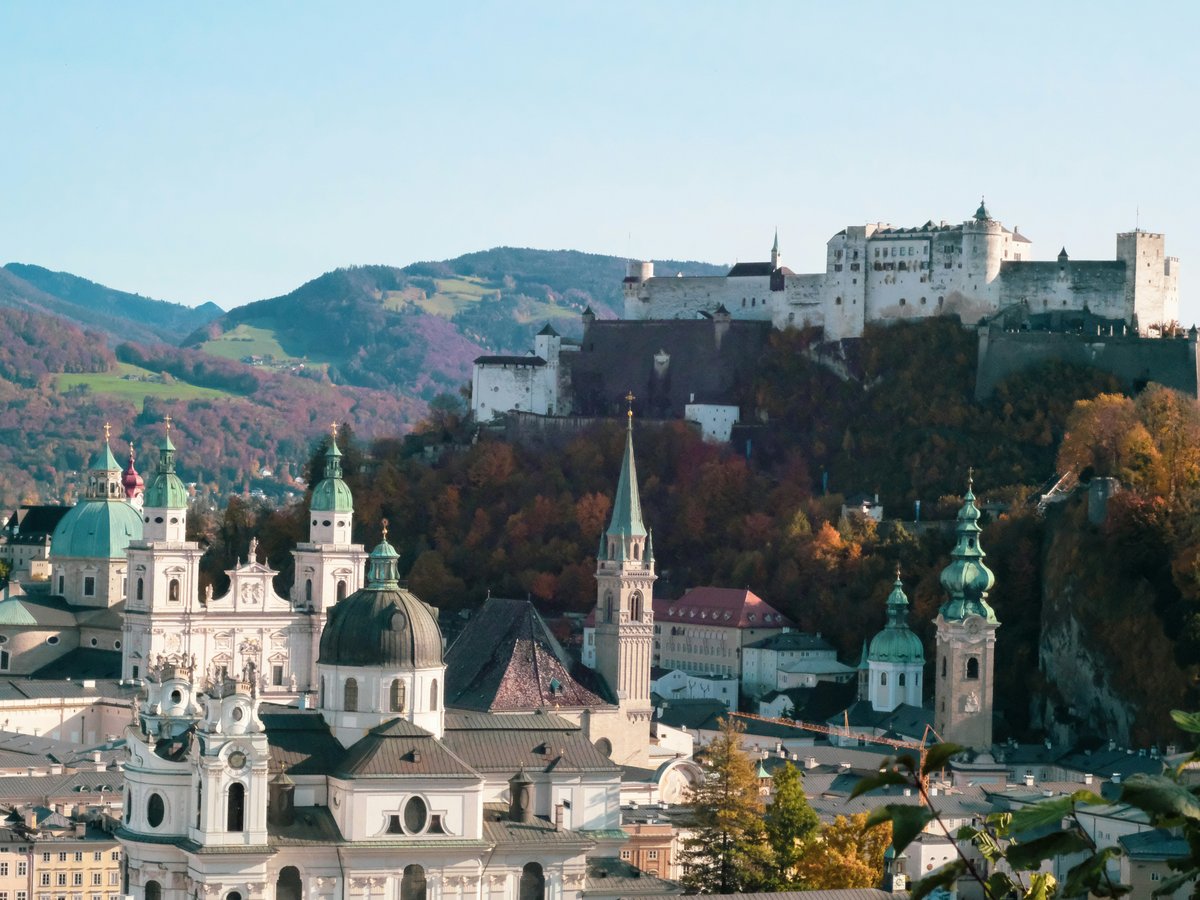
Salzburg sits in a peculiar position among European cities. The Altstadt earned UNESCO World Heritage status in 1996, and you can walk every cobbled meter of it for nothing. The Salzach River splits the city into two halves, each backed by a forested hill you can climb without paying a cent. Kapuzinerberg on the right bank rises about 214 meters above the river, while Mönchsberg on the left stretches nearly 2 kilometers along the Altstadt's southern edge. Both deliver panoramic views that compete with any paid observation deck in Austria. The Salzburger Dom opens its bronze doors daily, no ticket required. Mirabellgarten spreads across roughly 4 hectares of baroque garden geometry that anyone can walk through in any season. The daily Grünmarkt at Universitätsplatz lets you browse local produce and flowers without spending anything. Worth noting, the city's connection to Mozart surfaces at every turn in publicly accessible spaces, from the yellow facade of his Geburtshaus at Getreidegasse 9 to the Pegasus fountain in Mirabellgarten where The Sound of Music was filmed. Salzburg tends to reward the walker and the watcher more generously than the ticket-buyer.
Free attractions
-
Salzburger Dom
The cathedral on Domplatz seats roughly 900 people and first took its current baroque form under architect Santino Solari in 1628. Entry through the main doors is free, with a suggested donation of 2 to 3 euros. The interior smells faintly of incense and old stone. Five organs line the nave, and the baptismal font where Mozart was christened in January 1756 sits near the entrance. Mind you, the Dommuseum upstairs and the broader DomQuartier circuit are separately ticketed.
AltstadtChurch -
Mirabellgarten
These baroque gardens behind Schloss Mirabell are open daily from around 6:00 in the morning until dusk, year-round, completely free. The layout dates to a redesign by Johann Bernhard Fischer von Erlach around 1690. In summer the rose garden along the western wall fills the air with a sweetness you can catch from 20 meters away. The Pegasus fountain and Zwergerlgarten (dwarf garden) on the south side both appeared in The Sound of Music. In winter the paths go quiet and you might have the hedge garden to yourself at 8:00 on a Tuesday morning.
NeustadtPark -
Petersfriedhof
St. Peter's Cemetery sits against the Mönchsberg cliff face and has been in use since at least the 7th century. The wrought-iron crosses and carved headstones date mostly from the 17th and 18th centuries. Entry is free. You'll find family tombs carved directly into the rock wall, some with iron gates and fresh flowers behind them. To be fair, the early Christian catacombs above the cemetery do charge a small fee of about 2 euros, but the cemetery grounds themselves cost nothing.
AltstadtCemetery -
Kapuzinerberg
This forested hill on the right bank of the Salzach rises to about 636 meters above sea level. A marked trail from Linzergasse or Steingasse leads to the top in roughly 20 minutes of steady climbing. The path is steep enough to get your heart rate up, winding through beech and pine forest that keeps the air noticeably cooler even on a 30-degree July afternoon. At the Franziskischlössl near the summit, a terrace gives you an unobstructed view across the Altstadt rooftops to the Festung Hohensalzburg. Free, always open, no ticket.
Rechte AltstadtViewpoint and park -
Stift Nonnberg
The Benedictine convent on the Nonnberg has been operating continuously since around 714 AD, likely the oldest nunnery north of the Alps. Maria von Trapp was a novice here before leaving in 1926, which puts it on the Sound of Music trail. The abbey church is free to enter. Late-Romanesque frescoes in the main apse date to approximately 1150. The nuns still sing vespers in the afternoons, and you can sometimes hear them through the grille. The walk up from Kaigasse takes about 10 minutes on a cobbled path.
NonntalAbbey -
Sebastiansfriedhof
This cemetery on Linzergasse holds some notable graves in a quiet Italian Renaissance cloister layout from the 16th century. Paracelsus, the physician and alchemist, is buried near the central chapel. The tiled mausoleum of Prince-Archbishop Wolf Dietrich von Raitenau sits at the center, a 1603 structure decorated in blue and white Majolica tiles. Free entry. The cemetery feels more intimate than Petersfriedhof, smaller and less visited. Morning light through the arcade arches hits the tiles around 9:00 in summer.
NeustadtCemetery -
Franziskanerkirche
The Franciscan Church on Franziskanergasse has a Romanesque nave from the 1200s that transitions abruptly into a Gothic choir rebuilt after 1408. That shift in height and light is physically striking when you walk from the low, dim nave into the tall, bright apse. Michael Pacher's altarpiece Madonna, carved around 1495, still occupies the central shrine. Free entry, usually open from about 6:30 to 19:30. The cool interior temperature drops noticeably from the street, even in mild weather.
AltstadtChurch -
Kollegienkirche
Johann Bernhard Fischer von Erlach designed this university church, completed around 1707. The white stucco interior is deliberately minimal for the period, relying on the dome's height and the curve of the walls rather than painted ceilings. Free entry. It sits on Universitätsplatz, right beside the daily Grünmarkt, so you'll likely pass it while browsing the market stalls. Sound carries well under the dome. Even footsteps echo.
AltstadtChurch -
Salzburg Museum
Housed in the Neue Residenz on Mozartplatz 1, the Salzburg Museum covers the city's history from Celtic settlement forward. It won the European Museum of the Year Award in 2009. Standard adult admission is currently around 10 euros, but entry is free for visitors under 19 year-round. On October 26, Austrian National Day (Nationalfeiertag), the museum has traditionally opened at no charge. Check their current schedule before visiting, as free-day policies can shift from year to year.
AltstadtMuseum -
Museum der Moderne Salzburg
This contemporary art museum occupies a sharp-edged building on top of Mönchsberg, opened in 2004. The collection focuses on 20th- and 21st-century art. Regular admission runs about 10 euros for adults, but the museum has offered free entry on October 26 (Nationalfeiertag) and occasionally during special open-day events. Visitors under 19 enter free. Even without going inside, the terrace in front of the building provides one of the best free viewpoints in the city, looking north across the Altstadt and the Salzach.
MönchsbergMuseum -
Volksgarten
This public park between the Neustadt and the Salzach sits roughly 10 minutes' walk north of Schloss Mirabell. It has old-growth trees, a small pond, and enough bench space to sit unbothered. Locals use it for picnics and afternoon reading. The park is quieter than Mirabellgarten and less photographed. In autumn the leaf color across the canopy ranges from gold to a deep red-brown. Free, open at all hours.
NeustadtPark -
Schlosspark Hellbrunn
The grounds around Hellbrunn Palace, about 4 kilometers south of the Altstadt, are free to walk through year-round. The Wasserspiele (trick fountains) and palace interior require a ticket of roughly 15 euros, but the surrounding park covers several hectares of open lawn, tree-lined paths, and a small deer enclosure. You can reach it by walking the Hellbrunner Allee, a straight avenue planted in the early 1600s. On warm days the grass fills with families and the shade under the old chestnut trees stays cool well into the afternoon.
HellbrunnPark
Free activities
-
Altstadt walking circuit
A loop through the UNESCO-listed Altstadt covers Residenzplatz with its roughly 15-meter Residenzbrunnen fountain from 1661, Domplatz in front of the cathedral, Kapitelplatz with its view up to the fortress, and the Pferdeschwemme horse trough on Herbert-von-Karajan-Platz, painted with frescoes in 1695. The full circuit takes about 45 minutes without stops. Morning light before 9:00 hits the cathedral facade directly, and the squares tend to be quiet enough that you can hear water from the fountains.
AltstadtWalking -
Grünmarkt at Universitätsplatz
Salzburg's daily open-air produce market runs Monday through Saturday on Universitätsplatz, typically from about 7:00 to 13:00. Vendors sell local cheese, bread, cured meats, flowers, and seasonal fruit. Browsing costs nothing, and the smell of Bauernbrot and alpine cheese hangs in the air between the stalls. Saturday mornings tend to draw the largest crowds. The market has operated in some form at this location since the 1800s.
AltstadtMarket -
Getreidegasse guild sign walk
Getreidegasse, the Altstadt's main commercial street, is lined with wrought-iron guild signs that date back to the medieval trade tradition. Modern shops have continued the practice, so you'll see a McDonald's golden arches rendered in the same iron-scroll style as a 300-year-old bakery sign. The street runs east-west and is roughly 450 meters long. The narrower side passages (Durchhäuser) connecting to parallel streets are worth ducking into. Mozart's Geburtshaus sits at number 9, recognizable by its yellow facade.
AltstadtWalking -
Steingasse medieval lane
Steingasse is a narrow medieval lane on the right bank of the Salzach, running roughly 250 meters from Platzl to the old city gate at Steintor. The passage is so narrow that in places two people can barely walk side by side. Buildings on both sides rise 4 to 5 stories and block most daylight, giving the lane a permanent twilight quality even at midday. Joseph Mohr, who wrote the lyrics to Stille Nacht, was born on Steingasse in 1792.
Rechte AltstadtWalking -
Salzach riverside and Makartsteg
The paved paths along both banks of the Salzach make for a flat, easy walk with views of the Altstadt skyline and Festung Hohensalzburg on its hill. The Makartsteg, a pedestrian bridge near Schloss Mirabell, has been covered in padlocks by couples for years. On clear days you can see the Untersberg massif (1,972 meters) to the south from the bridge. The river itself runs a milky blue-green color from alpine sediment, particularly noticeable in spring when snowmelt is high.
City centerWalking -
Mönchsberg walk and Richterhöhe viewpoint
A walking path runs the length of Mönchsberg from the Mönchsbergaufzug (elevator, paid) near Anton-Neumayr-Platz to Stift Nonnberg, roughly 2 kilometers in total. You can access it for free via stairs from Toscaninihof or from the Nonntal side. The Richterhöhe viewpoint, partway along the ridge, looks directly down onto the Altstadt rooftops and cathedral domes. The path is forested, mostly flat once you're on top, and quiet enough to hear birdsong over the city noise below.
MönchsbergWalking and viewpoint -
Hellbrunner Allee
This straight, tree-lined avenue runs about 2 kilometers from Freisaal to Schloss Hellbrunn. The double row of trees was planted in the early 1600s under Markus Sittikus, making it one of the oldest designed avenues in Europe. It's flat and easy, popular with joggers and cyclists. The overhead canopy blocks most sunlight in summer, creating a green tunnel effect. Vehicles are largely excluded from the route.
Nonntal to HellbrunnWalking
Free events
-
Siemens Fest>Spiel>Nächte
Nightly during the Salzburg Festival, late July through AugustDuring the Salzburger Festspiele (Salzburg Festival), typically running late July through August, filmed recordings of operas and concerts are screened on a large outdoor screen at Kapitelplatz. The screenings start after dark, usually around 20:30 to 21:00, and you can sit on the grass or bring a folding chair. The sound quality is broadcast-grade. No ticket required. The program changes nightly, drawing from the current and recent festival seasons. The atmosphere on a warm August night, with the cathedral lit behind the audience, draws several hundred people to the square most evenings.
Kapitelplatz -
Salzburger Christkindlmarkt
Late November through December 26, dailyThe main Christmas market fills Domplatz and Residenzplatz from late November through December 26, with about 100 wooden stalls selling crafts, ornaments, and seasonal food. Browsing is free. The smell of Glühwein, roasted chestnuts, and Lebkuchen carries across the squares. A smaller market also operates at Schloss Mirabell. The Domplatz market has likely run in some form since 1491, making it one of the oldest Christmas markets in Austria.
Domplatz and Residenzplatz -
Jazz & The City
Late October or early November, annually over 4 to 5 daysThis annual jazz festival spreads across bars, cafes, hotel lobbies, and public squares throughout the Altstadt and Neustadt, typically over 4 to 5 days in late October or early November. Many of the roughly 100 performances across the festival are free. You might catch a trio in a beer hall, a solo pianist in a hotel foyer, or a brass ensemble on Alter Markt. The paid headline concerts happen separately at larger venues.
Various venues across the Altstadt and Neustadt -
Dom organ concerts
Regularly, often Thursdays or Saturdays (check posted schedule at the cathedral entrance)The Salzburger Dom holds organ recitals that are free to attend. The cathedral has 5 organs, including the main instrument above the west entrance. The acoustics under the dome amplify the sound in a way that smaller churches cannot match. Schedules appear on notices posted at the cathedral entrance and on the Salzburger Dom website. Arrive 10 to 15 minutes early to find a seat in the nave.
Salzburger Dom, Domplatz -
Rupertikirtag
Around September 24, annually, for approximately 5 daysSalzburg's traditional folk festival and market takes place around September 24, the feast day of St. Rupert, the city's patron saint. Stalls selling food, crafts, and Salzburger specialties fill the Altstadt squares for about 5 days. Browsing is free. The event has roots going back centuries and tends to feel more local than the tourist-oriented Christmas market. You'll hear Volksmusik from the stages and smell Bratwurst and candied almonds from blocks away.
Altstadt squares, centered on Residenzplatz
Free viewpoints worth the climb
Salzburg's geography gives you free elevation on two sides of the city. On the left bank, the Mönchsberg ridge runs parallel to the Altstadt, and the viewpoint at Richterhöhe (accessible via stairs from Toscaninihof) looks directly down onto the cathedral domes and Residenzplatz. The terrace in front of Museum der Moderne, near the top of Mönchsberg, faces north across the Salzach toward the Neustadt and, on clear days, toward the Bavarian Alps. On the right bank, the Kapuzinerberg's Franziskischlössl terrace at roughly 636 meters gives the widest panorama, taking in the Festung Hohensalzburg, the full Altstadt skyline, and the Untersberg to the south. A less-known spot is the Stefan-Zweig-Weg, a path partway up Kapuzinerberg named for the writer who lived at Kapuzinerberg 5 from 1919 to 1934. From the path you get a framed view of the fortress across the river. All of these are free and accessible during daylight hours. Early morning tends to have the best light and fewest people on any of these trails.
What is not free (to save you a surprise)
Festung Hohensalzburg, the fortress on the hill above the Altstadt, charges roughly 13 to 17 euros for adult admission including the funicular. You can walk up the Festungsgasse path for free, but the fortress interior and ramparts require a ticket. DomQuartier, the connected museum circuit through the Residenz galleries and Dommuseum, runs about 13 euros. Mozart's Geburtshaus at Getreidegasse 9 charges around 14 euros for the interior museum, and his Wohnhaus (later residence) on Makartplatz costs about 12 euros. The Haus der Natur (natural history museum) is approximately 10 euros. At Hellbrunn, the Wasserspiele trick fountains cost roughly 15 euros, though the surrounding park is free. The Salzburg Card, currently priced from about 30 euros for 24 hours, covers most of these paid sites and local transport. If you plan to enter 3 or more paid attractions in a day, the card likely pays for itself. But if you're sticking to the free options listed in this guide, you won't need it.
FAQ
Is the Salzburger Dom free to enter, or is there a hidden fee?
The main cathedral interior is free to enter through the front doors on Domplatz. There is a donation box near the entrance suggesting 2 to 3 euros, but this is voluntary and there is no gate or ticket check. The separately ticketed DomQuartier museum circuit, which includes the Dommuseum and Residenz galleries, is a different entity with its own entrance. The cathedral's nave, baptismal font, and side chapels are all accessible without a ticket during regular opening hours.
Are the Mirabellgarten gardens truly open year-round for free?
Mirabellgarten is a public park, free and open daily. Summer hours typically run from about 6:00 until dusk. In winter the gardens remain accessible, though the flower beds are dormant and the Zwergerlgarten section may have reduced access. The Pegasus fountain, hedge garden, and main baroque staircase are available in all seasons. Schloss Mirabell itself houses government offices and the Marmorsaal (Marble Hall), which is sometimes accessible during business hours.
Which Salzburg museums offer free admission on specific days?
The Salzburg Museum at Mozartplatz 1 admits visitors under 19 free year-round and has traditionally offered free entry on October 26, Austrian National Day (Nationalfeiertag). Museum der Moderne Salzburg on Mönchsberg has a similar under-19 policy and has participated in National Day free admission. Free-day policies can change between years, so check each museum's website before planning around a specific date. Some smaller gallery spaces around the Altstadt also hold occasional free open-door events.
Can I watch Salzburg Festival performances for free?
The Salzburger Festspiele itself requires tickets that often sell out months in advance and start well above 50 euros. However, the Siemens Fest>Spiel>Nächte screenings at Kapitelplatz project filmed opera and concert recordings on a large outdoor screen nightly during the festival period (late July through August). These are completely free and open to anyone who shows up. Bring a blanket or folding chair. On warm evenings, several hundred people typically gather in the square.
Is the walk up to Festung Hohensalzburg free even though the fortress charges admission?
You can walk up the Festungsgasse path from Kapitelplatz to the fortress area for free. The path takes about 15 to 20 minutes on foot and offers views of the Altstadt along the way. However, once you reach the fortress gate, you need a ticket (currently around 13 to 17 euros depending on the option) to enter the fortress interior, museum rooms, and upper ramparts. The exterior approach and the views from the path itself are the free part.
What is the best free thing to do in Salzburg on a rainy day?
The Salzburger Dom is the strongest option for a rainy afternoon. The interior is large enough to spend 30 to 45 minutes in, the acoustics reward simply sitting and listening to the quiet, and there is no entry fee. The Franziskanerkirche on Franziskanergasse provides a similar sheltered experience with its Romanesque-to-Gothic interior. If the rain lets up briefly, the Durchhäuser (covered passageways) connecting Getreidegasse to parallel streets keep you dry while still moving through the Altstadt. On the right bank, the covered arcade of Sebastiansfriedhof on Linzergasse is another option that stays dry.
Last verified by automated review (v1.7.2) on . What is automated review?