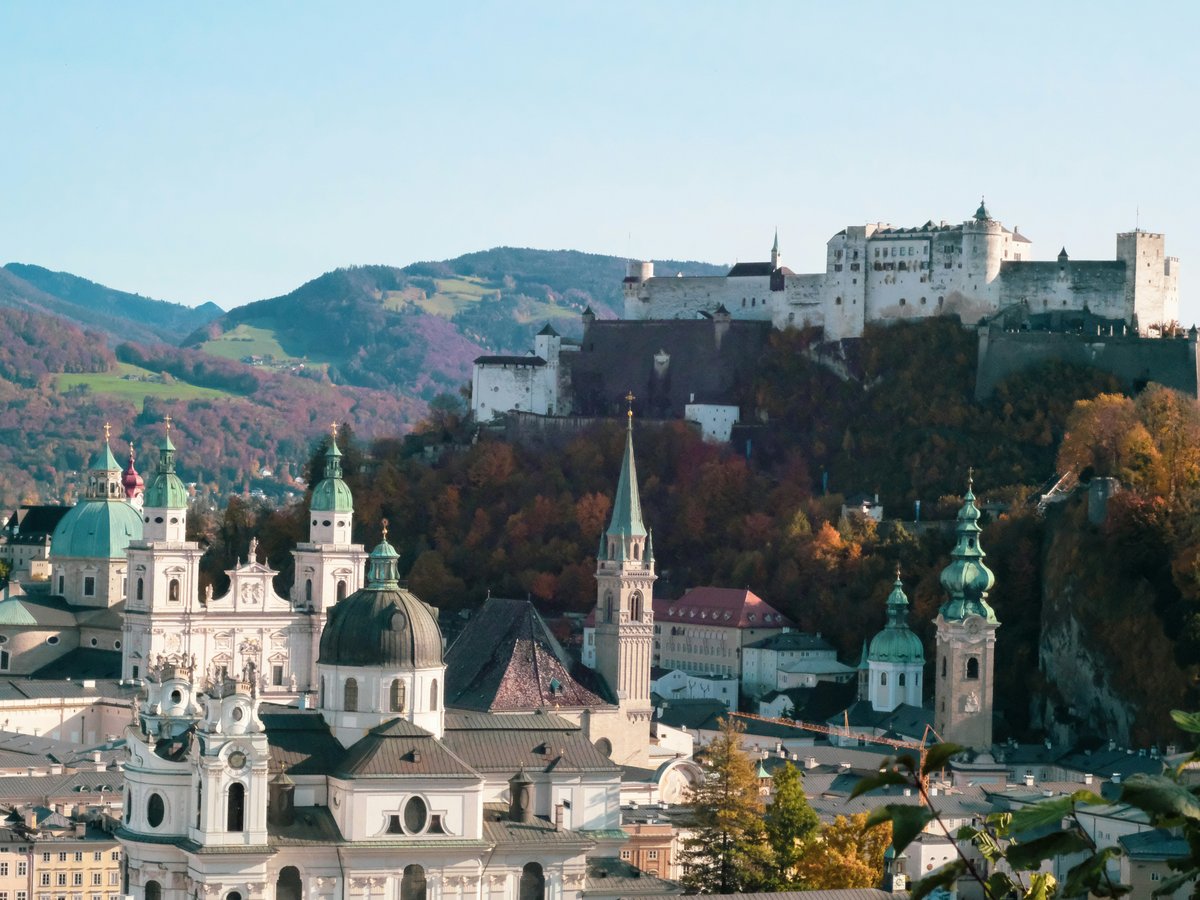
Salzburg splits cleanly down the middle along the Salzach River. The left bank holds the Altstadt, the medieval core pinned between the river and Mönchsberg hill, with Festung Hohensalzburg sitting 120 meters above it all. Cross the Staatsbrücke or the Makartsteg footbridge and you're on the right bank, where Linzer Gasse and the train station neighborhood take on a different, slightly looser feel. South of the fortress, Nonntal and Leopoldskron stretch toward open parkland. Northwest, Mülln climbs a gentle slope above the river and tends to attract locals more than tourists. The whole walkable core covers maybe 3 kilometers end to end, so your choice of neighborhood is less about transit logistics and more about what kind of street you want to wake up on. Most first-time visitors default to the Altstadt, and to be fair, it earns its reputation. But the right bank and Mülln are worth serious consideration, especially if you plan to stay more than 2 nights.
Neighborhoods
-
Altstadt (Left Bank Old Town)
Narrow lanes hemmed in by 4- and 5-story townhouses with pale stucco facades, wrought-iron shop signs, and the constant smell of roasting chestnuts near Universitätsplatz in colder months. The Getreidegasse foot traffic stays thick from about 9 a.m. to 7 p.m. in summer, and the stone underfoot gets slick with rain. It is quieter than you might expect after 8 p.m., when the day-trippers clear out and the Residenzplatz fountains echo off the Dom facade. Mozart's Geburtshaus at Getreidegasse 9 draws roughly 300,000 visitors a year, so the block around it stays congested. The architecture here is mostly Baroque over medieval bones, rebuilt after a series of fires in the 1500s.
- Best for
- First-time visitors, history-focused travelers, anyone wanting to walk everywhere without a bus pass
- Key streets
- Getreidegasse for the iron guild signs and shopping, Universitätsplatz for the daily Grünmarkt (produce market runs until about 1 p.m. on Saturdays), Residenzplatz for the Dom and the Residenz state rooms, Sigmund-Haffner-Gasse for a quieter parallel route
-
Rechte Altstadt (Right Bank, Linzer Gasse area)
The right bank feels like Salzburg at three-quarter speed. Linzer Gasse runs straight from the river toward the Kapuzinerberg hill, lined with smaller hotels, independent bookshops, and bakeries that seem to have been there since the 1970s. The buildings sit a little lower than on the left bank, mostly 3 to 4 stories, with more visible plasterwork in yellows and ochres. You'll hear church bells from the Sebastianskirche and the occasional busker near the Platzl intersection. Steingasse, a side alley running parallel to the river, is probably Salzburg's most underrated street. It is barely 3 meters wide in places, with a couple of wine bars and a small club or two tucked behind heavy wooden doors.
- Best for
- Couples, repeat visitors who already know the Altstadt, travelers who want to be central but sleep on a quieter street
- Key streets
- Linzer Gasse for everyday shopping and cafes, Steingasse for wine bars and late-night atmosphere, Wolf-Dietrich-Strasse for mid-range hotels near the Mirabell side, Dreifaltigkeitsgasse for the Sebastianskirche and its graveyard where Paracelsus is buried
-
Mülln
Mülln sits on a rise northwest of the Altstadt, maybe a 12-minute walk from the Getreidegasse. It still feels like a neighborhood that belongs to the people who live there. The Augustiner Bräustübl, a gravity-fed brewery and beer hall operating since 1621, anchors the area and draws a mix of university students, retired locals, and visitors who have done their homework. The pace here drops noticeably. Laundry hangs from balconies on Müllner Hauptstrasse, and the local Billa supermarket is where you'll see residents doing their daily shop. The Müllner Steg footbridge connects back to the right bank in about 3 minutes on foot.
- Best for
- Budget-conscious travelers, beer lovers, anyone who wants residential quiet within walking distance of the center
- Key streets
- Müllner Hauptstrasse for the local shops and the approach to the Bräustübl, Augustinergasse for the brewery itself, Lindhofstrasse for quieter guesthouses
-
Nonntal
Nonntal spreads south from the base of Festung Hohensalzburg, starting where the Festungsgasse path climbs up toward the fortress. It is residential and steep in places, with a handful of small pensions tucked along Erzabt-Klotz-Strasse and Nonntaler Hauptstrasse. The Stift Nonnberg convent, the oldest continuously inhabited nunnery north of the Alps (founded around 714 AD), sits above the neighborhood and its bells ring on a different schedule than the Dom's. The streets are quieter than the Altstadt by a wide margin, and at night the only real sound tends to be footsteps on the steep lanes. Architecture runs to solid, unshowy residential blocks mixed with older farmhouse-style buildings.
- Best for
- Walkers and hikers heading up Festungsberg or out to the Salzburg Open-Air Museum, families who want space and quiet
- Key streets
- Nonntaler Hauptstrasse for the main artery south, Erzabt-Klotz-Strasse for the climb toward the fortress, Erhardplatz where the neighborhood feels most like a small village
-
Leopoldskron-Moos
South of the Altstadt by about 2.5 kilometers, Leopoldskron sits around the lake of the same name and the Schloss Leopoldskron, the 1736 palace that served as a filming location for The Sound of Music. The neighborhood is flat, green, and spacious, with single-family houses, bike paths along the Leopoldskroner Weiher, and a distinctly suburban calm. You can hear ducks on the water and the occasional creak of a rowboat. Mind you, it is a bus ride or a 25-minute walk into the Altstadt, so you trade convenience for the space and the views across the water toward the Untersberg massif. A few guesthouses and a small number of Airbnbs cluster near the lake's northern shore.
- Best for
- Families with children, Sound of Music devotees, cyclists, anyone who values lakeside calm over walkable nightlife
- Key streets
- Leopoldskronstrasse for the approach to the palace, Moosstrasse running along the southern edge, the lakeside path around the Weiher itself
-
Elisabeth-Vorstadt (Bahnhofsviertel)
The train station quarter runs along Rainerstrasse and Südtiroler Platz, connecting Salzburg Hauptbahnhof to the Altstadt in about a 15-minute walk. It is the most international-feeling part of Salzburg, with a density of kebab shops, Asian restaurants, and budget hotels that you won't find elsewhere in the city. The buildings are mostly late 19th- and early 20th-century apartment blocks, 5 stories, functional rather than pretty. That said, Hotel & Villa Auersperg on Auerspergstrasse sits in a converted 1890s villa with a garden, which shows the range here. Noise picks up near the station and along Rainerstrasse due to tram construction that has been ongoing since 2024.
- Best for
- Budget travelers, anyone arriving late by train, visitors heading to Berchtesgaden or the Salzkammergut by rail
- Key streets
- Rainerstrasse as the main corridor from station to old town, Südtiroler Platz for the station hub and tram connections, Auerspergstrasse for a slightly quieter parallel option, Bayerhamerstrasse for cheap eats
-
Parsch and Aigen
These two neighborhoods lie east of the Kapuzinerberg, spreading up into the foothills. Parsch is the closer of the two, reachable in about 20 minutes on foot from Linzer Gasse or by the number 7 bus. Aigen sits further south and is leafier, with large gardens, older villas from the 1900s, and the Aigner Park stretching toward the Gaisberg trailhead. The pace here is distinctly residential. You might see someone tending roses at 7 a.m. or walking a dachshund along Aignerstrasse. Worth noting, the Gaisberg summit road (1,288 meters) starts from Aigen, and the panorama from the top covers the entire Salzburg basin and into Bavaria.
- Best for
- Hikers and nature-oriented travelers, anyone with a car who prefers a quiet base outside the center
- Key streets
- Aignerstrasse heading south into the foothills, Gaisbergstrasse for the mountain road, Parscherstrasse for local life
FAQ
What is the best neighborhood in Salzburg for a first-time visitor?
The Altstadt on the left bank puts you within a 5-minute walk of the Dom, Residenzplatz, Getreidegasse, and the Festungsbahn funicular. Hotels here tend to run 150 to 300 euros per night for a double in summer, which is steep, but you save on transport and gain the atmosphere of waking up inside the medieval core. If that budget feels uncomfortable, the right bank around Linzer Gasse offers similar proximity at slightly lower rates, typically 100 to 200 euros.
Is it practical to stay outside the Altstadt without a car?
Salzburg's bus network covers most neighborhoods every 10 to 15 minutes during the day, and the Salzburg Card (currently around 30 euros for 24 hours) includes unlimited bus travel plus fortress admission and museum entries. Mülln, Nonntal, and Elisabeth-Vorstadt are all walkable to the center in 12 to 20 minutes. Leopoldskron and Aigen are more comfortable with a bus or bike. The city's public bike-share system has stations in most neighborhoods, with rides under 30 minutes currently free.
Which neighborhoods have the best food scene?
The Altstadt has density, with the Grünmarkt on Universitätsplatz anchoring the daytime options and restaurants lining Judengasse and Kaigasse. The right bank's Steingasse has a handful of wine bars and small restaurants that feel more personal. Mülln has the Augustiner Bräustübl for beer and self-catered meals, and the area around Müllner Hauptstrasse has a few low-key restaurants where schnitzel runs 12 to 16 euros. For something off the radar, try Gasthof Schloss Aigen in the Aigen neighborhood for traditional Salzburg cooking in a setting that still feels genuinely local.
How does Salzburg Festival season affect neighborhood choice?
The Salzburg Festival runs from roughly mid-July through August, and hotel rates across the Altstadt and right bank can double or triple during this period. A room that costs 120 euros in May might reach 300 euros in late July. Mülln and Leopoldskron tend to see smaller price increases. The festival venues cluster in the Altstadt, mainly around the Grosses Festspielhaus on Hofstallgasse and the Felsenreitschule, so staying nearby saves you a post-performance walk in evening clothes, but the city is compact enough that a 20-minute walk or short bus ride from any central neighborhood works.
Where should families with young children stay in Salzburg?
Leopoldskron-Moos offers flat terrain, the lake for swimming, and a pace that suits small children better than the crowded Getreidegasse. Nonntal is another good option, with access to the fortress walk and more space than the Altstadt. Both are quieter after dark. If you want to be fully central, the right bank around Wolf-Dietrich-Strasse has a few family-run hotels with larger rooms, and Mirabell Gardens is a 3-minute walk for a playground and open green space.
Last verified by automated review (v1.7.2) on . What is automated review?