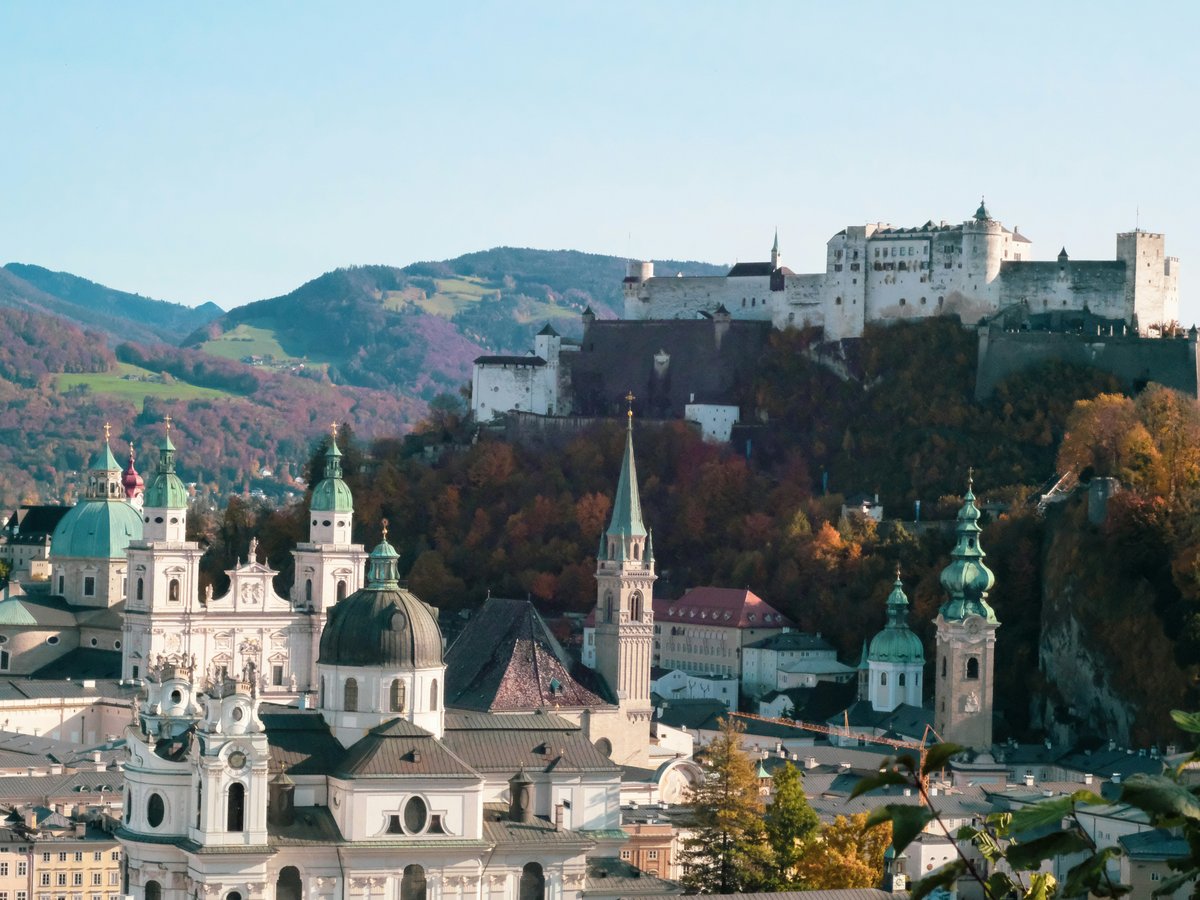
Salzburg sits in a valley where the Northern Limestone Alps meet the Salzburg Basin, with the Salzach River cutting through the middle of town. The Mönchsberg and Kapuzinerberg rise right from the old city center, so you're never more than a 10-minute walk from a proper hill trail. To the south, the Berchtesgaden Alps and the Salzkammergut lake district start within 20 km. The climate tends toward cool and wet, with around 1,220 mm of rain per year and reliable snow from December through March at higher elevations. Summer highs hover around 24°C in July, which makes for comfortable walking weather, though afternoon thunderstorms roll through the mountains frequently from June to August. The city's population of roughly 155,000 seems to double with visitors in high summer, but the trail network absorbs crowds well once you get above the valley floor.
Outdoor activities
-
Via Ferrata on the Untersberg
The Untersberg (1,853 m) sits about 11 km south of the city center, reachable by the Untersbergbahn cable car from St. Leonhard. A via ferrata route rated B/C runs along exposed limestone ridges near the summit plateau. You'll feel the wind pick up sharply once you clear the treeline, and the rock tends to stay cold even in July. Rental harness kits are available at sport shops in town like Sport Moser on Schallmooser Hauptstraße. The cable car runs from late March through early November, weather permitting.
- Difficulty
- B/C (intermediate, prior via ferrata experience recommended)
- Duration
- 3-4 hours from the upper cable car station
- Best season
- June to September
-
Road Cycling Along the Salzach
The Tauernradweg follows the Salzach River valley south from Salzburg toward Hallein and Golling, covering about 35 km one way on mostly paved, flat cycling paths. The route runs parallel to the river and passes through small farming villages where you can smell fresh-cut hay in late June. Rental bikes are available from Velo Active near the Hauptbahnhof for around €25 per day. The path is well-signed and suitable for standard road or hybrid bikes. Wind typically blows from the south in the afternoon, so riding south in the morning tends to be more pleasant.
- Difficulty
- Easy to moderate
- Duration
- 3-5 hours round trip to Hallein
- Best season
- April to October
-
Mountain Biking on the Gaisberg
The Gaisberg (1,288 m) rises on the east side of the city and has several forest roads and single-track trails open to mountain bikers. The climb from the Aigen neighborhood gains about 900 m of elevation over roughly 10 km, mostly on gravel forest roads. The descent can get slippery after rain because the soil is heavy clay in parts. You'll share the lower sections with walkers, so keep speeds reasonable. A Radler at the Gaisbergspitz restaurant at the top costs about €4.50.
- Difficulty
- Moderate to challenging (significant elevation gain)
- Duration
- 2-3 hours round trip
- Best season
- May to October
-
Paragliding from the Gaisberg
Several operators run tandem paragliding flights from the Gaisberg summit, with landing zones in the Salzach valley below. Flights typically last 15-25 minutes depending on thermals. The view takes in the Hohensalzburg Fortress below and the Berchtesgaden Alps to the south. Summer mornings before 10:00 tend to have the calmest conditions for first-timers. Tandem flights currently cost around €130-160 per person. Salzburg Paragliding and FlyTandem are two of the operators working the site.
- Difficulty
- No experience needed (tandem with licensed pilot)
- Duration
- 15-25 minutes airtime, plus 1 hour for briefing and transport
- Best season
- May to September
-
Rock Climbing at Plombergstein
Plombergstein sits above the eastern shore of the Wolfgangsee, about 40 km east of Salzburg. The crag offers roughly 50 sport routes on solid limestone, ranging from 4a to 7b+ (French grading). The rock faces west, so it catches afternoon sun and dries quickly after rain. The approach from the parking area near St. Gilgen takes about 20 minutes uphill. Worth noting, the routes in the 5a-5c range tend to be the best maintained.
- Difficulty
- Routes from 4a to 7b+ (beginner to advanced)
- Duration
- Half-day to full day
- Best season
- April to October
-
Cross-Country Skiing in Rif
The Loipe Rif, about 12 km south of the city near Hallein, maintains roughly 15 km of groomed classic and skating tracks when snow cover allows. The terrain is gently rolling along the Salzach floodplain. Trail fees are modest, around €5 per day. The snow situation at valley elevation (450 m) can be unreliable, so checking conditions on the Salzburger Land website before driving out saves a wasted trip. When it works, you'll hear nothing but the hiss of skis on packed snow.
- Difficulty
- Easy to moderate
- Duration
- 1-3 hours
- Best season
- December to February (snow-dependent)
Day hikes
-
Untersberg Summit via the Dopplersteig
This steep trail climbs from St. Leonhard to the Untersberg summit plateau at 1,853 m. The route gains roughly 1,300 m of elevation over about 6 km. The lower sections pass through dense spruce forest, and the upper portion crosses exposed limestone with some scrambling sections that require good footwear and dry conditions. Snow can linger on the north-facing sections into June. The Zeppezauerhaus mountain hut near the top serves Kaiserschmarrn and beer. On clear days, the summit views reach north to the Bavarian lowlands and south toward the Hohe Tauern.
- Difficulty
- Strenuous (1,300 m elevation gain, some scrambling)
- Duration
- 5-7 hours round trip
- Best season
- Late June to October
-
Nockstein from Koppl
A moderate half-day hike that starts from the village of Koppl, about 10 km east of Salzburg by bus (line 152). The Nockstein summit sits at 1,042 m and gives surprisingly open views of the Salzburg basin and the northern Alps. The trail passes through mixed forest and alpine meadows. Total elevation gain is around 500 m. The route is well-marked and doesn't require any technical ability. You might catch the smell of wild thyme on the upper meadows in July.
- Difficulty
- Moderate (500 m elevation gain, well-marked trail)
- Duration
- 3-4 hours round trip
- Best season
- May to October
-
Gaisberg via the Gaisbergweg
The Gaisbergweg climbs from the Aigen neighborhood in southeastern Salzburg to the 1,288 m summit. The route follows a mix of forest trails and gravel roads, gaining about 900 m over roughly 9 km. It's a steady climb without technical sections. The summit has a restaurant and a bus stop (line 151 runs in summer), so you can hike up and bus down if your legs are finished. The forest canopy keeps the lower two-thirds shaded, which matters on hot August afternoons.
- Difficulty
- Moderate (900 m elevation gain, no technical sections)
- Duration
- 4-5 hours round trip (or 2.5 hours up, bus down)
- Best season
- April to November
-
Barmsteine near Hallein
Two striking limestone towers rising to 851 m above the town of Hallein, about 15 km south of Salzburg. The trail from the Gasthof Barmstein involves some steep sections and light scrambling near the summit rocks. Elevation gain is roughly 400 m. The rock itself is sharp and grippy when dry, but gets treacherous when wet. Mind you, the short summit ridge between the two towers is exposed and not suitable for anyone uncomfortable with heights. The Salzach valley view from the top rewards the effort.
- Difficulty
- Moderate to strenuous (scrambling, exposure near summit)
- Duration
- 2.5-3.5 hours round trip
- Best season
- May to October
-
Filbling from Fuschl am See
The Filbling (1,307 m) rises above the north shore of the Fuschlsee, about 25 km east of Salzburg. The trail from Fuschl village climbs through forest and meadow, gaining about 800 m. It's quieter than the Gaisberg or Untersberg, and the descent path brings you close to the lakeshore where you can swim at the public Strandbad Fuschl. The upper sections cross open alpine meadow with good wildflower displays in June and early July.
- Difficulty
- Moderate (800 m elevation gain)
- Duration
- 4-5 hours round trip
- Best season
- June to October
Water activities
-
Swimming in the Fuschlsee
The Fuschlsee lies about 25 km east of Salzburg, reachable by Postbus in roughly 40 minutes. The lake water is clean enough for drinking water classification and reaches around 22-23°C in July and August. The public Strandbad on the west shore charges about €7 entry and has a grass sunbathing area, a wooden dock, and a small kiosk. The water has that cold-lake clarity where you can see the bottom at 3-4 meters depth. Less crowded on weekday mornings. That said, it can fill up fast on hot weekends when half of Salzburg has the same idea.
- Difficulty
- Easy (swimming ability required, no lifeguard at all spots)
- Duration
- Half-day trip
- Best season
- June to August
-
Swimming in the Salzach River
The Salzach flows right through the city, and locals swim at several spots during summer. The Leopoldskroner Weiher (the pond near Leopoldskron Palace) is a popular and calmer alternative for swimmers who find the river's current too strong. Water temperatures in the Salzach reach about 18-20°C in high summer. The current can be deceptively strong, particularly after rainfall in the mountains when the water turns a milky grey-green. Exercise real caution and stick to known swimming spots where locals gather.
- Difficulty
- Moderate (river current, cold water)
- Duration
- 1-2 hours
- Best season
- July to August
-
Kayaking on the Salzach
The Salzach through the city and downstream toward the German border offers flat-water touring suitable for recreational kayakers. Upstream sections toward Golling have Class II-III rapids for more experienced paddlers. Rental kayaks and stand-up paddleboards are available from operators near the Salzach banks during summer months. The flat section from Hallein to Salzburg covers about 15 km and takes around 3 hours at a relaxed pace. You'll pass limestone bluffs, gravel banks, and the occasional heron standing motionless in the shallows.
- Difficulty
- Easy (city section) to intermediate (upstream rapids)
- Duration
- 2-4 hours depending on section
- Best season
- May to September
-
Swimming at the Wolfgangsee
The Wolfgangsee is the largest of the nearby Salzkammergut lakes accessible from Salzburg, about 40 km east by car or Postbus. St. Gilgen on the western shore has a public beach (Strandbad St. Gilgen, entry around €6) with warmer shallow areas and a diving platform. Water temperatures reach about 23°C in August. The bus ride takes roughly 50 minutes from Salzburg Hauptbahnhof. The lake bottom is pebbly near shore, shifting to sand further out.
- Difficulty
- Easy
- Duration
- Half-day to full day
- Best season
- June to September
-
Stand-Up Paddleboarding on the Wallersee
The Wallersee sits about 18 km north of the city, closer than the Salzkammergut lakes and often less crowded. It's shallow (maximum depth around 23 m), which means it warms up faster, reaching about 24°C by mid-July. The Strandbad Seekirchen on the south shore rents SUP boards by the hour for around €15. Wind tends to pick up after 14:00 on summer afternoons, so morning sessions are calmer. The soft lake bed means the water near shore can get murky when it's busy.
- Difficulty
- Easy (calm, shallow lake)
- Duration
- 1-3 hours
- Best season
- June to September
Parks & gardens
-
Mirabellgarten
FreeThe formal baroque garden sits on the north bank of the Salzach, next to Schloss Mirabell. It was laid out around 1690 under Archbishop Johann Ernst von Thun. The geometric hedge patterns and seasonal flower beds are maintained with visible precision. The Zwergerlgarten (dwarf garden) at the south end has 28 marble dwarf statues from the early 1700s, which are stranger and funnier than they sound. Free entry at all hours.
Highlights: Baroque rose garden with over 4,000 rose bushes, the marble Pegasus fountain, and views of the Hohensalzburg from the main axis
-
Kapuzinerberg
FreeThis wooded hill rises 214 m above the right bank of the Salzach, directly across from the Altstadt. A network of steep footpaths winds through beech and pine forest to the Capuchin monastery at the top. Stefan Zweig lived on the Kapuzinerberg in the 1920s and 1930s, and his former house is still there on the Kapuzinerberg 5. The climb takes about 20 minutes from Linzergasse and the air smells of damp earth and pine resin in the shade of the canopy.
Highlights: Hettwer Bastion viewpoint over the old city, Stefan Zweig's former residence, old fortress walls from the 1620s
-
Mönchsberg
FreeThe Mönchsberg is the long limestone ridge running through the west side of the old city, topped by the Hohensalzburg Fortress at its southern end. A walking path runs the full 2 km length of the ridge through mixed forest, passing the Museum der Moderne and several viewpoints. You can reach it by the Mönchsberg Lift (elevator) from Anton-Neumayr-Platz for €4.20 round trip, or by the footpath from Müllner Bräu. On summer evenings the stone retaining walls hold warmth and radiate it back.
Highlights: Panoramic terrace behind the Museum der Moderne, the Richterhöhe viewpoint, the old city wall sections
-
Hellbrunn Park
FreeThe grounds around Schloss Hellbrunn, about 6 km south of the center, cover roughly 60 hectares of old-growth trees, lawns, and ponds. Archbishop Markus Sittikus built the palace and its trick fountains in 1615. The park itself is free to walk through year-round. Mature London plane trees and copper beeches line the main avenue, and the deer enclosure near the Steintheater still keeps fallow deer. The trick fountain tour costs about €15 for adults, but the park around it is the real draw for a quiet afternoon.
Highlights: The Steintheater (one of the oldest open-air stages in Europe, carved from the rock in 1617), the avenue of 350-year-old trees, the free-roaming fallow deer
-
Volksgarten
FreeA flat, unpretentious city park near the Salzburg Hauptbahnhof, popular with families and joggers. It has a pond, a small swimming pool (the Volksgarten-Freibad, open June to September, entry about €5), and lots of mature chestnut trees. It lacks the grandeur of the Mirabell but makes up for it by being the kind of green space where locals spend their Sundays. Kids' playgrounds on the north side are well maintained.
Highlights: Volksgarten-Freibad outdoor pool, the duck pond, mature chestnut tree canopy, open lawn areas large enough for football
Practical tips
- Footwear and Gear
- For anything above valley-floor walks, bring proper hiking boots with ankle support. The limestone trails on the Untersberg and Barmsteine are unforgiving in trainers, especially when wet. Sport Moser on Schallmooser Hauptstraße and Intersport Eybl in the Europark mall rent gear if you're traveling light. Trekking poles help on the steeper descents, where loose gravel over limestone slabs is common.
- Sun Protection
- UV exposure increases roughly 10% per 1,000 m of elevation gain, so the Untersberg summit at 1,853 m gets noticeably stronger sun than the city. Apply SPF 50 sunscreen, wear a hat, and bring sunglasses. The Salzburg basin can also get surprisingly warm in July and August, with temperatures occasionally reaching 35°C during heat waves. Shade disappears above the treeline at around 1,500-1,600 m.
- Water and Hydration
- Mountain huts like the Zeppezauerhaus on the Untersberg sell drinks, but carry at least 1.5 liters per person for a full-day hike. Salzburg's tap water comes from alpine springs and is excellent, so fill bottles at your accommodation before setting out. Many trailhead parking areas have no water source, and the smaller huts close on weekdays outside of July and August.
- Weather and Trail Conditions
- Afternoon thunderstorms are common in the Alps from June through August. Check the ZAMG (Zentralanstalt für Meteorologie und Geodynamik) weather forecast the morning of your hike, and plan to be off exposed ridges by 13:00-14:00. Trails on the Untersberg and Gaisberg can be muddy for days after rain. Snow lingers on north-facing trails above 1,500 m into June most years. In autumn, fog can fill the Salzburg basin while the summits sit in sunshine.
- Public Transport to Trailheads
- Salzburg's bus network reaches most trailheads without a car. Bus 25 goes to Untersberg, line 151 to the Gaisberg, line 152 to Koppl for the Nockstein, and Postbus lines serve Fuschl, St. Gilgen, and the Salzkammergut lakes. The Salzburg Card (€31 for 24 hours, €40 for 48 hours as of 2024 pricing) includes most local buses and the Untersbergbahn cable car. Buy bus tickets from the driver or at Tabak-Trafik kiosks.
- Trail Etiquette and Safety
- Austrian mountain trails follow a red-white-red blaze system for marked paths. Greet fellow hikers with 'Grüß Gott' or 'Berg Heil' on the way up. Mobile phone reception is patchy above 1,200 m on the Untersberg, so tell someone your planned route. Mountain rescue (Bergrettung) is reachable at 140 within Austria. Travel insurance covering helicopter evacuation is worth having, as a Bergrettung helicopter pickup costs upward of €3,500 without coverage.
FAQ
What is the best time of year for hiking near Salzburg?
The main hiking season runs from late May through October, with July and August offering the most reliable conditions above 1,500 m. June can still have snow patches on north-facing trails on the Untersberg. September and early October tend to be drier than midsummer and bring clearer views, though days get shorter and some mountain huts close by mid-October. The Gaisberg and Kapuzinerberg are walkable year-round at lower elevations.
Can I reach hiking trails from Salzburg without a car?
Most of the major trails are accessible by public bus. The Untersberg cable car is on bus line 25, the Gaisberg has line 151 in summer, and Postbus connects to the Salzkammergut lakes and Hallein. Buses run roughly every 30-60 minutes on most routes. The Kapuzinerberg and Mönchsberg are walkable directly from the Altstadt in under 10 minutes. For the Wolfgangsee, the Postbus from Hauptbahnhof takes about 50 minutes.
Are the lakes near Salzburg warm enough for swimming?
From late June through August, the Salzkammergut lakes reach 21-24°C depending on the lake and the summer. The Wallersee, being shallower, warms up fastest and might hit 24°C by mid-July. The Fuschlsee stays slightly cooler at around 22°C. The Salzach River in the city rarely exceeds 20°C and feels cold even in August. Most locals consider July and August the reliable swimming months.
Do I need special permits for hiking or climbing near Salzburg?
Standard hiking trails in the Salzburg region do not require permits. Via ferrata routes are open-access but you need your own equipment (harness, helmet, via ferrata set) or rentals from shops in the city. Rock climbing at crags like Plombergstein is free. Some parking areas at popular trailheads charge €3-5 per day. The Strandbad swimming areas at the lakes charge entry fees, typically €5-7 per person.
Is Salzburg suitable for outdoor activities with children?
The Mönchsberg and Kapuzinerberg walks are manageable for children over 5 or 6, with elevation gains under 200 m and shaded paths. Hellbrunn Park is flat and has the trick fountains to keep kids entertained. The Fuschlsee and Wallersee have shallow wading areas at the public beaches. The Gaisberg summit is reachable by summer bus line 151, which lets families skip the climb. Avoid the Untersberg Dopplersteig and Barmsteine with young children due to scrambling sections and exposed terrain.
What should I do if the weather turns bad during a hike?
Check the ZAMG forecast before departing and watch for building cumulus clouds after midday from June to August. If a thunderstorm approaches, descend immediately from any ridge or summit and avoid isolated trees. The Zeppezauerhaus on the Untersberg and the Gaisbergspitz restaurant offer shelter. Below the treeline, forest cover provides reasonable protection from lightning. Carry a lightweight rain jacket on every hike regardless of the forecast, as conditions in the Northern Limestone Alps can shift within 30 minutes.
Outdoor experiences in Salzburg
 Free cancellation
 Skip-The-Line Salt-Mines and Bavarian Mountains Tour from Salzburg
Outdoor experience: 4 hours, free cancellation.
via Viator Free cancellation
 Private Tandem Paragliding Salzburg Mt Gaisberg
Outdoor experience: free cancellation.
via Viator Free cancellation
 Private Tour: Eagle's Nest and Bavarian Alps Tour from Salzburg
Outdoor experience: 4 hours, free cancellation.
via ViatorLast verified by automated review (v1.7.2) on . What is automated review?