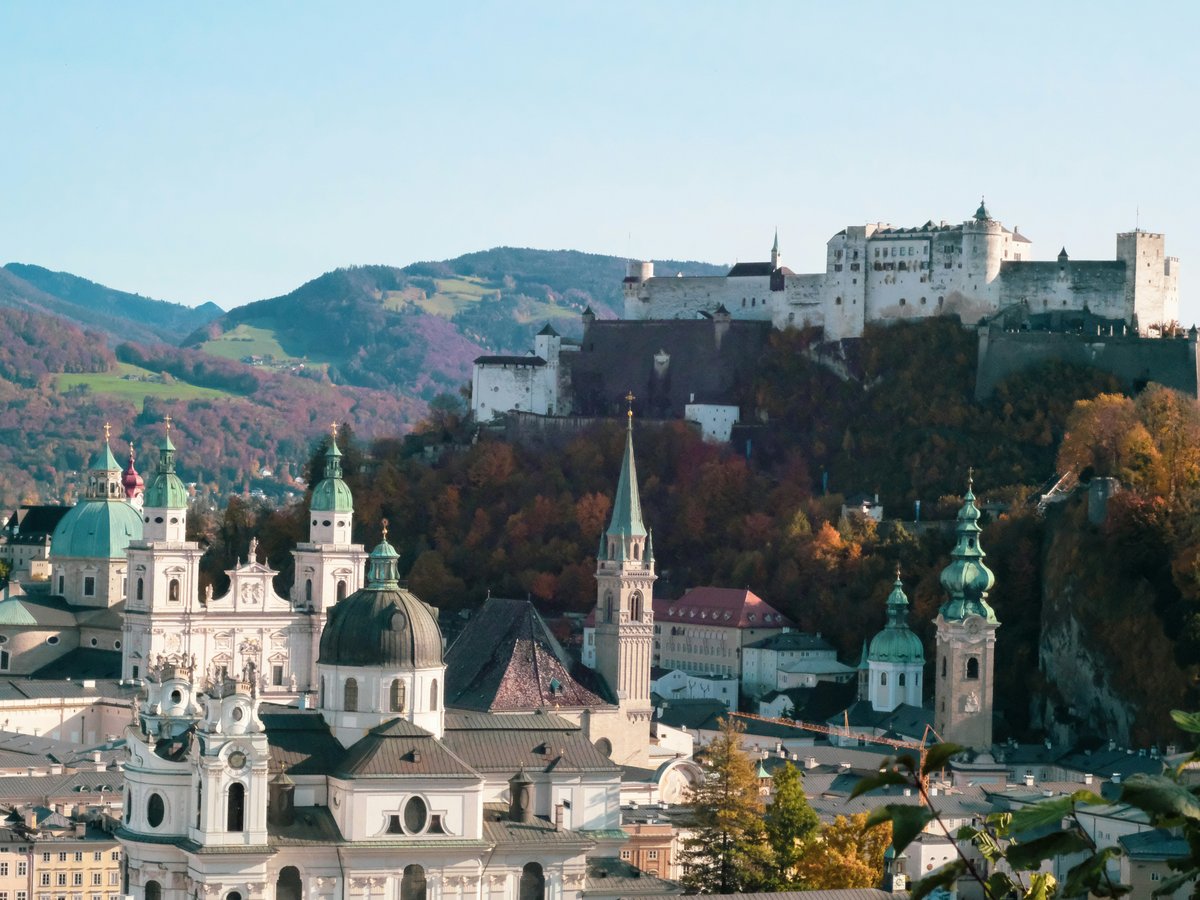
Stay in Salzburg in August
59 hotels in the Trip.com pool for Salzburg, from US$21 a night.
Opens Trip.com on Fri 6 Aug to Sun 8 Aug 2027; change the dates there.
August in Salzburg belongs to the Festspiele. The Salzburger Festspiele runs from mid-July through August 31 and draws roughly 250,000 attendees each year. This compact city of 155,000 residents transforms into one of Europe's performing arts capitals for 6 weeks. If you care about opera, orchestral music, or theater, this is likely the most important month on the entire European cultural calendar. If you don't, you'll still feel the festival's gravitational pull in every fully booked hotel and every restaurant reservation that vanished back in February.
Temperatures average a pleasant 24.3°C (76°F) during the day and drop to around 14.7°C (58°F) at night. That sounds comfortable, and it often is. But August is also Salzburg's wettest month, with 171mm of rain spread across roughly 16 days. These tend to be afternoon thunderstorms rather than all-day drizzle. They roll in over the Untersberg, crack open the sky for 40 minutes, and leave the Altstadt cobblestones steaming. You'll want layers and a rain jacket.
The trade-off is straightforward. August gives you the Festspiele, warm alpine lake swimming, peak wildflower meadows, and long 15-hour days. It also gives you the highest hotel prices of the year, shoulder-to-shoulder foot traffic on Getreidegasse, and rain that can derail an afternoon hike on Kapuzinerberg. For festival-goers, there's no substitute month. For general sightseeing, June or September offer nearly the same scenery with fewer people and lower prices.
Why visit in August
- The Salzburger Festspiele stages roughly 200 performances across opera, theater, and orchestral music through the entire month, with headline casts and premieres concentrated in August
- Alpine lake water temperatures at Fuschlsee and Wolfgangsee reach 22-24°C (72-75°F), warm enough for genuine swimming rather than a quick plunge
- Wildflower meadows on the Untersberg plateau above 1,500m hit peak bloom with gentian, alpine aster, and edelweiss
- Daylight lasts roughly 15 hours, enough for a morning hike and an evening concert in the same day
Worth knowing
- The wettest month of the year at 171mm across 16 rainy days, with afternoon thunderstorms that can strand you mid-hike above the treeline
- Hotel prices reach their annual peak, often 2-3x the winter rate, and properties near the Altstadt sell out months ahead of August
- Getreidegasse and the Altstadt squares are packed by mid-morning, with day-trip buses from Munich (2 hours away) adding to the foot traffic
- Humidity sits at around 80%, which makes even 24°C feel sticky in the narrow stone streets of the old town
Best for
Think twice if
August brings Salzburg's warmest overnight temperatures, with lows around 14.7°C (58°F) that keep evenings mild enough for outdoor dining along the Salzach. Daytime highs average 24.3°C (76°F), though the 80% humidity can make it feel warmer in the sun-trapped streets of the Altstadt. The real story is rain. At 171mm across roughly 16 days, August typically edges out July as the city's wettest month. Storms tend to build in the afternoon over the surrounding Alps. You might wake to blue sky over Hohensalzburg, enjoy a dry morning at Mirabellgarten, and hear thunder by 14:00. The rain usually clears within an hour, leaving behind cooler air and the smell of wet limestone.
Seasonal caution
- Afternoon thunderstorms can develop rapidly over the surrounding Alps, particularly on Untersberg and Gaisberg above the treeline. If you're hiking above 1,500m, plan to reach the summit before noon and begin descending by 14:00 if clouds are building to the south. Lightning on exposed ridgelines and the Untersberg summit plateau is a real risk.
Year-round climate
Averages from the last 5 years.
| Month | Avg high (°C) | Avg low (°C) | Rainfall (mm) |
|---|---|---|---|
| Jan | 6 | -3 | 95 |
| Feb | 9 | 0 | 82 |
| Mar | 12 | 1 | 83 |
| Apr | 14 | 3 | 98 |
| May | 18 | 9 | 165 |
| Jun | 25 | 14 | 104 |
| Jul | 25 | 15 | 166 |
| Aug | 24 | 15 | 171 |
| Sep | 21 | 11 | 146 |
| Oct | 17 | 7 | 89 |
| Nov | 10 | 1 | 113 |
| Dec | 6 | -1 | 100 |
Holidays and festivals in August
Public holidays
- Assumption Day(Maria Himmelfahrt)15 August 2027
Headline events
Salzburger Festspiele
Mid-July through August 31
One of the world's oldest and most prestigious performing arts festivals. Founded in 1920, it stages roughly 200 performances of opera, drama, and orchestral concerts across venues including the Großes Festspielhaus, Felsenreitschule, and Haus für Mozart. The open-air Jedermann performance on Domplatz has opened the festival annually since 1920. Ticket prices vary widely by production and seat category.
Best things to do in August
Attend a Salzburger Festspiele performance
cultureThe festival stages roughly 200 performances across 6 weeks. Opera productions in the Großes Festspielhaus seat 2,179. Chamber concerts fill the Mozarteum's smaller halls. The Felsenreitschule, a theater carved into the Mönchsberg cliff face, seats 1,495 and has some of the most striking acoustics in Europe.
The Festspiele runs mid-July through August 31. Most premieres and headline casts perform in August.Booking tipTickets go on sale in January. Popular opera productions sell out within days. Check for returned tickets (Kartenrückgabe) at the festival box office on Herbert-von-Karajan-Platz starting at 09:30 on performance days.
Watch Jedermann on Domplatz
cultureHugo von Hofmannsthal's morality play Jedermann has opened the Salzburger Festspiele on the cathedral square since 1920. The Dom's Baroque facade becomes the backdrop, and the death call echoes from the Hohensalzburg Fortress towers above. Roughly 2,500 seats fill the open-air square. If it rains, the performance moves indoors to the Großes Festspielhaus.
Jedermann runs exclusively during the Festspiele, with performances through August. The outdoor setting only works in summer.Booking tipAmong the first tickets to sell out each season. The Kartenrückgabe at Herbert-von-Karajan-Platz occasionally releases returned tickets the morning of a show.
Swim in the Salzkammergut lakes
outdoorFuschlsee (25 minutes east by bus) and Wolfgangsee (50 minutes by PostBus 150) reach their warmest temperatures in August, typically 22-24°C (72-75°F). Fuschlsee's north shore has a public Strandbad with a grassy sunbathing area and direct lake access. The water is clear enough to see the bottom at 3 meters (10 feet).
Lake water temperatures peak in late July and August. By mid-September they drop below 18°C (64°F) and swimming becomes bracing rather than relaxing.Booking tipTake the early bus before 09:00 on weekends to secure a spot at the Fuschlsee Strandbad. Parking fills by 10:00 on sunny Saturdays.
Hike the Untersberg via the Untersbergbahn
outdoorThe Untersbergbahn cable car lifts you from 456m to 1,776m in 9 minutes. From the summit station, marked trails cross alpine meadows where gentian, edelweiss, and alpine aster bloom. The Geiereck summit (1,805m) offers views north to Salzburg and south to the Hohe Tauern peaks. The Zeppezauerhaus at 1,663m serves Kaiserschmarrn and cold beer.
Alpine wildflower bloom peaks above 1,500m in late July and August. Snow patches from the previous winter have fully melted, opening all summit trails.Booking tipThe cable car runs every 30 minutes. Start early to return before afternoon thunderstorms. Last descent is typically at 17:30 in August.
Free festival screenings on Kapitelplatz
cultureEvery evening during the Festspiele, a large screen on Kapitelplatz broadcasts recordings and live performances from the festival. The square sits between the Dom and Hohensalzburg Fortress. Locals bring blankets and picnic food. The atmosphere is relaxed, with families and students spread across the pavement near the Sphaera sculpture.
The Siemens Fest>Spiel>Nächte screenings run only during the Festspiele period, mid-July through August 31. It's the way to experience the programming without a ticket.Booking tipNo booking needed. Arrive by 20:00 to get a spot with a clear sightline to the screen. Bring a blanket and an extra layer for the evening cool.
Walk the Kapuzinerberg at golden hour
outdoorThis forested hill on the right bank of the Salzach rises 214 meters above the city. The Stefan-Zweig-Weg trail climbs through beech forest to a viewpoint overlooking the Altstadt, the Dom, and Hohensalzburg Fortress. In August, the light turns golden around 19:30 and the city's church spires glow against the Mönchsberg.
August's long daylight with sunset around 20:30 lets you hike after dinner and still reach the top in warm evening light. The dense canopy keeps the trail cool even on humid afternoons.Browse the Saturday Grünmarkt for seasonal produce
foodSalzburg's daily open-air market on Universitätsplatz expands to its largest footprint on Saturdays, with farmers from the surrounding Flachgau region selling Wachau apricots, alpine cheeses, and bundles of Eierschwammerl. The smell of roasted almonds and grilled sausages mixes with the stone-and-earth scent of the Kollegienkirche arcade.
August brings Wachau apricots, chanterelles, alpine berries, and the first early plums to the stalls. The summer produce window is narrow and at its widest this month.Booking tipArrive before 09:00 for the best chanterelle selection. The stalls closest to the Kollegienkirche tend to carry the best organic producers.
Cycle the Salzach riverside path to Hallein
outdoorA flat, paved bike path runs 15km (9.3 miles) south along the Salzach from central Salzburg to the Celtic salt-mining town of Hallein. The route passes through the Leopoldskron meadows with Untersberg views to the south. In Hallein, the Keltenmuseum documents the region's 2,500-year salt-mining history.
August's warm temperatures and long daylight make this the most comfortable month for the ride. You can return by S-Bahn from Hallein to Salzburg Hbf in 18 minutes if afternoon storms roll in.Booking tipStart before 10:00 to return before afternoon thunderstorms. The S-Bahn from Hallein runs twice per hour.
What to eat in August
On menus now
Marillenknödel
Wachau apricots reach peak ripeness in late July and August. These apricot-filled potato dumplings, rolled in buttered breadcrumbs, appear on nearly every traditional restaurant menu in Salzburg during this narrow 6-week window. Stiftskeller St. Peter and the Stieglkeller both serve reliable versions.
Salzburger Nockerl
A baked sweet soufflé shaped like 3 peaks to represent the Mönchsberg, Kapuzinerberg, and Gaisberg. It arrives at the table puffed and golden, dusted with powdered sugar. Light enough for a summer dessert after a heavy Knödel main.
Ribiselkuchen
Red currant cake appears in bakeries and Konditoreien across Salzburg when the tart berries peak in late July and August. The fruit sits on a shortcrust base with a cap of meringue. Fürst on Brodgasse typically offers a version alongside their Mozartkugeln.
Street food peaks
Steckerlfisch
Whole mackerel butterflied and grilled on a wooden stick over charcoal. The crispy, smoky skin and tender flesh pair with a cold Stiegl or Augustiner. You'll find stalls at Augustiner Bräustübl's food corridor and at outdoor gatherings through August.
What to drink
Radler
A 50/50 mix of lager and lemon soda that becomes the default afternoon drink at beer gardens like Augustiner Bräustübl in Mülln when the humidity climbs. Stiegl, Salzburg's hometown brewery since 1492, makes a bottled version available at every kiosk in the city.
In markets
Eierschwammerl
Chanterelle mushrooms come into season across Austria's alpine forests in August. Restaurants in the Altstadt serve them sautéed with butter, parsley, and a splash of cream over Semmelknödel (bread dumplings). The best specimens show up at the Grünmarkt stalls early on Saturday mornings.
Regular events in August
Mariä Himmelfahrt (Assumption of Mary)Free
A public holiday across Austria on August 15. Many shops and businesses close for the day. The Salzburger Dom holds a special High Mass. One of the busiest single days for domestic visitors, as Austrians have the day off and Salzburg is a popular destination from Vienna and Linz.
August 15Siemens Fest>Spiel>NächteFree
Free open-air screenings of Festspiele performances on a large screen at Kapitelplatz, running nightly throughout the festival. The program includes opera, concert, and theater broadcasts. Seating is informal on the square's pavement and grassy edges, with Hohensalzburg Fortress lit up overhead.
Nightly, mid-July through August 31Best places this August
Mirabellgarten
parkThe Baroque gardens reach their peak summer display in August, with geometrically planted beds of roses, dahlias, and begonias. The Pegasus fountain and dwarf statues date to 1690. Morning light hits the garden best between 07:00 and 09:00, before tour groups arrive. The Heckentheater (hedge theater) occasionally hosts small Festspiele-adjacent performances.
NeustadtAugustiner Bräustübl
beer_gardenA monastic brewery and beer hall operating since 1621 in the Mülln district. In August, the tree-shaded beer garden seats over 1,000 people. Beer is still poured from wooden barrels in stone mugs. The ground floor has a corridor of food stalls selling Steckerlfisch, Leberkäse, pretzels, and cheese. You carry your own food to the garden tables. No credit cards at the bar.
MüllnKapitelplatz
squareThe square between the Dom and the Festungsbahn (fortress funicular) hosts the Siemens Fest>Spiel>Nächte free screenings every evening during the Festspiele. Sphaera, the large gold sphere sculpture by Stephan Balkenhol, marks the south end. On non-screening nights, it's one of the quieter Altstadt squares after 21:00.
AltstadtLeopoldskroner Weiher
lakeA small lake in the Leopoldskron district, about 2km south of the Altstadt. The north shore has a free public swimming area with a grassy bank. Schloss Leopoldskron (the Sound of Music's lake house) sits on the west shore. In August, locals swim here after work to avoid the 25-minute drive to Fuschlsee.
LeopoldskronMuseum der Moderne Mönchsberg
museumThe contemporary art museum sits on top of the Mönchsberg cliff, reached by the Mönchsberg Aufzug elevator from Anton-Neumayr-Platz. The rooftop terrace offers a panorama from the Dom domes to the Untersberg. In August, the air-conditioned galleries provide a welcome escape from the humidity, and the terrace restaurant M32 serves cold drinks with the view.
AltstadtStiftskeller St. Peter
restaurantDocumented since 803 AD, this restaurant at the foot of the Mönchsberg near the Petersfriedhof (St. Peter's Cemetery) claims to be the oldest in Europe. The courtyard garden, shaded by chestnut trees, stays cool even on August afternoons. The menu features Salzburger Nockerl and seasonal Eierschwammerl dishes. During the Festspiele, the Stiftskeller hosts themed dinner concerts.
AltstadtUntersberg summit plateau
mountainThe Untersbergbahn cable car from St. Leonhard (bus 25 from Salzburg Hbf, 25 minutes) reaches 1,776m. The summit plateau is a limestone karst landscape with sinkholes, alpine meadows, and views south to Berchtesgaden and the Watzmann. In August, alpine aster and gentian bloom across the meadows. The Geiereck summit (1,805m) is a 30-minute walk from the cable car station.
Your packing checklist
Tick items off as you pack. Your progress saves in this browser.
All packed — have a great trip.
Insider tips
The Siemens Fest>Spiel>Nächte screenings on Kapitelplatz are free every evening during the Festspiele, but sound quality varies by position. Sit within 30 meters of the left speaker cluster for the clearest audio. Bring a cushion or blanket. The stone ground gets cold by 21:00.
Augustiner Bräustübl in Mülln runs on cash only at the bar. The food stalls in the ground-floor corridor are separate vendors with their own registers. The upstairs hall is quieter than the garden but misses the point on a warm August evening.
Festspiele ticket returns (Kartenrückgabe) go on sale at the box office on Herbert-von-Karajan-Platz starting at 09:30 on performance days. Arrive by 08:30 for a real chance at opera tickets. Weekday matinees have the best odds.
Skip Getreidegasse between 10:00 and 16:00. The narrow shopping street becomes a slow-moving crowd by late morning. Walk it before 09:00 or after 18:00 when the tour buses have left and you can look up at the wrought-iron guild signs above the shop fronts.
The Salzburg Card covers nearly every museum, the Untersberg cable car, the Hohensalzburg funicular, and city transit. If you plan 2 or more paid attractions plus transit in a single day, it tends to pay for itself. Available in 24h, 48h, and 72h versions at the tourist information office on Mozartplatz.
Avoid these mistakes
- Expecting to buy Festspiele tickets in August. The most popular opera and orchestral programs sell out in January when the season is announced. If you arrive without tickets, your options are returned tickets at the morning Kartenrückgabe (not guaranteed) or the free Kapitelplatz screenings. Plan 6 months ahead.
- Packing only summer clothes. August nights in Salzburg drop to 15°C (58°F), and a thunderstorm can push afternoon temperatures down by 8°C within 30 minutes. A fleece layer and rain jacket prevent a miserable evening at an outdoor concert.
- Driving into the Altstadt on Mariä Himmelfahrt, August 15. This public holiday brings a wave of Austrian day-trippers, and parking garages near the old town fill by mid-morning. Take the S-Bahn or use the Park and Ride at Salzburg Süd.
- Starting an Untersberg hike after noon. Afternoon thunderstorms are common above 1,500m in August, and lightning on the exposed summit plateau is genuinely dangerous. Aim to reach the top before 12:00 and begin descending by 14:00 if clouds are building to the south.
Practical tips for August
Book Festspiele tickets in January when the program launches. Hotel rates in August run 2-3x the winter average, so reserve 4-6 months ahead for anything within walking distance of the Altstadt. The Salzburg Card (available in 24h, 48h, or 72h versions) covers most museums, the Untersberg cable car, Hohensalzburg fortress funicular, and city transit. Shops close on Sundays year-round and on August 15 (Mariä Himmelfahrt), so stock up on Saturday. Restaurants near the Festspielhaus fill before and after performances. Book dinner by 18:00 or after 22:30 during festival weeks. Festspiele evening opera at the Großes Festspielhaus leans toward formal dress. Afternoon concerts at the Mozarteum are smart-casual. There's no enforced code at the door, but shorts and trainers will draw looks. The Altstadt is largely pedestrianized, and most attractions sit within a 15-minute walk of each other on the left bank of the Salzach. The bus network (Obus) runs frequently, and single tickets can be bought from the driver.
FAQ
Is August a good time to visit Salzburg?
August is a good time if the Salzburger Festspiele is your primary draw. The festival is one of the world's top performing arts events and runs exclusively through this period. The weather is warm at 24.3°C (76°F) highs and daylight lasts roughly 15 hours. That said, August brings Salzburg's highest hotel prices, its worst crowds, and its heaviest rainfall at 171mm across 16 days. If you're coming for general sightseeing without festival plans, June or September tend to offer a similar experience with better value and fewer people.
What is the weather like in Salzburg in August?
Warm but wet. Average highs reach 24.3°C (76°F) and lows sit around 14.7°C (58°F). Humidity hovers at 80%. Expect rain on roughly 16 of 31 days, typically as afternoon thunderstorms that build over the surrounding Alps and pass within an hour. Mornings tend to be dry and pleasant. Pack layers and always carry rain protection. The humidity can make even moderate temperatures feel sticky, especially in the narrow Altstadt streets.
Is Salzburg crowded in August?
Yes. August is Salzburg's busiest month. The Festspiele draws roughly 250,000 attendees to a city of 155,000 residents. Day-trippers arrive by bus and train from Munich (2 hours), Vienna (2.5 hours by Railjet), and the Salzkammergut lake district. Getreidegasse and the Altstadt squares are packed from mid-morning to early evening. For breathing room, cross to the right bank around Linzergasse and Kapuzinerberg, or visit the old town early in the morning before 09:00.
Do I need to book Salzburg Festival tickets in advance?
Yes. The Festspiele program typically launches in the preceding autumn, and tickets go on sale in January. Popular opera productions and headline concerts sell out within days. If you arrive without tickets, returned tickets (Kartenrückgabe) are sold at the Herbert-von-Karajan-Platz box office starting at 09:30 on performance days, but availability is not guaranteed. The free Siemens Fest>Spiel>Nächte screenings on Kapitelplatz are always an option for those without tickets.
What should I wear to the Salzburg Festival?
Dress codes vary by venue and performance type. Opera at the Großes Festspielhaus tends toward formal, with dark suits and cocktail dresses being typical. Afternoon concerts at the Mozarteum or Kollegienkirche are smart-casual. There's no enforced dress code at the door, but jeans and trainers will draw looks at an evening opera premiere. For the outdoor Jedermann performances on Domplatz, smart-casual works fine, though bring an extra layer for the evening cool as temperatures drop to 15°C (58°F) after sunset.
Things to Do in Salzburg in August
 Free cancellation
 Hallstatt Half-Day Tour from Salzburg
Day trip: 5.5 hours, free cancellation.
via Viator Free cancellation
 Skip-The-Line Salt-Mines and Bavarian Mountains Tour from Salzburg
Outdoor experience: 4 hours, free cancellation.
via Viator Free cancellation Salzburg Super Saver: Original Sound of Music and Salt Mines Day Trip
Day trip: 9.2 hours, free cancellation.
via Viator Free cancellation
 Public 8h tour to sites of "The Sound of Music Movie" & Hallstatt
Day trip: 8 hours, free cancellation.
via Viator Free cancellation
 Private Full-Day Tour of Hallstatt and Salzkammergut from Salzburg with Options
Day trip: free cancellation.
via Viator Free cancellation
 Private Tandem Paragliding Salzburg Mt Gaisberg
Outdoor experience: free cancellation.
via ViatorFind a flight to Salzburg
Live fares to Salzburg appear here once cookies are accepted.
Last verified by automated review (v1.7.2) on . What is automated review?