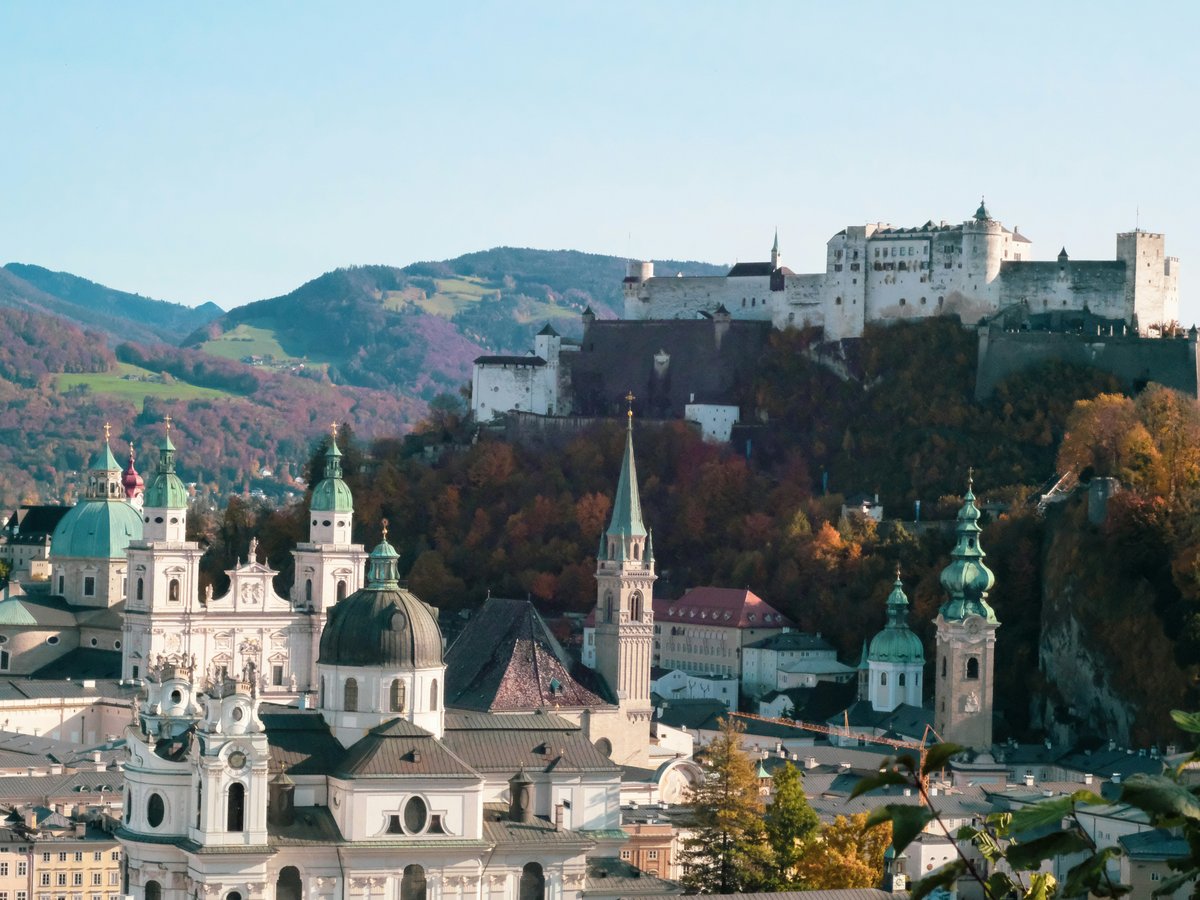
Stay in Salzburg in May
59 hotels in the Trip.com pool for Salzburg, from US$21 a night.
Opens Trip.com on Fri 7 May to Sun 9 May 2027; change the dates there.
May in Salzburg is wet. The city averages 165mm of rain spread across 18 days, making it one of the 3 wettest months alongside July and August. Daytime highs reach 18.3°C (65°F), and the Mirabellgarten is in full spring bloom by mid-month, with tulips, lilacs, and the Zwergerlgarten hedges at their greenest. The Salzburger Pfingstfestspiele, the city's Whitsun classical music festival held at the Großes Festspielhaus, typically falls over Pentecost weekend in late May. It draws serious classical audiences from across Europe.
To be fair, Salzburg's rain rarely ruins a full day. Showers tend to roll through the Altstadt in 30 to 45-minute bursts, then clear to reveal the Untersberg still patched with snow on its upper ridges. Mornings along the Salzach often start dry. Early walks up the Kapuzinerberg are genuinely pleasant before the afternoon clouds build. Overnight lows still dip to 8.5°C (47°F), though. That post-sunset chill in the Nonntal alleys catches visitors in T-shirts off guard.
May sits in a pricing sweet spot relative to Salzburg's summer peak. The Salzburger Festspiele (late July through August) drives Altstadt hotel rates to their annual high, but May shoulder-season pricing runs roughly 20-30% below that mark. The Pfingstfestspiele weekend is the exception. Rooms near the Festspielbezirk sell out 2 to 3 months ahead, and nightly rates for those 3 to 4 days approach summer levels.
Why visit in May
- The Mirabellgarten, Schloss Hellbrunn gardens, and the Kapuzinerberg trails are at peak spring green, with tulips blooming through mid-May and rhododendrons following by month's end.
- Salzburg's major sites, including Hohensalzburg Fortress and Mozart's Geburtshaus, see roughly 40% fewer visitors than in July and August, which means shorter queues and more breathing room in the narrow Getreidegasse.
- Shoulder-season hotel pricing runs 20-30% below the summer Festspiele peak, with particularly good value in the Maxglan and Schallmoos neighborhoods a 15-minute walk from the Altstadt.
- The Salzburger Pfingstfestspiele brings internationally recognized opera and orchestral performances to the Großes Festspielhaus without the scale and crowds of the summer festival.
- Daylight stretches past 20:30 by late May, giving long evenings for walks along the Salzach or up the Mönchsberg elevator to the terrace near M32.
Worth knowing
- 165mm of rain across 18 days makes May one of Salzburg's 3 wettest months. You will get rained on, likely multiple times. Outdoor plans need flexible timing.
- Overnight lows of 8.5°C (47°F) mean evenings are chilly enough for a proper jacket, and alpine day trips to the Untersberg summit still hit near-freezing temperatures.
- Two public holidays fall in May. Tag der Arbeit on May 1 and Christi Himmelfahrt (Ascension Day, a moveable date) close most shops and some restaurants, which catches visitors off guard on a weekday.
- The Untersberg cable car runs, but higher alpine trails above 1,500m may still have snow patches in early May, limiting serious hiking compared to June or July.
Best for
Think twice if
May in Salzburg feels like spring that hasn't fully committed. Mornings often start clear at 10-12°C, climbing to an average high of 18.3°C (65°F) by early afternoon before clouds roll in from the Alps. Afternoon showers are common but tend to pass in 30-45 minutes. The 165mm of monthly rainfall across 18 wet days makes this one of the city's rainiest stretches, rivaling July's 166mm and August's 171mm. Humidity sits at 77%, noticeable but not oppressive. The Salzach runs high with snowmelt, and the Untersberg's upper flanks still carry snow. By late May, temperatures occasionally touch 22-24°C on sunny stretches, though 15°C overcast days are equally possible.
Year-round climate
Averages from the last 5 years.
| Month | Avg high (°C) | Avg low (°C) | Rainfall (mm) |
|---|---|---|---|
| Jan | 6 | -3 | 95 |
| Feb | 9 | 0 | 82 |
| Mar | 12 | 1 | 83 |
| Apr | 14 | 3 | 98 |
| May | 18 | 9 | 165 |
| Jun | 25 | 14 | 104 |
| Jul | 25 | 15 | 166 |
| Aug | 24 | 15 | 171 |
| Sep | 21 | 11 | 146 |
| Oct | 17 | 7 | 89 |
| Nov | 10 | 1 | 113 |
| Dec | 6 | -1 | 100 |
Holidays and festivals in May
Public holidays
- Saint Florian's Day(Florianitag)4 May 2027
- Ascension Day(Christi Himmelfahrt)6 May 2027
- Pentecost(Pfingstsonntag)16 May 2027
- Whit Monday(Pfingstmontag)17 May 2027
- Corpus Christi(Fronleichnam)27 May 2027
Headline events
Salzburger Pfingstfestspiele
Pentecost weekend, typically late May or early June (varies yearly with the liturgical calendar)
The city's prestigious Whitsun music festival brings opera, orchestral, and choral performances to the Großes Festspielhaus and Haus für Mozart over the Pentecost long weekend. Founded in 1973, it operates as a smaller, more focused sibling to the summer Salzburger Festspiele. Programs typically center on a single composer or thematic thread, with internationally recognized soloists and conductors. Ticket prices start around 30-50 EUR for smaller recitals and climb past 300 EUR for the headline opera production.
Best things to do in May
Walk the Mönchsberg from Museum der Moderne to Augustiner Bräustübl
walkingThe Mönchsberg ridgeline trail runs roughly 2km from the Museum der Moderne terrace on the western edge to the steps descending into Mülln, where the Augustiner Bräustübl beer hall sits at the bottom. The path is flat, shaded by beech and chestnut trees, and the views over the Altstadt rooftops toward the Untersberg are unobstructed. End at the Bräustübl's chestnut-tree courtyard with a Maibock and a plate of Obatzda.
Late May foliage fills the canopy without blocking views, and the Bräustübl courtyard is comfortable at 18°C without the July crush of 300+ visitors.Booking tipNo booking needed. The Mönchsberg elevator from Anton-Neumayr-Platz saves the climb if you want to start at the top.
Attend the Salzburger Pfingstfestspiele
culturalThe Whitsun festival's concentrated program typically spans 4 days over the Pentecost weekend, with performances at the Großes Festspielhaus, the Haus für Mozart, and the Stiftung Mozarteum. Programs range from full staged operas to chamber recitals and lieder evenings. The focused format means you can see 3-4 performances without the scheduling complexity of the 6-week summer festival.
The Pfingstfestspiele happens once a year, pegged to the Pentecost weekend. It moves between mid-May and early June depending on Easter's date.Booking tipTickets go on sale in January. Headline opera performances sell out within weeks. Recitals and matinees are easier to get, often available 1-2 months ahead.
Day trip to Schloss Hellbrunn and the trick fountains
sightseeingThe 17th-century Lustschloss sits 6km south of the Altstadt in Morzg. The 40-minute guided Wasserspiele (trick fountain) tour includes hidden jets that spray visitors from stone seats, table edges, and garden paths. Archbishop Markus Sittikus commissioned them in 1612 to amuse and soak his dinner guests. The surrounding park is free to wander and the old trees are fully leafed by May.
The fountains typically open around April 1. May is early enough to visit before tour-bus crowds peak in July and August. Water temperature is still bracingly cold, which makes the surprise jets memorable.Booking tipArrive before 10:00 to join the first tour group. The park fills noticeably after 11:00 on weekends.
Hike the Gaisberg via Zistelalm
hikingThe Gaisberg (1,288m) is Salzburg's house mountain on the city's eastern edge. The standard route from Parsch through forest to the Zistelalm hut takes about 2.5 hours, with the option to continue 45 minutes to the summit for a 360° panorama over the city, the Salzach valley, and the Berchtesgadener Alpen. Zistelalm serves Kasnocken and cold Stiegl on its terrace.
At 1,288m, the Gaisberg is typically snow-free by early May while higher peaks are still locked. Wildflower meadows between 800m and 1,100m peak in the second half of the month.Booking tipNo booking required. The number 151 bus from Mirabellplatz runs to the Gaisberg summit road, shortening the hike if needed.
Explore the Grünmarkt on Universitätsplatz
foodSalzburg's daily open-air market fills the square behind the Kollegienkirche with 30-40 stalls selling Salzburger Bergkäse, smoked Forelle from the Salzkammergut lakes, seasonal Spargel, Bärlauch pesto, breads, and cut flowers. The cheese vendors let you taste before buying. Saturday mornings are the busiest and best-stocked, with farmers from the Flachgau and Tennengau driving in.
May brings the first serious spring produce. White asparagus, radishes, fresh herbs, and early lettuces dominate the stalls. Bärlauch products are still available but disappearing by month's end.Booking tipGo before 10:00 on Saturday for the best selection. The market runs Monday through Saturday, typically 7:00 to 17:00.
Cycle the Salzach riverside path to Hallein
cyclingThe Tauernradweg follows the Salzach south from Salzburg through the Tennengau valley to Hallein, roughly 18km one way on flat, paved cycle paths. Hallein's Altstadt is worth 30-40 minutes of wandering, and the Salzwelten salt mine above the town offers underground tours. Rent bikes from shops near the Hauptbahnhof or at the Staatsbrücke.
The path is clear of snow, river levels are high from alpine melt (the Salzach looks properly powerful), and 18°C is ideal cycling temperature. Return by S-Bahn from Hallein in 20 minutes.Booking tipBike rentals are plentiful and rarely need advance booking in May. Weekday rides are quieter than weekend mornings when local cycling clubs are out.
Evening stroll through the Altstadt after rain
walkingThis sounds like non-advice, but hear it out. The Salzburg Altstadt at dusk after a rain shower is a specific experience worth seeking. The Getreidegasse cobblestones reflect the wrought-iron guild signs. The Salzach picks up the last light off the Kapuzinerberg. Residenzplatz empties out. Walk from the Mozartsteg bridge through the Pferdeschwemme on Herbert-von-Karajan-Platz and up toward Stift Nonnberg as the fortress lights come on. The smell of wet stone and linden blossoms is particular to late May.
The combination of frequent rain, 20:30 sunsets, spring blossoms, and pre-summer quiet exists only in May. By July the same streets are shoulder-to-shoulder until 22:00.What to eat in May
On menus now
Radieschen mit Butter (radishes with butter)
Fresh spring radishes from Salzburg's surrounding Flachgau farmland show up at the Grünmarkt and on beer garden tables as a standard Brotzeit side. Sliced thin, fanned across a plate, salt-sprinkled, with cold butter and dark bread. Simple and entirely seasonal.
What to drink
Maibock
The traditional strong spring beer appears on tap at the Augustiner Bräustübl in Mülln and at the Stiegl-Brauwelt brewery in Maxglan. Maibock tends to run 6.5-7.5% ABV, paler and hoppier than the dark Doppelbock of winter. It pairs well with the Bräustübl's cold-counter schnitzel and radish plates.
Holunderblütensirup (elderflower syrup)
Elder trees along the Salzach and in the Mönchsberg parks bloom in late May. Locals gather the cream-colored flower heads to make Holunderblütensirup, which appears in Spritzer drinks across the city's cafes and in small-batch bottles at the Grünmarkt. The scent is faintly sweet and floral, particular to late spring.
In markets
Spargel (white asparagus)
May is the heart of Spargelzeit in Austria. White asparagus from the Marchfeld region east of Vienna appears on nearly every Salzburg restaurant menu, typically served with hollandaise, new potatoes, and ham, or in a creamy Spargelcremesuppe. The season ends abruptly on June 24 (Johannistag), so May is prime time. Look for it at the Grünmarkt stalls on Universitätsplatz.
Bärlauch (wild garlic)
The tail end of wild garlic season runs through early to mid-May in the forests around Salzburg. Restaurants in the Altstadt work it into pesto, Knödel fillings, and herbed butter. By late May it's largely gone, replaced by the broader summer herb season.
Regular events in May
Tag der Arbeit (May Day)Free
Austria's Labour Day is a public holiday. Most shops in the Altstadt and at Europark close, though restaurants and cafes in the tourist core typically stay open. Traditional Maibaum (maypole) celebrations happen in surrounding villages like Anif and Grödig, with brass bands and folk dancing around the pole.
May 1Christi Himmelfahrt (Ascension Day)Free
A moveable public holiday falling 39 days after Easter. Shops close, and many Salzburgers take the following Friday off for a 4-day weekend, leaving the city noticeably quieter. The Salzburger Dom and Stift Nonnberg hold special services. Expect reduced public transit schedules on Salzburg AG buses.
39 days after Easter, typically mid-May (May 14 in 2026)Salzburg MarathonFree
The annual Salzburg Marathon and half-marathon route loops through the Altstadt, along the Salzach, past Schloss Mirabell, and through Leopoldskron. Road closures affect parts of the city center from early morning until early afternoon. Worth watching if you're in town, or worth planning around if you need to drive.
Typically a Sunday in mid-to-late MayLange Nacht der Kirchen (Long Night of Churches)Free
An Austria-wide event where churches open their doors for evening concerts, guided tours, art installations, and readings from roughly 18:00 to midnight. In Salzburg, the Dom, Franziskanerkirche, and Kollegienkirche participate with organ recitals and candlelit tours of crypts and towers not normally accessible to the public.
Typically a Friday in late May or early JuneBest places this May
Mirabellgarten
parkThe formal baroque garden peaks in May with tulips giving way to roses in the Rosengarten, and the Zwergerlgarten (dwarf garden) hedges at their most sculpted. The view from the garden's upper terrace toward Hohensalzburg Fortress, framed by the Dom's dome, is the city's most photographed angle. Morning light before 09:00 is best for photos without tour groups standing in the frame.
NeustadtKapuzinerberg
viewpointThis steep, forested hill on the right bank of the Salzach is the quiet counterpart to the tourist-heavy Mönchsberg. The 30-minute climb from Linzergasse leads to the Kapuzinerkloster and the Stefan-Zweig-Weg path with views over the Altstadt rooftops. In May, the forest floor has late-blooming Bärlauch patches and the beech canopy is at fresh, translucent green. Few tourists make the climb.
NeustadtAugustiner Bräustübl
beer_hallAustria's largest beer hall has operated since 1621 in the former Augustinian monastery in Mülln. The chestnut-tree courtyard opens properly in spring, and May's 18°C afternoons are ideal for the outdoor Biergarten. You fill your own Steinkrug from the wooden barrel taps. The cold-food counters sell Leberkäse, smoked fish, Obatzda, and radish plates. Cash only.
MüllnStift Nonnberg
historic_siteThe Benedictine convent above the Altstadt was established around 714 AD. It's the oldest continuously operating women's monastery north of the Alps. The climb from Kaigasse takes 10 minutes through a steep, quiet lane. The Romanesque frescoes in the chapel are worth the visit, and the viewpoint from the convent terrace over Nonntal toward the Tennengebirge is uncrowded year-round. Vespers at 17:45 are open to the public.
NonntalSchloss Leopoldskron
palaceThe 18th-century rococo palace on the Leopoldskroner Weiher pond appeared in The Sound of Music's lake scenes. The grounds are partly open to walkers, and the view across the pond toward Hohensalzburg Fortress with the Alps behind is particularly good in May when the surrounding trees are fully leafed. Morning mist over the water is common on cooler May mornings, usually clearing by 09:00.
LeopoldskronSalzburger Dom
churchThe early-baroque cathedral on Domplatz is where Mozart was baptized in January 1756. The dome interior was restored in 1959 after World War II bomb damage. May is a good time to visit the Dommuseum on the upper gallery without summer queues. The Dom organ concerts, typically Thursday and Saturday, are free and worth timing a visit around.
AltstadtUntersberg cable car
mountainThe Untersbergbahn runs from Grödig (a 25-minute bus ride from the Altstadt) to 1,776m in 9 minutes. In May, the summit plateau still has snow patches, and the temperature at the top can be 10-12°C colder than in the city. On clear days the view stretches from the Dachstein to the Großglockner. The summit restaurant serves Kaiserschmarrn and Germknödel.
Your packing checklist
Tick items off as you pack. Your progress saves in this browser.
All packed — have a great trip.
Insider tips
The Grünmarkt on Universitätsplatz sells Spargel at roughly half the price of restaurant Spargel dishes. Buy a bundle of white asparagus and a jar of hollandaise from the same stall, take it to a self-catering apartment, and cook it yourself. It takes 12 minutes to boil and tastes better than the 22 EUR restaurant version.
The Augustiner Bräustübl in Mülln doesn't take credit cards. Bring cash. A Maß (1 liter) of beer costs around 7-8 EUR at the barrel taps, and the cold food counters are separate vendors who also prefer cash. The indoor halls on the upper floor are worth seeing even if you sit in the courtyard.
Skip the Hohensalzburg Fortress funicular queue and walk up via the Festungsgasse path from Kapitelplatz. It takes 15-20 minutes, the views improve with every switchback, and you avoid the 10-15 minute funicular queue that builds after 10:00.
The Kapuzinerberg has a nearly identical fortress view to the Mönchsberg but with a fraction of the foot traffic. Enter from the stone stairway on Linzergasse near house number 14, and follow the Stefan-Zweig-Weg to the viewpoint. On a May morning you might have the bench entirely to yourself.
If you're visiting over a public holiday (May 1 or Ascension Day), stock up on groceries and pull cash the day before. Austrian holidays close supermarkets completely, and ATM queues at the Hauptbahnhof Spar get long by mid-morning on the holiday itself.
Avoid these mistakes
- Packing only for spring warmth and leaving rain gear behind. The 18.3°C average high sounds mild, but 165mm across 18 rainy days means rain is more likely than not on any given day. Visitors from drier climates routinely underpack for it and end up buying overpriced rain jackets in Getreidegasse tourist shops.
- Booking an outdoor-only day with no backup plan. A bike ride to Hallein, a full-day Gaisberg hike, or a planned afternoon in the Mirabellgarten can all get soaked out. Build a museum visit (Museum der Moderne, DomQuartier, or Haus der Natur) into every day as a rain fallback.
- Arriving on May 1 or Ascension Day expecting normal shopping hours. Austrian public holidays shut down retail almost entirely. Getreidegasse shops, the Europark mall, and most supermarkets close. Only restaurants, cafes, and tourist attractions stay open.
- Assuming the Untersberg summit will be hikeable on foot. The cable car runs, but the summit plateau at 1,776m often still has snow cover in early to mid-May. Visitors in trail runners expecting a summer walk find icy patches and closed trail markers. Check conditions on the Untersbergbahn website before going up.
Practical tips for May
Book Pfingstfestspiele tickets in January if you want headline performances. General Salzburg hotels in May can be booked 3-4 weeks ahead without trouble, except during the Pfingstfestspiele weekend, when Altstadt rooms fill 2-3 months out. The Salzburg Card (24/48/72-hour versions starting around 30 EUR) covers the fortress funicular, most museums, and public transport, and typically pays for itself in 2-3 attraction visits. Restaurants in the Altstadt rarely require reservations in May except on Pfingstfestspiele evenings, but the Stiftskeller St. Peter and Esszimmer are exceptions worth booking a few days ahead. Dress codes are relaxed everywhere except formal Festspielhaus concerts, where Salzburgers tend toward smart attire. Tipping in Austria is typically 5-10% at sit-down restaurants, rounded to a convenient figure and handed directly to the server with 'Stimmt so' or 'Passt so.' Public transport runs on a Sunday/holiday schedule on May 1 and Ascension Day, so check the Salzburg AG timetable if you're planning day trips on those dates.
FAQ
Is May a good time to visit Salzburg?
May is a good time, not the best. The city is in full spring bloom, crowds are manageable compared to the July-August peak, and shoulder-season pricing saves 20-30% on hotels compared to summer. The main drawback is rain. At 165mm across 18 days, May is one of Salzburg's 3 wettest months. If you're comfortable carrying a rain jacket and flexing outdoor plans around showers, you'll enjoy the green landscapes, pleasant 18°C daytime temperatures, and a quieter Altstadt. June offers similar warmth with significantly less rain at 104mm, so if dry weather matters to you, pushing the trip 4 weeks might be worth considering.
What is the weather like in Salzburg in May?
Average highs reach 18.3°C (65°F) and lows dip to 8.5°C (47°F). Rainfall totals 165mm across approximately 18 rainy days, making it one of the wettest months of the year alongside July and August. Humidity averages 77%. Mornings tend to be clearer, with rain more common in the afternoon. Sunny stretches can push temperatures to 22-24°C, but overcast 14-15°C days happen too. The temperature swing between morning and afternoon means layering is essential, and a waterproof jacket belongs in your bag every day you go out.
Is Salzburg crowded in May?
Moderately. May sits between the quiet off-season (November through March) and the summer Festspiele crush in July and August. Hohensalzburg Fortress and Mozart's Geburtshaus have manageable queues most days. The Pfingstfestspiele weekend (typically late May, varying with Pentecost) brings a noticeable spike in visitors, particularly classical music audiences booking the Altstadt hotels. The Getreidegasse gets busier on weekends but nothing like July, when tour groups fill it shoulder-to-shoulder from 10:00 to 18:00.
Can I hike around Salzburg in May?
Lower-elevation hikes are in good condition by early May. The Kapuzinerberg (636m), Mönchsberg, and Gaisberg (1,288m) are snow-free and accessible, with wildflower meadows appearing on the Gaisberg slopes from mid-month. Higher routes on the Untersberg (1,972m) and in the Berchtesgaden Alps often still have snow patches through mid-May, especially on north-facing slopes above 1,500m. The Untersberg cable car runs, but summit trails may need microspikes or crampons. Check current conditions with the Salzburg section of the Austrian Alpine Club (ÖAV) before planning anything above 1,500m.
What should I pack for Salzburg in May?
Layers and rain gear. The 10°C difference between 8.5°C mornings and 18°C afternoons means you'll adjust clothing 2-3 times a day. A waterproof jacket is essential given the 18 rainy days. Waterproof shoes with grip handle the wet Altstadt cobblestones and muddy Mönchsberg trails better than sandals or canvas sneakers. Bring a warm sweater or fleece for evenings along the Salzach. If you're attending Pfingstfestspiele concerts at the Großes Festspielhaus, Salzburgers dress up, so pack one smart outfit.
Things to Do in Salzburg in May
 Free cancellation
 Hallstatt Half-Day Tour from Salzburg
Day trip: 5.5 hours, free cancellation.
via Viator Free cancellation
 Skip-The-Line Salt-Mines and Bavarian Mountains Tour from Salzburg
Outdoor experience: 4 hours, free cancellation.
via Viator Free cancellation Salzburg Super Saver: Original Sound of Music and Salt Mines Day Trip
Day trip: 9.2 hours, free cancellation.
via Viator Free cancellation
 Public 8h tour to sites of "The Sound of Music Movie" & Hallstatt
Day trip: 8 hours, free cancellation.
via Viator Free cancellation
 Private Full-Day Tour of Hallstatt and Salzkammergut from Salzburg with Options
Day trip: free cancellation.
via Viator Free cancellation
 Private Tandem Paragliding Salzburg Mt Gaisberg
Outdoor experience: free cancellation.
via ViatorFind a flight to Salzburg
Live fares to Salzburg appear here once cookies are accepted.
Last verified by automated review (v1.7.2) on . What is automated review?