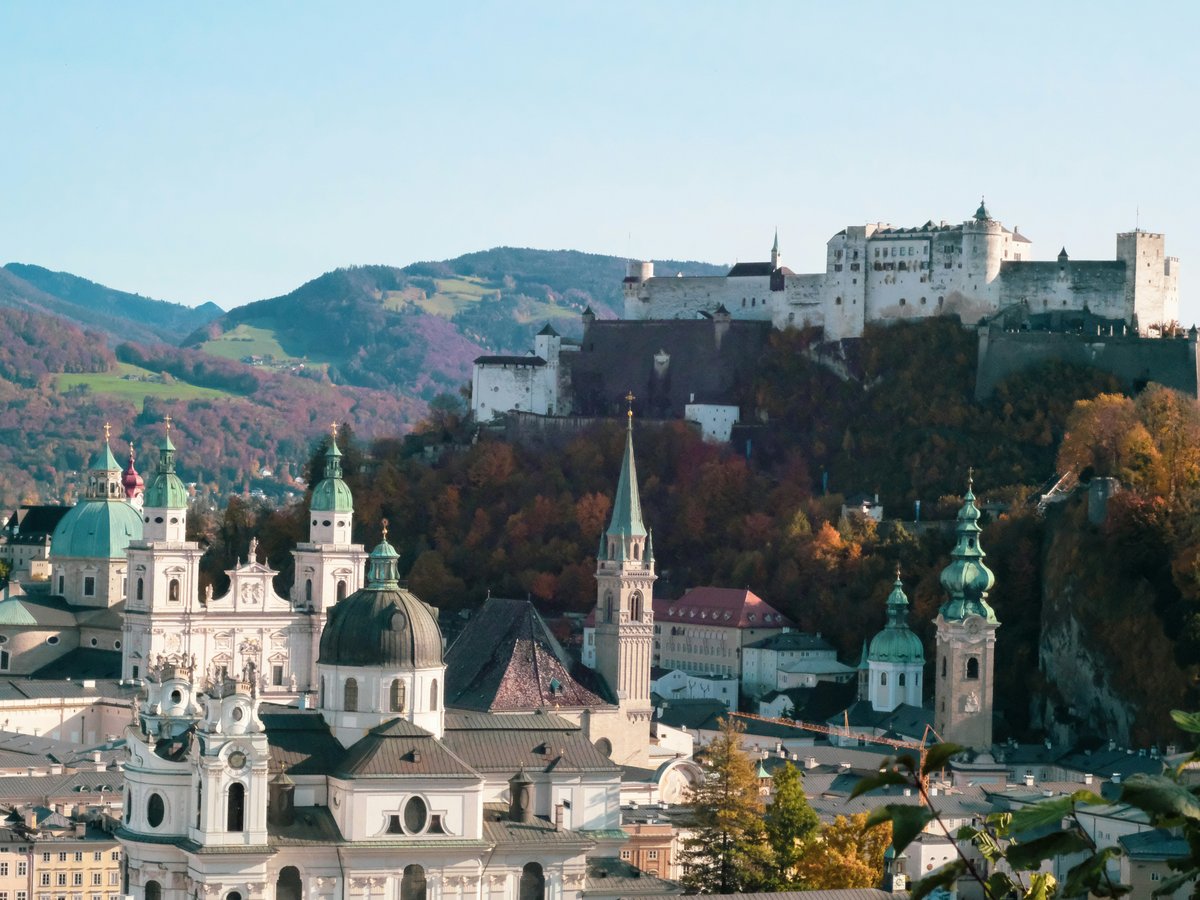
Stay in Salzburg in September
59 hotels in the Trip.com pool for Salzburg, from US$21 a night.
Opens Trip.com on Fri 25 Sep to Sun 27 Sep 2026; change the dates there.
September in Salzburg is the exhale after the Festspiele. The summer festival wraps up in late August, and within days the opera crowds, the tour buses on Getreidegasse, and the EUR 400-a-night hotel rates all thin out considerably. What remains is a city settling into early autumn at 20.5°C (69°F) highs and 11°C (52°F) lows, comfortable for long walks along the Salzach but cool enough by evening that you will want a second layer on the Mönchsberg.
That said, September is still one of Salzburg's wetter months. You will likely see rain on about 13 of 30 days, totaling roughly 146mm. It tends to arrive as afternoon showers rather than all-day grey, the kind that sends everyone into a Kaffeehaus for an hour before the sky clears over the Festung. The Mirabellgarten stays deeply, almost absurdly green, and the first golden tones start appearing on the beech slopes of Kapuzinerberg.
The month's anchor arrives around September 24, when the Rupertikirtag takes over the Altstadt. This folk festival has run since 1491, marking the feast day of Salzburg's patron saint Rupert. Lebkuchen stalls, beer tents, carnival rides, and brass bands fill the squares around the Salzburger Dom for about 5 days. It gives September a character the international festival months lack, one that smells like roasted almonds and sounds like a Blasmusik ensemble warming up at 10 in the morning.
Why visit in September
- Festspiele crowds disperse by early September, cutting wait times at Festung Hohensalzburg and Mozarts Geburtshaus by roughly half compared to August.
- Hotel rates drop 30-40% from the July-August peak while daytime temperatures still reach a comfortable 20.5°C (69°F) for walking the city.
- The Rupertikirtag around September 24 is Austria's oldest folk festival, dating to 1491, and fills the Altstadt with traditional food stalls, brass bands, and Lebkuchen bakers for 5 days.
- Early autumn colors appear on the slopes of Untersberg, Gaisberg, and Kapuzinerberg, making September one of the best hiking months in the Salzburg Alps before snowfall closes higher routes in October.
Worth knowing
- September still delivers about 146mm of rainfall across 13 days, the 4th wettest month after August (171mm), July (166mm), and May (165mm). Afternoon showers can derail outdoor plans in Schloss Hellbrunn's trick fountains or on the Mönchsberg terrace.
- Daylight drops noticeably from about 13.5 hours in early September to under 12 by month's end, cutting into evening sightseeing compared to the 16-hour June days.
- Some summer attractions wind down. The Hellbrunn Wasserspiele (trick fountains) typically close for the season in late October, but open-air events and beer garden hours start shortening through September.
Best for
Think twice if
September in Salzburg feels like autumn arriving in stages. The first week often still carries August warmth, with afternoons reaching 22-23°C (72-73°F). By the third week, mornings in Nonntal and along the Salzach carry a chill around 9-10°C (48-50°F), and you can smell wet leaves on the Kapuzinerberg paths. Humidity sits at a persistent 82%, which makes the cooler evenings feel damper than the thermometer suggests. Rain typically falls in afternoon bursts of 20-40 minutes rather than day-long soaks, though you will get the occasional surprise stretch of 2-3 grey days.
Year-round climate
Averages from the last 5 years.
| Month | Avg high (°C) | Avg low (°C) | Rainfall (mm) |
|---|---|---|---|
| Jan | 6 | -3 | 95 |
| Feb | 9 | 0 | 82 |
| Mar | 12 | 1 | 83 |
| Apr | 14 | 3 | 98 |
| May | 18 | 9 | 165 |
| Jun | 25 | 14 | 104 |
| Jul | 25 | 15 | 166 |
| Aug | 24 | 15 | 171 |
| Sep | 21 | 11 | 146 |
| Oct | 17 | 7 | 89 |
| Nov | 10 | 1 | 113 |
| Dec | 6 | -1 | 100 |
Holidays and festivals in September
Public holidays
- Saint Rupert's Day(Rupertitag)24 September 2026
Best things to do in September
Hike the Untersberg via the Grödig trail
hikingThe 1,853m Untersberg sits directly south of Salzburg and offers panoramic views from the Bavarian Alps to the Salzkammergut. The cable car runs from Grödig (St. Leonhard station) to the summit plateau in about 9 minutes, or you can hike the Dopplersteig trail in 3-4 hours. September trail conditions are typically dry and firm, with wildflowers fading and the first russet patches on the lower beech forests.
Temperatures in the 15-20°C range at the base make the 1,200m elevation gain far more comfortable than the July-August heat. Most high routes stay snow-free through September, and the summer hiking crowds thin after schools reopen across Bavaria and Austria in early September.Booking tipThe Untersbergbahn cable car runs every 30 minutes. No booking needed, but arrive before 9:30 on weekends to avoid the queue building by midmorning.
Walk the Mönchsberg ridge at golden hour
sightseeingThe Mönchsberg cliff runs parallel to the Altstadt, and a walking path along its spine connects the Museum der Moderne to the Festung Hohensalzburg over roughly 2km. The terrace at the museum has one of the best vantage points in the city, looking down over the Salzburger Dom and across to the Kapuzinerberg.
September sunsets hit the Altstadt rooftops at a lower angle than summer, turning the Salzburger Dom facade a warm amber around 18:30-19:00. The beech trees along the ridge path show the first yellow-gold leaves by mid-September, and the evening light through the canopy is noticeably different from the flat midday glare of July.Day trip to the Salzkammergut lakes
day tripWolfgangsee, Mondsee, and Fuschlsee are all within 30-45 minutes of Salzburg by car or Postbus. September water temperatures in Wolfgangsee still hover around 18-20°C from the summer thermal mass, warm enough for a quick swim if you are not faint-hearted. St. Wolfgang's waterfront is quieter than August, with most of the Viennese holiday families gone.
Lake temperatures remain swimmable through mid-September while the shoreline crowds drop to a fraction of the August peak. The morning mist that forms over the water in the cooler September air lifts by 10:00 and creates conditions landscape photographers wait all year for.Booking tipThe Schafbergbahn cog railway from St. Wolfgang typically runs through early October. Check the closing date, as it varies by a week or two each year.
Attend the Rupertikirtag in the Altstadt
festivalAustria's oldest folk festival fills the squares between the Salzburger Dom and the Residenzplatz with roughly 100 market stalls, amusement rides, beer tents, and Blasmusik stages. The smell of roasted almonds, Langos, and Bratwurst competes with the brass bands. Locals treat it as a genuine celebration, not a tourist attraction, and the crowd skews heavily Austrian.
The Rupertikirtag only happens once a year, around September 24, for approximately 5 days. It has run continuously since 1491 and is tied specifically to the feast of St. Rupert, Salzburg's patron saint.Booking tipNo tickets needed. The Kirtag is free to enter. Arrive after 17:00 on weekdays for the best atmosphere, when locals come after work.
Visit Festung Hohensalzburg without the summer queues
sightseeingThe 900-year-old fortress dominates Salzburg's skyline from its perch on the Festungsberg. The Fürstenzimmer (prince's chambers) on the upper level retain their late-Gothic wood paneling and a massive ceramic tile oven from 1501. The funicular runs every 10 minutes, or you can walk up the cobblestone path from Kapitelplatz in about 20 minutes.
August visitor counts at the Festung regularly exceed 3,000 per day. By mid-September that number drops noticeably, and you can spend time in the smaller rooms and the fortress museum without being shoulder-to-shoulder. The EUR 13.20 adult admission covers the funicular, the interior museums, and the rampart walk.Booking tipGo before 10:00 or after 15:00 for the quietest experience. Even in shoulder season, the midday hours see coach groups.
Explore the Grünmarkt at Universitätsplatz
food and marketsSalzburg's daily open-air market fills the square behind the Kollegienkirche with produce stalls, cheese vendors, bread bakers, and flower sellers every weekday and Saturday morning. September brings local pumpkins, wild mushrooms, late-season stone fruit, and the first pressed apple cider. The sourdough bread from the Riedl stand is still warm at 8:00.
September is the transition from summer produce to autumn harvest. You will find Zwetschgen, Steinpilze, early pumpkins, and fresh horseradish root all on the same tables. The market's selection changes week to week through September as each crop peaks and fades.Drink at Augustiner Bräustübl in Mülln
food and drinkEurope's largest monastery beer hall seats about 1,400 inside and another 1,000 in the chestnut-shaded garden. You collect a ceramic Masskrug at the tap room, fill it yourself with Augustiner Märzen, and carry it past a gauntlet of food counters selling Schweinsbraten, Obatzda, and radish spirals. The beer costs around EUR 4-5 per half-liter.
September is the last comfortable month for the outdoor garden before the chill pushes everyone inside by October. Evening temperatures around 11-13°C are crisp but tolerable with a sweater, and the chestnut canopy still has its full green canopy. By late September you might catch Märzen-season tapping celebrations.What to eat in September
On menus now
Zwetschgenknödel
Damson plum dumplings wrapped in potato dough and rolled in buttered breadcrumbs. September is peak Zwetschgen season in the Salzburg region, and restaurants across Mülln and the Altstadt run them as a main course or dessert through the month. The plums have a tartness you won't find in the imported versions.
Kürbiscremesuppe (pumpkin cream soup)
Austrian pumpkin season opens in September, and the bright orange Hokkaido variety shows up in creamy soups across Salzburg's restaurants and market stalls. Typically finished with a swirl of Kürbiskernöl (Styrian pumpkin seed oil) and toasted seeds, which adds a nutty, dark-green richness.
What to drink
Sturm (new wine)
The first lightly fermented grape must of the season appears in late September, cloudy and sweet with a gentle fizz. Austrian Heurigen tradition holds that Sturm should be drunk standing up because it makes you unsteady. You will find it at the Augustiner Bräustübl and wine bars around the Altstadt by the last week of the month.
In markets
Steinpilze (porcini mushrooms)
September is prime foraging season in the forests around Gaisberg and the Salzkammergut. Restaurants feature them in cream sauces, on Knödel, or simply pan-fried with butter and parsley. The Grünmarkt at Universitätsplatz carries them fresh from local foragers when the season cooperates.
Festival food
Bauernkrapfen
Fried yeast dough dusted with powdered sugar, a fixture at the Rupertikirtag and autumn markets across Salzburg Land. The Kirtag version tends to be larger and greasier than the year-round bakery type, cooked fresh in deep pans right at the stall. You can smell the hot oil from 2 blocks away.
Regular events in September
RupertikirtagFree
Austria's oldest folk festival, running since 1491, fills the Altstadt squares around the Salzburger Dom with market stalls, carnival rides, beer tents, and traditional Blasmusik. Roughly 100 vendors sell Lebkuchen, Bauernkrapfen, roasted almonds, and local handicrafts. The atmosphere is genuinely local rather than tourist-oriented.
Around September 24 (approximately 5 days, typically September 20-24)Salzburger BauernherbstFree
A region-wide harvest festival running across Salzburg Land from late August through early November. Events include traditional Almabtrieb cattle drives from Alpine pastures, farmers' markets, farm-to-table dinners, and craft demonstrations in villages throughout the province. September is the most active month, with Almabtrieb processions typically peaking in mid-to-late September.
Late August through early November, with peak activity in SeptemberTag des Denkmals (European Heritage Days)Free
Austria's participation in European Heritage Days opens historic buildings normally closed to the public. In Salzburg, this has included parts of the DomQuartier not on the standard tour, private palais in the Altstadt, and historic cellars beneath Getreidegasse. Each year features a different thematic focus.
Last Sunday of SeptemberSalzburger Landestheater season opening
The Landestheater on Schwarzstrasse opens its new season in September with opera, drama, and ballet premieres. The opening production typically draws Salzburg's cultural regulars and tends to sell out the 713-seat main hall within the first week of ticket sales.
Mid-September (varies by year)Best places this September
Kapuzinerberg
park and viewpointThe forested hill on the right bank of the Salzach is the quieter alternative to the Mönchsberg. A winding path climbs from Linzergasse through mixed forest to a viewpoint over the entire Altstadt and the Festung. September brings the first yellowing beech leaves and a carpet of fallen chestnuts along the upper path. Stefan Zweig lived at Kapuzinerberg 5 during the 1920s, and you can see the building from the trail.
Kapuzinerberg (right bank Altstadt)Stift Nonnberg
historic siteThe Benedictine convent where Maria von Trapp was a novice sits on the slope between the Festung and Nonntal. The Romanesque church interior is dim and cold, lit by 12th-century frescoes that are among the oldest in Austria. September mornings are quiet enough that you can hear the nuns singing Lauds if you arrive before 07:30.
NonntalSchloss Hellbrunn and the Wasserspiele
palace and parkThe 1612 pleasure palace south of the city in Morzg is famous for its trick fountains, which Archbishop Markus Sittikus designed to soak unsuspecting dinner guests. The fountains still operate in September (typically closing in late October), and the Hellbrunn park's mature lime and chestnut trees start their autumn turn by mid-month. The adjacent zoo (Tiergarten Hellbrunn) is a 15-minute walk from the palace.
MorzgMuseum der Moderne on Mönchsberg
museumThe contemporary art museum perched on the Mönchsberg cliff has rotating exhibitions and a terrace restaurant (M32) with a straight-on view of the Altstadt rooftops. The building itself is a sharp-edged contrast to the Baroque city below. September's lower sun angle makes the terrace particularly good for late-afternoon coffee around 16:00.
Mönchsberg (Altstadt)Leopoldskroner Weiher
lake and viewpointThe small lake in Leopoldskron, about 2km south of the Altstadt, reflects Schloss Leopoldskron (the Sound of Music's rear facade) on calm mornings. September mist often sits on the water surface at dawn and lifts by 09:00, creating a quality of light that draws local photographers. The flat path around the lake is roughly 1.5km.
LeopoldskronAugustiner Bräustübl beer garden
beer gardenThe 1,000-seat outdoor garden under old chestnut trees in Mülln is at its best in September's temperate evenings. The self-service model (collect a Masskrug, fill at the tap, buy food at the counter stalls) hasn't changed in decades. Locals outnumber tourists here 3 to 1 even in summer.
MüllnDomQuartier museum circuit
museumA connected route through the Residenz state rooms, the cathedral gallery, St. Peter's long gallery, and the Dommuseum. The circuit takes about 2 hours and includes rooms where Mozart performed as a child for Archbishop Colloredo. September's reduced crowds mean you can linger in the smaller cabinet rooms on the second floor.
Altstadt
Your packing checklist
Tick items off as you pack. Your progress saves in this browser.
All packed — have a great trip.
Insider tips
The Stieglkeller beer garden on the Festungsberg slope (below the fortress, above the Altstadt) is where Salzburgers go for an after-work beer with a view, while tourists queue for the Festung funicular 200 meters away. On a clear September evening around 18:00 the terrace catches the last sun and looks directly across to the Kapuzinerberg. It closes for the season sometime in October, so September is your last reliable month.
Skip the Sound of Music tour buses and walk to Schloss Leopoldskron yourself. It is a flat 25-minute walk from the Altstadt through the Leopoldskron neighborhood. The lake (Leopoldskroner Weiher) in front of the palace is free to walk around, and at 07:00 in September you will likely have the misty reflection view entirely to yourself.
The Grünmarkt at Universitätsplatz runs Monday through Saturday, but Saturday morning before 09:00 is when local chefs and serious cooks shop. That is when the foragers bring in the best Steinpilze. If you wait until 11:00, the mushroom selection is picked over.
If the Föhn wind is blowing (you will hear locals mention it, or notice an unusual warm gust from the south and a band of lens-shaped clouds over the mountains), visibility from the Festung or Mönchsberg can extend 100km or more into the Alps. It is the clearest weather Salzburg gets, though it tends to bring headaches. Locals are not joking about that.
Avoid these mistakes
- Assuming September weather means all-day rain. The 146mm monthly total sounds alarming, but it falls across 13 days in relatively short bursts. Canceling an outdoor plan because of morning cloud cover usually means missing a sunny afternoon. Check the hourly forecast (ZAMG, Austria's national weather service, is more accurate for Salzburg than international apps) before scrapping a day.
- Packing only for warm weather because August was hot. The 11°C (52°F) overnight lows catch visitors off guard, especially on the Mönchsberg or Kapuzinerberg after sunset. By the last week of September, you can see your breath on the Festungsberg path at 07:00. Bringing no insulating layer is the most common wardrobe mistake for September visitors.
- Booking a Salzburger Festspiele performance in September. The festival ends in late August. Visitors who assume it runs through September arrive to find the Grosses Festspielhaus between programs. The Landestheater season does open in September, but it is a different institution with a different program and a different booking site.
Practical tips for September
September sits in the gap between the Festspiele high season and the pre-Christmas quiet. Most major attractions (Festung Hohensalzburg, DomQuartier, Schloss Hellbrunn, Mozarts Geburtshaus) maintain summer hours through September, typically 09:00-17:00 or 18:00, but some shift to shorter autumn schedules in the last week of the month. Check individual closing times rather than assuming consistency. The Salzburg Card (24/48/72 hours, starting around EUR 30 for 24h) still offers good value in September because the reduced queues mean you can visit enough attractions to justify the cost, unlike August when you might spend half the validity period waiting in line. For Salzkammergut day trips, the Postbus from Salzburg Hauptbahnhof to St. Wolfgang or Mondsee runs hourly but the last return bus is typically around 19:00. If you are driving, the B158 toward St. Gilgen gets congested on sunny weekend mornings. Book Landestheater tickets for the season-opening weeks as soon as the program publishes, usually in June or July. Restaurants in the Altstadt and Mülln do not require reservations on most September weeknights, but weekend dinner at popular spots like the Stiftskeller St. Peter or the M32 on Mönchsberg still benefits from a day-ahead booking.
FAQ
Is September a good time to visit Salzburg?
September is one of the better months for Salzburg, likely ranking around 3rd out of 12. The Festspiele summer crowds are gone, hotel prices drop 30-40% from the August peak, and temperatures around 20.5°C (69°F) are comfortable for walking the Altstadt and hiking nearby mountains like Untersberg. The main drawback is rain. With about 146mm across 13 days, you will encounter showers, though they tend to be afternoon bursts rather than all-day grey. If you want drier conditions, October averages only 89mm and still has pleasant autumn weather.
What is the weather like in Salzburg in September?
September averages 20.5°C (69°F) for the high and 11°C (52°F) for the low, with 146mm of rainfall across about 13 rainy days. Humidity runs at a persistent 82%. Early September often still feels like late summer, especially in sheltered spots like the Mirabellgarten. By the last week, mornings carry a genuine autumn chill and you might see your breath on the Festungsberg. Rain usually arrives as afternoon showers of 20-40 minutes rather than sustained downpours. Pack a proper waterproof jacket and layers.
Is Salzburg crowded in September?
Noticeably less than July or August. The Salzburger Festspiele ends in late August, and European school holidays are over by early September. Tour groups still come (the Sound of Music bus tours run year-round), so Getreidegasse and the Festung still see foot traffic at midday. But September mornings at Stift Nonnberg or the DomQuartier feel genuinely quiet compared to summer. The Rupertikirtag around September 24 draws crowds to the Altstadt squares for about 5 days, but these are predominantly local visitors rather than international tourists.
What events happen in Salzburg in September?
The defining event is the Rupertikirtag, a folk festival dating to 1491 that runs for about 5 days around September 24. It fills the Altstadt with market stalls, brass bands, and carnival rides. The Salzburger Bauernherbst (Farmer's Autumn) runs across the wider Salzburg Land region with harvest markets, Almabtrieb cattle drives, and farm dinners. The Tag des Denkmals (European Heritage Days) opens historic buildings for free on the last Sunday of September. The Salzburger Landestheater typically launches its new season of opera, drama, and ballet in mid-September.
Can you still swim in the Salzkammergut lakes in September?
In early to mid-September, yes. Wolfgangsee and Mondsee retain summer thermal mass and typically sit around 18-20°C in early September, dropping toward 15-16°C by month's end. That is cool but swimmable if you are comfortable with cold water. Fuschlsee tends to be a degree or two colder. By late September, most locals have stopped swimming. The Strandbad (public beach) facilities at these lakes may reduce hours or close for the season in the second half of the month.
Things to Do in Salzburg in September
 Free cancellation
 Hallstatt Half-Day Tour from Salzburg
Day trip: 5.5 hours, free cancellation.
via Viator Free cancellation
 Skip-The-Line Salt-Mines and Bavarian Mountains Tour from Salzburg
Outdoor experience: 4 hours, free cancellation.
via Viator Free cancellation Salzburg Super Saver: Original Sound of Music and Salt Mines Day Trip
Day trip: 9.2 hours, free cancellation.
via Viator Free cancellation
 Public 8h tour to sites of "The Sound of Music Movie" & Hallstatt
Day trip: 8 hours, free cancellation.
via Viator Free cancellation
 Private Full-Day Tour of Hallstatt and Salzkammergut from Salzburg with Options
Day trip: free cancellation.
via Viator Free cancellation
 Private Tandem Paragliding Salzburg Mt Gaisberg
Outdoor experience: free cancellation.
via ViatorFind a flight to Salzburg
Live fares to Salzburg appear here once cookies are accepted.
Last verified by automated review (v1.7.2) on . What is automated review?