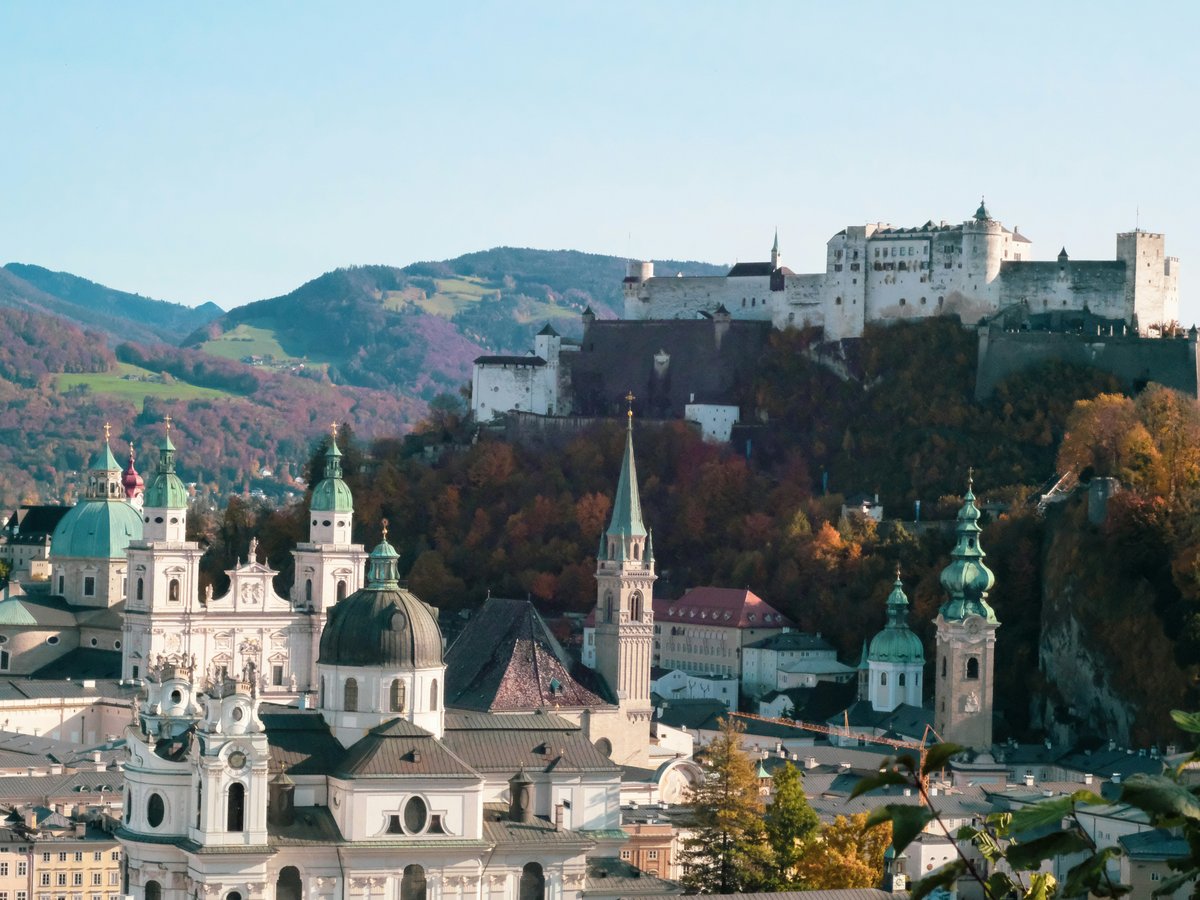
Stay in Salzburg in February
59 hotels in the Trip.com pool for Salzburg, from US$21 a night.
Opens Trip.com on Fri 5 Feb to Sun 7 Feb 2027; change the dates there.
February in Salzburg is properly cold. That's the first thing to know. Daytime highs sit around 4°C (39°F), and even when the sun catches the Baroque facades along Getreidegasse, it barely takes the edge off. Nights regularly drop to -3°C (27°F) and the cobblestones in the Altstadt turn slick with ice. Snow tends to linger on the Kapuzinerberg and Mönchsberg ridgelines, and the Untersberg south of the city stays white into March. You'll see your breath on the Staatsbrücke at 8 AM, and the Salzach runs gray-green and fast below.
To be fair, the cold brings a real upside. February is one of the quietest months in Salzburg, wedged between the December Christkindlmarkt crowds and the Easter and summer rush. You can walk through Mozart's Geburtshaus on Getreidegasse 9 without being elbowed along by tour groups, and the Festung Hohensalzburg feels like it belongs to you and a handful of locals.
The month sits in the heart of Fasching, Austria's carnival season. Faschingsdienstag (Shrove Tuesday) falls on February 17 in 2026 and February 9 in 2027, though in years when Easter is late it can slip into early March. Bakeries from Nonntal to Mülln pile their cases with Faschingskrapfen, fat doughnuts filled with Marillenmarmelade. For a proper sit-down meal after a cold afternoon, Stiftskeller St. Peter on St. Peter Bezirk 1 has been serving since 803 AD. The Tafelspitz comes with apple-horseradish and the vaulted stone dining room holds the chill at bay. Mind you, some smaller restaurants and most beer gardens stay closed until late March, and daylight fades before 5 PM through most of the month. By late February daylight reaches about 10.5 hours, up from 9.5 at the start. O-Bus lines 3 and 5 connect the Hauptbahnhof to the Altstadt in about 20 minutes, so there's no reason to brave the icy sidewalks on foot if you don't want to.
Why visit in February
- Hotel rates in the Altstadt run 30-40% below the July-August Festspiele peak, making 4-star stays affordable at prices that would buy a 3-star in summer.
- Major attractions like Festung Hohensalzburg and DomQuartier have virtually no queues, and you can linger in galleries and state rooms without being shuffled along.
- Fasching season brings Faschingskrapfen to every Konditorei in the city, and the small-scale carnival atmosphere in the Altstadt has a local warmth that larger cities' celebrations lack.
- Salzburg sits within 60-90 minutes of over a dozen ski resorts, and February typically has the season's deepest and most reliable snowpack.
Worth knowing
- Daylight is limited to roughly 9.5-10.5 hours, with sunset before 5:30 PM for most of the month. Outdoor sightseeing windows are short.
- Some smaller restaurants, most beer gardens, and a few seasonal attractions close from January through late March. The city operates at reduced capacity.
- Overcast skies are common. February in Salzburg can string together 3-4 gray days in a row, and the damp cold at 74% humidity feels more penetrating than the temperature alone suggests.
Best for
Think twice if
February brings genuine Central European winter to Salzburg. Daytime highs average 4.5°C (40°F), a couple of degrees above January's typical 2°C, but nights still dip to -3°C (27°F). Expect around 82mm of precipitation across roughly 11 days of rain or snow. Some of that falls as wet snow, particularly in the first half of the month and at higher elevations on the Mönchsberg or Gaisberg. Humidity sits around 74%, and overcast skies are common, though clear days offer sharp views of the snow-covered Alps from the Kapuzinerberg. The Föhn wind occasionally pushes afternoon temperatures 5-8°C above average for a day or two, creating short stretches of surprisingly mild air before the cold returns.
Seasonal caution
- Nighttime temperatures regularly drop below 0°C (32°F), and the Altstadt's cobblestoned streets and steep paths to the Festung Hohensalzburg ice over without warning. Waterproof boots with proper grip are essential, not a suggestion.
- The Föhn wind can arrive without much warning, raising temperatures by 5-8°C within hours but also triggering headaches and low pressure sensitivity in some people. Locals call it Föhnkrankheit. If you're prone to barometric-pressure headaches, bring medication.
Year-round climate
Averages from the last 5 years.
| Month | Avg high (°C) | Avg low (°C) | Rainfall (mm) |
|---|---|---|---|
| Jan | 6 | -3 | 95 |
| Feb | 9 | 0 | 82 |
| Mar | 12 | 1 | 83 |
| Apr | 14 | 3 | 98 |
| May | 18 | 9 | 165 |
| Jun | 25 | 14 | 104 |
| Jul | 25 | 15 | 166 |
| Aug | 24 | 15 | 171 |
| Sep | 21 | 11 | 146 |
| Oct | 17 | 7 | 89 |
| Nov | 10 | 1 | 113 |
| Dec | 6 | -1 | 100 |
Best things to do in February
Festung Hohensalzburg in winter quiet
sightseeingThe 1077 fortress sits 506 meters above the Altstadt and the funicular runs year-round. In February, the Fürstenzimmer (Prince's chambers) and the fortress museum are nearly empty. The rampart walk offers views across a snow-dusted city to the Untersberg, and on clear days the silence up top is striking.
February's low visitor numbers mean you can explore the fortress rooms and ramparts without tour-group congestion. Wait times for the funicular drop to near zero.Booking tipCheck the Festungsbahn website for current winter operating hours, which are shorter than summer. Last funicular up is typically around 5 PM in February.
Skiing from Salzburg as a base
outdoorObertauern sits about 90 minutes south by car, with reliable snow cover from November through April and terrain spread across 100km of runs between 1,630m and 2,313m. Ski Amadé, a network of 760km of linked runs, is reachable in roughly 70 minutes. Closer options include Gaißau-Hintersee, about 40 minutes west.
February typically sees the deepest snowpack of the Austrian ski season. Mid-week days outside Semesterferien avoid the weekend and holiday rush from Munich and Vienna.Booking tipRental shops in Salzburg near the Hauptbahnhof can be cheaper than resort-side rentals. Reserve ahead during Semesterferien week.
DomQuartier Museum circuit
cultureThe DomQuartier connects the Residenz, the Dom (cathedral), and the Erzabtei St. Peter through a sequence of galleries and staterooms above Residenzplatz. The route passes through the Residenzgalerie's 16th-to-19th-century European painting collection and offers elevated views of the Domplatz from the cathedral's organ gallery.
Winter means fewer visitors per room, and you can spend time with the Residenzgalerie's Rembrandts and Rubens without a crowd at your shoulder. The heated indoor circuit suits a cold February day.Booking tipA combined DomQuartier ticket covers all connected sections. Allow 2-3 hours for the full circuit.
Mozart's Geburtshaus and Wohnhaus
cultureMozart was born at Getreidegasse 9 in 1756. The Geburtshaus (birth house) covers his childhood, with original instruments including his child-sized violin. The Wohnhaus (residence) on Makartplatz 8, where the family moved in 1773, focuses on his later Salzburg years and has a larger collection of letters and scores.
February sits in the low season for both museums. In summer, the Geburtshaus can feel uncomfortably packed on its narrow staircase. In February you might share a room with 2-3 other visitors.Booking tipBoth houses are run by the Mozarteum Foundation. A combined ticket covers both and is valid across multiple days.
Stiegl-Brauwelt brewery tour
food_and_drinkStiegl has brewed in Salzburg since 1492. The Brauwelt on Bräuhausstraße in the Maxglan district walks through the brewing process, the history of beer in Salzburg province, and ends at a tasting room where you can sample seasonal and standard brews.
A 2-hour indoor activity that pairs well with a cold February afternoon. The brewery runs tours year-round and February rarely fills to capacity.Booking tipBrauwelt is a short O-Bus ride from the Altstadt. Check their website for English-language tour times, which are less frequent than German ones.
Kapuzinerberg winter walk
outdoorThe wooded hill on the east bank of the Salzach rises about 214 meters above the river. A walking path climbs from Linzer Gasse through forest to the Capuchin monastery at the top. In February, the path can be icy in patches but is generally passable. The view from the Stefan-Zweig-Weg over the Altstadt rooftops to the fortress is one of the best in the city.
Snow on the trees and low winter light give the Kapuzinerberg a stillness it lacks in summer. You'll likely have the upper paths to yourself on a weekday morning.Booking tipFree to walk. Wear boots with grip. The path from Linzer Gasse to the top takes about 20-30 minutes at a moderate pace.
Salzburg Museum at the Neue Residenz
cultureThe city's history museum on Mozartplatz covers Salzburg from Celtic and Roman Iuvavum through the prince-archbishops to the present. The top floor's panorama painting of the city from the 19th century is worth the visit alone. Temporary exhibitions rotate seasonally.
An unhurried indoor option for overcast February days. The museum tends to be quieter than the Festung or Mozart sites even in summer, and in February you'll often have galleries to yourself.Booking tipThe SalzburgCard, if you're visiting multiple paid sites, covers the Salzburg Museum along with most other attractions and public transport.
What to eat in February
On menus now
Pinzgauer Kasnocken
Salzburg province's signature cheese dumplings, made with local Pinzgau mountain cheese and finished with browned butter and fried onions. They appear on nearly every Gasthaus menu in winter and feel especially welcome after a cold February day on the Mönchsberg. The texture should be soft and slightly irregular, not smooth or gummy.
Leberknödelsuppe
A clear beef broth with a single large liver dumpling, served as a starter in virtually every traditional restaurant in the Altstadt. In February, ordering this before your main course is practically automatic. The good versions use a light hand with the breadcrumb binder so the dumpling stays tender, not dense.
Kaiserschmarrn
Shredded fluffy pancake dusted with powdered sugar and served with Zwetschkenröster (stewed plum compote). Traditionally a main course in Salzburg, not a dessert. On a cold February afternoon in the Stiftskeller or a Gasthaus on Linzer Gasse, the warm eggy sweetness and the tart plum hit differently than they would in July.
What to drink
Sturm (late-season)
The tail end of Austria's young wine season still appears at some Salzburg wine bars in early February, though availability depends on the vintage. By mid-month it's largely finished. Stiegl-Keller on Festungsgasse sometimes carries local Austrian whites alongside their beer menu through early February.
Festival food
Faschingskrapfen
Deep-fried yeast doughnuts filled with Marillenmarmelade (apricot jam), dusted with powdered sugar, and distinguished by a pale ring around the middle where the dough expanded in the hot oil. Every bakery and Konditorei in Salzburg produces them through Fasching season, typically from mid-January through Faschingsdienstag. The Stiftsbäckerei St. Peter near the abbey and Café Fürst on Brodgasse both do solid versions.
Regular events in February
Fasching (Carnival) celebrationsFree
Austria's carnival season runs from January 6 through Faschingsdienstag (Shrove Tuesday). Salzburg's observance is quieter than Vienna's or the Tyrolean versions but includes costumed events, children's parades in the Altstadt, and Faschingskrapfen in every bakery window. Faschingsdienstag falls on February 17 in 2026.
Through Faschingsdienstag (February 17, 2026; February 9, 2027)Mozartwoche
The Mozarteum Foundation's annual Mozart Week typically runs in late January and may extend into early February depending on the year. Concerts take place at the Mozarteum, the Residenz, and the Großes Festspielhaus, featuring international soloists and conductors performing Mozart's orchestral, chamber, and operatic works.
Late January into early February (check Mozarteum Foundation schedule)Salzburger Landestheater winter program
The Landestheater on Schwarzstraße runs a full winter repertoire of opera, ballet, and drama through February. Productions rotate nightly and the 700-seat house rarely sells out in February, so last-minute tickets are often available at the box office.
Throughout FebruaryBest places this February
Festung Hohensalzburg
landmarkThe 1077 fortress dominates the skyline from Festungsberg. February's low crowds let you explore the medieval state rooms, the Rainer Regiment museum, and the rampart panorama without being funneled through in a group. The funicular runs all winter.
Altstadt (Festungsberg)Getreidegasse
historic_streetSalzburg's most famous shopping street, lined with wrought-iron guild signs and narrow medieval passageways (Durchhäuser) that cut through to Universitätsplatz. In February, the street is manageable. Summer sees shoulder-to-shoulder foot traffic.
AltstadtDomQuartier and Salzburg Cathedral
museumThe connected museum circuit through the Residenz galleries, cathedral organ loft, and abbey collections is one of the best rainy-day options in the city. The Dom itself dates to 1628 in its current form and seats 10,000.
Altstadt (Residenzplatz)Stiftskeller St. Peter
restaurantOperating since 803 AD, this is likely Central Europe's oldest restaurant. The vaulted stone rooms stay warm in February, and the menu runs to traditional Salzburg dishes. Worth noting that reservations are a good idea on weekends even in low season.
Altstadt (St. Peter Bezirk)Mirabell Palace and Gardens
landmarkThe 1606 palace's Marble Hall hosts regular chamber concerts. The formal gardens are stripped back in February, but the views from the garden terrace across to the Festung are still the classic Salzburg postcard angle. The Zwergerlgarten (dwarf garden) is open year-round.
NeustadtHangar-7 at Salzburg Airport
museumRed Bull's aviation collection housed in a curved-glass hangar near the airport runway. Historic aircraft, Formula 1 cars, and rotating contemporary art exhibitions. The Ikarus restaurant inside holds 2 Gault-Millau toques. The hangar itself is free to enter.
Wals-Siezenheim (airport area)Café Tomaselli on Alter Markt
cafeOpen since 1705, Tomaselli is Salzburg's oldest coffee house. In February, the heated interior with its wood paneling and newspaper racks is a natural stopping point between sightseeing. The Einspänner (coffee with whipped cream in a glass) is the local order.
AltstadtUntersberg cable car
outdoorThe Untersbergbahn runs from St. Leonhard, about 15 minutes south of central Salzburg, to 1,776 meters. February conditions at the summit are full alpine winter. Clear days give views as far as the Bavarian plain. Check wind conditions before going, as the cable car closes in high winds.
Grödig / St. Leonhard
Your packing checklist
Tick items off as you pack. Your progress saves in this browser.
All packed — have a great trip.
Insider tips
The SalzburgCard covers most museum admissions, the Festungsbahn funicular, and unlimited public transport. In February, when you're likely moving between indoor attractions to escape the cold, it tends to pay for itself quickly over 2-3 days of sightseeing.
The Durchhäuser (passageways) off Getreidegasse cut through to Universitätsplatz and the Grünmarkt. In February, ducking through these narrow corridors gets you out of rain or sleet and into the covered market area where vendors sell local cheeses, Speck, and bread.
Stiegl-Keller on Festungsgasse, halfway up the hill to the Festung, is a Salzburg institution. It stays open in winter and serves Stiegl beer with views over the Altstadt rooftops. Most visitors walk past it heading to the funicular.
The Mönchsberg elevator from Anton-Neumayr-Platz takes you to the top of the ridge in under a minute. The Museum der Moderne Salzburg sits at the top, and the walk along the Mönchsberg ridge to the Festung is about 20 minutes, mostly flat and sheltered by trees.
If the Föhn wind is blowing on a February afternoon, the sudden warmth can reach 10-12°C. Locals know to take the unexpected mild spell outdoors. You might see people sitting on benches in Mirabellgarten without coats while the rest of the week was below freezing.
Avoid these mistakes
- Assuming every restaurant is open. Several smaller Gasthäuser and nearly all beer gardens close from early January through late March. Check ahead if you have a specific place in mind, especially in Nonntal and the neighborhoods outside the Altstadt core.
- Wearing smooth-soled shoes or fashion boots. The steep Festungsgasse path ices over, the Linzer Gasse hill toward Kapuzinerberg gets slippery, and even flat Residenzplatz can be treacherous after an overnight freeze. Proper tread matters.
- Packing only for cold without rain gear. February averages about 11 precipitation days, and the mix of rain, sleet, and wet snow can soak through a wool coat that handles dry cold perfectly well.
- Planning a Sound of Music locations tour expecting green Alpine meadows. Leopoldskron Palace and the Mirabell Gardens are accessible, but hillside filming locations outside the city are often muddy or snow-covered, and the landscape looks nothing like the film's summer imagery.
- Underestimating how early it gets dark. Sunset is before 5:30 PM through most of February. If you want daylight photos from the Kapuzinerberg or the Mönchsberg, start your outdoor sightseeing before noon.
Practical tips for February
February in Salzburg runs on winter hours. Most museums open at 9 or 10 AM and close by 5 PM, with some closing earlier on Mondays. The Festungsbahn funicular has reduced winter hours, so check the last departure time before heading up in the afternoon. O-Bus lines 3, 5, and 6 connect the Hauptbahnhof to the Altstadt reliably, running roughly every 10-15 minutes. Salzburg Airport (SZG) sits 4km west of the city center, and Bus 10 connects the terminals to the Hauptbahnhof in about 20 minutes. If you're day-tripping to ski resorts, the ÖBB regional trains and PostBus services reach Obertauern and Bad Gastein, though driving gives more flexibility for early starts. Semesterferien (Austrian school winter holidays, typically the second week of February in Salzburg province) brings families to the ski areas, but the city itself stays quiet. Restaurant reservations for weekend dinners at popular spots like Stiftskeller St. Peter are worth making a day or two ahead even in low season.
FAQ
Is February a good time to visit Salzburg?
It depends on what you're after. February is cold, gray, and short on daylight, with highs around 4°C and sunset before 5:30 PM. That said, it's one of the quietest months for tourism in Salzburg. Hotel rates drop 30-40% below summer, queues at the Festung and Mozart museums are minimal, and you'll experience the city more as locals do. If you're comfortable in winter weather and your interests lean toward museums, classical music, and indoor culture, February is a genuinely good time. If you want beer gardens, long twilight walks, and green Alpine scenery, wait for June.
Does it snow in Salzburg in February?
It can. February averages about 82mm of precipitation across 11 days, and a portion falls as snow, particularly in the first half of the month. Snow tends to stick on the elevated areas like Kapuzinerberg and Mönchsberg but often turns to slush in the Altstadt within a day or two. The surrounding mountains, including the Untersberg, stay snow-covered through March.
Can I ski from Salzburg in February?
Salzburg is one of the better European city bases for skiing. Obertauern is about 90 minutes south by car, Ski Amadé (760km of linked runs) is roughly 70 minutes, and smaller resorts like Gaißau-Hintersee sit about 40 minutes west. February typically has the deepest snowpack of the season. ÖBB trains and PostBus reach some resorts, though a rental car offers more flexibility for early starts.
What should I wear in Salzburg in February?
Layer for sub-zero mornings and damp, above-zero afternoons. A thermal base layer, a fleece or down mid-layer, and a waterproof winter coat form the core. Waterproof boots with aggressive tread are genuinely important on Salzburg's cobblestones and steep paths, which ice over regularly. Hat, gloves, and scarf are daily necessities, not optional extras. Bring an umbrella for the frequent light rain.
Is the Salzburg Christmas market still running in February?
No. The Christkindlmarkt on Residenzplatz and Domplatz typically ends on December 26 or January 1, depending on the year. By February the stalls are long gone. The winter atmosphere is still present in the Altstadt's cafes and restaurants, but the market-specific experience is a November-December event.
Things to Do in Salzburg in February
 Free cancellation
 Hallstatt Half-Day Tour from Salzburg
Day trip: 5.5 hours, free cancellation.
via Viator Free cancellation
 Skip-The-Line Salt-Mines and Bavarian Mountains Tour from Salzburg
Outdoor experience: 4 hours, free cancellation.
via Viator Free cancellation Salzburg Super Saver: Original Sound of Music and Salt Mines Day Trip
Day trip: 9.2 hours, free cancellation.
via Viator Free cancellation
 Public 8h tour to sites of "The Sound of Music Movie" & Hallstatt
Day trip: 8 hours, free cancellation.
via Viator Free cancellation
 Private Full-Day Tour of Hallstatt and Salzkammergut from Salzburg with Options
Day trip: free cancellation.
via Viator Free cancellation
 Private Tandem Paragliding Salzburg Mt Gaisberg
Outdoor experience: free cancellation.
via ViatorFind a flight to Salzburg
Live fares to Salzburg appear here once cookies are accepted.
Last verified by automated review (v1.7.2) on . What is automated review?