Stay in Savannah in March
35 hotels in the Trip.com pool for Savannah, from US$52 a night.
Opens Trip.com on Fri 5 Mar to Sun 7 Mar 2027; change the dates there.
March in Savannah belongs to St. Patrick's Day. The city's parade, a tradition since 1824, is one of the largest in the United States, and the week surrounding March 17 transforms the Historic District into a citywide celebration. Fountains in Forsyth Park are dyed emerald green. River Street fills shoulder to shoulder. If you want to be here for the parade, book months in advance, because rooms within walking distance of the route tend to sell out by January.
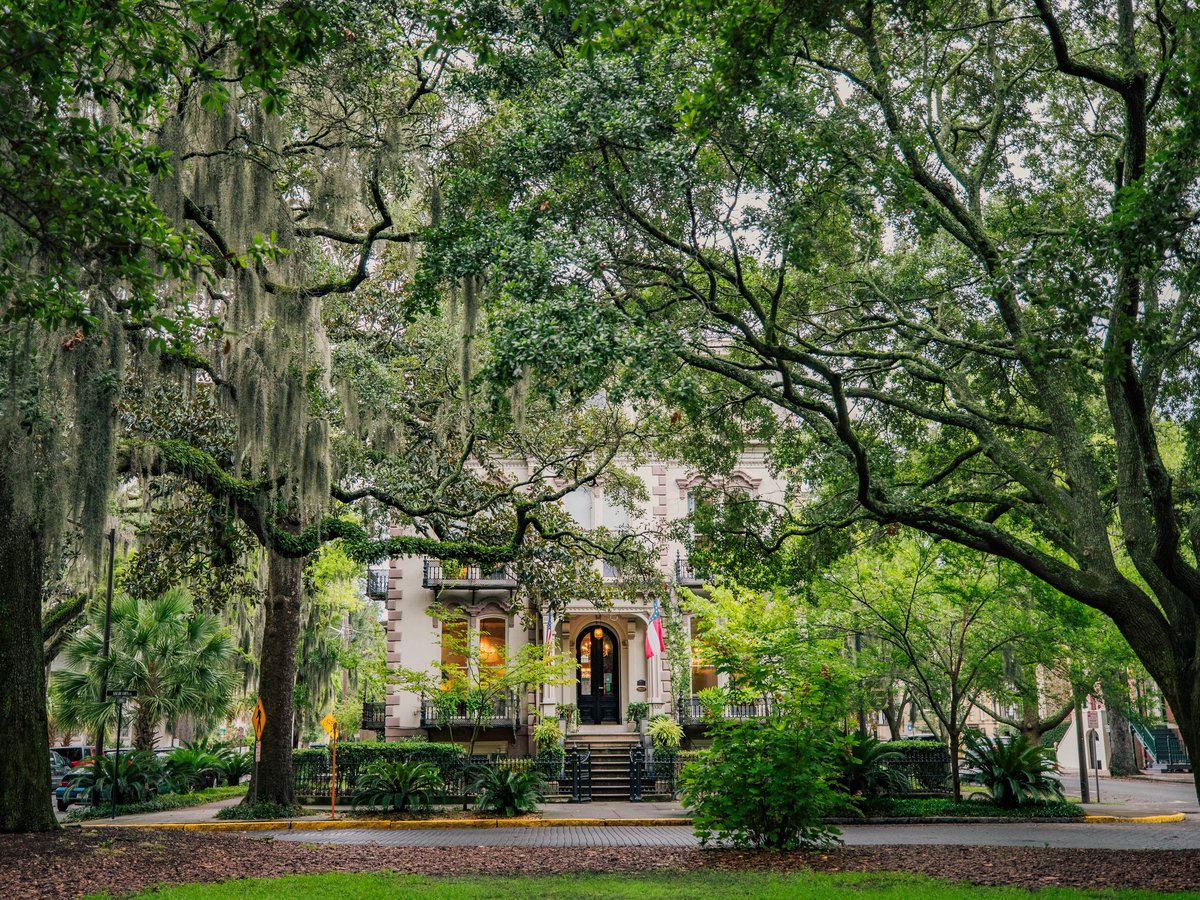
Outside that single loud week, March settles into what might be Savannah's most appealing season. Azaleas start blooming across Ardsley Park and the Victorian District in thick waves of pink and white against Spanish moss. Summer heat hasn't arrived, mosquitoes are still mostly dormant, and the city's 22 public squares feel comfortable for walking from morning through sunset.
Mind you, March is not a quiet month by any measure. Spring-break visitors overlap with the St. Patrick's crowd, and the Savannah Music Festival opens in the final week. If calm and uncrowded is the priority, October might suit better. Azalea season and comfortable temperatures put March in the city's top 3 months for hotel occupancy alongside October and April.
Why visit in March
- Azaleas peak in late March, with the thickest seasonal displays along residential streets in Gordonston and the squares south of Gaston Street.
- Mild temperatures between January's cold snaps and the oppressive humidity that arrives by June, ideal for 3-4 hours of daily walking.
- The Savannah Music Festival opens its multi-week run with jazz, classical, and roots acts across a dozen historic venues.
- Coastal attractions including Tybee Island's 5 km (3 mi) of beach are warm enough to enjoy without summer crowds.
Worth knowing
- The parade weekend brings extreme crowds to the Historic District, with noise levels in nearby lodgings that make sleep difficult from Thursday through Sunday.
- March has more rain than any month between November and May, and afternoon downpours can cut short outdoor plans for an hour or two.
- Tree pollen from live oaks and pines reaches annual highs, and the dense canopy over the squares concentrates it at street level.
- Hotel rates during the parade reach their annual peak, and last-minute availability within the Historic District is nearly zero.
Best for
Think twice if
Savannah in March feels like early spring with a coastal edge. Highs average 22°C (72°F) and lows settle near 11.8°C (53°F), so mornings can feel cool enough for a light jacket while afternoons warm into t-shirt weather. Rainfall totals about 110mm across 10 days, typically as afternoon showers that clear within 30 to 60 minutes. Humidity sits around 70%, noticeable but nothing like the 85-90% of July and August. The occasional cold front can still drop nighttime temperatures into single digits Celsius, though that grows increasingly rare by late March. You might get one or two genuinely warm days that push toward 27°C (80°F), a preview of what April brings.
Seasonal caution
- Live oaks and longleaf pines release heavy pollen loads in March. Savannah's tree canopy concentrates pollen at pedestrian level in the squares, and vehicles, benches, and outdoor dining surfaces develop a visible yellow-green coating. Pack antihistamines and consider a nasal spray even if your allergies are usually mild at home.
- Spring severe thunderstorms can develop across Chatham County, occasionally producing hail and brief tornado watches. These storms usually pass within 30 minutes but can bring intense wind and heavy downpours while active.
Year-round climate
Averages from the last 5 years.
| Month | Avg high (°C) | Avg low (°C) | Rainfall (mm) |
|---|---|---|---|
| Jan | 16 | 6 | 79 |
| Feb | 19 | 9 | 77 |
| Mar | 22 | 12 | 110 |
| Apr | 25 | 15 | 69 |
| May | 28 | 19 | 88 |
| Jun | 31 | 22 | 132 |
| Jul | 32 | 24 | 156 |
| Aug | 31 | 24 | 232 |
| Sep | 29 | 21 | 126 |
| Oct | 25 | 16 | 72 |
| Nov | 21 | 11 | 78 |
| Dec | 18 | 8 | 83 |
Holidays and festivals in March
Public holidays
- Good Friday(Good Friday)26 March 2027
Headline events
Savannah St. Patrick's Day Parade
March 17 (held on the date itself regardless of day of week)
One of the oldest and largest St. Patrick's Day parades in the country. The multi-hour procession winds through the squares along Bull Street and Abercorn Street, and open containers are permitted on the city streets, which gives the day a freewheeling atmosphere that runs well into the night. Spectators line the route from early morning.
Best things to do in March
Watch the St. Patrick's Day Parade
festivalThe parade route passes through some of Savannah's most scenic squares, and the procession lasts over 3 hours. The blocks between Madison Square and Monterey Square tend to have the most concentrated atmosphere.
The parade runs once a year, and nothing else on Savannah's calendar approaches its scale.Booking tipFree to watch. Most spectators claim curbside spots by 8am. Johnson Square and Chippewa Square are popular vantage points.
Walk the azalea paths in Forsyth Park
natureThe park's 12 hectares (30 acres) fill with blooming azaleas in late March, particularly along the paths between the fountain and the south end near the Fragrant Garden. The contrast of pink and white blossoms against live-oak canopy and Spanish moss is the city's most photographed spring scene.
Azaleas typically peak in the last 2 weeks of March, with timing shifting by a week depending on winter temperatures.Booking tipNo booking needed. Early morning before 9am offers the best light and thinnest crowds.
Tour Bonaventure Cemetery
cultureBonaventure Cemetery, established in 1846, sits on a bluff above the Wilmington River about 5 km (3 mi) east of the Historic District. Its live-oak alleys draped in Spanish moss and Victorian-era sculptures make it one of the most atmospheric cemeteries in the Southeast. The site became well known through the cover photograph of the novel 'Midnight in the Garden of Good and Evil.'
March temperatures make the 2-3 hour walking tour comfortable. Summer's exposed heat above 32°C (90°F) makes the same walk physically draining.Booking tipSelf-guided visits are free. Guided tours from local operators sell out on weekends in March, so book 3-5 days ahead.
Visit Fort Pulaski National Monument
historyFort Pulaski, whose construction began in 1829, sits on Cockspur Island about 24 km (15 mi) east of downtown. Its walls exceed 2 meters (7.5 ft) in thickness, and the 1862 Union bombardment here proved that rifled cannons could defeat masonry fortifications, a result that reshaped military engineering.
Warm enough to walk the ramparts and nature trails without the biting insects and oppressive heat of June through September.Explore the Starland District on foot
neighborhoodThe Starland District, centered on Bull Street south of 37th Street, has become Savannah's most active neighborhood for independent restaurants, coffee shops, and small galleries. The area is walkable and less tourist-dense than the squares to the north.
March temperatures make the 15-20 minute walk south from the Historic District comfortable, and the outdoor patios are enjoyable before summer humidity arrives.Attend Savannah Music Festival opening concerts
cultureThe festival stages performances in intimate historic venues, including the Trustees Theater on Broughton Street. Opening-week shows tend to feature a mix of established and emerging artists across jazz, bluegrass, classical, and world music.
The festival's first performances fall in late March, with less ticket pressure than the headline acts scheduled for April.Booking tipTickets for individual shows go on sale weeks ahead. Popular acts sell out, but weeknight performances often still have availability.
Kayak the marsh creeks near Isle of Hope
outdoorThe tidal marshes east of Savannah are accessible by kayak from launch points near Isle of Hope and Skidaway Island. March water temperatures hover around 16-18°C (61-64°F), cool but tolerable, and the marshes hold wading birds, fiddler crabs, and the occasional dolphin in Skidaway Narrows.
Water is warm enough to paddle comfortably, wildlife is active in the warming marshes, and the biting insects that plague summer kayaking haven't emerged.Booking tipOutfitters near Isle of Hope rent single and tandem kayaks. Weekend morning slots in March fill up, so book 2-3 days ahead.
What to eat in March
In season: fruit
Georgia strawberries
Early-season strawberries from farms south of the city appear at the Forsyth Farmers Market on Saturdays starting in March. They tend to be smaller and more tart than California varieties, with a concentrated sweetness.
On menus now
She-crab soup
Blue crabs become more active in the warmer marsh waters of March, and she-crab soup made with crab roe appears on menus across the city. The soup is rich and creamy, typically finished with a splash of dry sherry.
Street food peaks
Boiled peanuts
Street vendors and roadside stands increase in March as temperatures rise. Savannah's version is cooked in salted water for hours until soft and briny, with Cajun-spiced varieties common at outdoor events.
In markets
Georgia white shrimp
Wild-caught spring shrimp from the coast near Thunderbolt are smaller and sweeter than their summer counterparts. Most Savannah restaurants feature them in shrimp and grits or fried baskets through March and April.
Festival food
Corned beef and cabbage
St. Patrick's Day brings corned beef and cabbage to nearly every restaurant and pub in Savannah for the week around the parade. Local spots tend to serve it with colcannon or soda bread on the side.
Regular events in March
Savannah Tour of Homes and Gardens
An annual walking tour of private historic homes and gardens, typically opening 8-10 residences in the Historic and Victorian Districts that are not otherwise accessible to the public.
Late March, usually the last weekendSavannah Stopover Music Festival
A 3-day independent music festival showcasing emerging bands across small venues and bars in the Historic District and Starland District. The lineup leans toward indie rock, folk, and experimental acts.
Early to mid-March, dates vary by yearSavannah Music Festival opening week
The city's premier multi-genre music festival begins its run in late March, with performances in historic churches, theaters, and civic spaces across the city.
Last week of March, continuing into AprilFirst Saturday on the RiverFree
A monthly community gathering on River Street with live music, food vendors, and open-air entertainment along the Savannah River waterfront.
First Saturday of MarchBest places this March
Forsyth Park
parkEstablished in 1840, the park includes the Fragrant Garden near the south entrance, a quieter area away from the busy fountain plaza. Early mornings before 8am, the east-side paths are nearly empty, and the oak canopy filters soft light through Spanish moss.
Victorian DistrictWormsloe Historic Site
historic siteThe 2.4 km (1.5 mi) avenue of live oaks at the entrance is one of the most photographed roads in Georgia. In March, the light through the canopy carries a particular warmth before summer's full leaf-out, and the grounds around the colonial-era tabby ruins are free of the gnats and mosquitoes that dominate summer visits.
Isle of HopeCathedral of St. John the Baptist
landmarkCompleted in 1873 on Lafayette Square, the cathedral's stained-glass windows catch morning light between 9 and 11am with notable intensity. The painted ceiling and interior murals are worth the visit even for those who have only admired the twin spires from the street.
Historic DistrictTelfair Museums
museumFounded in 1886, the Telfair Academy and its companion Jepson Center on Telfair Square house American and European art spanning three centuries. March rain days make these a strong indoor alternative, and the permanent collection alone takes 2-3 hours.
Historic DistrictSCAD Museum of Art
museumOpened in 2002 in a converted railroad building, the museum rotates exhibitions roughly every quarter. March often coincides with spring exhibition openings tied to the Savannah College of Art and Design's academic calendar.
Historic DistrictMercer House
historic houseBuilt in 1868 on Monterey Square, this Italianate mansion became central to the 'Midnight in the Garden of Good and Evil' story. Guided tours of the main floor run daily, and the square's afternoon shade makes March a comfortable time to sit on the benches and take in the surrounding architecture.
Historic DistrictCongregation Mickve Israel
historic siteFounded in 1733, this is one of the oldest Jewish congregations in North America. The Gothic Revival synagogue houses 18th-century Torah scrolls and documents carried to Savannah by the city's original Jewish settlers.
Historic District
Your packing checklist
Tick items off as you pack. Your progress saves in this browser.
All packed — have a great trip.
Insider tips
The squares north of Oglethorpe Avenue are the most tourist-heavy, especially around Johnson Square. For a quieter walk, start at Calhoun Square or Whitefield Square in the southern Historic District and work your way north.
Locals who want to watch the parade without the crush position along the cross-streets perpendicular to the route rather than on Bull Street itself. The blocks between Chippewa Square and Madison Square tend to have room even at peak.
If you're here during the parade weekend, Historic District restaurants will have wait times past 90 minutes for dinner. The Starland District and Habersham Village in Midtown have comparable food quality with a fraction of the wait.
The city's open-container law applies only within the Historic District boundaries, roughly from Victory Drive to the south and the river to the north. Drinks must be in plastic cups, not glass bottles or cans.
Tybee Island, 30 minutes east by car, is warm enough for beach walks in March, but the water still sits around 16-17°C (61-63°F). Locals wade, though most wait until May to swim.
Avoid these mistakes
- Booking a hotel on River Street or Bay Street for the parade weekend without realizing the noise from street celebrations can last until 3am. If sleep matters, stay in the Victorian District or Ardsley Park and take a rideshare to the parade.
- Choosing shoes for style over grip. The city's historic surfaces reward rubber soles and punish anything smooth-bottomed, especially after afternoon rain.
- Driving into the Historic District expecting easy parking on parade day. Streets close from the morning of the parade, and finding a space becomes a 30-45 minute ordeal. Park in one of the public garages along the periphery and walk in.
- Packing only warm-weather clothes. March mornings are cooler than many visitors expect, especially during the first two weeks when cold fronts from the interior still push through. Without a jacket, early walks through the squares are uncomfortable.
Practical tips for March
Reserve accommodations 3-4 months ahead if your trip overlaps with St. Patrick's Day week, as Historic District availability disappears early. For the rest of March, 2-3 weeks' notice is usually sufficient. Many restaurants in the Historic District switch to limited menus or close entirely on parade day, so plan dining alternatives in the Starland District or Midtown. Public restrooms are scarce during the parade. The Visitor Center on Martin Luther King Jr. Boulevard and the restrooms inside City Market are the most reliable options. If you plan to visit Tybee Island, Wormsloe, or Fort Pulaski, rent a car or arrange a rideshare since public transit to all three locations is infrequent. Savannah's humidity causes sunscreen to wear off faster than in dry climates, so reapply every 90 minutes during extended outdoor sightseeing.
FAQ
Is March a good time to visit Savannah?
March is one of Savannah's strongest months for visitors. The weather is comfortable for walking, azaleas bloom across the parks and residential neighborhoods, and the St. Patrick's Day parade is the city's largest annual event. The trade-off is higher-than-average hotel pricing and significant crowds around mid-month.
What is the weather like in Savannah in March?
Spring weather with a coastal influence. Days are warm enough for short sleeves by afternoon, and mornings cool enough for a light layer. Rain shows up roughly every 3 days, usually as afternoon showers that pass within an hour. Humidity is noticeable but well below the oppressive levels of midsummer.
Is Savannah crowded in March?
Yes, particularly around St. Patrick's Day when the city's population effectively multiplies for a long weekend. The rest of March sees spring-break visitors and early-season tourists, keeping the Historic District busy but not overwhelming. The final week tends to thin out as the parade energy fades.
Do I need a car in Savannah?
For the Historic District and surrounding neighborhoods, no. The squares are walkable, and most central attractions sit within a 2 km (1.2 mi) radius. For Tybee Island, Wormsloe, or the coastal sites, you will need a car or rideshare since bus service runs infrequently to those areas.
When do azaleas bloom in Savannah?
Peak azalea season typically falls in the last 2-3 weeks of March, though the exact timing shifts by a week or so depending on how cold the preceding winter was. By early April, most blooms have passed their peak. The densest displays tend to be in the southern residential neighborhoods rather than along the main tourist corridor.
Things to Do in Savannah in March
 Free cancellation
 Savannah Hop-On Hop-Off Trolley Tour
City tour: free cancellation.
via Viator Free cancellation
 Savannah First Squares Culinary & Cultural Walking Food Tour
City tour: 3 hours, free cancellation.
via Viator Free cancellation
 Narrated Historic Savannah Sightseeing Trolley Tour
City tour: 1.2 hours, free cancellation.
via Viator Free cancellation
 Savannah Land & Sea Combo: City Sightseeing Trolley Tour with Riverboat Cruise
Cruise: 5 hours, free cancellation.
via Viator
Southern Flavors Food, Pub Crawl, and History Walking Tour
City tour: 3 hours.
via Viator Free cancellation
 Savannah to Tybee Island with Dolphin Cruise
Day trip: free cancellation.
via ViatorFind a flight to Savannah
Live fares to Savannah appear here once cookies are accepted.
Last verified by automated review (v1.7.2) on . What is automated review?