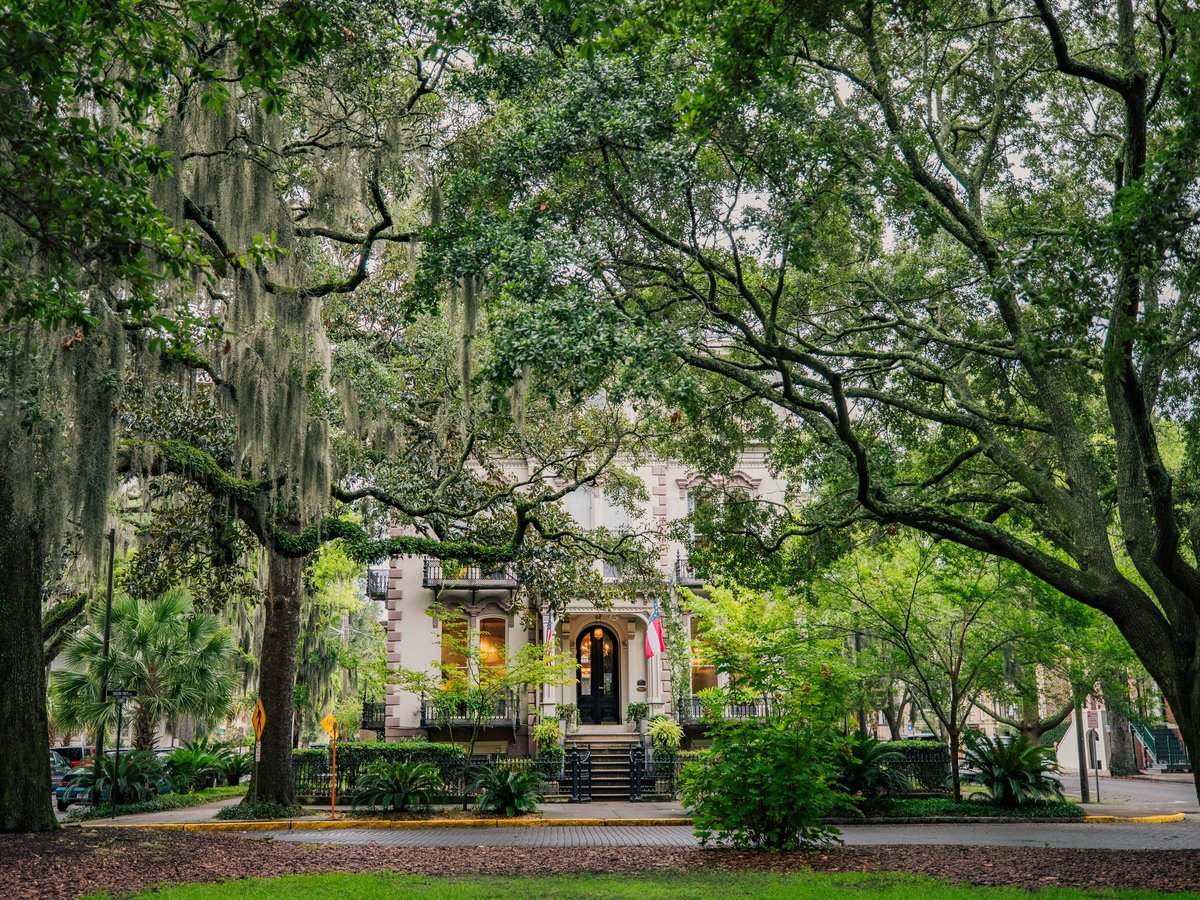
Most of Savannah's essential sights are made of stone, brick and memory: houses of worship, forts and monuments, not attractions built to sell tickets. Congregation Mickve Israel dates from 1733, the Savannah Theatre from 1818, Fort Pulaski National Monument from 1829 and the Cathedral of St. John the Baptist from 1873, and the record keeps going after that. This list is for the visitor who would rather understand a city than collect it, which means slow walks, quiet interiors and a willingness to read a memorial as evidence and not as decoration. Expect working sanctuaries where worshippers come before sightseers, forts that reward a slow afternoon, and monuments that tell you as much about who did the remembering as about who is remembered. Pace yourself. Two or three of these done properly will teach you more than all twelve rushed between lunch reservations.
-
1 Cathedral of St. John the Baptist
222 East Harris Street, Savannah, GA 31401An 1873 cathedral interior that counts as a contributing property on the National Register of Historic Places
At 222 East Harris Street, in the 31401 postal area, the Cathedral of St. John the Baptist is the interior on this list most worth planning a morning around. The building dates from 1873 and is a contributing property on the National Register of Historic Places. Skip the quick photo from the pavement that so many walking groups settle for, go inside, sit near the back and give your eyes a minute to adjust before you start hunting for details. Treat it as a church first and a sight second: keep your voice low and dress as you would for any parish. Check the cathedral's own site, savannahcathedral.org, before you go, so your visit fits around the people who come to pray.
Dates from 1873 · National Register of Historic Places contributing property
-
2 Congregation Mickve Israel
20 East Gordon Street, Savannah, 31401A synagogue whose congregation dates from 1733, on the National Register of Historic Places
Dating from 1733, Congregation Mickve Israel keeps its synagogue at 20 East Gordon Street in 31401, and that founding date carries real weight: Jewish life was part of Savannah's story almost from the start, not added later. The site is listed on the National Register of Historic Places. A drive-by from a trolley seat misses what matters here. This is a place to stand still in and approach with the courtesy you would show any active house of worship. Read mickveisrael.org before you set out and plan around what it tells you. Come with questions, and leave the selfie stick at the hotel.
Dates from 1733 · National Register of Historic Places listed place
-
3 Fort Pulaski National Monument
A national monument whose fort dates from 1829 and is listed on the National Register of Historic Places
Late afternoon light catches the walls of Fort Pulaski National Monument, and that is the hour to be there. The fort dates from 1829 and is a national monument in the United States, listed on the National Register of Historic Places. Skip the souvenir-shop version of the past, all cannonball keyrings and costumed photo ops. Give this place half a day and walk it slowly, and you will think harder about how and why a coast gets fortified than any plaque could make you. Wear proper shoes, carry water, and do not try to squeeze it in between two other stops. Rush through it and you are left with masonry.
Dates from 1829 · National Register of Historic Places listed place
-
4 Casimir Pulaski Monument
A Savannah monument to Casimir Pulaski, best seen on foot in early light
The Casimir Pulaski Monument in Savannah, Georgia is best met on foot and early, before the streets fill. Avoid the midday crush, when tour groups bunch around every marker and nobody can hear their own guide. Come first thing with a coffee, read the inscriptions slowly, and pay attention to how the monument holds the space around it. The light is softer in the early hours, and so is the noise. Keep walking after: monuments here work best as a chain of stops, not a destination in themselves. Five quiet minutes here are worth more than twenty spent jostling for the same angle as everyone else.
-
5 Laurel Grove North Cemetery
2101 Kollock Street, Savannah, GA 31415A cemetery dating from 1850, out in the 31415 postal area
Out at 2101 Kollock Street, in the 31415 postal area, Laurel Grove North Cemetery dates from 1850, and it is a cemetery in Savannah, Georgia that rewards the visitor who wants the city's past without a script. Skip the over-photographed burial grounds every tour bus queues for. This one asks you to wander, read the names, and draw your own conclusions about who was remembered and how. Go in the cooler hours, wear sensible shoes, and treat it as what it is: a place families still have ties to. Bring nothing you would not carry into a church, and leave with more questions than you arrived with.
Dates from 1850
-
6 Savannah Theatre
222 Bull Street, Savannah, GA 31401A theatre and music venue, once a movie theater, whose history runs back to 1818
Curtain-up at the Savannah Theatre, 222 Bull Street in 31401, takes place in a building whose record runs back to 1818. It is a music venue and theatre now, and was once a movie theater, and that layered history is the reason to buy a seat rather than pass the facade. An evening here puts you in a room that has entertained the city for a very long time, which is a different proposition from the generic dinner-show circuit that recycles the same act in every tourist town. Check the programme before you commit, pick something that suits you, and arrive early enough to take in the house before the lights go down.
Dates from 1818
-
7 Confederate Monument
A war memorial in Savannah, best read as a historical document
Evening light fades slowly over the Confederate Monument, a war memorial in Savannah, Georgia, and it belongs on a must-see list because it shows how a city chose to remember, not because it deserves admiration. Tour scripts that treat it as decoration or a backdrop for photos are missing the point. Read it as a document: ask who paid for it, who it speaks to and who it leaves out, then hold that against the other sites on this list. Visit with some background reading done, and give yourself time afterwards to talk it through. The point of standing here is to think, not to tick a box.
-
8 William Jasper Monument (Savannah)
A Savannah monument worth working into a slow walking loop
Pause at the William Jasper Monument (Savannah), a monument in Savannah, Georgia, as one stop in a longer walk rather than a destination on its own. The locals know these monuments read best on foot, linked together in an unhurried loop; from a car window they blur into one. Stand long enough to read whatever it has to say, then look at the streets around it and how the city arranges itself around its memorials. Mornings are quieter and kinder on the feet. Carry water, skip the hop-on bus for this stretch and let the walk set the pace.
-
9 Independent Presbyterian Church
A Savannah church building for visitors who care about how sacred spaces are made
Anyone who cares about church buildings will want the Independent Presbyterian Church, a church building in Savannah, Georgia, on their route. Skip the hurried exterior shot and, where the doors allow, step inside to see how the space is put together: how light and proportion shape the room, and how a congregation's habits show up in the furniture. Dress modestly and keep conversation low, because this is a place of worship before it is a sight. Pair it with the cathedral and the synagogue elsewhere on this list for a morning that shows how differently faith communities built in one city.
This is an early version of the Savannah list. We add picks as we test more places.
Last verified by automated review (v1.7.2_fame1017b-1015-4264-20261016233710) on . What is automated review?