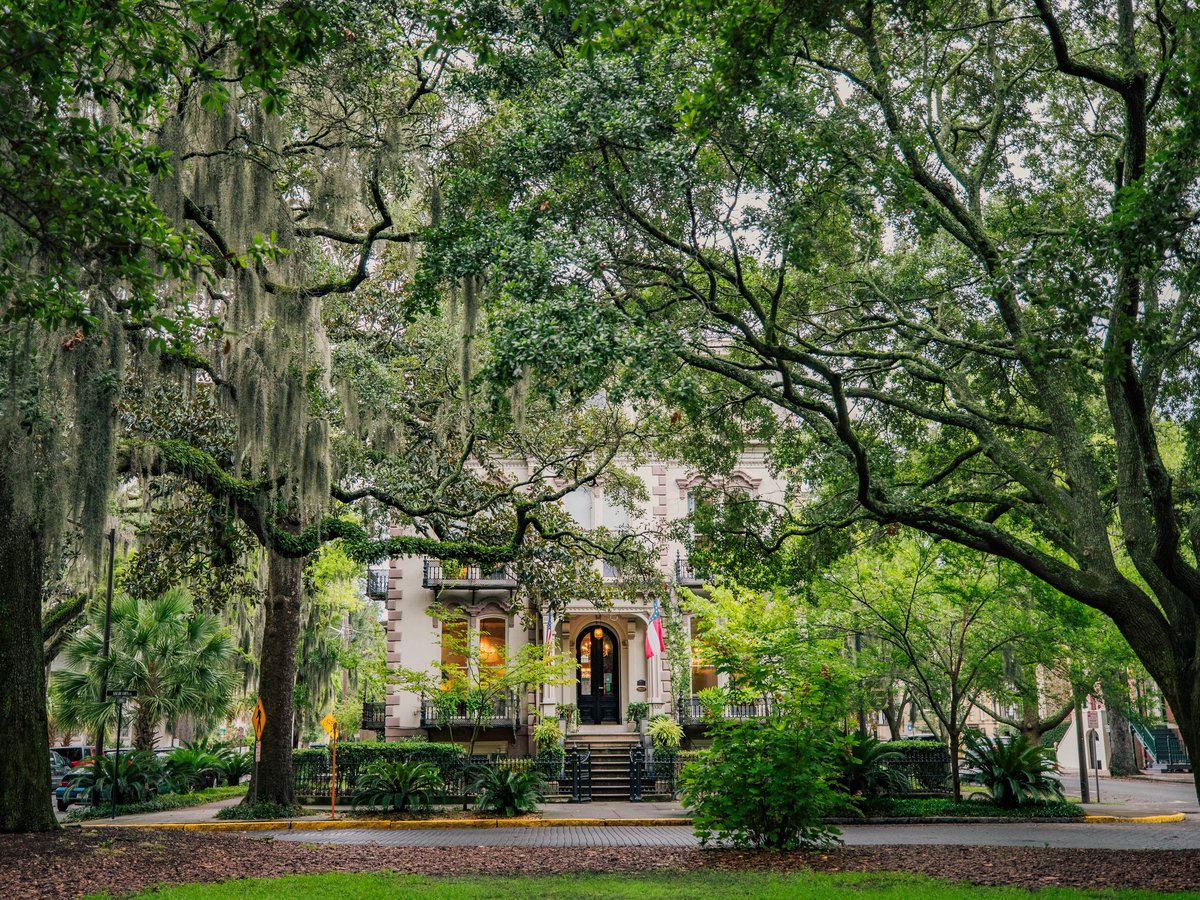
Savannah sits on a bluff above the Savannah River, still shaped by the grid James Oglethorpe designed when he founded the colony in 1733. His original squares survive as small parks under live oak canopy. The squares lay out the city's core as a walkable rectangle about 1 mile north to south. The Historic District holds that entire grid, from River Street at the waterfront down to Forsyth Park. South of the park, the Victorian District gives way to the Starland District and then Midtown, each progressively more residential and less tourist-trafficked. Tybee Island sits 20 miles east at the coast. The free DOT shuttle and Chatham Area Transit buses cover the downtown core well enough to skip a rental car (see https://en.wikivoyage.org/wiki/Savannah#Get_around for route maps). Worth noting, September still feels like deep summer here. The temperature currently reads 25.6°C with 93% humidity, and the air carries that thick, warm weight Savannah holds well into October.
Neighborhoods
-
Historic District
This is the Oglethorpe grid. Twenty-two squares connected by oak-lined streets, all built to roughly the same 200-foot dimensions but each with its own personality. The architecture runs from Georgian townhouses to Greek Revival mansions, most of them 2 to 4 stories, all built close to the sidewalk. Spanish moss hangs low enough to brush your shoulders in places. Bull Street runs the full north-south spine, and Broughton Street cuts east-west as the main commercial corridor with independent shops, galleries, and SCAD students on every other corner. Jones Street stays residential and quiet at night. Broughton gets loud on weekend evenings. You might notice that the district smells different block to block. Sweet olive trees near the squares give way to roasting coffee near Broughton, then river mud near the bluff. Telfair Museums, founded in 1886, sits on Telfair Square and houses a strong collection of American and European paintings (see https://en.wikivoyage.org/wiki/Savannah#See for a fuller list). Monterey Square alone holds three landmarks. Mercer House, completed in 1868, stands on the west side. Congregation Mickve Israel, founded the same year the colony was established, occupies a Gothic Revival synagogue on the south. The Casimir Pulaski Monument marks the center of the square.
- Best for
- First-time visitors, couples, and history-focused travelers who want walkable access to restaurants and most of the city's landmarks
- Key streets
- Bull Street (central spine through most squares), Broughton Street (shopping and restaurants), Jones Street (the quietest residential block), Abercorn Street (connects several squares including Lafayette), and Monterey Square
-
River Street and Factors Walk
The waterfront runs along the base of the bluff, one level below Bay Street. River Street's cobblestones are old ballast stones from 18th-century trading ships, and they're rough enough to make heels or thin-soled shoes a bad idea. The cotton warehouses lining the south side have been converted into restaurants, candy shops, and bars, mostly tourist-oriented. That said, the views of container ships passing within 50 feet of the railing are worth the crowds. The Savannah River is a working shipping channel, and the horn blasts from those vessels rattle your chest when they pass. Factors Walk connects Bay Street down to River Street via iron catwalks and stone stairways, and it tends to stay quieter than the cobblestone level below. The CSS Georgia, a Confederate ironclad, was scuttled in these waters in 1864 as Sherman's forces approached the city. On still mornings, the Savannah River smells like salt marsh and diesel, and the light off the water hits the old brick warehouses at an angle that photographs better than it sounds.
- Best for
- Short visits, families with kids who want to watch cargo ships, and anyone looking for a concentrated stretch of bars and restaurants within 4 blocks
- Key streets
- River Street (the cobblestone waterfront road), Bay Street (one level up, with better restaurants and fewer crowds), Factors Walk (the catwalks and alleys connecting the two levels), and Rousakis Riverfront Plaza
-
Victorian District and Forsyth Park
South of Gaston Street, the architecture shifts from Federal-era townhouses to larger Victorian homes with wraparound porches, turrets, and gingerbread trim. Forsyth Park anchors the north end of this neighborhood with 30 acres of green space. The park was established in 1840, and its cast-iron fountain, modeled after one in Paris's Place de la Concorde, might be the most photographed thing in the city. Fewer tour groups pass through here. More locals walk dogs along the Forsyth Park perimeter paths. The Saturday morning farmers market at the park's south end draws a steady crowd, and the smell of roasting pecans and fresh sourdough carries a full block. Several well-regarded B&Bs line the streets around the park, and per-night rates tend to run $20-40 less than comparable rooms in the grid to the north (see https://en.wikivoyage.org/wiki/Savannah#Eat for the surrounding food scene).
- Best for
- Couples, families, and repeat visitors who already know the Historic District and want a quieter home base. Savannah scores 8.2/10 for family friendliness (see the TTDI Family-Friendliness Index), and this neighborhood's green space and calm streets are a big reason why.
- Key streets
- Whitaker Street south of Gaston (lined with Victorian homes), Park Avenue (borders Forsyth Park east and west), Bull Street through the park, and Drayton Street south of Gaston for the Victorian townhouse rows
-
Starland District
The Starland District sits along Bull Street and Habersham between 37th and 41st streets, named after the old Starland Dairy building. The structures are lower here, mostly 1- and 2-story commercial spaces mixed with shotgun houses, and the feel is more neighborhood than destination. Coffee roasters, small-batch bakeries, and restaurants run by SCAD graduates have filled the storefronts over the past decade. Two Tides Brewing draws a steady after-work crowd. Starland Yard, an open-air food court in a converted lot, has rotating vendors and outdoor seating under string lights. The smell of espresso and fresh bread drifts through this stretch of Bull Street most mornings. Starland doesn't have hotels, but vacation rentals and short-term apartments sit scattered through the surrounding blocks.
- Best for
- Foodies, younger travelers, SCAD visitors, and anyone who tires of gift shops and trolley tours. Savannah's digital-nomad suitability sits at 4.8/10 (sourced from TTDI's editorial rubric), partly because coworking options remain limited, though a few Starland coffee shops do see laptop workers.
- Key streets
- Bull Street between 37th and 41st (the commercial spine), Habersham Street (parallel, more residential), and the intersection at 40th and Bull where several restaurants cluster
-
Ardsley Park and Midtown
South of the Starland District, Ardsley Park is a planned residential neighborhood from the 1910s. Wide streets with grassy medians, bungalows with deep front porches, colonial-style homes set back behind magnolia and pecan trees. Daffin Park provides 75 acres of open space with a public pool, tennis courts, and a lake where locals run the perimeter loop. Victory Drive marks the neighborhood's northern edge, its median lined with palm trees planted in the early 1920s as a World War I memorial. The restaurants along Habersham Street in Ardsley Park serve the neighborhood, not the tourism industry, which means shorter waits and per-plate prices $5-10 below Historic District equivalents. The distance to the squares is about 2 miles, a comfortable bike ride on flat ground.
- Best for
- Longer stays, budget-conscious visitors willing to trade walkability to the squares for lower accommodation costs and a residential pace
- Key streets
- Washington Avenue (main east-west road through Ardsley Park), Bull Street south of Victory Drive, Habersham Street for neighborhood restaurants, and the Daffin Park perimeter for morning runs
-
Tybee Island
Tybee is Savannah's beach, about 30 minutes east of downtown by car. The island stretches roughly 3 miles long and never more than a few blocks wide. The sand is firm and gray-brown, not the white powder of the Gulf Coast, and the Atlantic water stays warm enough for swimming from May through October. The town still has the feel of a 1970s beach community that never fully gentrified. Crab shacks, surf shops, and bars with screen porches line Butler Avenue. North Beach near Fort Screven tends to stay quieter, while South Beach near the pier draws the larger crowds. A lighthouse has stood on this site since the 1730s, and the current Tybee Island Light Station rises 145 feet above the dunes. Fort Pulaski National Monument sits on Cockspur Island along the route from downtown. Construction on the fort started in 1829, and a young Robert E. Lee worked on the project as an Army engineer before the Civil War reshaped its purpose entirely.
- Best for
- Beach days, families with kids, and anyone staying more than 3 nights who wants a break from the squares. The city's solo-traveler safety sits at 6.2/10 (see the TTDI Solo-Safety Index), and Tybee feels comfortable during daylight, though you'll want a car or rideshare to get back after dark.
- Key streets
- Butler Avenue (the main road), Tybrisa Street at the south end (pier and public beach access), Strand Avenue along the north shore, and the Fort Screven area near the lighthouse
FAQ
Where should I stay in Savannah for a first visit?
The Historic District puts you within walking distance of the squares, most restaurants, and the waterfront. Hotels along Bull Street or near Chippewa Square land you at the center of the grid. If you prefer a quieter base, the area around Forsyth Park keeps you within a 10-minute walk of the main sights but trades the tour-group foot traffic for residential streets and B&Bs with wraparound porches.
Is Savannah walkable without a car?
The core Historic District is flat and compact, about 20 blocks end to end. You can reach everything from River Street to Forsyth Park on foot. The DOT shuttle loops through the district for longer stretches. You'll need a car or rideshare for Tybee Island, Bonaventure Cemetery (founded in 1846, east of downtown along the Wilmington River), and the residential neighborhoods south of Victory Drive. Savannah/Hilton Head International Airport is about 20 minutes from downtown by car (see https://en.wikivoyage.org/wiki/Savannah#Get_in for arrival options).
Is Savannah welcoming for LGBTQ+ travelers?
Savannah's LGBTQ+ friendliness scores 6.5/10 (sourced from TTDI's editorial rubric). The bar and restaurant scene along Congress Street has been increasingly welcoming, though the city doesn't have a dedicated LGBTQ+ district in the way Atlanta or New Orleans might. Club One on Jefferson Street has been a fixture since the late 1980s and hosts regular drag shows. For general safety context, see https://en.wikivoyage.org/wiki/Savannah#Stay_safe.
What is the best time of year to visit Savannah?
March through May and October through November bring the most comfortable weather. Summer temperatures regularly exceed 32°C with humidity that makes it feel several degrees hotter, and September still carries that heaviness. The azaleas bloom across the park and the squares in March. The Savannah Music Festival runs each spring and fills downtown hotels weeks in advance. December brings holiday tours of the historic homes and noticeably drier air.
How many days do I need in Savannah?
Two full days cover the Historic District, the waterfront, and Forsyth Park at a comfortable pace. A third day lets you add the beach at Tybee or the cemetery on the Wilmington River. The Starland District and the SCAD Museum of Art, which opened in 2002, reward a slower visit on a fourth day. Four nights seems to be the number where most travelers feel they ate well and didn't rush.
Last verified by automated review (v1.7.2) on . What is automated review?