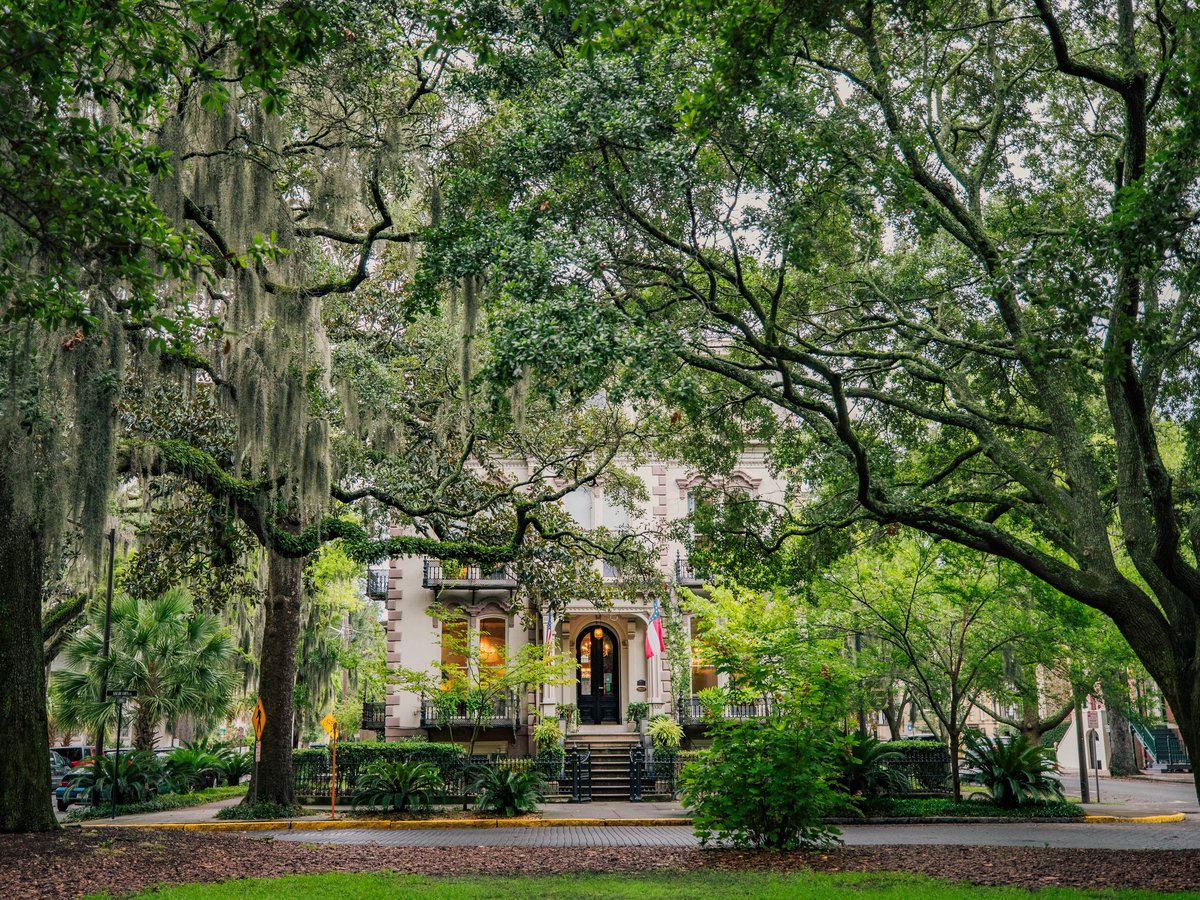
Savannah's Historic District spreads across 22 public squares laid out by James Oglethorpe in 1733. Nearly 300 years later, those open-air rooms still function as the city's living architecture, free to everyone who walks through them. The district covers about 2.5 square miles, compact enough to cross on foot in 40 minutes. Forsyth Park adds 30 acres of live oaks and azaleas at the southern edge. Bonaventure Cemetery opens daily on the banks of the Wilmington River, 3 miles east of downtown. The Cathedral of St. John the Baptist on Lafayette Square welcomes visitors at no charge, as does the Casimir Pulaski Monument in Monterey Square. Savannah earns a family friendliness score of 8.2/10 (see the TTDI Family-Friendliness Index), largely because so many of its core experiences cost nothing. September temperatures currently hover around 25°C with humidity above 90%, which makes early morning the best window for long walks through the squares.
Free attractions
-
Forsyth Park
Forsyth Park was established in 1840 and stretches from Gaston Street south to Park Avenue. The white cast-iron fountain near the northern entrance dates to 1858 and draws a steady crowd of photographers by mid-morning. Spanish moss hangs from live oaks that line the half-mile central walkway. A large playground sits near the Park Avenue end, and public tennis and basketball courts stay open until dark.
Victorian Districtpark -
Bonaventure Cemetery
Bonaventure Cemetery was established in 1846 on a wooded bluff overlooking the river east of downtown. The grounds became widely known after John Berendt's Midnight in the Garden of Good and Evil featured the Bird Girl statue that once stood among the graves. That statue now lives at the Telfair Academy. Paths wind past headstones from the 1850s through the present, shaded by magnolias and live oaks. On a quiet weekday morning, birdsong and the occasional boat motor from the river below are the only sounds. The cemetery charges no admission and is open daily from 8 AM to 5 PM.
Bonaventurecemetery -
Cathedral of St. John the Baptist
The Cathedral of St. John the Baptist dates to 1873 and serves as the seat of the Roman Catholic Diocese of Savannah. Its French Gothic interior holds stained glass windows imported from Innsbruck, Austria, and a hand-painted ceiling that took artisans roughly 2 years to complete. Self-guided visits are welcome on weekdays and Saturdays, and there is no admission fee. The cathedral is an active parish, so Sunday morning Mass schedules may limit visitor access to the nave.
Historic Districtchurch -
Casimir Pulaski Monument
The Casimir Pulaski Monument honors the Polish-born general who was mortally wounded during the 1779 Siege of Savannah. The marble column rises from one of the quieter squares in the Historic District. The surrounding benches sit under mature live oaks and tend to be less crowded than Chippewa Square or Johnson Square to the north.
Historic Districtmonument -
Congregation Mickve Israel
Congregation Mickve Israel has served Savannah's Jewish community since 1733, making it one of the oldest congregations of its kind in the United States. The current Gothic Revival synagogue on Gordon Street dates to the 1870s and is recognizable by its pointed arches and Gothic tracery. Visitors are sometimes welcome for self-guided sanctuary views during weekday hours, though calling ahead is recommended.
Historic Districtsynagogue -
Colonial Park Cemetery
Colonial Park Cemetery on Abercorn Street served as Savannah's main burial ground from 1750 through 1853. Button Gwinnett, one of Georgia's signers of the Declaration of Independence, is buried here among rows of weathered marble and brownstone markers. The cemetery is free and open during daylight hours. Union soldiers reportedly altered dates on several headstones during their occupation of the city in 1864.
Historic Districtcemetery -
Emmet Park
Emmet Park runs along Bay Street on the bluff above River Street, named for the Irish patriot Robert Emmet. The park looks out over the Savannah River and the Talmadge Memorial Bridge to the west. A Vietnam War memorial and a Celtic cross stand among the trees. The elevation catches whatever breeze comes off the water, and the park tends to be quieter than Factors Walk below.
Historic Districtpark -
Daffin Park
Daffin Park spreads across Savannah's Midtown neighborhood north of Victory Drive. Tennis courts and open fields draw pickup games on weekday evenings, and a paved path loops around the lake at the park's center. Grayson Stadium, a baseball venue and local landmark, sits at the park's eastern edge. The park is open from dawn to dusk at no charge.
Midtownpark
Free activities
-
Bull Street Walking Corridor
Bull Street runs north to south through the Historic District, from City Hall on Bay Street toward Forsyth Park. The 1-mile walk passes through 5 of Savannah's squares. Chippewa Square is where the bench scenes from the 1994 film Forrest Gump were shot. The actual prop bench now sits in the Savannah History Museum on Martin Luther King Jr. Boulevard. At Monterey Square, the Mercer Williams House, completed in 1868, is a paid attraction but worth seeing from the sidewalk. The full corridor takes about 25 to 30 minutes at a casual pace.
Historic Districtwalking route -
River Street Waterfront Walk
River Street runs along the Savannah River for roughly 9 blocks of cobblestone promenade. The stones were originally ballast from 18th- and 19th-century merchant ships. On weekends, street musicians claim spots along the walkway. The smell of pralines drifts from River Street Sweets in the converted cotton warehouses. The old warehouse facades now house restaurants, shops, and galleries along the south side. For transit options and walking distances, the Wikivoyage Savannah guide has useful detail at https://en.wikivoyage.org/wiki/Savannah#Get_around.
Waterfrontwalking route -
SCAD Gallery Spaces and Public Art
The Savannah College of Art and Design maintains free gallery spaces and outdoor installations across its campus, concentrated in the Starland District and along Broughton Street. Student and visiting-artist exhibitions rotate throughout the academic year. The outdoor murals and sculptures change seasonally. No appointment or ticket is needed for the open galleries. The SCAD Museum of Art, which opened in 2002, charges admission separately.
Starland Districtart -
Factors Walk
Factors Walk is a network of iron bridges and stone stairways between Bay Street above and River Street below. The name comes from the cotton factors, or brokers, who worked in these 19th-century warehouses when Savannah was one of the busiest cotton ports on the Atlantic coast. The elevated iron walkways offer a perspective of the waterfront that most visitors miss. The route connects to Emmet Park at its eastern end and takes about 10 minutes to traverse.
Historic Districtwalking route -
Tybee Island Beach
Tybee Island sits about 20 miles east of downtown Savannah and has roughly 3 miles of public beach with no entrance fee. The north beach near the lighthouse tends to be less crowded than the areas around the pier and pavilion. Bottlenose dolphins are a common sight offshore between May and October. Chatham Area Transit runs a bus to the island from downtown for a few dollars each way.
Tybee Islandbeach
Free events
-
First Friday
First Friday of each month, typically 6 PM to 9 PMGalleries and studios in the Starland District open their doors on the first Friday of each month, with free exhibitions, new artist work, and a walkable circuit through the neighborhood. Several Broughton Street galleries participate as well. Complimentary drinks are common at participating spaces.
Starland District and Broughton Street -
Forsyth Farmers' Market
Saturdays, approximately 9 AM to 1 PMA Saturday morning market at the south end of Forsyth Park where local farms sell seasonal produce alongside prepared food vendors and craft stalls. Browsing costs nothing, and the market runs year-round through rain and heat alike. Live music sometimes accompanies the vendors near the Park Avenue entrance.
Forsyth Park, south end near Park Avenue -
Savannah St. Patrick's Day Parade
March 17 annuallySavannah hosts one of the largest St. Patrick's Day celebrations in the United States, second in scale only to New York City. The parade winds through the Historic District each March 17, drawing crowds in the hundreds of thousands. The fountains in Forsyth Park are dyed green for the occasion. Viewing is free from anywhere along the route.
Historic District parade route -
Savannah Jazz Festival
Late September, typically 3 to 4 daysA multi-day free music festival organized by the Coastal Jazz Association since the early 1980s. Regional and national jazz musicians perform on outdoor stages in Forsyth Park. The festival typically spans 3 to 4 days and requires no ticket or registration.
Forsyth Park -
Fourth of July on the Waterfront
July 4River Street hosts free fireworks over the Savannah River each Independence Day, with live music stages and food vendors lining the waterfront. Views from the riverbank or from the bluff at Bay Street are free. The fireworks display typically begins after 9 PM.
River Street and Savannah River waterfront
Free on Certain Days
Fort Pulaski National Monument was built starting in 1829 on Cockspur Island at the mouth of the Savannah River, about 15 miles east of downtown. General admission currently runs about $15 per person, but the National Park Service waives entrance fees on several days each year. These fee-free days include Martin Luther King Jr. Day in January, the first day of National Park Week in April, National Public Lands Day in late September, and Veterans Day on November 11. The fort saw the 1862 Union bombardment that proved rifled cannon could breach masonry walls, a turning point in military engineering. Telfair Museums, founded in 1886, operates three sites in the Historic District and charges general admission. The Telfair has historically participated in Smithsonian Magazine's Museum Day, typically held on the third Saturday in September. Advance registration through the Smithsonian website grants free entry on that day, though participation has shifted from year to year. For broader context on Savannah's attractions, the Wikivoyage guide at https://en.wikivoyage.org/wiki/Savannah#See covers museums, monuments, and galleries.
When Free Savannah Is at Its Best
Spring from mid-March through May is likely the most comfortable season for walking the squares. Azaleas bloom throughout the Historic District, and temperatures hover between 18°C and 28°C. Summer from June through August brings heat above 32°C with humidity that can feel punishing by early afternoon. Mind you, even 9 AM can feel warm in late July. Plan outdoor walking for before 10 AM or after 5 PM in those months. Fall from September through November is warm but gradually cooling, with fewer tourists and lower humidity by October. Winter rarely drops below 5°C, and you can have the cemetery paths and the waterfront largely to yourself on a January weekday. For safety notes by neighborhood, the Wikivoyage guide at https://en.wikivoyage.org/wiki/Savannah#Stay_safe offers additional context.
FAQ
Is downtown Savannah safe to walk at night?
Savannah earns a solo-traveler safety score of 6.2/10 (see the TTDI Solo-Safety Index). The Historic District and River Street are generally well-lit and see foot traffic through the evening. That said, side streets south of Forsyth Park and areas west of Martin Luther King Jr. Boulevard tend to be quieter after dark, so sticking to main routes is a reasonable precaution if you're walking alone.
Can you carry alcohol on the street in Savannah?
Savannah is one of the few U.S. cities that allows open containers of alcohol in its Historic District. Drinks must be in plastic cups of 16 ounces or less. Bars along River Street and Congress Street will pour your drink into a to-go cup if you ask. Worth noting, the policy does not extend to areas outside the Historic District or to Tybee Island. For more on Savannah's bar and cafe scene, see https://en.wikivoyage.org/wiki/Savannah#Drink.
Is Tybee Island beach free to visit?
The beach itself is free, with no entrance fee or tag required. The drive from downtown takes about 30 minutes east on US-80. Metered parking near the pier runs about $5 to $8 per day, but free street parking is available on residential blocks a few minutes' walk from the sand. Lifeguards are on duty at the main beach from late May through Labor Day.
Is Savannah LGBTQ+ friendly?
Savannah scores 6.5/10 for LGBTQ+ friendliness (sourced from TTDI's editorial rubric). The city has a visible LGBTQ+ community, and several bars along Congress Street are long-established gathering spots. Savannah Pride events have typically been held in the fall, usually around October, though dates shift year to year.
How many days do you need for free Savannah?
Two full days is enough to walk the squares, visit the cemeteries, explore the waterfront, and see the cathedral and the monuments. A third day allows for a Tybee Island trip. Most of the free activities involve significant walking, so spreading them across 2 to 3 days keeps the pace comfortable, especially in summer heat. For detailed arrival options by air, train, and road, see https://en.wikivoyage.org/wiki/Savannah#Get_in.
Is Savannah a good base for digital nomads?
Savannah's digital-nomad suitability score is 4.8/10 (sourced from TTDI's editorial rubric). The city has cafes with wifi throughout the downtown area, and the Live Oak Public Libraries system offers free internet access at multiple branches. Dedicated co-working spaces exist but are limited compared to Atlanta or Charleston. Short-term housing costs and the compact local job market are the main limiting factors. For practical logistics, see https://en.wikivoyage.org/wiki/Savannah#Cope.
Last verified by automated review (v1.7.2) on . What is automated review?