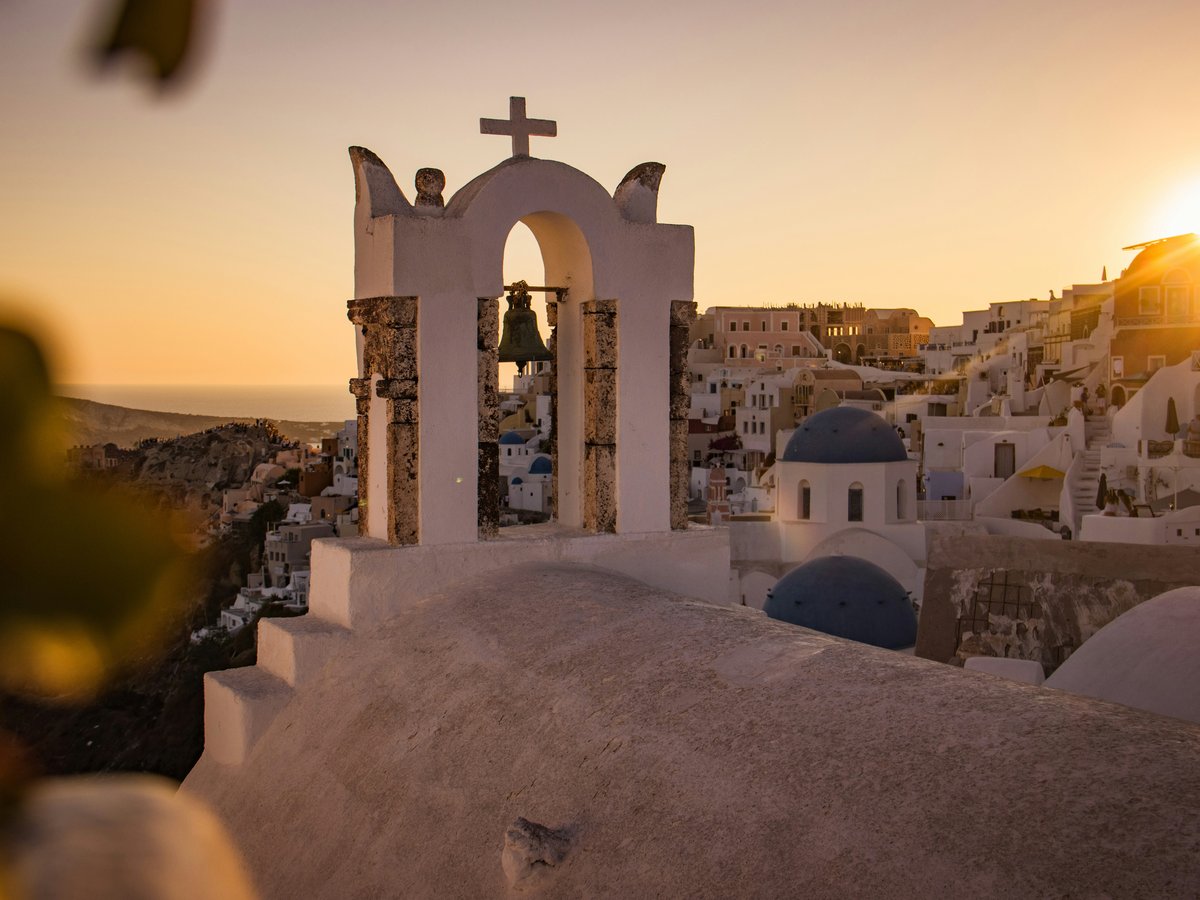
Santorini sits on the fractured rim of a volcanic caldera in the southern Aegean, about 200 km southeast of Athens. The Minoan eruption around 1600 BCE collapsed the island's center and flooded it, creating the basin that ferries and cruise ships cross daily. On the western edge, caldera cliffs drop roughly 300 meters to the water. The eastern shore tapers toward the black volcanic beaches at Kamari and Perissa. Mind you, even those beaches are volcanic pebble, not soft sand. Rainfall averages near 350 mm per year, concentrated between November and March. Santorini has no rivers, no lakes, and no natural springs of any real volume. Every drop of fresh water comes from desalination plants built along the coast. The meltemi wind blows from the north through July and August, regularly gusting above 40 km/h. Mid-September tends to be calmer, with temperatures currently around 24°C under mainly clear skies. Profitis Ilias, the island's summit at 567 meters, supports the only real stand of Aleppo pines. Below that elevation, the landscape is exposed pumice, volcanic rock, and the low basket-trained grape vines local winemakers call kouloura. You walk on sun-baked volcanic rock with the Aegean visible from every stretch of the caldera rim. Most outdoor tour operators on Santorini close for the rainy winter season.
Outdoor activities
-
Road Cycling the Island
Santorini's road network covers roughly 70 km, and a full loop passes through Fira, Oia, Imerovigli, Pyrgos, and the coastal flats near Vlychada. The roads are narrow, often without shoulders, and shared with cars, buses, and ATVs. Elevation changes are moderate but frequent, with the steepest grades climbing out of Athinios port. Several rental shops in Fira and Kamari offer road bikes and e-bikes, typically for €15 to €25 per day. Morning rides before 9 AM avoid the worst traffic and heat. Wind is the main variable. A northerly meltemi on exposed stretches between Oia and Firostefani can turn a pleasant ride into a slog.
- Difficulty
- Moderate (grades and wind exposure)
- Duration
- 3 to 5 hours for a full island loop
- Best season
- April through May, late September through October
-
ATV and Quad Touring
ATVs are one of the most common ways to cover ground on Santorini. Rental operators cluster in Fira, Perissa, and Kamari, with full-day rentals running €40 to €60 for a 125cc quad. You can reach the Akrotiri lighthouse, the caldera viewpoints above Imerovigli, and Vlychada's sculpted beach formations in a single day. An international driving license is technically required for anything above 50cc. Wear a helmet. The roads around Athinios port and the hairpins above Kamari get tight when tour buses pass.
- Difficulty
- Easy to moderate (dependent on driving skill and traffic awareness)
- Duration
- Half day to full day
- Best season
- March through November
-
Horseback Riding on Volcanic Beaches
A few operators near Megalochori run guided rides along the southern coast, covering Vlychada and Exo Gialos. The terrain is black volcanic sand, low scrubland, and dried creek beds. Rides last 1 to 2 hours and follow the shoreline at a walk, with some trotting on open stretches. You can smell salt and warm rock the entire way. Expect to pay roughly €60 to €80 per person for a 90-minute session. Evening rides along the south coast catch low light on the pumice cliff formations above Vlychada.
- Difficulty
- Easy (guided, walk-trot pace)
- Duration
- 1 to 2 hours
- Best season
- April through October
-
Wine Country Walking between Pyrgos and Megalochori
The central plateau between these two villages is covered in Santorini's traditional Assyrtiko vines, grown low to the ground in basket shapes to resist the wind. The 4 km stretch follows village roads and farm tracks through a landscape of dry stone walls, tiny roadside chapels, and volcanic soil that crunches underfoot. You'll pass Santo Wines and Estate Argyros along the way. It is flat to gently rolling terrain. Bring a hat and water, as shade between the two villages is nonexistent.
- Difficulty
- Easy
- Duration
- 2 to 3 hours with tasting stops
- Best season
- April through June, September through October
Day hikes
-
Fira to Oia Caldera Trail
The signature walk on Santorini follows the caldera rim north from Fira, starting near St. John the Baptist Cathedral (founded 1823), through Firostefani and Imerovigli, then descending and climbing over rocky terrain before dropping into Oia. Total distance is roughly 10 km. The path is well-worn but unmarked in places past Imerovigli, where it becomes rockier and more exposed. Footing gets loose on pumice sections. Allow 3 to 5 hours depending on stops. Start early to avoid midday heat. Finish in Oia where you can take a bus back for €1.80, or walk down to Amoudi Bay. Water and snacks are available in Firostefani and Imerovigli but not on the stretch between Imerovigli and Oia.
- Difficulty
- Moderate (rocky terrain, fully exposed, cumulative elevation gain around 350 meters)
- Duration
- 3 to 5 hours
- Best season
- April through early June, mid-September through October
-
Ancient Thera via the Sellada Saddle
Ancient Thera sits on Mesa Vouno, the 369-meter ridge between Kamari and Perissa on the island's eastern side. The hiking route from the Sellada saddle climbs steeply over switchbacks for about 1.5 km to the archaeological site, which occupies a narrow plateau with ruins from Hellenistic, Roman, and Byzantine periods. The path is paved but steep, with sections carved into the rock. A ticket for the site costs around €6 as of recent seasons. The summit is fully exposed to sun and wind. The Kamari-side approach follows a paved road used by tour vehicles, so the Perissa route through the Sellada pass is quieter and more scenic.
- Difficulty
- Moderate to difficult (steep grade, fully exposed, no shade)
- Duration
- 1.5 to 2.5 hours round trip from the Sellada saddle
- Best season
- April through May, September through October
-
Skaros Rock from Imerovigli
Skaros Rock is a conical promontory jutting out from the caldera wall below Imerovigli, once the site of a Venetian-era fortress and the island's medieval administrative center. The path from the main walkway in Imerovigli descends steeply to the rock, with rough stone steps and a short scramble at the end. The round trip takes about 45 minutes to an hour. The small chapel of Theoskepasti sits on the approach trail. The rock itself is narrow and exposed, with drops on both sides, so take care in strong wind. On a calm morning, it is one of the quieter spots along the caldera rim.
- Difficulty
- Easy to moderate (short but steep, with some light scrambling)
- Duration
- 45 minutes to 1 hour round trip
- Best season
- Year-round, though best avoided on strong meltemi days
-
Nea Kameni Volcanic Crater
Nea Kameni is the small volcanic island in the center of the caldera, formed by eruptions between 1570 and 1950. Boat tours depart from Fira's old port at Skala or from Athinios, and the crossing takes about 20 minutes. The trail from the landing dock to the crater rim covers roughly 1 km over loose, dark volcanic rock with sulfur-stained vents near the top. The smell of sulfur is strong close to the fumaroles. Guided group tours run €15 to €25 per person including the boat. The crater is a shallow depression, not the dramatic pit most visitors expect. The most recent lava flows date from 1950, and nothing grows on them yet. Wear closed-toe shoes. The rock will shred sandals.
- Difficulty
- Easy (short, well-defined trail with some loose footing)
- Duration
- 2 to 3 hours including boat transfer
- Best season
- May through October
-
Profitis Ilias Summit from Pyrgos
The hike from Pyrgos village to the summit follows the paved access road for most of its roughly 3.5 km distance, gaining about 260 meters of elevation. The road is open to vehicles, but traffic is light. You pass through vineyard terraces in the first kilometer before the terrain shifts to bare rock and scrubby phrygana. The final approach reaches the tree-covered summit grounds described in the parks section. On clear mornings, you can see Naxos and Paros to the north, and the mountains of Crete to the south. The descent can follow the same road, or a rougher trail leads southeast toward the archaeological ruins on Mesa Vouno, though that route is poorly marked and easy to lose.
- Difficulty
- Moderate (sustained uphill, sun-exposed for most of the route)
- Duration
- 1.5 to 2 hours up, about 1 hour down
- Best season
- April through May, September through November
Water activities
-
Caldera Sea Kayaking
Several operators in Fira and Oia run guided kayak tours along the caldera's western wall, paddling beneath the towering cliffs that define Santorini's western profile. Morning tours typically launch from the old port below Fira or from Amoudi Bay below Oia. The caldera water is deep and clear near the cliff base. Tours last 2 to 4 hours and cover 8 to 12 km depending on conditions. Spring and early autumn are calmer for paddling than the windy peak summer. Expect to pay €50 to €80 per person for a guided half-day tour. You paddle past sea caves, pocket beaches accessible only from the water, and volcanic rock formations layered in red, black, and white tephra bands.
- Difficulty
- Moderate (open water, cliff exposure, wind-dependent)
- Duration
- 2 to 4 hours
- Best season
- April through June, September through October
-
Swimming at Red Beach near Akrotiri
Red Beach sits at the base of towering red volcanic cliffs on the island's southwestern tip, a 10-minute walk from the Bronze Age settlement at Akrotiri. The shore is a mix of red and black volcanic pebbles, and the water runs warm from June through September, typically 23 to 26°C. Worth noting, the cliff above the beach has experienced rockfalls in recent years, and local authorities have periodically restricted access. Check current status before making the walk. The approach trail is rocky and uneven. Bring water shoes for the pebbled shore. Snorkeling along the cliff base reveals volcanic formations underwater, with solid visibility on calm days.
- Difficulty
- Easy (swimming), moderate (access trail with loose rock)
- Duration
- Half day
- Best season
- June through September
-
Snorkeling at Amoudi Bay
Amoudi Bay sits directly below Oia, reached by about 300 steps down from the village. The small harbor is ringed by red volcanic rock, and the water deepens quickly past the fishing boats. Snorkeling is best on the eastern side of the bay, where submerged volcanic boulders create ledges and crevices. Visibility tends to reach 15 to 20 meters on calm days. Sea urchins are thick on the rocky bottom, so neoprene booties help. The bay fills up from mid-morning through sunset. If you go before 9 AM, you might have the water to yourself. Tavernas at the waterline serve grilled octopus between swims.
- Difficulty
- Easy
- Duration
- 2 to 3 hours
- Best season
- May through October
-
Caldera Catamaran Sailing
Half-day and sunset catamaran tours circle the caldera, passing the volcanic islands of Nea Kameni and Palea Kameni, with swimming stops at hot springs near Palea Kameni where geothermal water warms a patch of sea to around 30 to 35°C. The sulfurous water stains swimsuits yellow, so bring something you don't mind ruining. Tours typically depart from Vlychada marina on the south coast and run about 5 hours, with food and drinks included. Prices range from €100 to €150 per person on a shared boat. Sailing is smooth inside the caldera but can get choppy on the exposed southern coast. Sunset tours time the return to catch the light from the water.
- Difficulty
- Easy (passive sailing with swimming stops)
- Duration
- About 5 hours
- Best season
- May through October
-
Scuba Diving off Santorini's Coast
Santorini's volcanic geology creates unusual diving conditions, with underwater lava formations, hot gas vents, and walls of columnar basalt. Dive operators in Kamari and Perissa run boat dives to sites around the caldera and along the eastern coast. Wall dives at the caldera's edge drop from 5 meters to beyond 30 meters along dark volcanic rock. Visibility averages 20 to 30 meters in summer. Water temperature sits around 22 to 26°C between June and October. An introductory discover-scuba dive runs roughly €80 to €100 per person. Certified divers can book two-tank trips for €120 to €160. Marine life includes moray eels, octopus, and barracuda, though Santorini is not primarily a reef destination.
- Difficulty
- Varies from introductory to advanced depending on dive site
- Duration
- Half day per dive trip
- Best season
- June through October
Parks & gardens
-
Profitis Ilias Monastery and Summit Grounds
FreeThe highest point on Santorini is surrounded by the island's only significant tree cover. Aleppo pines, Mediterranean cypress, and wild herbs like oregano and thyme grow on the slopes around the 18th-century monastery. The air smells different up here, resinous and noticeably cooler, compared to the exposed pumice trails at lower elevations. The monastery grounds include stone-walled garden terraces and a small chapel. Military installations occupy part of the summit and are fenced off, but the accessible areas offer 360-degree views across the caldera, the eastern beaches, and on clear days, the neighboring islands of Ios and Anafi.
Highlights: Aleppo pine groves, wild oregano and thyme, panoramic views toward Ios and Anafi, stone-walled monastery gardens
-
Pyrgos Village Square
FreeThe medieval hilltop village of Pyrgos, about 5 km southeast of Fira, has a small central plateia shaded by mature trees and ringed by whitewashed houses. A few cafes serve Greek coffee in the shade, which feels like genuine luxury on this island. The kasteli above the square has its own small garden area planted with cactus and bougainvillea. Panagia Episkopi, the Byzantine church in neighboring Mesa Gonia, sits about a 15-minute walk downhill through vineyard-lined lanes.
Highlights: Shaded plateia with mature trees, kasteli garden, walking distance to the Byzantine church Panagia Episkopi
-
Fira to Firostefani Caldera Promenade
FreeThe paved caldera-rim walkway between Fira and Firostefani runs about 1 km along the cliff edge, passing through landscaped sections of bougainvillea, prickly pear cactus, and ornamental plantings maintained by adjacent hotels and restaurants. It is not a park in any formal sense. But on an island with almost no green space, the planted terraces and shaded pergolas along this stretch are the closest thing to a public garden in the capital. The Three Bells of Fira, built in 1757, sit along the walkway near the Catholic quarter, and the Cathedral of Candlemas from 1827 stands nearby. The walkway gets crowded at sunset but is quiet before 9 AM.
Highlights: Bougainvillea terraces, caldera panorama, the 18th-century Catholic quarter with its two landmark churches
Practical tips
- Sun Protection
- Santorini has almost zero natural shade below the Profitis Ilias treeline. From May through September, UV levels are high by 9 AM. Wear a wide-brimmed hat, SPF 50+ sunscreen, and polarized sunglasses for any outdoor activity. Reapply sunscreen every 90 minutes, especially on water-based activities where reflection from the Aegean intensifies exposure. Long-sleeve UPF-rated shirts are more practical than sunscreen alone for full-day hikes along the caldera.
- Water and Hydration
- Carry at least 2 liters of water per person for the Fira-to-Oia trail and any hike over 2 hours. Tap water on Santorini is desalinated and safe but tastes mineral-heavy. Bottled water costs €0.50 to €1 at shops in Fira, Oia, and Kamari. There are no water sources on trails between villages. Dehydration and heat exhaustion account for a significant share of tourist medical visits during the peak summer months.
- Footwear and Gear
- The volcanic terrain on Santorini chews through sandals and smooth-soled shoes within a single hike. Wear closed-toe hiking shoes or sturdy trail runners for any path beyond paved village walkways. Water shoes are useful for Red Beach and other pebbled shores. Lightweight trekking poles help on the steeper descents from Imerovigli toward Oia. Bring a wind shell for exposed ridgelines, even in summer.
- Wind Awareness
- The meltemi reaches its peak intensity in July and August, and it affects every outdoor activity on the island. Sea kayak operators cancel tours in strong wind. Cycling becomes a battle on north-facing exposed stretches. Hiking the caldera rim in strong gusts is unpleasant and potentially dangerous near cliff edges. Check marine forecasts on the Poseidon system from the Hellenic Centre for Marine Research before booking water activities. The Windy app also provides reliable wind data for the Cyclades.
- Solo Hiking Safety
- Santorini scores 8.4 out of 10 on TTDI's solo-traveler safety index (see the TTDI Solo-Safety Index), and solo hiking on the main caldera trail and village paths is common and straightforward. That said, carry a charged phone with offline maps downloaded, as cell signal can drop between Imerovigli and Oia. Tell someone your route and expected return time if you head off the main trails. The volcanic terrain is loose in places, and a twisted ankle in an isolated spot means a difficult self-rescue.
- Trail Conditions and Navigation
- Santorini's trails are not formally marked with painted blazes or signposts the way mainland Greek mountain paths tend to be. The main caldera route is obvious through the villages but becomes a social trail over bare rock past Imerovigli. Download offline maps from Mapy.cz or AllTrails before setting out. The path up to Ancient Thera from the Sellada saddle is paved but steep. After rain, which is rare but intense in winter, volcanic soil becomes slippery. No mountain rescue teams are stationed on the island, so self-sufficiency matters.
FAQ
What is the best time of year for outdoor activities on Santorini?
Late April through early June and mid-September through October offer the best combination of comfortable temperatures (18 to 28°C), manageable wind, and fewer crowds. July and August are hot, often above 35°C, with strong northerly winds that affect kayaking and exposed hiking. Winter brings rain and cooler temperatures around 10 to 15°C, and many tour operators shut down for the season.
Is the Fira to Oia hike suitable for beginners?
The first half through Firostefani and Imerovigli follows paved walkways and is straightforward. Past Imerovigli, the trail becomes rockier and less defined, with steep sections and loose footing on volcanic gravel. A reasonably fit person with proper shoes can complete it, but it is not a casual stroll, especially in afternoon heat. Starting before 8 AM in summer months is strongly recommended.
Can you swim in the volcanic caldera?
The caldera water is deep, clean, and swimmable, though there are no sandy beaches on the caldera side of the island. Most swimming access comes from boat tours, kayak stops, or the small harbors at Amoudi Bay beneath Oia and Skala beneath Fira. The warm geothermal waters near Palea Kameni are the most popular caldera swimming destination.
Is Santorini family-friendly for outdoor activities?
Santorini rates 5.8 out of 10 on TTDI's family-friendliness scale (see the TTDI Family-Friendliness Index), reflecting practical challenges like steep stairways, unguarded cliff edges, limited shade, and a lack of enclosed play spaces for small children. The volcano boat trip to Nea Kameni works well for older children around 8 and up. Beach swimming at Kamari and Perissa is more manageable for families than the caldera side, with organized facilities and calmer water.
Do I need permits for any outdoor activities on Santorini?
No permits are required for hiking any trail on the island. Archaeological sites like Ancient Thera charge a modest entrance fee. Scuba diving requires a recognized certification or enrollment in a discover-scuba course through a local operator. ATV and motorcycle rentals above 50cc technically require an international driving permit. No fishing licenses are needed for recreational shore fishing, though marine protected areas exist around parts of the caldera.
What should I do if weather cancels my outdoor plans?
The Museum of Prehistoric Thera in Fira, opened in 2000, houses frescoes and ceramics recovered from the Bronze Age settlement at Akrotiri. The Archaeological Museum of Thera, established in 1960, covers later periods from the Geometric era through the Roman occupation. Both sit within walking distance of central Fira. In Oia, the Museum of Ancient Greek, Byzantine and Post-Byzantine Instruments has been open since 1984 and occupies a quieter corner of the village. A rainy day on Santorini is rare between April and October but well served by these three collections.
Outdoor experiences in Santorini
 Free cancellation
 Santorini ATV Experience | Off-Road, Secret Places & FREE Pickup
Outdoor experience: 3.5 hours, free cancellation.
via Viator Free cancellation
 Santorini Private Custom Tours 3 - 7 Hours-Skip The Line
Outdoor experience: free cancellation.
via Viator
Santorini E-bike Adventures - The Original Bike Tours
Outdoor experience: 3 hours.
via Viator Free cancellation
 Santorini Wrangler Jeep Afternoon Convoy Tour
Outdoor experience: 5 hours, free cancellation.
via Viator Free cancellation
 Santorini Tour on Electric Bikes & Scooters
Outdoor experience: 3 hours, free cancellation.
via Viator Free cancellation
 Santorini ATV-Quad Off-road Experience Tour +FREE PICKUP/DROP OFF
Outdoor experience: 3.5 hours, free cancellation.
via Viator Free cancellation
 Semi - Private Fishing Tour (transportation included)
Outdoor experience: 5 hours, free cancellation.
via Viator Free cancellation
 Santorini Half-Day Luxury Private Cruise
Outdoor experience: 5 hours, free cancellation.
via Viator Free cancellation
 Santorini: 4hr Small Group Caldera Hike from Fira to Oia
Outdoor experience: 4 hours, free cancellation.
via Viator Free cancellation
 Santorini: Full Island Sunset Tour with Hotel Pickup
Outdoor experience: 5 hours, free cancellation.
via Viator Free cancellation
 Private Santorini Sunset Wine Tour with Tastings and Tapas
Outdoor experience: 4 hours, free cancellation.
via Viator Free cancellation
 Santorini Small Group Guided E-bike Tour & Local Tomato Museum
Outdoor experience: 3.5 hours, free cancellation.
via ViatorLast verified by automated review (v1.7.2) on . What is automated review?