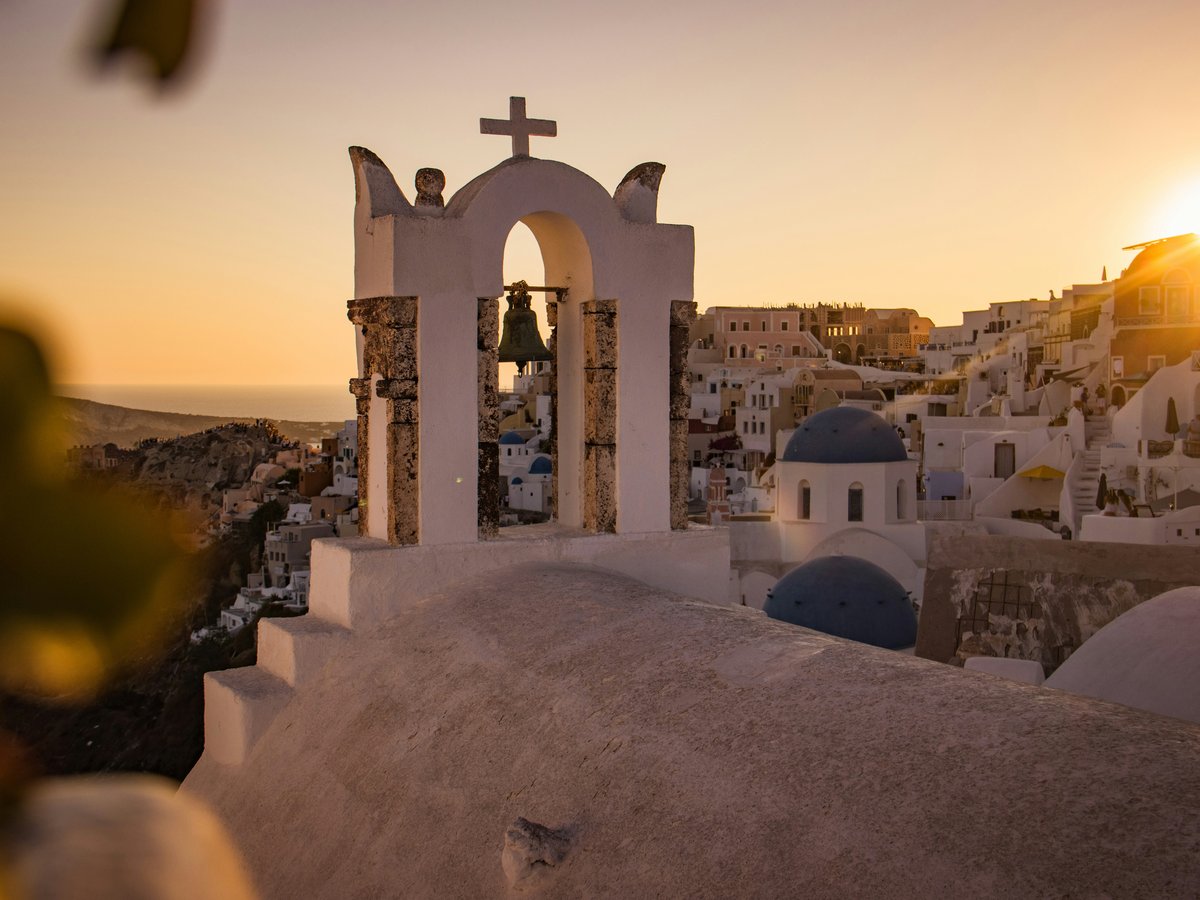
Santorini's must-sees are older and odder than the sunset photographs suggest. This list starts with a Bronze Age settlement on the volcanic island and an ancient city high above the coast, then works through the island's churches, from a monastery dating from 1711 to two cathedrals in Fira, one from 1823 and one from 1827. It ends with a 1907 liner converted to troopship, which is not a building at all. This is a list for the visitor who wants to understand the island as well as admire it. That visitor will trade a few hours of terrace time for broken walls, castle ruins and a Greek Catholic church that most people see as backdrop and nothing more. Some entries come with very little documentation, and we say so plainly where that is the case. The opinions are ours. The facts are cited, one by one, so you can check them before you spend a hot morning finding out for yourself.
-
1 Akrotiri
A Bronze Age settlement preserved on a volcanic island
Bronze Age streets are the reason Akrotiri leads this list: it is a settlement from that age on the volcanic Greek island of Santorini, also known as Thera, and Greece protects it as an archaeological site. That designation matters. You are walking through evidence, not a stage set. Skip the sunset-terrace circuit for one morning and give the hours to this instead, because nothing else on the island explains as well why historians care about the place. Bring water, bring patience and read a little before you go; the site rewards the visitor who arrives curious and punishes the one who arrives for a photograph alone. If you see one thing on Santorini that has nothing to do with the view, see this.
Archaeological site in Greece
-
2 St. John the Baptist Cathedral, Santorini
A Fira cathedral dating from 1823
In Fira, St. John the Baptist Cathedral is a church building whose story runs back to 1823, which puts it among the older working landmarks in the island's main town and gives a fixed point to a district that otherwise blurs into shopfronts. Avoid the habit of treating every dome in town as interchangeable scenery: this one has a name, a date and a congregation, and it deserves a few quiet minutes inside. Dress modestly, keep your voice down and let the building set the pace. Pair it with the other Fira cathedral on this list, which dates from 1827, and you have two anchors for an unhurried walk through town that has nothing to do with shopping.
Dates from 1823
-
3 Panagia Episkopi
A protected church building in Episkopi Gonias
Panagia Episkopi, out in Episkopi Gonias, is a church building that Greece lists as a protected building. That designation is the clearest signal in its record: the state has decided this is worth keeping, not just another whitewashed chapel. The locals prefer their churches without an audience of tour groups, and out here, away from the caldera towns, you are more likely to find it that way. Go in the morning, take your time, and resist treating the interior as a photo opportunity. It is a short detour most visitors never make, and the ones who do tend to remember it longer than the crowded viewpoints they spent hours queuing for.
Protected building in Greece
-
4 Ancient Thera
An ancient city and archaeological site, open Tuesday to Sunday from 08:00
The gates of Ancient Thera open at 08:00, Tuesday to Sunday, on a seasonal timetable that closes at 15:00. What lies inside is an ancient city and archaeological site on Thera, and the early start is your friend. Arriving after lunch is not worth it: the window is short, and you want the stones before the heat takes over. Check the season before you set out, because the hours are marked seasonal and a closed gate is a long way to go for nothing. Wear proper shoes and carry more water than you think you need. Read up beforehand on what you are looking at, since bare walls only come alive when you know the city they belonged to.
-
5 Moni Profiti Ilia (Santorini)
A monastery dating from 1711
Dating from 1711, Moni Profiti Ilia is a monastery in Thira Municipality, which makes it the oldest dated building on this list, older than either Fira cathedral by more than a century, and still a religious house rather than a museum. The locals know the difference, and so should you. Cover your shoulders and knees, keep your voice low, and accept that some doors may be closed to visitors. Skip it if you only want a viewpoint, because the point of coming here is the institution, not the panorama. Visitors who arrive respectfully and without a rigid schedule get the most from it: a working monastery with three centuries of continuity behind it.
Dates from 1711
-
6 Cathedral of Candlemas of the Lord
A Fira cathedral dating from 1827
The Cathedral of Candlemas of the Lord is a church building in Fira, with a record beginning in 1827. St. John the Baptist Cathedral dates from 1823, and the fact that Fira held two cathedrals within the same decade tells you how much the town mattered as a centre at the time. Don't treat it as a backdrop for a photograph on the way to dinner; step inside, sit for five minutes, and look properly. The name refers to the Candlemas feast, and the building rewards anyone who comes with some curiosity about what it commemorates. We'd go early or late in the day, when the town is quieter and the cathedral feels like a place of worship again.
Dates from 1827
-
7 Three Bells of Fira
A Greek Catholic church dating from 1757
Evening light glows on the Three Bells of Fira, a Greek Catholic church dating from 1757. That date makes it older than both Fira cathedrals on this list, a detail that tends to get lost in the rush to photograph it. Don't elbow for the same angle as everyone else on the path; the photograph you take will look like a thousand others, and the building deserves more attention than a frame. Look at it as a church first: a Catholic presence on a largely Orthodox island, with more than 260 years behind it. Come at a quiet hour, stand back, and let it be what it is. Then move on and leave space for the next person.
Dates from 1757
-
8 Skaros Rock
Ruins on Santorini for the visitor who prefers broken walls to boutiques
Late light glows across the ruins of Skaros Rock, the most minimal entry on this list: its record says no more than ruins on Santorini. We will not dress that up with invented history, and you should be wary of anyone who does. Skip the polished viewing terraces if what you want is to feel the island's past under your feet rather than behind glass; bring sturdy shoes, take water, and plan around the heat. The mapped position will get you there. What you make of it depends on how much you read beforehand, and that is the real recommendation: do the reading, then go and stand among the stones yourself.
-
9 Castle of Akrotiri
Castle ruins on Santorini, unrestored and unpolished
Castle ruins, not a rebuilt fortress, are what the Castle of Akrotiri offers, and that honesty is the appeal. There is no gift shop narrative here, just what remains. Skip the reconstructed castles you have seen elsewhere in Europe; a ruin asks more of you and gives more back. Walk the outline slowly, imagine what stood there, and let the gaps do some of the work. Pair it with the Bronze Age settlement that shares its name for a day spent on the island's deeper history, but do not assume the two are connected beyond the name. Use the mapped position to arrive, and bring shoes that can handle loose ground.
-
10 HMT Royal Edward
A 1907 liner converted to troopship, the list's one non-building
One entry on this list is a ship: HMT Royal Edward, a 1907 liner converted to troopship. It belongs here because the island's story is not only stone and plaster, and a vessel built for passengers and then turned to carrying soldiers occupies a different chapter of Aegean history. Skip it if you want a postcard. Keep it if you read history and want to understand how this stretch of sea has served empires as well as holidaymakers. Its recorded position is the starting point for anyone who wants to go further, and a conversation with a local boat operator is the sensible next step. It is a fitting final entry: a reminder that the island's past runs well beyond its cliffs.
This is an early version of the Santorini list. We add picks as we test more places.
Last verified by automated review (v1.7.2_regen1014c-1014-4379-20261015025235) on . What is automated review?