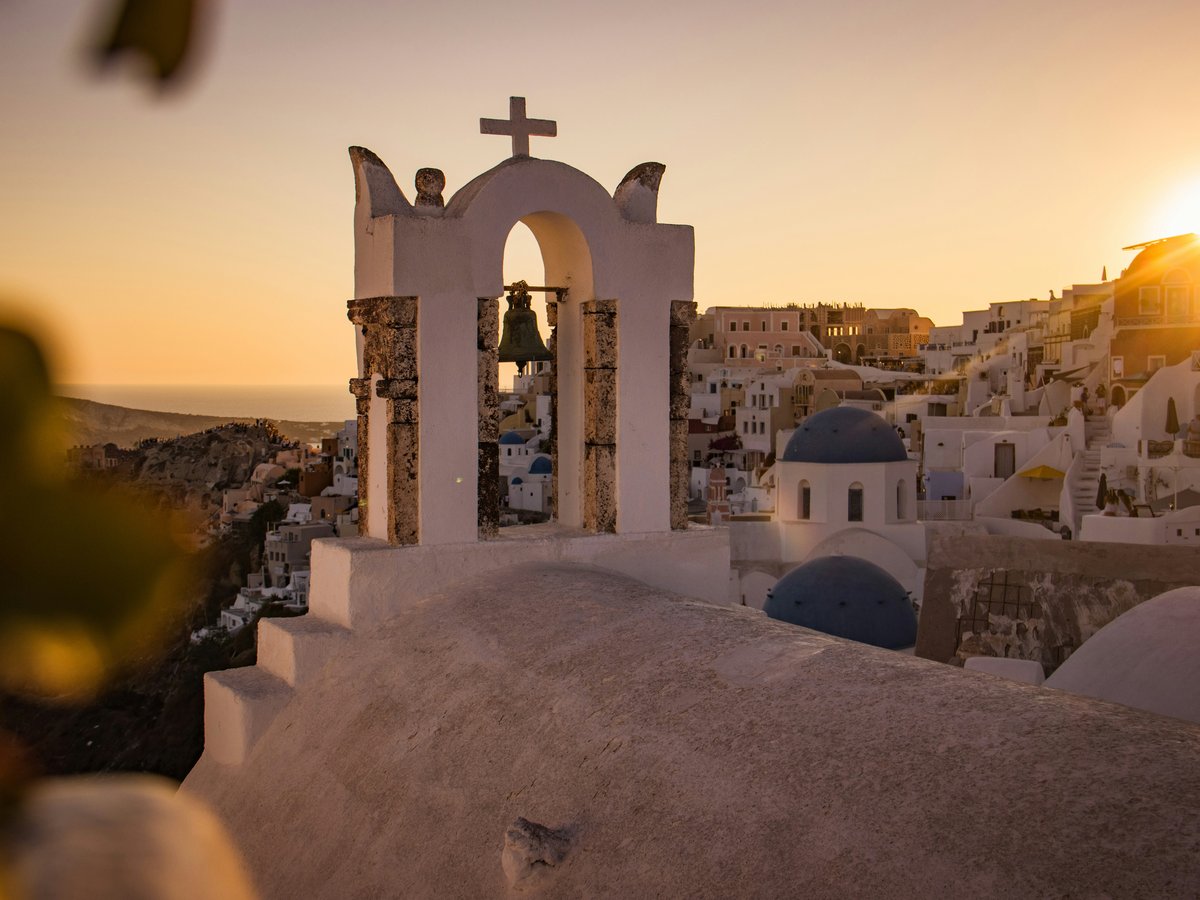
Santorini isn't one town. It's a crescent-shaped volcanic island where roughly 15 settlements scatter across 76 square kilometers of terrain, and the ones most visitors care about follow two distinct axes. Along the western caldera rim, a footpath of about 10 kilometers connects the main villages from Fira in the center to Oia at the northern tip. On the eastern coast, the beach towns of Kamari and Perissa sit on black volcanic sand, separated by the Mesa Vouno headland. Inland, hilltop villages like Pyrgos rise above 300 meters with barely a tourist in sight. The southern tip belongs to the Akrotiri peninsula, home to the island's most significant archaeological excavation. Most arrivals come through the port at Athinios or the small airport near Kamari, and the KTEL bus network fans out from Fira's central station. Mid-September temperatures currently sit at 24.1°C under mainly clear skies, comfortable enough for the 3-hour caldera walk between Fira and Oia. Caldera-rim hotels start around 150 EUR per night in September, while eastern-coast rooms can run as low as 40 EUR, so your base shapes both the experience and the budget.
Neighborhoods
-
Fira
Fira is the island's capital and its loudest village. The Three Bells church, a Greek Catholic building dating to 1757, sits near the caldera edge and draws photo-seeking crowds, but the town itself is more commercial than romantic. Gold shops, souvenir stores, and fast-food spots pack the narrow streets along Ypapantis, the main pedestrian drag that locals sometimes call Gold Street. The noise picks up after 10 PM when bars along the caldera fill with cruise ship passengers and package tourists. That said, Fira still has weight. The Cathedral of Candlemas of the Lord, built in 1827, anchors the Catholic quarter with its pale yellow facade and a quiet courtyard. LGBTQ+ friendliness on Santorini scores 7.5 out of 10 (sourced from TTDI's editorial rubric), and Fira's bar scene is the island's most open after dark. The KTEL station connects to every other village on the island, which makes Fira the practical hub even if you're sleeping elsewhere.
- Best for
- First-time visitors who want walkable access to nightlife, dining, and the island's main transport connections
- Key streets
- Ypapantis (Gold Street) runs from the central square toward the caldera and holds most of the retail. Erythrou Stavrou connects toward the cable car station. The St. John the Baptist Cathedral, built in 1823, and the Museum of Prehistoric Thera, opened in 2000, both sit within a few minutes' walk of the main square. The museum holds frescoes and artifacts from the Akrotiri excavation that you won't see at the dig site itself.
-
Firostefani
Firostefani sits roughly 500 meters north of Fira along the caldera path, and that short walk is enough to drop the noise level considerably. The architecture here tends toward whitewashed cave houses and small boutique hotels carved into the cliff face. The pace is slower, the crowds thinner, and the caldera views from the main walkway might be the best on the island for a simple reason. You can see Fira to the south and Imerovigli to the north, with the volcanic islets of Nea Kameni and Palea Kameni appearing closer from this stretch than from any other village on the rim. The village is small enough to walk end to end in 10 minutes. Restaurants along the caldera edge lean Greek-Mediterranean, with mains running 15 to 30 EUR, and they tend to be noticeably quieter than their Fira equivalents.
- Best for
- Couples and photographers who want caldera views with fewer crowds but still want to reach Fira's restaurants and nightlife in under 10 minutes on foot
- Key streets
- The main caldera walkway, part of the Fira-to-Oia trail, runs through the entire village and holds the string of boutique hotels and cafe terraces that define Firostefani. The walkway is paved but narrow, barely 2 meters across in some spots, and gets slippery after rain.
-
Imerovigli
Imerovigli is the highest village on the caldera rim. It sits at roughly 300 meters above sea level and is sometimes called the Balcony of the Aegean, a name you'll hear locals use without irony. The settlement is small, maybe 15 minutes on foot from one end to the other, and the dominant sound most evenings is wind and distant church bells rather than bar music. Skaros Rock, the remains of a Venetian-era fortress, extends from the northwestern edge of the village on an exposed promontory. The hike out to the tip takes about 20 minutes and involves uneven stone steps with no railings. Hotels here tend toward the high end, with caldera-view suites starting around 250 to 400 EUR per night in peak season. The restaurant scene is limited to maybe 8 or 10 places, and the better ones require reservations 2 to 3 days out in July and August.
- Best for
- Couples and solo travelers seeking quiet caldera-rim stays, strong hikers wanting the best base for the trail to Oia, and anyone who values silence over convenience
- Key streets
- The main caldera footpath passes through the village center. The trail down to Skaros Rock starts near the Anastasi church. A secondary path descends toward the small Panagia Malteza chapel on the cliff face below the village.
-
Oia
Oia is the village that sells Santorini to the world. The sunset crowds at the Kastro, the ruined Venetian castle at the western tip, can number in the hundreds on a summer evening. By day, the marble-paved main street holds a steady procession of visitors passing art galleries, jewelry shops, and cafes. The buildings are photogenic, all white walls and blue domes, but the village is more than its postcards. The Museum of Ancient Greek, Byzantine and Post-Byzantine Instruments, opened in 1984, occupies a quiet side street and houses reconstructions of instruments spanning from 2800 BC to the 19th century. Below the village, the Ammoudi Bay path descends about 300 steps to a cluster of seafood tavernas at the water's edge. Grilled octopus and local wine from the Assyrtiko grape run around 12 to 18 EUR per plate down there.
- Best for
- Honeymoon couples, photographers, and visitors willing to pay premium prices for the island's most recognizable setting
- Key streets
- Nikolaou Nomikou is the main pedestrian artery running roughly east to west through the village. The path to Ammoudi Bay starts near the Kastro ruins. A quieter lane runs from the main church toward the windmill ruins on the eastern approach.
-
Kamari
Kamari sits on the eastern coast, about 10 kilometers from Fira by road, and it feels like a different island entirely. The black volcanic sand beach stretches for roughly 2 kilometers, lined with sunbed rentals at about 8 to 10 EUR for a pair. The beachfront promenade holds tavernas, gelato shops, and small hotels at rates that tend to run 40 to 60 percent lower than caldera-rim equivalents. The Mesa Vouno headland rises 369 meters directly behind the town, and the archaeological site of Ancient Thera sits at its summit, reachable by a steep road or a hiking trail from the Kamari side. Santorini scores 5.8 out of 10 for family friendliness (see the TTDI Family-Friendliness Index), and Kamari's flat promenade, shallow-entry waters, and lower-key atmosphere make it the strongest candidate for families with young children on this island.
- Best for
- Families with children, budget-conscious travelers, and anyone who wants a proper beach holiday rather than a caldera-gazing one
- Key streets
- The beachfront promenade runs the full length of the sand and holds most of the restaurants and shops. The road up to the archaeological site begins at the southern end of town near the open-air cinema. Agia Paraskevi road connects inland toward the airport, which sits less than 2 kilometers away.
-
Perissa
Perissa sits on the other side of Mesa Vouno from Kamari, facing southeast. The black sand beach here runs even longer, roughly 3 kilometers if you count the continuation into Perivolos to the west. The atmosphere skews younger than its neighbor. Beach bars play music through the afternoon, water sports operators line the sand, and the hostels along the main road draw backpackers and 20-somethings from across Europe. Rooms near the beach start around 40 to 70 EUR per night in September, making Perissa one of the more affordable bases on the island. The food scene is casual, with gyros at 3.50 to 5 EUR and taverna mains around 10 to 15 EUR. Solo-traveler safety on Santorini rates 8.4 out of 10 (see the TTDI Solo-Safety Index), and Perissa's social hostel scene makes it the most natural landing spot for those traveling alone.
- Best for
- Solo travelers, backpackers, budget visitors, and anyone who wants a beach-party atmosphere with affordable food and lodging
- Key streets
- The main beachfront road runs parallel to the sand for the full length of Perissa, curving west into Perivolos. A short path near the Timios Stavros church at the base of Mesa Vouno connects to the hiking trail up to the archaeological site at the summit.
-
Pyrgos
Pyrgos sits near the geographic center of the island at one of its highest elevations, roughly 350 meters above sea level. It was the capital of Santorini until the early 19th century, and the medieval kasteli at its summit still holds narrow stone lanes barely wide enough for two people to pass. The village sees far fewer tourists than the caldera-rim settlements. On a weekday morning, you might walk for 10 minutes without encountering another visitor. The 360-degree views from the hilltop take in the caldera, the Aegean, and the terraced vineyards that cover the surrounding slopes. The food scene is limited to a handful of tavernas, but the quality tends to be higher and the prices lower than Fira or Oia. Nearby in the settlement of Mesa Gonia, the church of Panagia Episkopi stands as one of the oldest surviving churches on the island, with Byzantine-era frescoes inside its walls.
- Best for
- History-oriented visitors, wine enthusiasts, and travelers who want the real village atmosphere of pre-tourism Santorini
- Key streets
- The stone lanes of the kasteli wind upward from the main plateia (village square) to the hilltop fortress ruins and the Profitis Ilias monastery. The road from Pyrgos toward Mesa Gonia passes several of the island's traditional canava wineries.
-
Akrotiri
Akrotiri occupies the southern tip of the island, and the Bronze Age settlement preserved under volcanic ash is the reason most people make the trip down here. The excavation sits under a modern shelter and takes about 1 to 2 hours to walk through. The town was buried by the eruption that shaped the caldera roughly 3,600 years ago, and the level of preservation rivals Pompeii for certain building types. The village of Akrotiri itself is small and residential, with a Venetian castle ruin called Goulas and a handful of tavernas that cater more to locals than visitors. Red Beach, a cove of red volcanic rock accessible by a short trail from the site parking area, draws swimmers despite ongoing rockfall warnings. The Faros lighthouse at the island's southwestern tip was built in 1892 and marks the end of a quiet coastal track. The HMT Royal Edward, a 1907 liner converted to a troopship, sank in nearby waters during World War I and remains one of the deeper wreck sites in the southern Aegean.
- Best for
- Archaeology enthusiasts, history travelers, and visitors who want to see the island's most significant cultural site without caldera-rim crowds
- Key streets
- The main road from Akrotiri village leads south to the archaeological site entrance and continues to Red Beach. A rougher coastal track runs west toward the Faros lighthouse, about 2 kilometers from the village center.
FAQ
Where should a first-time visitor to Santorini stay?
Firostefani or Fira are the strongest first-visit bases. Firostefani gives you caldera views with a quieter atmosphere, and Fira's central bus station is a 10-minute walk south, which makes day-tripping to beaches and archaeological sites straightforward. If budget is a priority, Kamari or Perissa on the east coast offer rooms at roughly half the caldera-rim price, and the bus to Fira runs every 30 to 60 minutes.
Do I need a car to get around Santorini?
The KTEL bus network connects Fira to Oia, Kamari, Perissa, Akrotiri, and the port at Athinios, with service running from roughly 7 AM to 11 PM in summer. Fares typically stay under 2.50 EUR per trip. The caldera-rim villages from Fira to Oia are linked by walkable footpath. A car helps for reaching less-connected spots like Pyrgos, the wineries near Megalochori, or the Faros lighthouse, but parking in Fira and Oia is genuinely difficult from June through September. ATV rentals are popular but carry real risk on the island's narrow, winding roads. Wikivoyage's Santorini guide covers the local transit options in more detail (see sources).
Is Santorini suitable for digital nomads?
Santorini scores 5.2 out of 10 for digital-nomad suitability (sourced from TTDI's editorial rubric). Wi-Fi in most hotels and cafes is functional but rarely fast by European standards, and dedicated coworking spaces are essentially nonexistent on the island. The economy is highly seasonal, with many businesses closing between November and March. Accommodation costs during peak months make a multi-week stay expensive compared to Athens or Thessaloniki. If you're set on remote work here, Fira has the most reliable connectivity and the widest selection of cafes with seating and outlets.
What's a reasonable daily budget for Santorini?
Santorini is one of the more expensive Greek islands. At the time of writing, 1 USD converts to about 0.87 EUR. A budget traveler in Perissa or Kamari might spend 60 to 90 EUR per day on a hostel bed, taverna meals, and bus fares. A mid-range couple on the caldera rim should expect 200 to 350 EUR per day for a cave hotel, sit-down restaurants, and a boat tour of the volcanic islets. Peak season in July and August can push those figures 20 to 30 percent higher.
Which neighborhoods have the best food on Santorini?
Fira has the widest selection, from 4 EUR gyros near the bus station to 40 EUR tasting menus along the caldera. Oia's Ammoudi Bay tavernas specialize in grilled seafood at the water's edge. For a more local experience, the tavernas in Pyrgos and Megalochori serve traditional dishes like fava (split pea puree) and tomatokeftedes (tomato fritters) at prices 20 to 30 percent below the caldera-rim average. The island's signature white wine pairs well with nearly everything and typically costs 6 to 10 EUR per glass.
Is Santorini safe for solo travelers?
Santorini's solo-safety score reflects a generally low-crime environment across the island. The main hazards for solo visitors are practical rather than criminal. The caldera footpath has unprotected drop-offs in several places, and the donkey trail in Fira can be slippery. ATVs cause the island's most serious tourist injuries each year. Perissa's hostel scene offers the easiest social entry point for those traveling alone, while Fira's bar strip along the caldera provides the most active nightlife. Wikivoyage's safety section covers additional precautions (see sources).
Last verified by automated review (v1.7.2) on . What is automated review?