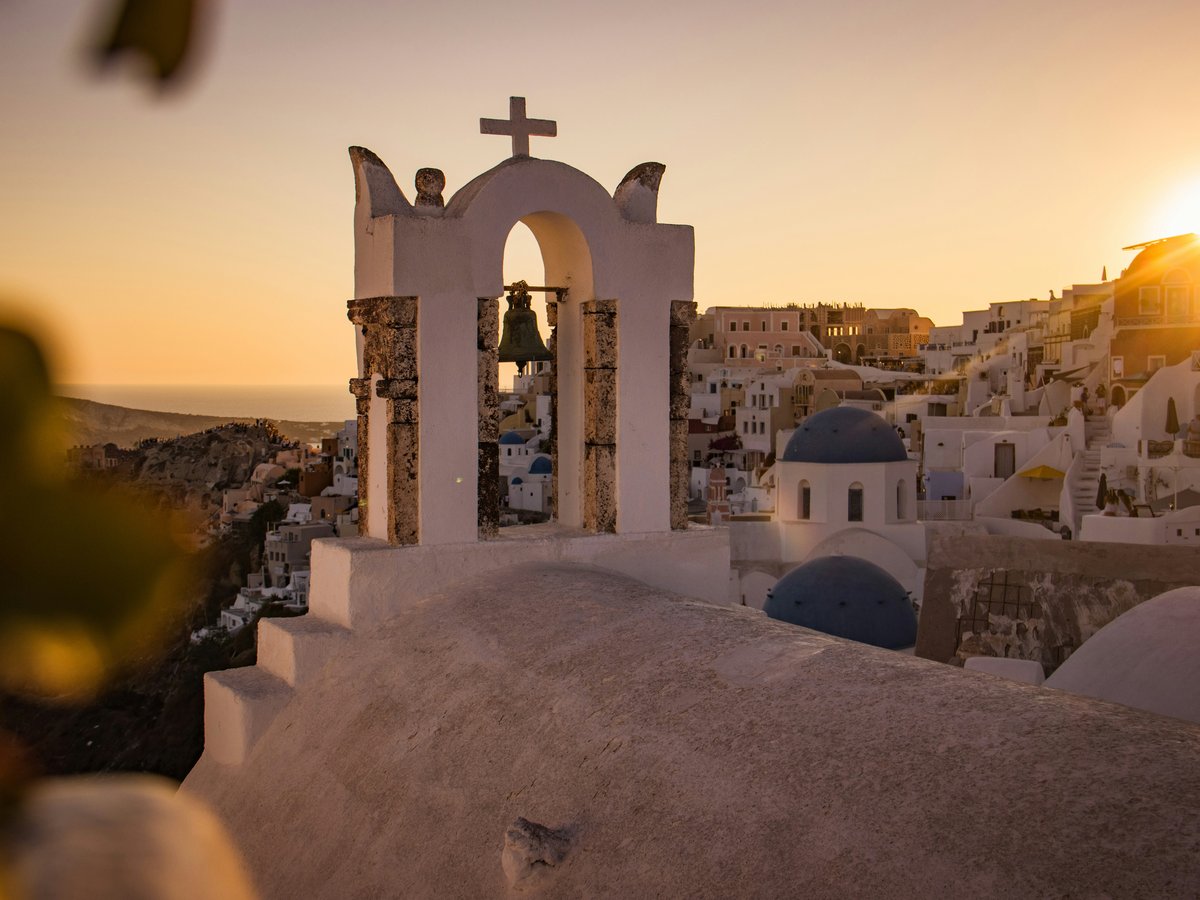
Santorini's caldera collapsed around 1600 BCE, and the volcanic cliffs it left behind, rising over 200 meters above the Aegean, are free to walk. Perissa and Kamari offer black-sand beaches at no charge. Centuries-old Orthodox and Catholic churches across Fira, Oia, and the inland villages open their doors year-round. The western caldera rim offers unobstructed sunset views from Fira to Oia. The island scores 8.4/10 for solo-traveler safety (see the TTDI Solo-Safety Index), which matters if you're covering ground on foot and alone. Taverna plates in Fira currently sit around €12 to €18. To be fair, Santorini's Bronze Age and Classical-era ruins do charge for entry. But two state museums in Fira open at no cost on select winter Sundays, and the volcanic shoreline from Vlychada to Red Beach is open to the public.
Free attractions
-
Three Bells of Fira
Founded in 1757, this small Catholic church on the caldera edge might be the most photographed building in the Cyclades. Three blue domes cluster next to a white bell tower. Inside, the painted wooden ceiling is low, and the air smells faintly of candle wax and old stone. Free to enter, though the church occasionally closes for services. You'll find it along the caldera footpath in Fira, a short walk north of the cable car station.
Firachurch -
Cathedral of Candlemas of the Lord
The main Greek Orthodox cathedral of Santorini, built in 1827 in central Fira. The 1956 earthquake damaged the original structure, and the current interior reflects that era's restoration. Frescoes line the walls. The cathedral sits slightly off the main tourist path, which means you might have it largely to yourself outside Sunday morning liturgy. Free to enter.
Firacathedral -
St. John the Baptist Cathedral
The Catholic cathedral of Santorini, dating to 1823. It stands in Fira's Catholic quarter, near the Dominican Convent. The interior is quieter and more restrained than the Orthodox churches, with stone arches and wooden pews. Free to enter.
Firacathedral -
Panagia Episkopi
A Byzantine church in Episkopi Gonias (also known as Mesa Gonia), roughly 5 km south of Fira. Traditionally dated to the 11th century, it is likely the oldest standing church on the island. The interior is dim, with thick stone walls and a marble templon screen that has survived the island's earthquakes. Free to visit. You'll need transport or about a 40-minute walk from Kamari to reach it.
Episkopi Goniaschurch -
Oia Castle
Ruins of a Venetian-era fortress at the western tip of Oia. This is the single most popular sunset viewpoint on Santorini. In July and August, the crowd can number in the hundreds by 7 PM. The view faces northwest over the caldera toward Thirasia. Free at all hours, though you'll want to arrive at least 45 minutes before sunset in peak season to secure a comfortable spot. The rocks underfoot are uneven.
Oiaviewpoint -
Skaros Rock
A volcanic headland jutting from the caldera rim at Imerovigli. This promontory served as the medieval capital of Santorini, and fragments of Venetian fortifications still cling to the rock. The walk out to the tip takes about 20 minutes from the village, with steep drops on both sides. On a clear day, you can see Ios to the north. Free and always open.
Imerovigliviewpoint -
Profitis Ilias summit
The highest point on Santorini at 567 meters, and the only spot on the island with real tree cover. Aleppo pines shade the hiking path from Pyrgos to the summit. The monastery at the top, Moni Profiti Ilia, was founded in 1711 and remains active. Wind drops inside the tree cover, and temperatures tend to run several degrees cooler than in the caldera towns. Free to hike, free to walk the grounds.
south-central Santorinigreen space / hiking -
Kasteli of Pyrgos
A medieval fortress village built in concentric rings around a Venetian watchtower, in central Santorini. Narrow lanes spiral upward through arched passages to the kasteli ruins at the top. Plateia Pyrgou, the main square, sits under shade trees with a view toward the mountain above. The village draws far fewer tourists than the caldera-rim towns. Free to explore at any hour.
Pyrgoshistoric village / green space -
Goulas of Emporio
A medieval watchtower complex in Emporio, one of the island's larger villages. The goulas (fortified tower) anchors a maze of dark, narrow passages originally designed to confuse raiders. External staircases lead to upper-floor dwellings. The whole structure sits along the road between Fira and Perissa. Free to walk through, though some passages are tight enough to require turning sideways.
Emporiohistoric quarter -
Museum of Prehistoric Thera
Opened in 2000 in Fira, this museum displays finds from the excavations at Akrotiri, including wall paintings that survived burial for roughly 3,500 years. Normal admission carries a small fee, but the Greek Ministry of Culture opens it free on the first Sunday of each month from November through March. Additional free-entry dates have included March 6, April 18, May 18, and October 28.
Firamuseum (free on specific days) -
Archaeological Museum of Thera
Founded in 1960, this is the older of Fira's two state museums. The collection spans a broader arc than its Bronze Age neighbor, with artifacts from the Ancient Thera archaeological site dating to the Geometric through Roman periods. The same winter free-entry schedule and national free-admission dates apply here.
Firamuseum (free on specific days)
Free activities
-
Fira-to-Oia caldera trail
Roughly 10 km from Fira through Firostefani and Imerovigli, then descending to Oia. Allow 3 to 4 hours at a steady pace. The path is mostly paved or well-trodden dirt, but the stretch after Imerovigli drops steeply and offers no shade. You'll catch the scent of wild thyme along the first half, and hear little beyond wind and the occasional distant ferry. In mid-September, temperatures currently sit around 23°C, comfortable for the full walk. In peak summer, start before 9 AM. Carry at least a liter of water per person between May and October.
Fira to Oiawalking route -
Perissa Beach
A long black-sand beach on the southeast coast, backed by the Mesa Vouno headland. Free to spread a towel anywhere outside the sunbed zones. The volcanic sand absorbs heat quickly, so by midday in July it can burn bare feet. The water drops off gradually, and the dark sand gives it a deep-blue appearance close to shore. A line of tavernas runs along the shore road, but there is no obligation to buy anything.
Perissabeach -
Kamari Beach and promenade
Another black-sand beach on the east coast, north of Perissa. Kamari's pedestrian promenade runs along the shore, lined with planted trees and public benches. The walkway is the closest thing to a public park on this side of the island. Free to use. The beach divides into sunbed areas and open public stretches.
Kamaribeach / green space -
Red Beach (Kokkini Paralia)
A small cove near the Akrotiri archaeological site, named for its red volcanic cliff face. The beach is free to use. Access has been complicated by rockfall on the cliff path, so check locally for current trail conditions before hiking down. If the path is closed, small boats from Akrotiri port offer rides for a few euros. The sand is coarse red and black pebble, and the cliff radiates stored heat even after the sun moves behind it.
Akrotiribeach -
Vlychada Beach
On the south coast, a short walk from the small marina. Volcanic cliffs behind the beach have been sculpted by wind and water into pale, striated formations. Free access. The beach tends to be quieter than the east-coast options, partly because reaching it by bus requires a transfer in Fira.
Vlychadabeach -
Ypapantis Street browsing, Fira
The main pedestrian shopping street in Fira, running parallel to the caldera edge. The jewelry shops, small galleries, and clothing stores are free to browse. The street is paved in smooth volcanic stone and fills up between 5 PM and 8 PM in summer. Some of the smaller galleries along this strip display work by Santorini-based artists.
Firashopping / gallery walk
Free events
-
Ifestia (Volcano Festival)
August or September, date announced annuallySantorini's annual volcano festival. Fireworks and flares launch from Nea Kameni, the volcanic islet at the center of the caldera, simulating an eruption. The display is free to watch from any vantage point along the caldera rim. Fira, Imerovigli, and Oia all offer clear sightlines. Boat tours for a closer look do charge, but the spectacle from shore is the same.
Viewed from the caldera rim (Fira, Imerovigli, Oia) -
Panigiria (village feast days)
Various dates, May through SeptemberTraditional Greek village festivals celebrating patron saints. Each village holds its own panigiri on a different date through the summer. Expect live lyra and laouto music, communal food from the hosting church, and dancing in the village plateia. The Panagia celebrations around August 15 tend to be the largest across the island. Free to attend.
Village squares across the island -
Megaro Gyzi exhibitions
Various dates, primarily June through SeptemberThe Megaro Gyzi Cultural Center in Fira, housed in a restored mansion of the Gyzi family, hosts rotating exhibitions of local art and historical photography. Some exhibitions and evening cultural events are free during the summer season. Check the posted schedule at the entrance for current programming.
Fira -
Easter week processions
Easter week (dates vary by year, following the Orthodox calendar)Greek Orthodox Easter celebrations on Santorini include candlelit processions through village streets on Good Friday and Holy Saturday. The epitaphios processions feature flower-covered biers carried through Fira's narrow lanes, accompanied by chanting and candlelight. The midnight Resurrection service on Holy Saturday fills every churchyard. Free to observe and participate.
Fira and villages across the island
Stretching your budget beyond the free list
Even beyond the named free attractions, Santorini has practical ways to keep costs low. Tap water on the island is desalinated and generally considered safe, though most visitors prefer bottled at €0.50 to €1 from minimarkets in Fira or Kamari. A simple picnic of bread, tomatoes, feta, and olives from those same shops currently runs around €6 to €8 and feeds two. The local KTEL bus network connects Fira with most villages and beaches for roughly €1.80 to €2.50 per ride, making rental cars (€40 to €60 per day in high season) optional. For sunsets, the caldera path between Firostefani and Imerovigli faces the same direction as the famous Oia viewpoint, with a fraction of the crowd.
What requires a ticket
A few of Santorini's top attractions do charge admission. Akrotiri, the Bronze Age settlement preserved under volcanic ash, currently hovers around €12. Ancient Thera, on the Mesa Vouno ridge between Kamari and Perissa, has been running around €4. The Museum of Ancient Greek, Byzantine and Post-Byzantine Instruments in Oia, founded in 1984, charges its own entrance fee. Boat tours to Nea Kameni typically start around €20 per person and depart from Fira's old port at the base of the cable car.
FAQ
Are the archaeological sites at Akrotiri and Ancient Thera free to visit?
Neither is free for regular visits. Both charge admission year-round. The same seasonal free-entry calendar that applies to Fira's state museums also covers these archaeological sites, but those windows fall mostly in the cooler months. Verify current free-entry dates with the Hellenic Ministry of Culture before planning around one.
Can you swim at Red Beach for free?
The beach itself is free. Access is the complication. The cliff path from the parking area has been affected by rockfall and may be closed or restricted depending on conditions. Check with locals or your accommodation before hiking down. If the path is blocked, boats from the nearby port run short shuttle trips for a few euros.
Is Santorini a good destination for families on a budget?
It depends on what your family needs. The island scores 5.8/10 for family friendliness (see the TTDI Family-Friendliness Index), reflecting limited play areas, steep unguarded caldera paths, and a tourism economy geared toward couples. Beaches at Perissa and Kamari are the most family-accessible, with gentle water entries and nearby facilities. The free churches in Fira, the caldera viewpoints, and the coastal trails work for all ages, but child-focused restaurants and attractions are limited compared to larger Greek islands like Crete or Rhodes.
What time of year is best for free activities on Santorini?
Late October through early April offers the strongest combination of lower prices and museum free days. Accommodation costs can drop by half or more outside peak season. Late-October temperatures still reach the low 20s Celsius, warm enough for comfortable walking and occasional beach days. The trade-off is that some restaurants and shops close for winter, and ferry frequency between islands drops. Spring, particularly April and May, hits a balance where most businesses have reopened but prices remain lower than the June-to-September peak.
Is the Oia Castle sunset free to watch?
Completely free. No gate, no ticket booth, no rope line. Summer crowds fill the area well before sundown, so plan accordingly. The entire western caldera rim catches the same light and faces the same direction.
Last verified by automated review (v1.7.2) on . What is automated review?