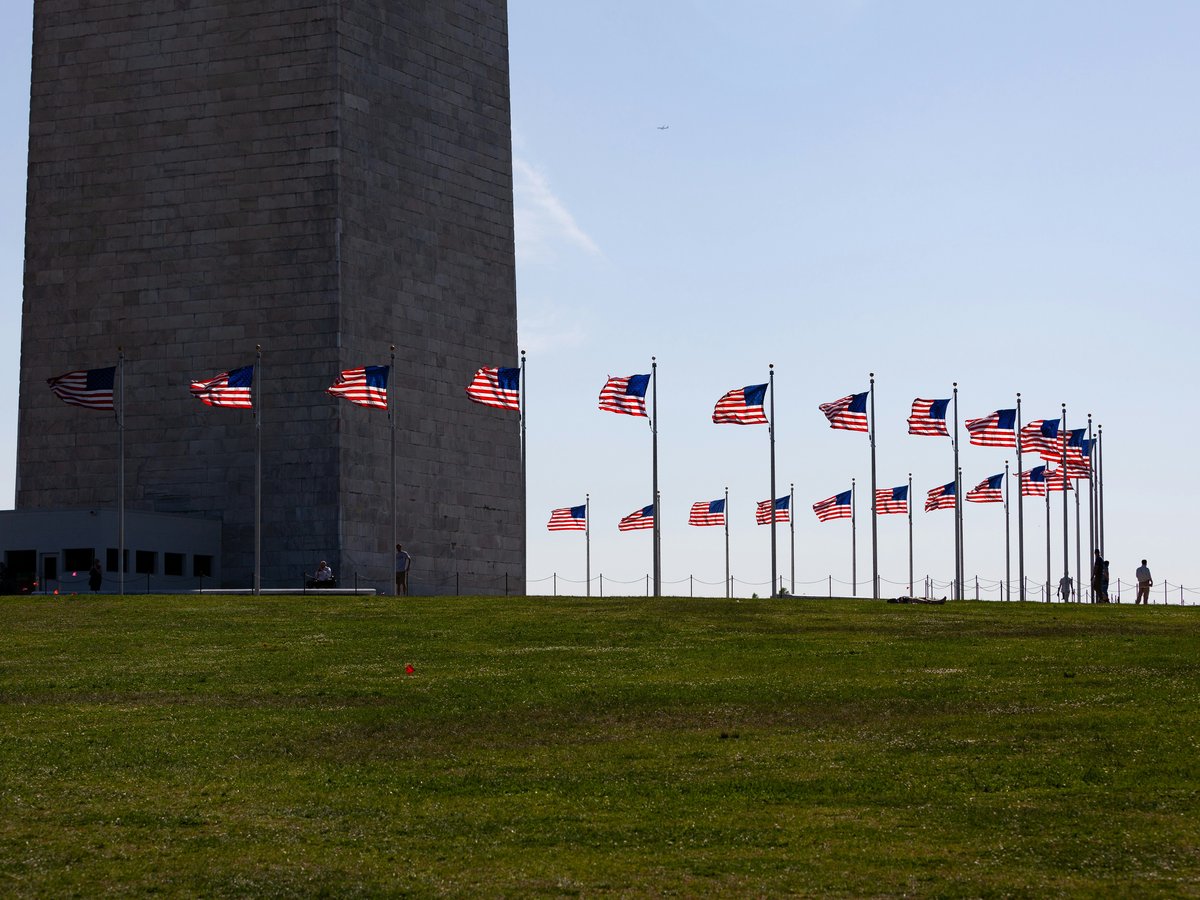
Stay in Washington DC in July
77 hotels in the Trip.com pool for Washington DC, from US$72 a night.
Opens Trip.com on Fri 2 Jul to Sun 4 Jul 2027; change the dates there.
July in Washington DC is oppressively humid. Average highs reach 31.4°C (89°F), and at 73% humidity, the heat index on exposed sections of the National Mall pushes past 38°C (100°F) by early afternoon. Your shirt sticks to your back within 10 minutes outside. The air sits heavy over the Potomac basin and barely moves.
The month's defining draw is Independence Day. The celebration on the National Mall, the city's public gathering ground since 1791, pulls hundreds of thousands of spectators for fireworks staged between the Washington Monument and the Lincoln Memorial. A free concert on the Capitol's West Lawn typically begins around 8pm, with fireworks following at roughly 9:15pm. Beyond that night, the city runs at full capacity with extended museum hours, outdoor film screenings, and 15-20 home baseball games at Nationals Park in Navy Yard.
If heat makes you miserable, October and April offer temperatures 10-15°C cooler with lighter crowds and lower hotel rates. But if summer break dictates your schedule, DC's free Smithsonian museums remain the strongest free cultural package in any American city. Afternoon temperatures, often exceeding 32°C (90°F), push most outdoor sightseeing to the morning hours before 10am or after 6pm.
Why visit in July
- The Smithsonian Institution, founded in 1846, extends summer hours across its 21 museums. Several galleries stay open until 7:30pm daily, 2 hours longer than the winter schedule, and every one of them is free.
- Independence Day stages the country's premier public fireworks display on the Mall, free to attend. The parade along Constitution Avenue draws marching bands and floats from across all 50 states.
- Nearly 15 hours of daylight, with sunset around 8:35pm in early July, lets you schedule monument visits and evening walks for the cooler hours after 7pm.
- The city scores 9.5/10 for LGBTQ+ friendliness (sourced from TTDI's editorial rubric). Dupont Circle and the U Street Corridor are particularly welcoming neighborhoods.
Worth knowing
- The humidity compounds the high temperatures into something oppressive. Any outdoor sightseeing between 11am and 4pm becomes physically demanding, especially on the shade-free stretches of the Mall between the museums.
- July is DC's wettest month. Afternoon thunderstorms arrive between 2pm and 5pm, often with only 15-20 minutes of warning, and the Mall offers almost no shelter.
- Peak tourist season means crowded museum entrances, fully booked hotels, and long security lines at the Washington Monument and the White House Visitor Center.
- Hotel rates reach their annual peak. Rooms near the Mall, especially during July 4th week, command the highest premiums of any month.
Best for
Think twice if
July is DC's most uncomfortable month for outdoor activity. Daytime highs average 31.4°C (89°F) and overnight lows settle near 21.4°C (71°F), so the city never fully cools. Total rainfall reaches 168mm across roughly 15 rainy days, arriving almost entirely as sudden afternoon thunderstorms between 2pm and 5pm. Humidity averages 73%, compounding the heat into something that feels significantly worse than the thermometer reading. Clear mornings can turn to downpours within 30 minutes, though the storms typically clear within an hour.
Seasonal caution
- The heat index can exceed 40°C (104°F) on peak afternoons. The National Weather Service issues heat advisories for the DC metro area several times in a typical July. Limit outdoor exposure between 11am and 4pm, and carry water at all times on the Mall.
- Afternoon thunderstorms frequently carry lightning and can produce wind gusts above 90 km/h (55 mph). The Mall's open layout offers no enclosed shelter along most of its length. Monitor the sky after noon and locate the nearest Smithsonian entrance before storms develop.
- Ground-level ozone can reach Code Orange (unhealthy for sensitive groups) during multiday heat waves, occurring roughly 3-5 times each July. Check AirNow.gov before planning extended outdoor activity if you have asthma or respiratory conditions.
Year-round climate
Averages from the last 5 years.
| Month | Avg high (°C) | Avg low (°C) | Rainfall (mm) |
|---|---|---|---|
| Jan | 6 | -2 | 84 |
| Feb | 9 | 0 | 82 |
| Mar | 15 | 4 | 98 |
| Apr | 20 | 8 | 95 |
| May | 24 | 13 | 139 |
| Jun | 29 | 18 | 138 |
| Jul | 31 | 21 | 168 |
| Aug | 30 | 20 | 140 |
| Sep | 26 | 17 | 118 |
| Oct | 20 | 10 | 78 |
| Nov | 14 | 4 | 62 |
| Dec | 9 | 0 | 98 |
Holidays and festivals in July
Public holidays
- Independence Day(Independence Day)5 July 2027
Headline events
Independence Day on the National Mall
July 4
The nation's largest Fourth of July celebration fills the National Mall. Fireworks launch from near the Washington Monument, preceded by a free concert on the Capitol's West Lawn. The display is visible from rooftops, bridges, and the Virginia side of the Potomac. A daytime parade runs along Constitution Avenue.
Best things to do in July
Watch Independence Day fireworks on the National Mall
eventThe fireworks display runs roughly 17 minutes, launched from near the Washington Monument with the Capitol dome and the Lincoln Memorial framing the scene. No ticket is needed. The display is visible from dozens of vantage points across the city and into Virginia.
July 4th in the nation's capital is a singular annual event with no equivalent elsewhere in the country.Booking tipNo booking required, but arrive by 2pm to claim a spot on the Mall. Late arrivals can watch from the steps of the Lincoln Memorial or from across the Potomac at the Marine Corps War Memorial in Arlington.
Walk the monuments after dark
sightseeingThe Lincoln Memorial (dedicated 1922), the Washington Monument, and the Jefferson Memorial are illuminated after sunset and remain open late. The Reflecting Pool catches the Monument's illumination, and the full walk at night means temperatures near 24-25°C (75-77°F) with a fraction of the daytime crowds.
July's long twilight keeps the sky light until 9pm, and the evening temperature drop makes the walk genuinely pleasant for the first time all day.Explore the Smithsonian during extended summer hours
cultureThe National Museum of Natural History (founded 1910) and the National Gallery of Art (opened 1937) are two of the most visited galleries on the Mall. The late afternoon slot between 4pm and closing tends to be less crowded than the 10am-1pm rush. Both collections are free.
Summer hours extend many Smithsonian galleries to 7:30pm daily, adding 2 hours of visiting time compared to winter. The air conditioning alone is worth it.Kayak or paddleboard on the Potomac River
outdoorOutfitters near Georgetown Waterfront and the Capitol Riverfront rent kayaks and stand-up paddleboards by the hour. The river offers views of the Kennedy Center, Theodore Roosevelt Island, and the Georgetown shoreline from water level. A 90-minute paddle covers roughly 5 km (3 mi).
The Potomac's water temperature reaches about 26°C (79°F) in July, its annual peak. Early morning paddles before 9am offer calm water and cooler air.Booking tipWeekend morning slots fill up by mid-week. Reserve 4-5 days ahead for Saturday or Sunday morning launches.
Catch a Nationals game at Nationals Park
sportsThe Washington Nationals play 15-20 home games each July at their stadium in Navy Yard along the Anacostia River. Evening games starting at 7:05pm bring comfortable temperatures by the middle innings, and the ballpark district's restaurants fill up before first pitch.
Baseball's regular season concentrates its home schedule in June through August. July's long evenings make the 7:05pm start time ideal.Booking tipUpper-deck seats are widely available on game day for most non-rivalry matchups. Field-level weekend seats should be purchased a week ahead.
Sunrise walk at the Lincoln Memorial
sightseeingThe Memorial faces east across the Reflecting Pool. A 5:45am arrival catches the sunrise as it lights up the Georgia marble of the interior walls and the seated Lincoln statue. At that hour, you might share the space with 15-20 people instead of the usual midday thousands.
July sunrise at approximately 5:50am is early enough to complete a full Mall walk before the heat sets in. The golden light hits the interior marble between 5:50am and 6:15am.Browse peak-harvest farmers markets
foodEastern Market in Capitol Hill runs weekend outdoor stands carrying peak-season produce from farms within 160 km (100 mi). Stone fruit, berries, corn, and heirloom tomatoes from Virginia and Maryland farms converge in July at prices well below grocery store chains.
July marks the overlap of stone fruit, berry, and early vegetable seasons from the surrounding Mid-Atlantic farm belt. This is the single best month for local produce variety.What to eat in July
In season: fruit
Maryland peaches
Local peach harvest peaks in mid-July from orchards across Maryland and Virginia. Sunday farmers markets across the city carry them at a fraction of grocery store prices, with varieties that rarely appear in supermarket chains.
On menus now
Chesapeake Bay blue crab
Peak crab season runs June through September, with July crabs at full size and sweetness. Maryland-style means steaming them whole with Old Bay seasoning, cracked open with a wooden mallet on newspaper-covered tables. Waterfront restaurants in Navy Yard and Georgetown serve them by the dozen.
What to drink
Rickey cocktail
DC declared July as Rickey Month. The gin rickey, reportedly created at a downtown DC bar in the 1880s, is the city's official cocktail. Lime juice, gin, and club soda over ice. Bars across Capitol Hill and H Street NE run Rickey specials through the month.
In markets
Heirloom tomatoes
Virginia and Maryland farms bring their first ripe heirloom tomatoes to DC farmers markets by mid-July. Cherokee Purple and Brandywine varieties are regional favorites with a depth of flavor you won't find in shipped produce.
Sweet corn
Local corn from Virginia's Shenandoah Valley reaches farmers markets by early July. The Silver Queen variety, a regional favorite with smaller, sweeter kernels, appears for only a few weeks before the season shifts.
Regular events in July
Smithsonian Folklife FestivalFree
A free annual festival on the National Mall featuring music, crafts, cooking demonstrations, and cultural programming from communities around the world. Draws over a million visitors across its roughly 10-day run and remains one of the largest free cultural events in the country.
Late June through July 4 weekendCapital Fringe Festival
DC's independent performing arts festival with hundreds of shows across venues in H Street NE and Penn Quarter. Programming ranges from experimental theater to stand-up comedy and spoken word.
Throughout JulyBastille Day celebrations
French cultural events and dining specials around the Kalorama neighborhood near the Embassy of France. Several Georgetown and downtown restaurants offer prix fixe menus and themed cocktail evenings for the occasion.
Around July 14Best places this July
Rock Creek Park
parkWashington's largest urban park stretches through Northwest DC with forested trails shaded by a dense canopy. Temperatures under the trees run 3-5°C cooler than the exposed Mall. The creek adds the constant sound of running water, and the 13 km (8 mi) trail network connects to the National Zoo's northern entrance.
Northwest DCGeorgetown Waterfront Park
parkA narrow stretch of green along the Potomac in Georgetown. Evening breezes off the river make this noticeably cooler than inland blocks by about 3°C. Restaurants and a boardwalk line the waterfront, and the park connects to the C&O Canal towpath for shaded walks west toward Great Falls.
GeorgetownThe Wharf (District Wharf)
waterfrontA 1.6 km (1 mi) waterfront development along the Washington Channel in Southwest DC. The outdoor piers catch Potomac breezes, and the mix of restaurants, a concert venue, and marina seating makes it a natural evening destination when the Mall becomes unbearable.
Southwest DCWashington National Cathedral
landmarkThe neo-Gothic cathedral, with construction beginning in 1910, sits on Mount Saint Alban at 117 m (384 ft) above sea level, the highest point in DC. The limestone interior stays cool in summer without modern air conditioning. The Bishop's Garden behind the building offers a quiet green space away from the Mall's crowds.
Upper NorthwestWashington Monument
landmarkThe 169 m (555 ft) obelisk, with its cornerstone laid in 1848, offers the city's highest observation point. The view from the top on a clear July day extends across the Potomac to Arlington National Cemetery and south toward Alexandria. Timed-entry elevator tickets are required and should be reserved on recreation.gov.
National MallU.S. National Arboretum
gardenAt 180 hectares (446 acres), this Northeast DC garden draws a fraction of the Mall's visitors. The Capitol Columns, 22 Corinthian columns from the original Capitol building, stand in a meadow that blooms with wildflowers in July. The crape myrtle and daylily collections also peak this month.
Northeast DCArlington National Cemetery
memorialThe 253-hectare (625-acre) national cemetery across the Potomac in Virginia, established in 1854. The changing of the guard at the Tomb of the Unknown Soldier occurs every 30 minutes during summer months. The open-air walk between sections is demanding in the heat, so arrive in the first hour after opening.
Arlington, VA
Your packing checklist
Tick items off as you pack. Your progress saves in this browser.
All packed — have a great trip.
Insider tips
The monuments stay open and are illuminated after dark. The Lincoln Memorial at 11pm on a Tuesday in July might have 20 people instead of the midday thousands. The Reflecting Pool catches the Washington Monument's illumination in a way you won't see during the day.
The National Museum of African American History and Culture requires timed-entry passes that release on the first Wednesday of each month at 8am Eastern. July passes tend to disappear within minutes. Set a phone alarm for 7:55am on release day if this museum is a priority.
Walk across Key Bridge from Georgetown into Rosslyn, Virginia. The Marine Corps War Memorial (the Iwo Jima statue) is a 10-minute walk from the Virginia side and offers one of the best panoramic views of the DC skyline, with far fewer people than any Mall viewpoint.
The Dupont Circle FreshFarm Market on Sundays is where DC chefs buy their produce. In July, local peaches, tomatoes, and Eastern Shore blueberries cost roughly half what Georgetown grocery stores charge for the same farms' output.
Avoid these mistakes
- Walking the entire National Mall end-to-end at midday. The stretch covers 3 km (2 mi) with almost no shade between the Capitol and the Washington Monument. Heat exhaustion cases at the Mall spike in July. Plan the crossing for before 9am or after 6pm.
- Packing only summer clothes and skipping a layer for indoor spaces. Smithsonian museums set their AC to roughly 20°C (68°F), and the 10°C swing from outside to inside causes genuine discomfort after an hour-long visit if you're in a sweaty tank top.
- Scheduling an all-outdoor itinerary without museum breaks. A July day of monument walks, Tidal Basin loops, and outdoor lunches will leave most people dehydrated and exhausted by 2pm. Alternate outdoor stretches with 60-90 minute museum sessions to recover.
Practical tips for July
The Metro (WMATA) extends service past midnight on July 4th to handle the post-fireworks crowd. On regular July days, trains stop at 11:30pm Sunday through Thursday and midnight on Friday and Saturday. Buy a SmarTrip card at any station kiosk rather than using paper farecards. Popular Smithsonian museums develop entrance lines by 10:30am, so arrive at opening time, especially at the National Museum of Natural History and the National Air and Space Museum. Timed-entry tickets for the Washington Monument elevator release on recreation.gov and sell out weeks in advance for July dates. Self-guided tours of the White House, the presidential residence since 1800, must be requested through your congressional representative's office at least 21 days in advance. Dress codes at DC restaurants are generally relaxed in summer, though Georgetown dinner spots occasionally expect collared shirts. The Mall has almost no shade trees between 3rd Street NW and the Washington Monument, roughly 1.5 km (1 mi) of exposed walkway, so plan that stretch for early morning or late evening.
FAQ
Is July a good time to visit Washington DC?
July is a fair choice, not an ideal one. The heat and humidity make extended outdoor sightseeing uncomfortable, and it is one of the most crowded and expensive months of the year. That said, Independence Day on the Mall is a singular experience, and the free Smithsonian museums provide all-day refuge from the weather. If your schedule is flexible, October and April are the two most comfortable months for a first visit.
What is the weather like in Washington DC in July?
Expect daytime highs around 31°C (89°F) and overnight lows near 21°C (71°F), with persistent humidity that makes the air feel considerably hotter. Thunderstorms are common, typically arriving in the afternoon and lasting 30-60 minutes before clearing. Mornings before 9am and evenings after 7pm are the most comfortable windows for outdoor sightseeing.
Is Washington DC crowded in July?
Yes. July is peak tourist season, driven by family travel during summer break and the July 4th holiday. Expect lines at the most popular museums by mid-morning, security queues at the Capitol Visitor Center, and hotels near the Mall sold out or at premium rates. Crowds thin somewhat after July 4th weekend and drop noticeably after mid-July when some family trips wind down.
How do I get July 4th fireworks tickets in Washington DC?
The fireworks display and the National Mall viewing areas are free and open to the public with no ticket required. Arrive by 2pm to claim a good spot on the grass between the Washington Monument and the Capitol. The concert on the Capitol's West Lawn is also free but fills early. Blankets and low chairs are allowed on the Mall. Coolers are permitted but subject to security screening.
Are the Smithsonian museums really free in July?
All Smithsonian museums charge no admission, year-round, including July. The only exception is the National Museum of African American History and Culture, which is free but currently requires a timed-entry pass released monthly. All other Smithsonian galleries are walk-in with no reservation needed.
Things to Do in Washington DC in July
 Free cancellation
 DC Monuments by Night: 10+ Landmarks | Open-Top Upgrade Available
City tour: 3 hours, free cancellation.
via Viator Free cancellation
 DC Monuments Night Tour with 10+ Stops, National Mall, Tickets
City tour: 3 hours, free cancellation.
via Viator Free cancellation
 Washington DC in One Day: Guided Sightseeing Tour + Boat Cruise
City tour: 6 hours, free cancellation.
via Viator Free cancellation
 Arlington Cemetery Small-Group Tour & Changing of the Guards
City tour: free cancellation.
via Viator Free cancellation
 US Capitol "Big 3" Highlights with Reserved Entry
City tour: free cancellation.
via Viator Free cancellation
 Washington DC "See the City" Guided Sightseeing Segway Tour
City tour: 2.5 hours, free cancellation.
via ViatorFind a flight to Washington DC
Live fares to Washington DC appear here once cookies are accepted.
Last verified by automated review (v1.7.2) on . What is automated review?