Washington DC might be the only major capital where a full week of museum-going costs nothing in admission fees. The Smithsonian Institution, founded in 1846, operates 21 museums across the city, and every single one is free. Add the National Gallery of Art, the Library of Congress, and the National Archives to that list, and the no-cost cultural offerings here match paid collections in London or Paris. The National Mall provides a broad parkland corridor connecting monuments and Smithsonian buildings on both sides. For families, this density of free attractions earns DC an 8.5/10 for family friendliness (see the TTDI Family-Friendliness Index). Rock Creek Park covers more than 1,700 acres of forested trails within city limits. Budget constraints here tend to focus on meals and Metro rides, not museum tickets. A food truck lunch near the Mall currently runs about $10 to $15, and that is likely your main daily expense.
Free attractions
-
National Museum of Natural History
The Smithsonian's flagship natural history collection has occupied its building on the Mall since 1910. The Hope Diamond, a 45.52-carat blue diamond, sits in the Harry Winston Gallery on the second floor. The Ocean Hall, which fills most of the ground level, underwent a full renovation in 2019. Weekday mornings before 11 AM tend to have the lightest crowds. The rotunda's mounted African bush elephant, installed in 1959, still greets you at the Constitution Avenue entrance. The smell of old stone and conditioned air hits the moment you step through the revolving doors.
National Mallmuseum -
National Gallery of Art
Andrew Mellon's private collection seeded this museum when Congress established it in 1937. The West Building covers European painting and sculpture from the 13th through 19th centuries. I.M. Pei's angular East Building, opened in 1978, focuses on modern and contemporary work. An underground walkway with a moving sidewalk connects the two. The Sculpture Garden sits between them, open daily. No tickets or reservations needed at any point of entry.
National Mallmuseum -
Lincoln Memorial
The memorial opened in 1922 at the western end of the Reflecting Pool on the National Mall. Daniel Chester French's seated Lincoln stands 19 feet tall inside a Greek Doric temple framed by 36 columns, one for each state in the Union at the time of Lincoln's death. Martin Luther King Jr. delivered his 1963 'I Have a Dream' speech from these steps, and a granite inscription now marks the spot. Open 24 hours a day, 365 days a year. No tickets, no reservation, no fee.
National Mallmemorial -
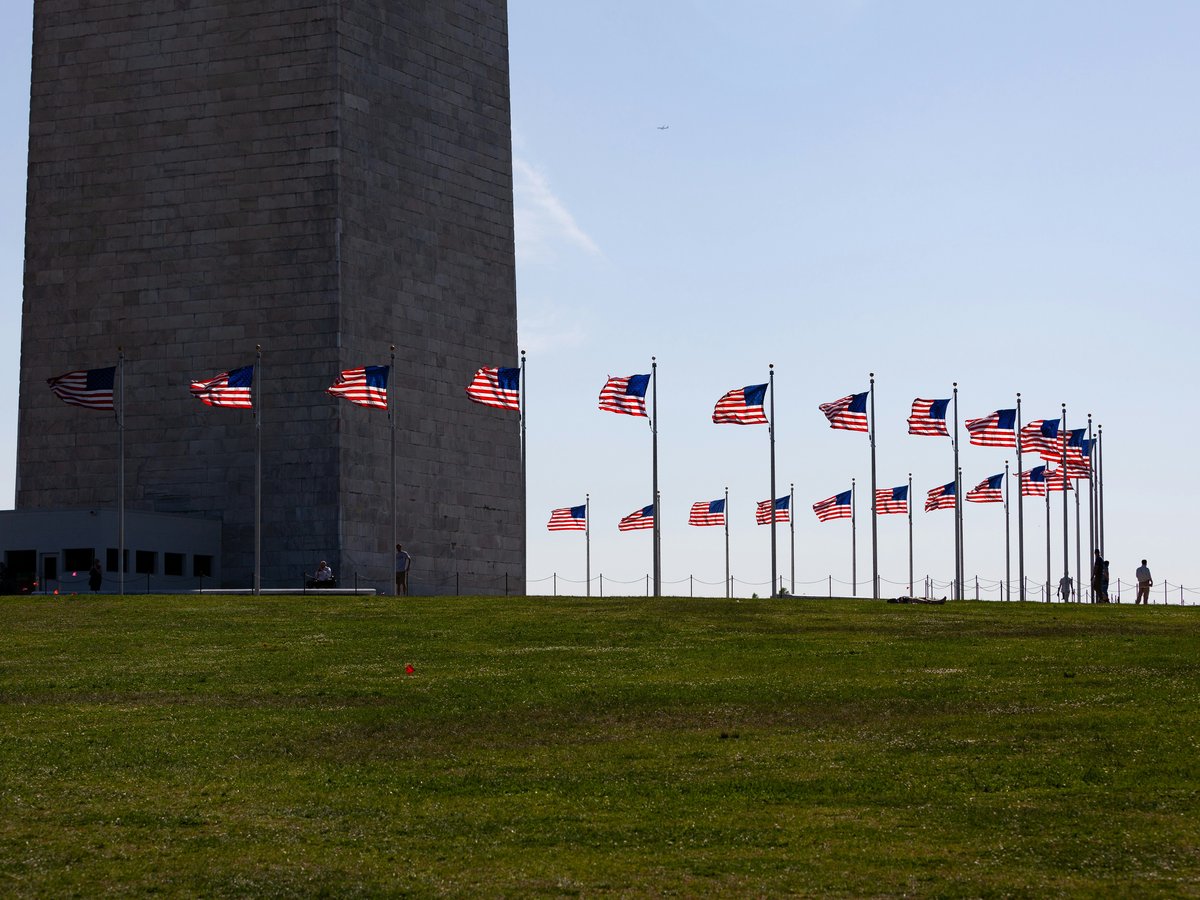
Washington Monument
The 555-foot obelisk took decades to complete after construction began in 1848. A visible color change roughly a third of the way up marks where work paused during the Civil War and resumed with stone from a different quarry. Free timed-entry tickets are required to ride the elevator to the 500-foot observation level. The National Park Service releases tickets online on a rolling basis, and they tend to go fast during spring and summer. Monument grounds are open without any pass.
National Mallmemorial -
National Mall
First planned in Pierre L'Enfant's 1791 design for the federal city, this 2-mile parkland corridor runs from the U.S. Capitol to the Lincoln Memorial. More than a dozen memorials and Smithsonian museums line both sides. A full walking tour of the core monuments takes roughly 3 to 4 hours at a comfortable pace. The grass panels between 3rd and 14th Streets host everything from pickup soccer to the annual Folklife Festival in summer.
Central Washingtonpark -
Arlington National Cemetery
Established in 1854 on the grounds of Robert E. Lee's former estate across the Potomac in Virginia, the cemetery holds more than 400,000 service members and their families. The Changing of the Guard at the Tomb of the Unknown Soldier takes place every hour from October through March and every half hour from April through September. President John F. Kennedy's gravesite, marked by an eternal flame, is among the most visited locations. Admission is free. The cemetery is a short walk from the Arlington Cemetery Metro station on the Blue and Yellow lines.
Arlington, Virginiacemetery -
National Air and Space Museum
The most visited Smithsonian museum holds the 1903 Wright Flyer, Charles Lindbergh's Spirit of St. Louis, and a touchable Moon rock from the Apollo 17 mission. A multi-year renovation that began in 2018 has transformed most of the galleries. Free timed-entry passes are currently required and available through the Smithsonian website. The Steven F. Udvar-Hazy Center near Dulles Airport in Chantilly, Virginia, is the companion facility with larger aircraft including Space Shuttle Discovery.
National Mallmuseum -
National Museum of African American History and Culture
The newest Smithsonian museum on the Mall opened in September 2016. David Adjaye's bronze-clad building draws on West African architectural forms, and the dark metalwork catches the afternoon sun in a way that shifts the facade's appearance by the hour. The collection spans from the Atlantic slave trade through the Civil Rights movement to contemporary culture. Free timed-entry passes are required and tend to be the hardest Smithsonian tickets to get, often claimed within minutes of release. Same-day passes are sometimes available starting at 10 AM on weekdays, but availability varies by season.
National Mallmuseum -
U.S. Botanic Garden
The Botanic Garden sits at the foot of Capitol Hill and has been cultivating plants on or near this site since 1842. The conservatory's tropical house feels like stepping into a Central American cloud forest, with orchids, bromeliads, and tree ferns under a humid glass canopy. The outdoor National Garden, added in 2006, features native Mid-Atlantic plantings and a butterfly garden. Open daily from 10 AM to 5 PM, with extended summer hours. Admission is always free.
Capitol Hillgarden -
Library of Congress
The Thomas Jefferson Building, completed in 1897, is worth visiting for the architecture alone. The Great Hall's marble floors, stained glass skylights, and gilded ceiling took 50 artists and craftsmen to complete. The Main Reading Room, visible from a visitors' gallery above, stretches 160 feet in diameter. Admission is free and no library card is needed to visit as a tourist. The adjacent James Madison Building holds rotating exhibitions and a free public reading room.
Capitol Hillattraction -
Rock Creek Park
This 1,754-acre forested park runs through the northwest quadrant of the city, from the Maryland border south to the Potomac. The trail surface is packed dirt and gravel, cool and quiet under a canopy of tulip poplars and oaks. You might hear woodpeckers and spot white-tailed deer on the Valley Trail. The Nature Center off Military Road offers free ranger-led programs on weekends. Peirce Mill, a restored 1820s gristmill along the creek, is open for free tours on select weekends from spring through fall.
Northwest Washingtonpark -
Kenilworth Aquatic Gardens
The only National Park Service site dedicated to aquatic plants, Kenilworth sits in the Anacostia River wetlands in northeast DC. The lotus and water lily ponds bloom from late June through August, with the best displays in early morning before the heat closes the blossoms. The adjacent Kenilworth Marsh is a 77-acre tidal wetland with boardwalk trails. Birders know this as one of the most productive spots in the District, with herons, red-winged blackbirds, and the occasional bald eagle overhead. The gardens are open from 7 AM to 4 PM daily, and admission is free.
Northeast Washingtongarden
Free activities
-
Tidal Basin Loop Walk
The roughly 2-mile loop around the Tidal Basin passes the Jefferson Memorial, the Martin Luther King Jr. Memorial, and the FDR Memorial. In late March and early April, more than 3,000 cherry trees, most of them Yoshino, line the water's edge. The pale pink blossoms carry a faint sweetness when the wind picks up, and fallen petals collect on the water's surface. Outside that season, the path is quieter but the willows still trail into the water and the reflections on a calm morning are worth the early start. Begin at the 15th Street entrance near the Washington Monument for the best opening view.
National Mallwalking route -
Embassy Row on Massachusetts Avenue NW
A walk along Massachusetts Avenue NW between Dupont Circle and the Naval Observatory passes dozens of embassies and chanceries, many housed in Gilded Age mansions with limestone facades and ornamental iron gates. The Indonesian Embassy at 2020 Massachusetts Avenue occupies the Walsh-McLean House, a Beaux-Arts landmark from 1903. The British Embassy grounds, set back from the avenue at number 3100, feature a statue of Winston Churchill with one foot on embassy land and one on American soil. Free to walk any day.
Dupont Circle to Observatory Circlewalking route -
Georgetown Waterfront and C&O Canal Towpath
Georgetown Waterfront Park, opened in 2011, runs along the Potomac between Wisconsin Avenue and Key Bridge. The Chesapeake and Ohio Canal towpath starts at 30th and M Streets NW and extends 184.5 miles to Cumberland, Maryland, though even a 2-mile stroll to Fletcher's Cove makes for a pleasant afternoon. The old canal locks, built in the 1830s, still hold water in places, and the towpath smells of damp stone and river mud. On warm evenings, the waterfront fills with joggers and families, and you can hear crew teams practicing on the river.
Georgetownwalking route -
Eastern Market
Capitol Hill's Eastern Market has operated since 1873, making it the city's oldest continuously running public market. The indoor hall smells of fresh bread and butcher paper on weekday mornings and sells produce, meat, and baked goods Tuesday through Sunday. On weekends, outdoor vendors set up stalls along 7th Street SE with antiques, vintage prints, and handmade crafts. The building itself, a red-brick Victorian structure, survived a 2007 fire and reopened in 2009. Browsing costs nothing.
Capitol Hillmarket -
Dupont Circle FreshFarm Market
One of the city's largest farmers' markets runs every Sunday year-round at 20th Street NW and Massachusetts Avenue, near the Dupont Circle Metro. Local farmers from Virginia and Maryland sell seasonal produce, pastured eggs, and fresh-baked bread. The market typically runs from 8:30 AM to 1:30 PM, and vendors frequently offer samples of whatever is in season.
Dupont Circlemarket -
Shaw and U Street Mural Corridor
The blocks around U Street NW between 9th and 14th Streets are home to some of DC's most concentrated street art. The murals cover everything from Duke Ellington, who was born at 2129 Ward Place NW in 1899, to contemporary social justice themes. The neighborhood's mural scene has grown considerably since 2015, with new commissions appearing each year. MuralsDC, the city's public art program, maintains an online map of sanctioned works. Free to walk any time of day.
Shaw / U Streetpublic art -
Capitol Hill Neighborhood Walk
The residential streets east of the Capitol building, particularly along East Capitol Street and around Lincoln Park, feature some of the city's best-preserved 19th-century rowhouses. The Emancipation Memorial in Lincoln Park, dedicated in 1876, was funded by contributions from formerly enslaved people. Folger Park and Stanton Park, both small green squares, break up the grid with benches and shade trees. The walk from Union Station south to the Navy Yard covers about 1.5 miles and passes through three distinct neighborhood characters.
Capitol Hillwalking route
Free events
-
Kennedy Center Millennium Stage
Daily at 6 PMThe Kennedy Center hosts a free performance on the Millennium Stage every evening at 6 PM. Acts range from jazz ensembles and classical quartets to world music and spoken word. No tickets needed. Walk in through the main entrance and head to the Grand Foyer. Voices carry in the vaulted 630-foot-long hall, mixing with musicians warming up before the set. Performances are also live-streamed on the Kennedy Center website.
Kennedy Center, 2700 F Street NW -
Jazz in the Garden
Friday evenings, late May through SeptemberThe National Gallery of Art hosts live jazz in its Sculpture Garden on Friday evenings during summer, typically from late May through September. The setting puts you among large-scale sculptures by artists like Claes Oldenburg and Louise Bourgeois while a combo plays near the central fountain. The event draws a relaxed after-work crowd. Picnic blankets on the grass are welcome, and there is a bar selling wine and beer, though you do not need to buy anything to stay. Music generally starts around 5 PM.
National Gallery of Art Sculpture Garden, National Mall -
National Cherry Blossom Festival
Late March through mid-April, annuallyThe festival runs for about 4 weeks from late March through mid-April, celebrating the 1912 gift of cherry trees from Tokyo to Washington. The parade along Constitution Avenue NW is ticketed for grandstand seats but free to watch from the sidewalk. Most festival programming, including cultural performances on the Mall and the Blossom Kite Festival, costs nothing. Peak bloom varies by year. The National Park Service publishes forecasts in late February based on temperature data.
Tidal Basin and National Mall -
Smithsonian Folklife Festival
Late June through early July, annuallyThe Folklife Festival takes over a stretch of the National Mall for about 10 days straddling late June and early July, spotlighting living cultural traditions from selected regions and communities. The format mixes music stages, cooking demonstrations where the smell of grilling arepas or fresh naan pulls you toward the tents, craft workshops, and storytelling circles. Each year's program centers on 2 or 3 featured cultures or themes. Entirely free to attend.
National Mall between 7th and 14th Streets NW -
National Memorial Day Concert
Sunday before Memorial Day, late MayThe concert takes place on the West Lawn of the U.S. Capitol on the Sunday evening before Memorial Day. The National Symphony Orchestra performs alongside guest artists in a program honoring fallen service members. Gates open in the afternoon. Lawn seating is first-come, first-served, and tens of thousands attend. Broadcast live on PBS.
West Lawn of the U.S. Capitol -
A Capitol Fourth
July 4, annuallyThe annual July 4th concert on the Capitol's West Lawn draws roughly 500,000 people to the Mall for an evening of patriotic music capped by fireworks over the Washington Monument. The National Symphony Orchestra anchors the program, with pop, country, and Broadway guest artists rotating each year. Music starts around 8 PM. Fireworks follow around 9:09 PM. Lawn seating is free and open to the public.
West Lawn of the U.S. Capitol and National Mall
Attractions That Charge or Require Advance Booking
Washington National Cathedral, founded in 1910 and not completed until 1990, charges around $17 for adult general admission. That said, worship services remain free to attend, with regular Sunday services and a well-attended evensong on select weekdays. The International Spy Museum on L'Enfant Plaza typically charges around $25 for adults. The National Geographic Museum on 17th Street NW runs about $15. A useful rule for sorting things out in this city is that if a museum charges admission, it is not part of the Smithsonian. Some free attractions require advance reservations. The White House, completed in 1800, offers free tours but you need to submit a request through your member of Congress at least 21 days ahead. Foreign nationals can request access through their country's embassy in Washington. The Pentagon, headquarters of the Department of Defense since 1941, offers free guided tours that similarly require advance scheduling through a congressional office.
Best Months for Free DC
Late March through mid-May offers the widest window of outdoor free programming alongside comfortable walking temperatures. Cherry blossom peak along the Tidal Basin typically falls in late March or early April, though exact dates shift each year. Summer brings the Folklife Festival and the Friday jazz evenings described above, but Washington's July and August heat regularly pushes above 32 degrees Celsius with humidity thick enough that you feel it on your skin the moment you step outside. Worth noting that current mid-August conditions, with temperatures around 25 degrees and clear skies, are relatively mild for the season. September and October bring relief with warm days, lower humidity, and thinner crowds at the always-free attractions. Winter has the fewest visitors, meaning you will likely have museum galleries mostly to yourself on a weekday in January or February.
Sources
Primary references for transit, neighborhoods, safety, and logistics consulted during research for this guide. Wikivoyage Washington DC main article (https://en.wikivoyage.org/wiki/Washington_DC), including sections on arriving (https://en.wikivoyage.org/wiki/Washington_DC#Get_in), local transit and neighborhoods (https://en.wikivoyage.org/wiki/Washington_DC#Get_around), major attractions and museums (https://en.wikivoyage.org/wiki/Washington_DC#See), dining (https://en.wikivoyage.org/wiki/Washington_DC#Eat), and safety (https://en.wikivoyage.org/wiki/Washington_DC#Stay_safe). Attraction founding dates verified against Wikidata entries for each institution. Weather observation from Open-Meteo, recorded 2026-08-20.
FAQ
Is everything at the Smithsonian really free?
Every Smithsonian museum and gallery in Washington DC is free to enter, with no exceptions. Some, like the National Air and Space Museum and the National Museum of African American History and Culture, currently require free timed-entry passes that need to be reserved through the Smithsonian website in advance. The passes cost nothing. The National Zoo in upper Northwest DC is also a Smithsonian institution and free to visit, though parking there is not.
Do I need timed-entry tickets for any free attractions?
The Washington Monument requires free timed-entry tickets through the National Park Service. Two Smithsonian museums also use timed passes, as noted above. The White House requires a separate congressional request process described in the advance-booking section. Everything else on this page is walk-in during operating hours. That said, for popular sites during peak season, arriving before 10 AM generally means shorter waits at security screening.
Is DC safe for solo travelers?
Washington DC scores 6.5/10 for solo-traveler safety (see the TTDI Solo-Safety Index). The tourist core around the National Mall, Capitol Hill, and Georgetown feels well-patrolled and comfortable during daylight hours. Metro stations in central areas are busy enough to feel safe well into the evening. Some neighborhoods east of the Anacostia River and parts of Northeast DC warrant more caution after dark. The Wikivoyage safety section (https://en.wikivoyage.org/wiki/Washington_DC#Stay_safe) has neighborhood-specific notes worth reading before your trip.
What is the best time of year for free outdoor activities?
Spring, from late March through May, and autumn, from September through October, offer the most comfortable weather for walking the Mall and visiting outdoor memorials. Summer adds event programming but comes with considerable heat and humidity. Winter is manageable with layers, and you will have the museums nearly to yourself on weekday mornings in the cooler months.
How do I get around DC without a car?
The Metro system (WMATA) covers much of the tourist core, with stations at Smithsonian, Federal Triangle, Capitol South, and Arlington Cemetery. Fares vary by distance and time of day, currently running about $2.25 to $6.00 per trip on a SmarTrip card. The city's grid layout makes walking between Mall attractions straightforward, and most of the sites on this page are within a 30-minute walk of one another. The Wikivoyage transit section (https://en.wikivoyage.org/wiki/Washington_DC#Get_around) covers routes and fare details.
Is Washington DC welcoming for LGBTQ+ visitors?
DC scores 9.5/10 for LGBTQ+ friendliness (sourced from TTDI's editorial rubric). The Dupont Circle neighborhood has been a center of LGBTQ+ culture for decades. Capital Pride, typically held in June, includes a free street festival and parade along the 17th Street NW corridor between P and R Streets. The city legalized same-sex marriage in 2010, well before the national ruling in 2015.
Last verified by automated review (v1.7.2) on . What is automated review?