Stay in Washington DC in August
77 hotels in the Trip.com pool for Washington DC, from US$72 a night.
Opens Trip.com on Fri 6 Aug to Sun 8 Aug 2027; change the dates there.
August in Washington DC is defined by humidity. The 74% average turns afternoon highs of 29.5°C (85°F) into a heat index near 38°C (100°F) on peak days. Nighttime lows sit around 20°C (68°F) and offer minimal relief. You feel the weight of the air the moment you step outside Union Station or Reagan National Airport, warm and close against your skin. The marble monuments along the National Mall absorb and radiate that heat all day. Thunderstorms hit on roughly 13 of the month's 31 days. They drop the month's 140mm of rainfall in intense 20-minute bursts, and the post-storm humidity can briefly climb above 80%.
That said, August has a real upside for visitors who plan around it. Congress goes into recess by early August, and a noticeable share of the city's professional class leaves town. Hotel rates ease from the spring cherry blossom peak. Restaurants in Georgetown and along the U Street Corridor that need 2-week advance reservations in April sometimes have same-day tables in August. The Smithsonian Institution, founded in 1846 and still free across all 21 of its museums, becomes the practical center of any August trip. Air conditioning and more than 150 million artifacts across the complex turn the hottest hours into the most productive.
Most locals would tell you to come in April or October instead. But if you treat mornings and evenings as outdoor time and fill the 11 a.m. to 4 p.m. window with the National Museum of Natural History or the National Gallery of Art (founded in 1937), August delivers a solid trip at lower cost. Dupont Circle, Adams Morgan, and Capitol Hill feel noticeably less packed than they do during the spring and fall peaks.
Why visit in August
- All 21 Smithsonian museums are free and air-conditioned year-round, and in August they become a genuine survival strategy rather than a supplement to outdoor sightseeing.
- Hotel rates drop from the city's spring peak, and same-day restaurant availability improves at Georgetown and Penn Quarter spots that normally book weeks out.
- Congressional recess and the professional exodus thin crowds at the Capitol Building, Library of Congress, and surrounding government landmarks noticeably compared to spring.
- Daylight runs from about 6:15 a.m. to 8 p.m. in early August, giving you wide windows for comfortable dawn and evening outdoor time before and after the midday heat.
Worth knowing
- Summer humidity makes sustained outdoor walking between 10 a.m. and 5 p.m. genuinely draining. The Mall's central path runs its full length with almost no tree shade.
- Afternoon thunderstorms are common, typically hitting between 2 p.m. and 5 p.m. with little warning. They pass in under 30 minutes but can strand you without shelter on exposed ground.
- No trip-defining festival or event anchors August. The month lacks the draw of cherry blossom season, the July 4th fireworks on the Mall, or fall foliage in October.
Best for
Think twice if
August sits at the tail end of DC's hottest stretch, which runs from late June through early September. The humidity is the dominant factor. You step outside and the air has a physical weight to it, warm and close. It rarely breaks even at night, and mornings turn sticky again by 8 a.m. Afternoon thunderstorms arrive suddenly, typically between 2 p.m. and 5 p.m. They dump rain hard for 20 minutes and clear out. They rarely cancel an entire day, but they will rearrange your afternoon plans. By month's end, you might notice the first hints of September's approaching relief. Sunrise comes about 10 minutes later by August 31 compared to August 1, and the worst heat spikes tend to become less frequent in the final week.
Seasonal caution
- The heat index regularly exceeds 38°C (100°F) between 11 a.m. and 4 p.m. on peak August days. The National Weather Service issues heat advisories for the DC metro area multiple times each August. Drink water proactively, especially on the shadeless stretches of the Mall.
- Afternoon thunderstorms can produce lightning, strong winds, and brief flash flooding in low-lying areas. When the sky darkens between 2 p.m. and 5 p.m., move indoors. The storms pass quickly but being caught in the open on the Mall during lightning is dangerous.
Year-round climate
Averages from the last 5 years.
| Month | Avg high (°C) | Avg low (°C) | Rainfall (mm) |
|---|---|---|---|
| Jan | 6 | -2 | 84 |
| Feb | 9 | 0 | 82 |
| Mar | 15 | 4 | 98 |
| Apr | 20 | 8 | 95 |
| May | 24 | 13 | 139 |
| Jun | 29 | 18 | 138 |
| Jul | 31 | 21 | 168 |
| Aug | 30 | 20 | 140 |
| Sep | 26 | 17 | 118 |
| Oct | 20 | 10 | 78 |
| Nov | 14 | 4 | 62 |
| Dec | 9 | 0 | 98 |
Best things to do in August
Dawn monument walk on the National Mall
sightseeingThe Mall, DC's central park since 1791, stretches from the Capitol to the Lincoln Memorial (dedicated in 1922). At 6 a.m. in August, temperatures sit near 22°C (72°F) and the first light hits the marble from the east. The crowds haven't arrived, and you can stand at the Lincoln Memorial's steps with clear sight lines to the Washington Monument and the Capitol dome. The quiet at that hour is striking for a city this size.
Midday heat makes this walk miserable by 10 a.m. in August. The dawn window is the only comfortable time for the full end-to-end route.Booking tipNo booking needed. Start by 6 a.m. to finish before the heat builds.
Smithsonian museum marathon
museumThe National Museum of Natural History (opened in 1910, home to over 145 million specimens), the National Air and Space Museum, and the National Museum of African American History and Culture can absorb 2 to 3 full days of visits. All are free. All are heavily air-conditioned. The range runs from the Hope Diamond to the Wright Brothers' Flyer to Harriet Tubman's hymnal.
August heat turns indoor attractions from supplement to survival strategy. These museums are the most rational way to spend the 5-6 hours between 11 a.m. and 5 p.m.Booking tipThe National Museum of African American History and Culture requires timed-entry passes. Book online at least 2 weeks ahead, as August family tourism fills slots fast.
Evening kayaking on the Potomac River
outdoorOutfitters near the Georgetown waterfront and Key Bridge rent kayaks and paddleboards by the hour. The Potomac's water temperature peaks around 27°C (80°F) in August. You paddle with the Kennedy Center, Roosevelt Island, and the Rosslyn skyline in view. The river surface catches the lowering sun and the noise of the city fades within 5 minutes of pushing off.
The river reaches its warmest point of the year. Evening sessions between 5 p.m. and sunset catch the best light and avoid the worst heat.Booking tipWeekend sunset slots fill by Thursday. Book midweek for easier availability.
Night monument tour on foot
sightseeingThe memorials along the National Mall stay open 24 hours and are dramatically lit after dark. The Lincoln Memorial, the Martin Luther King Jr. Memorial, the World War II Memorial, and the Vietnam Veterans Memorial all take on a different character under floodlights with few other visitors. In the quiet you can hear your footsteps on the granite. The lit Washington Monument is visible from every angle.
Temperatures drop below 25°C (77°F) after 9 p.m. A 2-hour walking loop at night is the first comfortable extended outdoor time all day.Booking tipNo booking needed. National Park Service rangers are stationed at major memorials until 11:30 p.m.
The Wharf waterfront dining and drinks
diningThe District Wharf, which opened its first phase in 2017 along the Southwest Waterfront, runs about 1 kilometer of restaurants, bars, and public boardwalk on the Washington Channel. Salt air drifts off the channel, and the breeze makes it feel 2-3°C cooler than inland neighborhoods. The Maine Avenue Fish Market, one of the oldest continuously operating open-air fish markets in the US, sits at the north end.
The waterfront breeze factor matters most in August. Evening dining here is noticeably more comfortable than at restaurants on inland streets without the airflow.National Gallery of Art extended visit
museumThe Gallery, which is not part of the Smithsonian despite sitting on the Mall, fills two buildings. The West Building holds European paintings from the 13th through 19th centuries, including Ginevra de' Benci, the only Leonardo da Vinci painting in the Americas. The East Building, designed by I.M. Pei, covers modern and contemporary art. Both buildings are free.
August's reduced visitor count means you can stand in front of a painting without competing for space. The air conditioning alone is worth the detour.Booking tipNo timed entry required. The ground-level cafe in the East Building is less crowded than the main cafeteria.
Rock Creek Park trail hiking
outdoorRock Creek Park covers over 710 hectares of forested land running through Northwest DC. The tree canopy keeps trail temperatures 3-5°C below the exposed city streets. The Valley Trail and the Western Ridge Trail are the main routes. Cicadas provide the soundtrack in August, a wall of buzzing sound that fills the canopy, and the creek runs over rocks with a constant low murmur.
The forest canopy is at full thickness in August, providing maximum shade. The temperature difference from the sun-baked Mall is noticeable the moment you step onto the trails.What to eat in August
In season: fruit
Maryland peaches
The local peach harvest from farms in Maryland and northern Virginia peaks in August. Eastern Market in Capitol Hill and the Dupont Circle FRESHFARM market stock them on weekends. They're fragrant, soft, and noticeably different from the firm supermarket imports available year-round.
Heirloom tomatoes
August brings the widest variety of heirloom tomatoes to DC's markets. Cherokee Purples, Brandywines, and Green Zebras appear alongside dozens of other cultivars from Virginia and Maryland farms. The flavor gap between these and grocery-store tomatoes is significant enough to build a meal around.
On menus now
Chesapeake Bay blue crabs
August falls in the heart of blue crab season on the Chesapeake Bay, roughly June through September. The crabs reach their largest and meatiest in late summer. Restaurants across DC serve them steamed and coated in Old Bay seasoning. The sharp snap of the shell, the sting of Old Bay on your fingertips, the sweetness of the backfin meat. It's as close to a defining DC food ritual as the city gets.
What to drink
Rickey cocktail
DC's official cocktail, recognized by the DC Council in 2011. Made with bourbon or gin, half a lime, and sparkling water. No sugar. The drink was reportedly created at a Capitol Hill bar in the 1880s, and DC bartenders feature their house variations through the summer months.
In markets
Silver Queen corn
The Mid-Atlantic's signature white sweet corn reaches peak harvest in August at farms across Virginia and Maryland. The kernels are smaller and sweeter than standard yellow corn. Best eaten within a day or two of picking, which makes weekend farmers markets the right source.
Regular events in August
DC Restaurant Week
The summer edition of Metropolitan Washington Restaurant Week, with fixed-price lunch and dinner menus at reduced rates across more than 200 participating restaurants throughout the city.
Mid-August (exact dates vary by year)Evening Parade at Marine Barracks WashingtonFree
A 75-minute ceremony at 8th and I Streets SE featuring the United States Marine Band (the President's Own), the Silent Drill Platoon, and the Drum and Bugle Corps. Reservations fill weeks in advance, so plan early.
Friday evenings through late AugustWashington Nationals home games at Nationals Park
Major League Baseball's regular season runs through August. The Nationals play home games in the Navy Yard neighborhood, and the stadium sits on the Anacostia River where evening games catch river breezes that help take the edge off the heat.
Various dates throughout AugustFree summer concerts by US military bandsFree
The US Navy Band, Army Band, and Air Force Band perform free outdoor concerts at the Capitol's west lawn, the Navy Memorial on Pennsylvania Avenue, and other locations throughout the summer concert season.
Various evenings through AugustBest places this August
Rock Creek Park
parkOver 710 hectares of forested trails running through Northwest DC. The canopy shade keeps temperatures significantly cooler than the exposed Mall. The sound of the creek running over rocks provides a constant backdrop, and the trails are well-maintained for varying fitness levels.
Northwest DCThe Wharf (District Wharf)
waterfrontA kilometer-long waterfront development on the Washington Channel in Southwest DC. The boardwalk catches river breezes that cut the heat. Dining, bars, and the historic Maine Avenue Fish Market are accessible without a reservation on most August weekdays.
Southwest DCGeorgetown Waterfront Park
parkA stretch of public parkland on the Potomac in Georgetown. Evening air carries the mineral smell of the river and mixes with kitchen smoke from the nearby restaurants. The views downstream toward the Kennedy Center and Roosevelt Island are best at sunset.
GeorgetownWashington National Cathedral
landmarkFounded in 1910, the cathedral was not completed until 1990. The stone interior stays cool even on the hottest August afternoons, and the scale of the nave is worth the trip across town. The Bishop's Garden, adjacent to the cathedral, is a quiet, shaded space that few tourists find.
Northwest DC (Woodley Park area)Tidal Basin
landmarkThe reservoir between the Potomac and the National Mall is best visited at dawn in August, when the water reflects the Jefferson Memorial and the surrounding cherry trees provide some shade. The morning light turns the still water surface to copper. By 10 a.m. the exposed paths become uncomfortable.
National Mall areaWashington Monument grounds
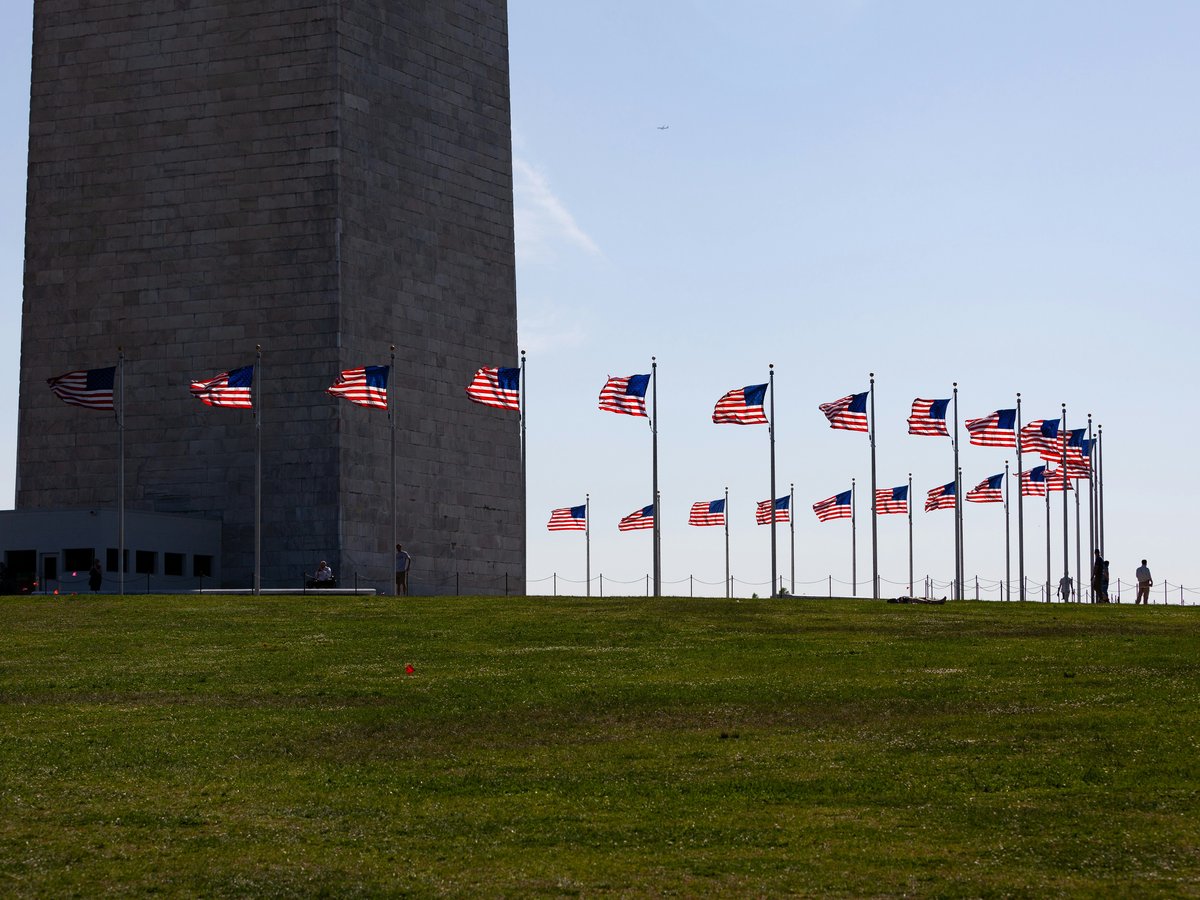
landmarkThe obelisk (cornerstone laid in 1848) is visible from most of the city, but the grounds around its base offer the widest open-sky views of the Mall. In August, visit at dawn or after 7 p.m. The monument itself requires timed-entry tickets for the elevator to the 152-meter observation level.
National MallUnited States National Arboretum
garden180 hectares of gardens, specimen trees, and open meadows in Northeast DC. Far fewer visitors than the Mall, with considerably more shade. The Capitol Columns, 22 Corinthian columns from the original Capitol building, stand in an open field and are one of DC's most striking sights with almost no crowd around them.
Northeast DCArlington National Cemetery
landmarkThe national military cemetery, established in 1854 across the Potomac in Virginia. The walk from the entrance to the Tomb of the Unknown Soldier covers about 1.5 kilometers of mostly unshaded asphalt. In August, go at opening time. Afternoon visits in full sun on the dark pavement are inadvisable.
Arlington, VA (across the Potomac)
Your packing checklist
Tick items off as you pack. Your progress saves in this browser.
All packed — have a great trip.
Insider tips
The window between the Smithsonian museums closing at 5:30 p.m. and sunset (around 8 p.m. in early August, closer to 7:30 p.m. by month's end) is the sweet spot for outdoor memorials. The worst heat has broken, the tour-bus crowds have left, and the evening light on the white marble is at its warmest and most photogenic.
For Chesapeake Bay blue crabs at lower prices than the sit-down restaurants, head to the Maine Avenue Fish Market near The Wharf in Southwest DC. It has operated as an open-air market since the early 1800s, and the carry-out steamed crabs are significantly cheaper than the waterfront dining rooms a block away.
Georgetown and Penn Quarter restaurants that require advance reservations in spring often have walk-in availability in August. Check OpenTable the morning of your visit, especially for weeknight dinners.
The Library of Congress in the Thomas Jefferson Building has one of the most striking interior spaces in Washington, but most visitors only see it from the upper gallery. A free reader identification card, available same-day at the Madison Building next door, gets you onto the Main Reading Room floor.
Avoid these mistakes
- Planning a full day of outdoor monument touring starting at 10 a.m. The heat index enters dangerous territory by midday in August. The Mall's central path has almost no tree shade for its full length. Go at dawn or after 5:30 p.m. instead.
- Underestimating distances on the National Mall. What looks walkable on a map becomes 30-45 minutes of exposed walking in direct sun between the Capitol and the Lincoln Memorial. The DC Circulator bus runs a National Mall route with air-conditioned stops and is far more comfortable than walking the open stretches in August heat.
- Assuming every museum near the Mall is free because the Smithsonian is. The International Spy Museum and several other private museums charge admission. Verify before you queue.
- Visiting Arlington National Cemetery in the afternoon. The grounds are almost entirely unshaded, and the uphill walk to the Tomb of the Unknown Soldier is about 1.5 kilometers on asphalt that radiates stored heat. Go at the 8 a.m. opening.
Practical tips for August
Washington DC scores 6.5/10 for solo-traveler safety (see the TTDI Solo-Safety Index), and standard urban precautions apply, particularly east of the Capitol and in parts of Southeast after dark. The Metro runs until 11 p.m. on weeknights and midnight on Fridays and Saturdays, which keeps late-evening transit reliable. Book White House (the president's official residence since 1800) or Capitol Building tours through your congressional representative at least 3 weeks ahead, because August family-tourism demand fills slots fast. The dress code is casual at all Smithsonian museums and most restaurants, though a handful of Georgetown and Penn Quarter dinner spots expect business casual. Carry a refillable water bottle to the Mall, as drinking fountains are spaced far apart. Be aware that August falls within hurricane season on the East Coast. Direct hits on DC are extremely rare, but tropical moisture from offshore systems can bring 2-3 days of heavy rain with limited advance notice. For transit routing and neighborhood orientation, Wikivoyage's DC guide (https://en.wikivoyage.org/wiki/Washington_DC#Get_around) maps Metro lines, bus connections, and walking distances. For neighborhood-level safety detail, their safety section (https://en.wikivoyage.org/wiki/Washington_DC#Stay_safe) is also worth reading before the trip.
FAQ
Is August a good time to visit Washington DC?
It's not one of the better months, and most locals would suggest spring or fall instead. The heat and humidity are the main obstacles. That said, lower hotel costs, thinner crowds at government landmarks, and the full Smithsonian complex make it a workable choice for visitors who plan their days around the weather. If your schedule is flexible, late September or October is a more comfortable version of the same trip.
What is the weather like in Washington DC in August?
Hot and humid throughout the month. Afternoon temperatures reach the low 30s Celsius (mid-80s Fahrenheit), and high humidity makes it feel considerably worse than the thermometer reads. Thunderstorms are frequent but brief, typically passing in under 30 minutes. Mornings before about 10 a.m. and evenings after 6 p.m. are the comfortable windows for outdoor activity.
Is Washington DC crowded in August?
Family tourism is high since schools are out, and you'll encounter lines at the most popular Smithsonian museums by mid-morning. But the overall visitor count is lower than during the March-April peak or fall foliage in October. The biggest difference is around the Capitol, where Congressional recess noticeably thins the foot traffic and makes the surrounding area feel less hurried.
What are the best things to eat in Washington DC in August?
Chesapeake Bay blue crabs are the signature seasonal food. The harvest runs June through September, with late summer producing the largest crabs. Beyond that, local farms bring peak-harvest peaches, heirloom tomatoes, and Silver Queen corn to weekend farmers markets at Eastern Market and in Dupont Circle. The Rickey, DC's official cocktail, is the local summer drink to try. For a neighborhood-by-neighborhood dining guide, Wikivoyage's DC coverage (https://en.wikivoyage.org/wiki/Washington_DC#Eat) is a solid starting reference.
Things to Do in Washington DC in August
 Free cancellation
 DC Monuments by Night: 10+ Landmarks | Open-Top Upgrade Available
City tour: 3 hours, free cancellation.
via Viator Free cancellation
 DC Monuments Night Tour with 10+ Stops, National Mall, Tickets
City tour: 3 hours, free cancellation.
via Viator Free cancellation
 Washington DC in One Day: Guided Sightseeing Tour + Boat Cruise
City tour: 6 hours, free cancellation.
via Viator Free cancellation
 Arlington Cemetery Small-Group Tour & Changing of the Guards
City tour: free cancellation.
via Viator Free cancellation
 US Capitol "Big 3" Highlights with Reserved Entry
City tour: free cancellation.
via Viator Free cancellation
 Washington DC "See the City" Guided Sightseeing Segway Tour
City tour: 2.5 hours, free cancellation.
via ViatorFind a flight to Washington DC
Live fares to Washington DC appear here once cookies are accepted.
Last verified by automated review (v1.7.2) on . What is automated review?