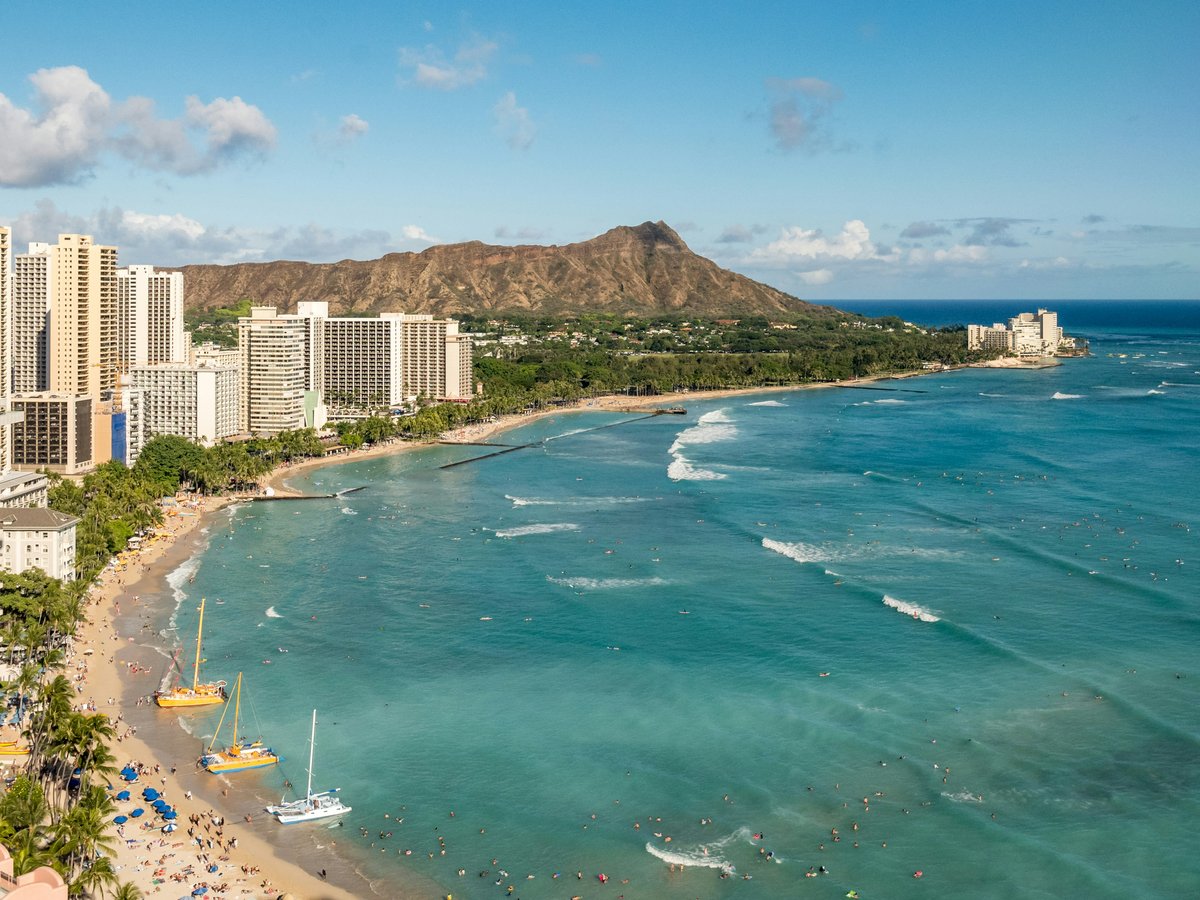
Stay in Honolulu in March
63 hotels in the Trip.com pool for Honolulu, from US$27 a night.
Opens Trip.com on Fri 5 Mar to Sun 7 Mar 2027; change the dates there.
March in Honolulu is the last reliable month of humpback whale season. The mothers and calves that arrived in Hawaiian waters around November are at their most active now, breaching and spouting in the channels between Oahu and Molokai. From the Makapuu Point Lighthouse Trail on Oahu's southeast coast, you can watch them for free on most clear mornings. Water temperatures sit around 24°C (75°F), air temperatures reach about 26°C (78°F) by day and 20°C (69°F) at night, and the tail end of the wet season brings roughly 58mm of rain over 14 days. Most of those showers blow through in 20 minutes. You get wet, a rainbow appears over Manoa Valley, and the sun comes back.
Spring break arrives mid-March. Mainland families flood Waikiki, and hotel rates tend to climb 20-30% above the annual average. Kalakaua Avenue fills up, and spots like Hanauma Bay Nature Preserve and Diamond Head require advance reservations that sell out days ahead. The Honolulu Festival, held over a weekend in mid-March, fills the Hawaii Convention Center with Pacific Rim cultural performances and sends a Grand Parade of taiko drummers and Okinawan dance troupes down Kalakaua Avenue. Prince Kuhio Day on March 26 is a state holiday, and some banks and government offices close.
To be fair, Honolulu has better months. September and October offer drier skies, warmer ocean water near 27°C (80°F), and far thinner crowds. But March gives you whales, the last of the North Shore's winter surf, and comfortable hiking temperatures. The trade winds blow from the northeast at 15-25 km/h (10-15 mph) most afternoons. Plumeria trees along Ala Moana Boulevard are in bloom, and the wind carries their scent mixed with salt spray off the reef.
Why visit in March
- Humpback whale season peaks in March. Tour boats out of Kewalo Basin Harbor report sighting rates above 95%, and the Makapuu Point Lighthouse Trail offers free shore-based watching on most clear mornings.
- Daytime temperatures around 26°C (78°F) with steady trade winds at 15-25 km/h (10-15 mph) make outdoor activity comfortable. Trails like Diamond Head and Manoa Falls are 3°C (5°F) cooler than the same hikes in August.
- The Honolulu Festival in mid-March brings 3 days of Pacific Rim cultural performances, food booths, and a Grand Parade down Kalakaua Avenue. Most events are free to attend.
- Ocean water temperatures around 24°C (75°F) are warm enough for long snorkeling sessions at Hanauma Bay without a wetsuit, and March water visibility tends to be good.
Worth knowing
- Spring break crowds arrive mid-March and stay through early April. Waikiki hotel rates climb 20-30% above the annual average, and popular sites like Hanauma Bay and Diamond Head need reservations booked days ahead.
- March averages 58mm of rain across 14 days. The showers are usually brief, but a stretch of 2-3 overcast days is possible, particularly in the first half of the month.
- North Shore beaches remain dangerous for swimming due to winter swells that can reach 4-6 meters (15-20 feet). Big wave season does not fully wind down until late April.
Best for
Think twice if
March sits at the tail end of Honolulu's wet season, but the rain is rarely dramatic. The average high reaches 25.7°C (78°F) with overnight lows around 20.3°C (69°F). Rainfall totals about 58mm spread over 14 days, though most showers pass within 20 minutes and give way to sun. Humidity holds at 74%, which sounds high but feels manageable thanks to the northeast trade winds that blow most afternoons. Ocean water temperatures hover near 24°C (75°F). Mornings tend to start clear and warm, with clouds building over the Ko'olau Mountains by early afternoon and dropping brief showers that usually clear before sunset.
Seasonal caution
- The UV index in Honolulu reaches 8-10 in March, high enough to burn unprotected skin in 15-20 minutes. Hawaii law requires reef-safe sunscreen at state beaches, so check the label before you pack.
- Winter swells on the North Shore can produce waves of 4-6 meters (15-20 feet) through March. NOAA posts daily surf advisories. These conditions are deadly for casual swimmers, even near the shore.
- Box jellyfish tend to appear near south-facing beaches (including Waikiki) approximately 9-10 days after a full moon. March 2026 full moon falls around March 14, so watch for beach warnings around March 23-24.
Year-round climate
Averages from the last 5 years.
| Month | Avg high (°C) | Avg low (°C) | Rainfall (mm) |
|---|---|---|---|
| Jan | 26 | 20 | 71 |
| Feb | 25 | 20 | 44 |
| Mar | 26 | 20 | 58 |
| Apr | 26 | 21 | 59 |
| May | 27 | 22 | 60 |
| Jun | 28 | 23 | 17 |
| Jul | 29 | 23 | 18 |
| Aug | 29 | 23 | 25 |
| Sep | 29 | 23 | 19 |
| Oct | 29 | 23 | 28 |
| Nov | 28 | 22 | 31 |
| Dec | 26 | 21 | 72 |
Holidays and festivals in March
Public holidays
- Good Friday(Good Friday)26 March 2027
Headline events
Honolulu Festival
Second or third weekend of March (Friday through Sunday)
A 3-day celebration of Pacific Rim cultures featuring performances by groups from Japan, the Philippines, Australia, Tahiti, and Hawaii at the Hawaii Convention Center. The Grand Parade on Sunday evening sends floats, taiko drummers, and hula halau down Kalakaua Avenue from Fort DeRussy to Kapiolani Park, followed by a fireworks show over Waikiki. The festival typically draws around 6,000 participants and is one of the few events that fills Waikiki's streets with genuine cultural performance rather than commercial promotion.
Best things to do in March
Whale watching from Makapuu Point Lighthouse Trail
natureThis 3.2 km (2-mile) paved trail on Oahu's southeast tip climbs to a lookout roughly 150 meters above sea level. Humpback whales breach in the Kaiwi Channel below, sometimes close enough that you can hear the slap of a tail on the water. Binoculars help, but are not essential on clear mornings. The trailhead parking lot fills by 8:00 AM on weekends.
March is the final peak month of humpback season before the whales begin migrating north to Alaska in April. Mother-calf pairs are at their most active and visible.Booking tipNo reservation needed. Arrive before 7:30 AM on weekends to secure parking. The trail is fully exposed, so bring water and sun protection.
Snorkeling at Hanauma Bay Nature Preserve
water sportsThis sheltered volcanic crater bay on Oahu's southeast shore holds calm, clear water with visibility often reaching 15 meters in March. The reef supports roughly 400 fish species. Green sea turtles feed along the outer reef. The bay limits daily visitors to reduce reef damage, so advance online reservations are required.
Water visibility in March tends to be clearer than the summer months, and the 24°C (75°F) water is comfortable without a wetsuit. Whale sightings from the bay's lookout point are a bonus.Booking tipReserve online at least 2 days ahead. The bay is closed on Tuesdays for rest. The facility provides a short orientation video before entry.
Surfing the North Shore's winter swells
water sportsPipeline, Sunset Beach, and Waimea Bay on Oahu's North Shore still hold winter swells through March, with face heights of 3-6 meters (10-20 feet) on bigger days. March tends to be slightly smaller than January and February, which can make conditions more approachable for experienced intermediate surfers at spots like Laniakea. The famous Banzai Pipeline breaks over a shallow reef less than 50 meters offshore.
March is the tail end of the big wave season. Swells are still consistent but gradually decreasing, offering experienced surfers large waves with slightly less extreme conditions than midwinter.Booking tipThese breaks are for experienced surfers only. Beginners should stay in Waikiki, where the south-shore waves rarely exceed 1 meter in March.
Hiking Diamond Head (Leahi)
hikingThe 1.3 km (0.8-mile) trail inside the Diamond Head crater climbs 171 meters through switchbacks and a tunnel to a World War II-era bunker with 360-degree views of Waikiki, Honolulu, and the Ko'olau Range. On clear March mornings, you can sometimes spot whale spouts offshore. The hike takes about 45 minutes up and 30 minutes down.
March temperatures of 26°C (78°F) are 3-4°C cooler than summer highs, and the trail has no shade. The cooler air makes the steep sections noticeably more comfortable.Booking tipOnline reservations are required and sell out 2-3 days ahead during spring break. Book the earliest time slot to beat both the heat and the crowds.
Exploring Chinatown and its galleries
cultureHonolulu's Chinatown district, bounded roughly by River Street, Beretania Street, and Nuuanu Avenue, holds a mix of dim sum parlors, lei shops, herbal medicine stores, and contemporary art galleries. The smell of roasting duck and incense mixes in the air along Maunakea Street. First Friday art walks draw crowds to galleries along Bethel Street and Smith Street on the first Friday of each month.
March's First Friday falls early in the month, before spring break crowds peak. The evening temperatures around 22°C (72°F) make walking the district comfortable.Booking tipNo reservations needed for the First Friday walk. The galleries open around 5:00 PM and the street activity continues until about 9:00 PM.
Kayaking to the Mokulua Islands from Kailua Beach
water sportsTwo small islets sit about 1.6 km (1 mile) offshore from Kailua Beach on the Windward side. The paddle takes 20-30 minutes in calm conditions. Moku Nui, the larger island, has a small beach for landing and a rocky trail to a lookout. Green sea turtles and monk seals occasionally haul out on the sand. The water between Kailua and the islands is typically turquoise and clear over a sandy bottom.
March trade winds are generally steady but not as strong as the peak winter gusts of January and February, making the crossing more manageable. Water clarity tends to be good.Booking tipSeveral outfitters near Kailua Beach Park rent kayaks. Book ahead during spring break weeks. Launch early in the morning before the afternoon trades pick up.
Visiting Iolani Palace
cultureThe only royal palace on American soil, Iolani Palace in downtown Honolulu served as the residence of the Hawaiian monarchy from 1882 to 1893. The palace had electric lights before the White House. Guided tours cover the throne room, the imprisonment of Queen Liliuokalani in 1895, and the restoration of the palace's original koa wood furniture and crown jewels.
Prince Kuhio Day on March 26 is a state holiday honoring Prince Jonah Kuhio Kalanianaole. The palace and surrounding grounds sometimes host commemorative events, adding historical context to the visit.Booking tipGuided tours run on a timed-entry schedule. Book online a few days ahead, especially during the week of March 26.
What to eat in March
In season: fruit
Lilikoi (passion fruit)
Lilikoi season runs from January through April on Oahu. The tart, intensely fragrant pulp shows up in everything from shave ice toppings to butter and cheesecake at bakeries along Monsarrat Avenue near Diamond Head. The smell is unmistakable, sweet and floral with a sharp citrus edge. Farmers markets at KCC (Kapiolani Community College) on Saturday mornings tend to carry fresh lilikoi by the bag.
On menus now
Opakapaka (Hawaiian pink snapper)
This deep-water reef fish is at its best during the cooler months from November through March. You will likely find it pan-seared or steamed at restaurants around Honolulu, with a delicate, slightly sweet flavor and firm white flesh. The fish runs on menus at higher-end spots in Chinatown and along Kapahulu Avenue. Worth noting, opakapaka is one of the few Hawaiian reef species considered sustainably fished by the Western Pacific Regional Fishery Management Council.
Poke
Poke is a year-round staple in Honolulu, but March brings reliably good ahi (yellowfin tuna) quality. Grocery store fish counters at Foodland and Tamura's on Waialae Avenue typically carry 8-10 varieties by weight. The shoyu (soy sauce) and limu (seaweed) styles are the traditional preparations. Texture matters here, the fish should be cool, clean-tasting, and slightly firm.
Street food peaks
Malasadas
These Portuguese-Hawaiian doughnuts are available year-round, but Leonard's Bakery on Kapahulu Avenue and Champion Malasadas in Kalihi see longer lines during spring break weeks when mainland visitors discover them. The dough is warm and pillowy, rolled in granulated sugar, and the haupia (coconut cream) filling is the local favorite. They are best eaten within 10 minutes of the fryer.
Regular events in March
Prince Kuhio DayFree
A Hawaii state holiday on March 26 honoring Prince Jonah Kuhio Kalanianaole, who served as Hawaii's delegate to the U.S. Congress from 1903 to 1922. Government offices, banks, and some businesses close. Commemorative events are sometimes held at the prince's birthplace memorial in Waikiki near Kuhio Beach.
March 26First Friday HonoluluFree
Monthly art walk through Chinatown's galleries, centered on Bethel Street and Smith Street. Galleries open their doors from about 5:00 PM, and the surrounding streets fill with food vendors, musicians, and pedestrians. March's edition tends to draw a moderate crowd before spring break peaks later in the month.
First Friday of MarchWaikiki Spam JamFree
An annual street festival on Kalakaua Avenue celebrating Hawaii's well-documented relationship with Spam. Local restaurants serve creative Spam dishes and live music fills the blocked-off street. Hawaii consumes more Spam per capita than any other U.S. state, roughly 7 million cans per year.
Late April (occasionally late March, check annual schedule)Best places this March
Makapuu Point Lighthouse Trail
hikingA 3.2 km paved trail on Oahu's easternmost point with whale-watching lookouts. The trail is fully exposed with no shade, but the 150-meter elevation gain rewards with views of the Kaiwi Channel, Rabbit Island, and Makapuu Beach below.
Windward OahuHanauma Bay Nature Preserve
natureA protected volcanic crater bay with calm, clear snorkeling water and roughly 400 fish species. Daily visitor limits and an orientation video help protect the reef. Closed on Tuesdays.
East HonoluluDiamond Head (Leahi)
hikingA 300,000-year-old volcanic crater with a short, steep trail to a summit bunker offering panoramic views of Waikiki and the south shore. The most-visited trail on Oahu, requiring advance reservations.
WaikikiChinatown
cultureHonolulu's oldest commercial district, bounded by River, Beretania, and Nuuanu. A dense mix of dim sum restaurants, lei stands, herbal shops, and contemporary art galleries. The scent of roasting duck and pikake lei follows you down Maunakea Street.
Downtown HonoluluKailua Beach Park
beachA 3.5 km stretch of fine white sand on Oahu's Windward side, consistently rated among Hawaii's top beaches. The water is calm and turquoise, protected by an offshore reef. The Mokulua Islands sit 1.6 km offshore for kayaking.
KailuaAla Moana Beach Park
beachA long, crescent-shaped beach fronting a shallow reef lagoon between Waikiki and downtown Honolulu. The water is calm enough for small children, and the adjacent Ala Moana Center is one of the largest open-air shopping centers in the world. Plumeria trees along the park's pathways bloom heavily in March.
Ala MoanaIolani Palace
cultureThe only royal palace on U.S. soil, built in 1882 for King Kalakaua. The American Florentine-style building had electricity before the White House. Guided and self-guided tours cover the throne room, royal regalia, and the 1893 overthrow of the monarchy.
Downtown HonoluluKCC Farmers Market
foodThe Saturday morning market at Kapiolani Community College, running from 7:30 AM to 11:00 AM, draws locals and visitors for fresh produce, prepared foods, and local coffee. March brings lilikoi, apple bananas, and rambutan. The market overlooks Diamond Head crater.
Kaimuki
Your packing checklist
Tick items off as you pack. Your progress saves in this browser.
All packed — have a great trip.
Insider tips
The Makapuu Point Lighthouse Trail parking lot fills by 8:00 AM on weekends. Arriving at 7:00 AM on a weekday morning gives you a quieter trail and better whale-watching light, with the sun behind you as you look seaward.
Hanauma Bay reservations open online at 7:00 AM two days before the visit date. They sell out within minutes during spring break weeks. Set an alarm and have your browser ready.
The box jellyfish calendar is predictable enough that locals plan around it. Check the Waikiki Aquarium's jellyfish calendar online before scheduling south-shore beach days around March 23-24.
KCC Farmers Market on Saturday mornings is where Honolulu chefs shop. Arrive before 8:00 AM for the best selection of lilikoi, rambutan, and locally roasted coffee. The market closes at 11:00 AM but popular vendors sell out well before that.
For quieter snorkeling without the Hanauma Bay reservation hassle, Shark's Cove on the North Shore is calmer in March than during summer south swells, though you should still check surf reports before going. The name is misleading. Shark sightings there are rare.
Waikiki's ABC Stores carry basic beach supplies at convenience-store prices. For better-quality reef-safe sunscreen and snorkel gear, the surf shops along Kapahulu Avenue near the zoo tend to carry better brands at competitive rates.
Avoid these mistakes
- Skipping sunscreen reapplication. The UV index of 8-10 in March burns exposed skin in 15-20 minutes, even on overcast days. The trade winds create a cooling effect that masks how much UV exposure you are getting.
- Swimming at North Shore beaches without checking surf reports. Winter swells of 4-6 meters still roll through in March. Lifeguards close beaches regularly, and the shore break at Waimea Bay can slam an unprepared swimmer into the sand.
- Booking Hanauma Bay or Diamond Head visits without advance reservations. Both require online booking, and slots during spring break weeks sell out days ahead. Walk-ups are turned away.
- Driving to the North Shore on a weekend without allowing extra time. The H-2 freeway and Kamehameha Highway bottleneck near Haleiwa, and what should be a 45-minute drive from Waikiki can take 90 minutes or more on Saturday mornings.
- Packing only beach gear and no rain layer. March averages 14 rainy days, and getting caught on an exposed trail like Diamond Head in a downpour without a shell is miserable. The showers pass quickly, but you will be soaked.
Practical tips for March
Book Hanauma Bay and Diamond Head reservations online at least 2-3 days ahead during spring break weeks, as both have daily visitor caps that fill quickly. Rental cars should be reserved at least 3 weeks before arrival, since spring break demand on Oahu consistently tightens inventory. TheBus system covers most of the island for a flat fare per ride, and Route 22 runs from Waikiki to Hanauma Bay. For the North Shore, allow 90 minutes each way on weekends due to traffic through Haleiwa. March rain is frequent but brief, so carry a packable rain shell rather than rearranging plans around the forecast. The state holiday on March 26 (Prince Kuhio Day) closes government offices and some businesses, so plan errands accordingly.
FAQ
Can you still see whales in Honolulu in March?
March is one of the last reliable months for humpback whale sightings off Oahu. The whales begin migrating north to Alaska in April. Tour boats out of Kewalo Basin Harbor report sighting rates above 95% in March, and shore-based watching from Makapuu Point Lighthouse Trail is productive on most clear mornings. Mother-calf pairs tend to be especially active and visible this late in the season.
How crowded is Waikiki during spring break in March?
Waikiki gets noticeably busier from mid-March through early April. Hotel occupancy rates climb, Kalakaua Avenue fills with foot traffic, and popular attractions like Diamond Head and Hanauma Bay require advance reservations that sell out days ahead. Arriving in early March (before most mainland school breaks begin) avoids the worst of it. Kailua Beach and Ala Moana Beach Park are less affected than Waikiki proper.
Is March a good time to surf in Honolulu?
It depends on your skill level. The North Shore still holds winter swells of 3-6 meters through March, which is world-class for experienced surfers but dangerous for beginners. Waikiki's south-shore breaks are gentle and rarely exceed 1 meter, making them appropriate for beginners and intermediate surfers year-round. Surf schools operate daily in Waikiki.
What should I know about box jellyfish in March?
Box jellyfish appear near south-facing beaches (including Waikiki) approximately 9-10 days after each full moon. The March 2026 full moon falls around March 14, so beach warnings may go up around March 23-24. The Waikiki Aquarium publishes a jellyfish prediction calendar. Wearing a rash guard provides some protection. The stings are painful but rarely dangerous to healthy adults.
Do I need a car to get around Honolulu in March?
For Waikiki, Chinatown, and downtown Honolulu, you can manage without a car using TheBus and rideshare services. Route 22 connects Waikiki to Hanauma Bay. However, reaching the North Shore, Kailua, and the Makapuu Lighthouse Trail is significantly easier with a rental car. Book at least 3 weeks ahead during spring break to avoid limited inventory and higher rates.
Things to Do in Honolulu in March
 Free cancellation
 Oahu: Full or Half Day Grand Circle Island Tour
Day trip: free cancellation.
via Viator Free cancellation
 Oahu Majestic Circle Island Tour with Waimea Falls and Byodo Inn
Outdoor experience: 9 hours, free cancellation.
via Viator Free cancellation
 Pearl Harbor Remembered Tour
Day trip: 7 hours, free cancellation.
via Viator Free cancellation
 Pearl Harbor USS Arizona Memorial Tour from Waikiki
Day trip: 4 hours, free cancellation.
via Viator Free cancellation
 Oahu Circle Island Snorkeling Tour: Dole, Pali Lookout & More
Outdoor experience: free cancellation.
via Viator Free cancellation
 Oahu Small-Group Circle Island Tour with Turtle Snorkeling
Outdoor experience: 8 hours, free cancellation.
via ViatorFind a flight to Honolulu
Live fares to Honolulu appear here once cookies are accepted.
Last verified by automated review (v1.7.2) on . What is automated review?